
Coding & Development
Browsing page 380 of AI tools for Coding & Development. Sorted by confidence score — our independent quality rating.

Study AI: Your Smart Companion
Study AI is an AI-powered mobile application designed to be a smart study companion, offering instant homework help and personalized tutoring. Students can quickly get solutions by scanning any question with their camera, typing it, or using voice input. The app provides step-by-step explanations to break down complex problems and clarify concepts. It supports a wide range of subjects including Mathematics, Physics, Biology, Chemistry, and Literature, making it a versatile tool for academic assistance. Study AI also allows users to chat with an AI tutor for follow-up questions and keeps a complete history of all questions and solutions for easy review and continued learning, aiming to deepen understanding and improve problem-solving skills.
interpretable_machine_learning_with_python
Interpretable Machine Learning with Python offers a collection of Jupyter notebooks demonstrating techniques for building responsible and transparent machine learning models. It covers methods for training interpretable ML models, explaining their predictions, and debugging them for issues related to accuracy, discrimination, and security. The notebooks introduce concepts such as Monotonic XGBoost, partial dependence, individual conditional expectation plots, Shapley explanations, decision tree surrogates, disparate impact analysis (DIA), LIME, and sensitivity/residual analysis. This resource is ideal for data scientists and analysts who need to understand, validate, and communicate their ML models, especially in regulated environments or when addressing concerns about fairness and trustworthiness.
LogicStar AI
LogicStar AI is an advanced Coding & Development tool designed to help engineering teams identify and prioritize bugs based on their potential revenue and customer impact. It integrates with existing tools across your stack, such as Sentry, Datadog, Jira, and Git repositories, to connect weak signals and trace issues to their root causes. The platform provides a daily priority queue of bugs, complete with validated fixes and tests to reproduce the bug and confirm its resolution. LogicStar AI aims to reduce the time engineers spend investigating noisy bugs, allowing them to focus on high-impact issues and feature development. It leverages static and dynamic analysis, production signals, and customer usage patterns to build a system-level understanding of your codebase.
Bites: AI-Powered Studying!
Bites: AI-Powered Studying! (part of the Shaguf educational platform) is designed to enhance the learning experience for students from high school through university. It leverages AI to convert study materials into engaging and interactive content, including multiple-choice questions, dynamic flashcards, and instant explanations. The platform supports various academic levels, from general courses and university subjects to specialized training camps. Students can also interact with a personal AI tutor and organize their notes for efficient revision, making the study process more enjoyable and effective. Shaguf aims to provide a smart and interactive learning environment with top instructors and trainers.
Flask + dev server
Flask + dev server offers a ready-to-use template for deploying Flask applications on Hugging Face Spaces. This tool is designed to streamline the development of AI applications by providing a pre-configured environment with a development server. It integrates with datasets and models, as indicated by the attempt to load 'go_emotions' dataset. While the current live version shows a runtime error related to dataset loading, the underlying intention is to provide a functional starting point for developers. It supports Python 3.10.4 and is licensed under MIT, making it a flexible option for prototyping and testing AI models within the Hugging Face ecosystem.
LightNet
LightNet is an open-source project offering a collection of light-weight neural networks specifically designed for semantic image segmentation. It focuses on achieving high segmentation accuracy while maintaining computational efficiency, making it suitable for embedded devices often found in autonomous driving systems. The repository includes implementations of several architectures such as MobileNetV2Plus, RF-MobileNetV2Plus, MobileNetV2Vortex, MobileNetV2Share, Mixed-scale DenseNet, SE-WResNetV2, and ShuffleNetPlus. These models incorporate techniques like Spatial-Channel Squeeze & Excitation (SCSE), Receptive Field Block (RFB), and Vortex Pooling. LightNet provides code in PyTorch and supports training and evaluation on Cityscapes and Mapillary Vistas Datasets, along with data augmentation using GANs.
Quizzle AI
Quizzle AI is an innovative mobile application that combines artificial intelligence with adult humor to create a unique quiz experience. It offers a variety of game modes, including QuizzleMania for fast-paced challenges, QuizzleLarnia for story-driven quests, and QuizzleQuest for engaging mini-games. Users can adopt virtual companions called Quizzlings, earn rewards, and climb leaderboards. The platform is designed to be interactive and entertaining, allowing users to test their knowledge across diverse subjects with a quirky twist. Quizzle AI aims to provide endless entertainment and a challenging yet fun way to learn new facts.
parallax
Parallax is an open-source, fully decentralized inference engine developed by Gradient, designed to enable users to build their own AI clusters for model inference. It allows for the deployment of models onto a set of distributed nodes, regardless of their varying configurations and physical locations. Key features include the ability to host local LLMs on personal devices, cross-platform support, pipeline parallel model sharding, and paged KV cache management with continuous batching for Mac. The framework also provides dynamic request scheduling and routing for high performance, utilizing P2P communication powered by Lattica and GPU backend powered by SGLang and vLLM, with MLX LM for Mac backend. It supports a wide range of models from providers like HuggingFace, DeepSeek, MiniMax AI, Z AI, Moonshot AI, Qwen, OpenAI, and Meta.
Sureel AI
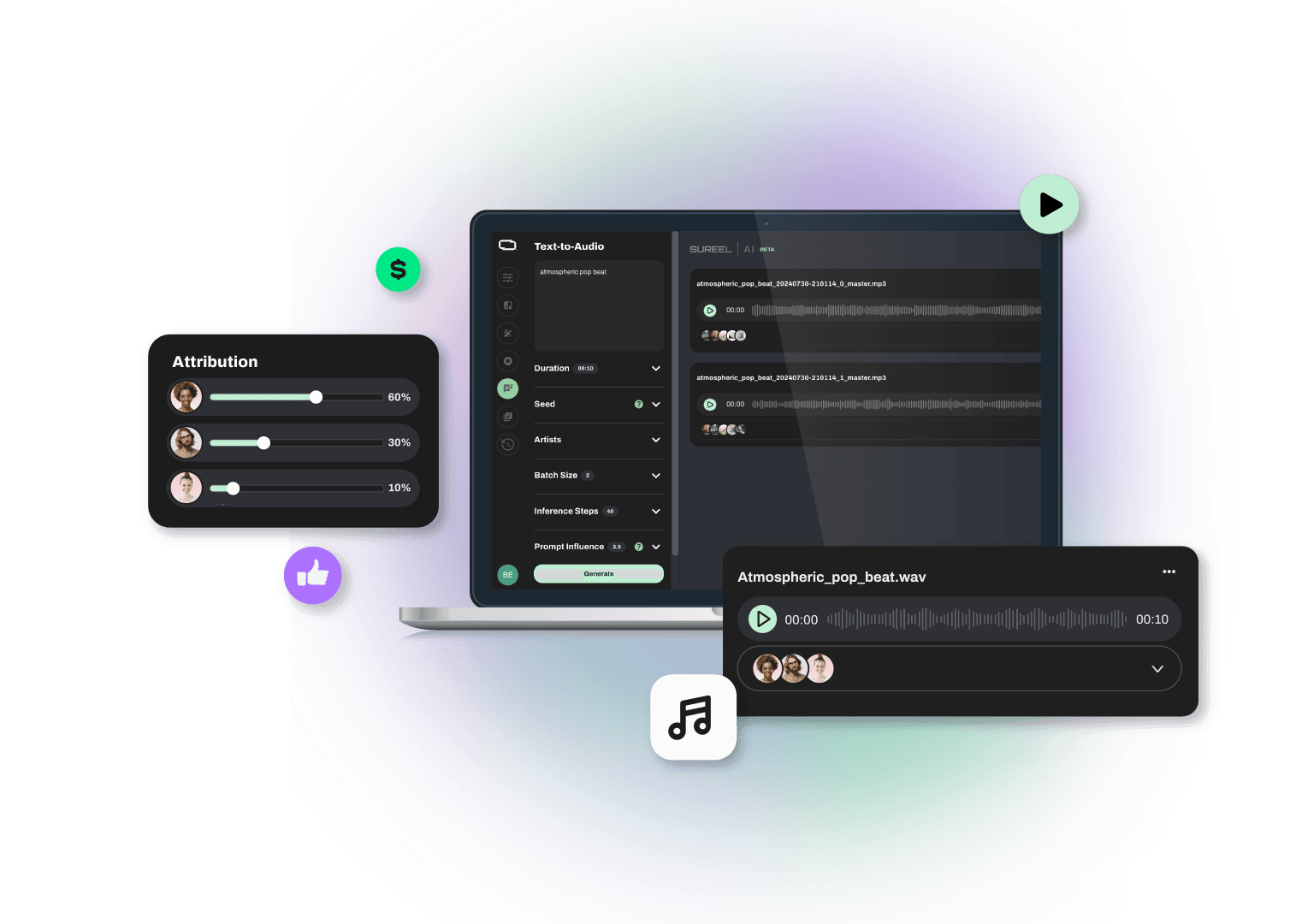
Sureel is a platform designed for creators, media rights owners, and AI companies to navigate the AI revolution. It offers solutions to protect, control, and monetize media by allowing owners to define how their content can be used for AI training. Key features include showing AI companies what content they can and cannot train on, setting granular rules for media usage and alteration, and dynamically licensing media based on its impact on AI outputs. Sureel also provides attribution tools, enabling creators to opt-in to share approved media for protection and monetization, or opt-out to prevent specific content from being used as training data. Real-time attribution reporting and analysis of media influence on AI creations are also core functionalities.
MMSA
MMSA is a comprehensive, open-source framework designed for Multimodal Sentiment Analysis (MSA). It allows users to train, test, and compare various MSA models within a single, unified environment. The framework supports 15 different MSA models, including recent advancements, and integrates with three key MSA datasets: MOSI, MOSEI, and CH-SIMS. MMSA is highly accessible, providing both Python APIs for programmatic integration and command-line tools for quick experimentation and deployment. Users can also experiment with fully customized multimodal features using the MMSA-FET toolkit. The project is packaged for easy installation via PyPI, making it straightforward to get started with sentiment analysis tasks.
neuropod
Neuropod is a library designed to offer a uniform interface for running deep learning models across various frameworks, including TensorFlow, PyTorch, TorchScript, Keras, and Ludwig. It aims to simplify the productionization of deep learning models, enabling researchers and developers to build models in their framework of choice without being constrained by deployment complexities. A key benefit is framework-agnostic inference code, allowing easy switching between deep learning frameworks without altering runtime code. Neuropod also supports defining a problem API, which helps in building generic tools, pipelines, and comparing models solving the same problem, even if they originate from different frameworks. It supports both C++ and Python, offers efficient zero-copy operations, and ensures model isolation with out-of-process execution.
onnxruntime-inference-examples
onnxruntime-inference-examples is a GitHub repository offering a collection of practical examples for leveraging ONNX Runtime (ORT) in machine learning inferencing. It serves as a valuable resource for developers and data scientists looking to integrate and optimize machine learning models across different environments. The repository includes examples for C/C++, mobile applications, JavaScript APIs, and quantization techniques for CPU and TensorRT Execution Providers. These examples demonstrate how to effectively utilize ORT's capabilities, making it easier to implement efficient inference solutions. The project welcomes contributions and adheres to Microsoft's Open Source Code of Conduct.
mlrun
MLRun is an open-source MLOps platform designed to streamline the entire lifecycle of continuous machine learning applications. It seamlessly integrates into existing development and CI/CD environments, automating the delivery of production data, ML pipelines, and online applications. The platform significantly reduces engineering efforts, accelerates time to production, and optimizes computation resources. MLRun supports various gen AI tasks, including data management, development, deployment, and live operations, with features like data lineage, versioning, and real-time serving. For MLOps, it offers project management, CI/CD automation, data ingestion and processing with a Feature Store, scalable model training, and robust model monitoring capabilities to detect drift and anomalies.
Transformers CI dashboard
The Transformers CI dashboard is a specialized tool designed for developers working with the Hugging Face Transformers library. It provides a comprehensive overview of Continuous Integration (CI) test results and regressions for various models, offering detailed statistics and historical data. Users can filter results by device, enabling focused analysis of performance across different hardware configurations. This dashboard is crucial for maintaining the stability and performance of the Transformers library, allowing developers to quickly identify and address issues arising from new code changes or model updates. It serves as a central hub for monitoring the health of the CI pipeline, ensuring that the integration of new features and models does not introduce performance bottlenecks or errors.
ml-workspace
ml-workspace is a comprehensive web-based Integrated Development Environment (IDE) designed specifically for machine learning and data science tasks. It offers a streamlined deployment process, allowing users to quickly set up and begin building ML solutions on their own machines. The workspace comes pre-loaded with a wide array of popular data science libraries such as Tensorflow, PyTorch, Keras, and Scikit-learn, alongside essential development tools like Jupyter, VS Code, and Tensorboard. These tools are perfectly configured, optimized, and integrated to provide a productive environment. Key features include web-based access to Jupyter, JupyterLab, and Visual Studio Code, a full Linux desktop GUI via web browser, seamless Git integration optimized for notebooks, and integrated hardware and training monitoring via Tensorboard and Netdata. It supports easy deployment on Mac, Linux, and Windows via Docker.
NVTabular
NVTabular is a powerful feature engineering and preprocessing library specifically designed for tabular data, enabling the manipulation of terabyte-scale datasets. It accelerates computation on the GPU using the RAPIDS Dask-cuDF library, making it ideal for training deep learning-based recommender systems. As a core component of NVIDIA Merlin, it seamlessly integrates with other Merlin tools like Merlin Models, HugeCTR, and Merlin Systems to provide end-to-end acceleration for recommender systems on the GPU. NVTabular addresses challenges such as processing huge datasets, managing complex data pipelines, and overcoming input bottlenecks, allowing data scientists and ML engineers to focus on data transformation rather than scaling issues. It significantly reduces the time required for feature engineering and preprocessing, with reported completion times of 13 minutes on a single V100 GPU and 3 minutes on a DGX-1 cluster for the Criteo 1TB Click Logs Dataset.
365-Days-Computer-Vision-Learning-Linkedin-Post
365-Days-Computer-Vision-Learning-Linkedin-Post is an open-source GitHub repository curated by Ashish Patel, offering a comprehensive, day-by-day learning journey through various computer vision concepts and models. Each entry in the repository corresponds to a LinkedIn post, providing a concise overview and a link to further resources on topics ranging from EfficientDet and YOLO Series to Vision Transformers, GANs, and advanced segmentation techniques. This resource is ideal for individuals looking to deepen their understanding of computer vision through a structured, accessible format, leveraging the power of community learning and readily available information.
3d-bat
3D-BAT (3D Bounding Box Annotation Tool) is an open-source, web-based platform designed for annotating 3D bounding boxes on point cloud and image data. It offers a comprehensive suite of features for efficient and accurate data labeling, including AI-assisted labeling, batch-mode editing, and interpolation for sequences. The tool supports full-surround annotations, 3D to 2D label transfer, automatic tracking, and various viewing options like side views and perspective/orthographic editing. With capabilities for custom dataset, class, and attribute support, along with HD map integration and OpenLABEL compatibility, 3D-BAT is ideal for researchers and developers working with multi-sensor data in fields like autonomous driving and robotics. It also includes features like auto-save, redo/undo, and keyboard-only annotation for a streamlined workflow.
OpenCoder 8B Instruct
OpenCoder 8B Instruct is an 8B parameter instruct model from the OpenCoder family, designed to assist developers with code-related tasks. Users can enter a description of what they want a program to do, and the application will write the corresponding source code. This tool is versatile, capable of handling a wide range of programming tasks, from generating simple functions to creating small games. It is hosted on Hugging Face Spaces, making it easily accessible for anyone looking to quickly generate code based on their specifications. The model aims to streamline the coding process by translating natural language into functional source code.
multimodal-agents-course
multimodal-agents-course is a free, open-source educational program designed to teach developers how to build advanced AI agents. The course focuses on creating agents that can process and understand multimodal data, including images, text, audio, and videos. Participants will learn to build an MCP (Model Context Protocol) server for video processing using Pixeltable and FastMCP, design Groq-powered agents, and integrate systems with Opik for observability and prompt versioning. The curriculum emphasizes practical, hands-on implementation, covering topics like complex multimodal processing pipelines, video search engines, and LLMOps principles, making it suitable for ML/AI engineers, software engineers, and data engineers/scientists.
Awesome Foundation Model Leaderboard Search
Awesome Foundation Model Leaderboard Search is a specialized tool hosted on Hugging Face Spaces, designed to help users navigate a comprehensive list of over 400 foundation model leaderboards. This application enables efficient searching through a vast collection of AI model rankings, providing direct access to detailed entries from the Awesome Foundation Model Leaderboard List. It's an invaluable resource for AI researchers, developers, and practitioners who need to quickly find and compare the performance of various foundation models, streamlining the process of staying updated with the latest advancements in the field.
Consilium MCP Server
Consilium MCP Server is a Multi-AI Expert Consensus Platform designed to enable users to conduct comprehensive, research-driven discussions with multiple expert AI models. Users can input specific queries, and the application leverages web searches and academic research to gather relevant information. This platform aims to facilitate consensus among diverse AI agents, providing a robust environment for exploring complex topics. It supports various models, including Mistral and SambaNova, and is implemented as a Gradio application, making it accessible for interactive use. The tool is ideal for those seeking to harness the collective intelligence of multiple AI experts for advanced research and problem-solving.

ColonyByte
ColonyByte is a leading software development company dedicated to crafting innovative digital solutions tailored for client success. They specialize in developing custom software that accelerates growth, optimizes operations, and enriches user experiences. Their expertise spans mobile app development, web applications, and advanced AI-driven solutions. ColonyByte focuses on digital transformation, cloud computing, and providing 10x engineers to deliver high-quality, impactful projects. They offer free consultations to plan and execute projects, ensuring client satisfaction and technological advancement.
SD3.5 Prompt Generator
SD3.5 Prompt Generator is an AI tool hosted on Hugging Face that assists users in creating diverse prompts for AI models. It allows for the generation of random prompts based on user-selected categories and parameters, offering flexibility for various creative and experimental needs. Users can either input their own custom prompts or select from a range of predefined types, including "Random," "Fantasy," and "Landscape." This makes it a versatile tool for content creators, developers, and anyone looking to explore the capabilities of AI models through varied inputs. The application is designed to be user-friendly, providing an accessible way to experiment with prompt generation.