
Coding & Development
Browsing page 383 of AI tools for Coding & Development. Sorted by confidence score — our independent quality rating.

Unlocking On-Policy Distillation for Any Model Family
Unlocking On-Policy Distillation for Any Model Family is an educational tool hosted on Hugging Face, designed to demystify the complex process of on-policy distillation. It offers interactive diagrams that visually explain how this technique aligns token sequences and merges log-probabilities across various model families. The tool requires no input, making it accessible for immediate exploration. It serves as a valuable resource for AI researchers and machine learning engineers looking to deepen their understanding of advanced model training and alignment strategies. By providing clear visual explanations, it helps users grasp the core concepts of on-policy distillation without needing to delve into complex code or theoretical papers initially.
Zero And Few Shot Reasoning
Zero And Few Shot Reasoning is an AI tool hosted on Hugging Face, designed to explore the capabilities of large language models in solving complex problems. Users can input riddles or mathematical problems and receive solutions generated by various language models. A built-in calculator is available to help verify the accuracy of the provided answers. This tool is particularly useful for researchers and educators interested in understanding and evaluating the performance of AI in zero-shot and few-shot reasoning tasks, offering a practical environment for experimentation and analysis.
Yoloe
Yoloe is an AI application hosted on Hugging Face Spaces, developed by jameslahm (Ao Wang). This tool specializes in object detection and segmentation within images. Users can upload an image and then utilize various methods to identify and isolate objects. These methods include providing text descriptions, drawing bounding boxes, or creating masks. Additionally, Yoloe offers a prompt-free mode for more automated detection. It's designed to be accessible and provides a platform for exploring computer vision capabilities.
latitude-llm
Latitude-llm is an open-source platform designed for building and operating LLM features in production. It emphasizes observability and evaluation, allowing users to instrument existing LLM calls to capture prompts, inputs/outputs, tool calls, latency, token usage, and cost. The platform supports a reliability loop that turns production failures into repeatable fixes through features like issue discovery, automatic evaluations, and a prompt optimizer. Users can start with observability and evaluations, then progress to a reliability loop to continuously improve prompts. Latitude-llm works with most model providers and frameworks out of the box and offers both a managed cloud product and a self-hosted deployment option.
steel-browser
Steel Browser is an open-source browser API designed for AI agents and applications, offering a comprehensive browser sandbox to automate web interactions without the need for complex infrastructure management. It enables developers to build live web agents and browser automation tools with ease, providing full control over Chrome instances via Puppeteer and CDP. Key features include robust session management, proxy support for IP rotation, extension loading, and anti-detection capabilities. The tool also offers debugging tools, resource management, and APIs for quick page conversions to markdown, readability, screenshots, or PDFs. It supports both Node.js and Python SDKs, making it versatile for various development environments.
beikeshop
BeikeShop is a free and open-source e-commerce platform built on PHP and Laravel, designed for rapid deployment and full control over code, data, and infrastructure. It offers a comprehensive foundation for online stores, including product management, shopping cart, checkout, payments, and shipping. The platform supports multiple languages and currencies, making it ideal for international commerce, and integrates AI agents. Its modular, event-driven architecture, utilizing a robust Hook and Event-based system, enables developers to extend features and build plugins through non-intrusive customization, ensuring the core code remains untouched for easy maintenance and upgrades. BeikeShop provides a modern UI with a high-conversion storefront and an intuitive admin dashboard.
TensorFlow-Lite-Object-Detection-on-Android-and-Raspberry-Pi
This GitHub repository offers a comprehensive tutorial for training, converting, and running TensorFlow Lite object detection models on various edge devices, including Android phones and the Raspberry Pi. It guides users through the process of creating custom TensorFlow Object Detection models, optimizing them for TensorFlow Lite, and deploying them for real-time applications. The tutorial provides Python code for performing object detection on images, videos, web streams, or webcam feeds. It also highlights the benefits of using Google Colab for training, offering a free GPU-enabled virtual machine, and includes step-by-step setup guides for different devices. The resource emphasizes faster inference times and reduced processing power requirements compared to standard TensorFlow models.
SaaS Boilerplates
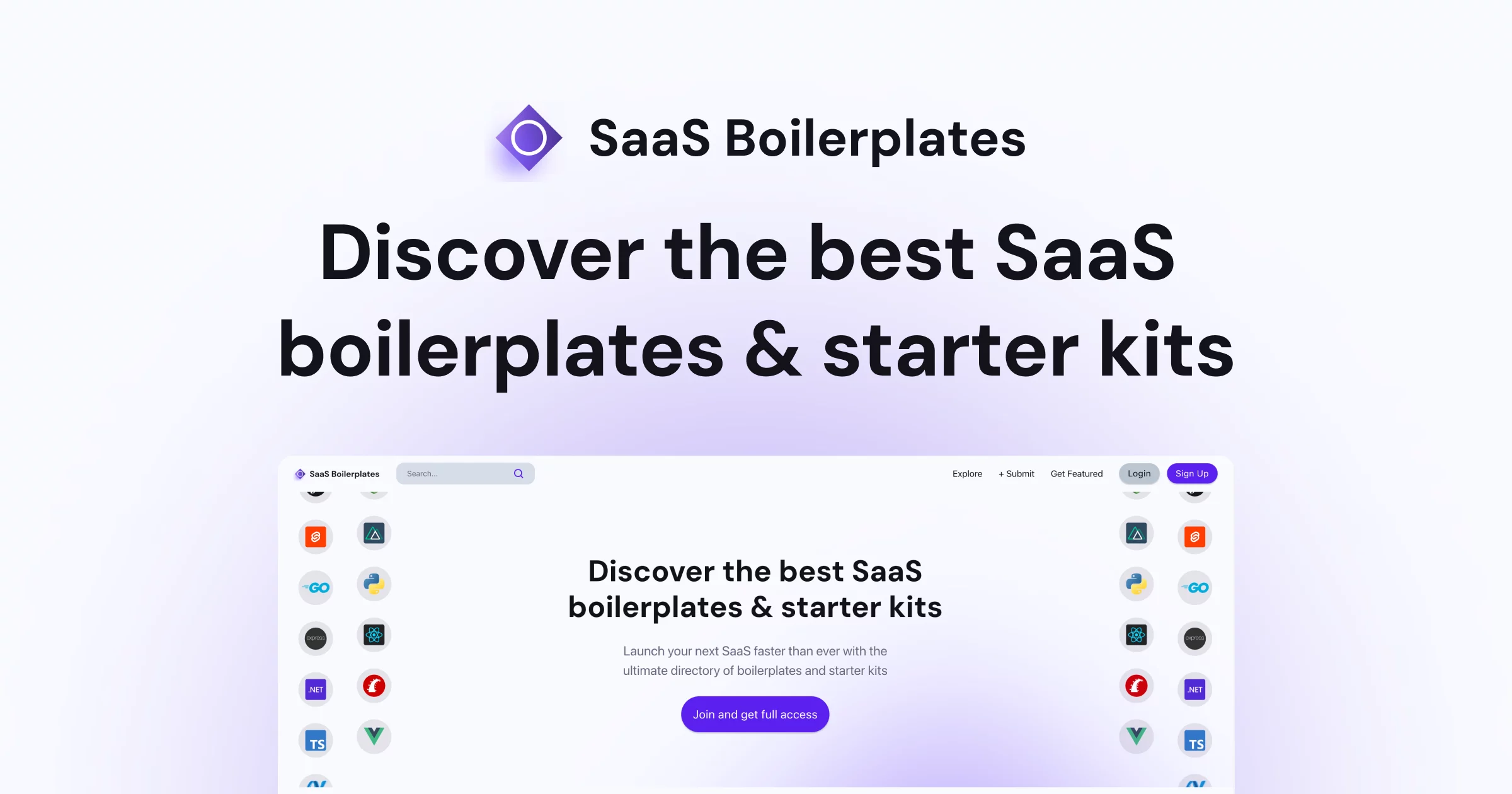
SaaS Boilerplates offers a comprehensive directory of curated SaaS boilerplates and starter kits designed to accelerate the development and launch of new SaaS products. The platform allows users to browse through over 120 boilerplates, filtering them by various technologies such as .NET, Angular, Django, Laravel, Next.js, Node.js, React, Ruby on Rails, Svelte, and Vue.js. Each entry provides details on the boilerplate's features, helping developers choose the most suitable starter kit for their project. The goal is to save significant development time by providing pre-built solutions for common SaaS functionalities, enabling founders to ship their products in days rather than months. The site also features a blog with articles on selecting, implementing, and maximizing efficiency with SaaS boilerplates and starter kits.
Arondite
Arondite is a British defense technology company specializing in software platforms for accelerated decision-making in autonomous systems. The company brings together a unique blend of operational and technical expertise to build technology with immediate, real-world impact on a global scale. Their flagship product, Cobalt, is described as a defense software platform. Arondite's team comprises individuals with backgrounds in the British Army, Ministry of Defence, and leading tech companies like Palantir, Helsing, and Betfair, indicating a strong foundation in both defense and advanced software engineering. They aim to address evolving global threats by developing innovative solutions.
TextGAN-PyTorch
TextGAN-PyTorch is a comprehensive PyTorch framework designed for Generative Adversarial Networks (GANs) based text generation models. It supports both general and category-specific text generation, making it a versatile tool for researchers and developers. The framework serves as a benchmarking platform, facilitating the evaluation and comparison of various GAN-based text generation models. It is particularly beneficial for those familiar with PyTorch, enabling them to quickly engage with the text generation field. The repository includes implementations of several prominent models like SeqGAN, LeakGAN, and RelGAN, along with detailed instructions for setup and usage, including real data experiments and visualization tools.
Magnet.me
Magnet.me is a comprehensive career network designed to help students and professionals find their perfect job, traineeship, or internship. The platform connects over 450,000 students and professionals with more than 6,000 employers, ranging from startups to multinationals. A key feature is its AI career coach, which assists users in discovering suitable job opportunities, practicing interview skills, and making informed career decisions. Users can create a profile, connect with top employers, receive job matches based on their preferences, and even be approached by recruiters. The platform lists over 30,000 vacancies across various industries and locations, making it a robust resource for career development.
VLMEvalKit
VLMEvalKit is an open-source evaluation toolkit designed for large vision-language models (LVLMs), supporting over 220 LMMs and 80+ benchmarks. It simplifies the evaluation process by allowing one-command evaluation without extensive data preparation across multiple repositories. The toolkit uses generation-based evaluation for all LVLMs, offering results with both exact matching and LLM-based answer extraction. Recent updates include improved handling for models with thinking mode and long responses, as well as multi-node distributed inference support for faster evaluations. It aims to provide an easy-to-use, reproducible evaluation environment for researchers and developers.
Capture.dev
Capture.dev is a comprehensive bug reporting tool designed to streamline the process of identifying and fixing software issues. It offers a tiny yet powerful bug reporting toolbar that works on any website, allowing teams to capture developer-friendly bug reports without leaving their current workflow. The tool automatically collects crucial context, including screen captures, user information, inspector details, console logs, and network requests, ensuring that developers receive all necessary information to fix bugs efficiently. Capture.dev integrates seamlessly with popular tools like Slack, Linear, Jira, Asana, Trello, ClickUp, and Zapier, enabling teams to send bug reports directly to their existing project management systems. It also features auto-history for step-by-step playback of issues and auto-summaries for quick prioritization, making it an essential tool for product, QA, and support teams.
ChatGPT Google Assistant
ChatGPT Google Search Assistant is a convenient Chrome extension designed to enhance your web search experience by displaying ChatGPT's AI-generated answers directly alongside your Google search results. This integration allows users to receive instant, intelligent responses and suggestions without navigating to chat.openai.com. The tool is a significant time-saver, offering a two-in-one solution for information retrieval. Beyond Google, it also supports other popular search engines like Bing, DuckDuckGo, and Yahoo!, making its advanced AI capabilities accessible across multiple platforms. This free tool aims to provide quick access to ChatGPT's insights, streamlining the research process for various users.

Blackcurrant Labs Pvt. Ltd.
Blackcurrant Labs is a full-stack application development company offering comprehensive services for web, mobile, and AI products. They excel at building Cloud-based, hyper-scaled product solutions for a diverse range of customers. Their approach includes agile development methodologies, ensuring timely delivery and high-quality standards. The company provides expertise across the entire product development lifecycle, from design and frontend to backend, DevOps, and niche technologies. Blackcurrant Labs is proficient in designing and deploying truly distributed, cloud-native applications that scale seamlessly. They offer turnkey solutions, encompassing deduction, design, development, and deployment, with a team of developers, designers, analysts, system architects, and product managers.
devv
Devv AI is an AI-powered search engine tailored for developers, offering fast and accurate results for programming-related queries. It is designed to be an indispensable tool for developers by providing relevant information across various programming languages and frameworks. The platform is continuously learning and improving based on user interactions. Devv AI also has a dedicated GitHub repository for community engagement, allowing users to report bugs, request new features, ask questions, and provide feedback. Upcoming features include support for additional languages, an agent mode for real-time coding assistance, enhanced user experience, and integration with popular developer tools and platforms.
react-native-ml-kit
react-native-ml-kit is an open-source library designed to bring Google ML Kit's powerful on-device machine learning capabilities to React Native applications. This integration allows developers to implement various AI features directly within their mobile apps for both Android and iOS platforms. Key functionalities supported include image labeling, language identification, face detection, text recognition, barcode scanning, and text translation. By leveraging Google ML Kit, react-native-ml-kit provides a robust solution for adding intelligent features to mobile applications without relying on cloud-based processing, enhancing privacy and performance. It's a valuable resource for developers looking to incorporate advanced machine learning into their React Native projects.
VectorHub
VectorHub is a free and open-source learning platform designed for individuals ranging from software developers to senior ML architects who are keen on integrating vector retrieval into their machine learning stack. The platform offers practical resources to help users create Minimum Viable Products (MVPs) with easy-to-follow learning materials. It also assists in solving use case-specific challenges related to vector retrieval, enabling users to confidently take their MVPs to production. Additionally, VectorHub provides insights into various vendors in the space, helping users select the solutions that best fit their needs. A notable tool offered by VectorHub is the Vector DB Comparison, which outlines and verifies the feature sets of different Vector Database solutions.
accelerated-text
Accelerated Text is a no-code natural language generation platform designed to transform data into varied textual descriptions. It provides a web-based Document Plan builder where users can define the logical structure of a document, express communication goals, and specify data usage within the text. The platform's Natural Language Generation engine then uses these Document Plans and connected data to produce multiple text variations, ensuring precision and adherence to the provided data. Key features include a document plan editor, support for CSV data samples, text structure variations, language and vocabulary control, a built-in rule engine, and a live preview of generated text. It focuses on data-bound text generation, ensuring descriptions are always and only about the data provided.
[D] How do you document your ML system architecture?
draw.io is a free online diagram software designed for creating a wide array of visual representations, including flowcharts, process diagrams, organizational charts, UML diagrams, ER diagrams, and network diagrams. It functions as a comprehensive tool for documenting complex systems, such as machine learning architectures, database schemas, and BPMN processes. Users can easily design and share diagrams for various technical and business needs, making it a versatile solution for visual communication. The platform also supports importing files from other popular diagramming tools like .vsdx, Gliffy, and Lucidchart, enhancing its utility and compatibility for a broad user base.
ViT-pytorch
ViT-pytorch offers a PyTorch reimplementation of the Vision Transformer (ViT) model, based on the paper 'An Image is Worth 16x16 Words: Transformers for Image Recognition at Scale'. This tool allows users to leverage the power of Transformers for image recognition, demonstrating that applying them directly to image patches and pre-training on large datasets yields state-of-the-art results. It includes various pre-trained models like ViT-B_16, R50+ViT-B_16, and ViT-L_32, which can be downloaded and used for training. The repository provides scripts for training models on datasets like CIFAR-10 and CIFAR-100, with options for mixed precision training and gradient accumulation. Additionally, it supports visualization of attention maps, offering insights into how the model processes images.

Will AI do This?
Will AI do This? is an online gaming platform that offers a comprehensive selection of casino games, including baccarat, slots, roulette, blackjack, and more, from over 50 leading providers. The platform emphasizes direct API connections to game developers, ensuring authenticity and fairness without intermediaries. It features an auto deposit and withdrawal system with no minimum limits, making transactions easy and accessible. The service is available 24/7, supports multiple languages, and is accessible across various operating systems like Android, iOS, Windows, and macOS. The platform also highlights its high customer satisfaction scores and experienced management team in the online gaming industry.

aiTouch
aiTouch is an advanced technologies software services startup recognized by the Government of India, specializing in AI, ML, and data science. They offer a comprehensive suite of services including custom software development for web and mobile applications, SaaS solutions, and full-stack development. A core offering is their data annotation and labeling services, covering image, video, text, and audio annotation, supported by an in-house annotation tool. aiTouch focuses on creating high-quality data sets essential for AI/ML model training and development. They serve various verticals such as Retail & CPG, Sports, Automotive, and Healthcare, assisting clients globally from early ventures to large-scale enterprises in building top-performing AI models and software solutions.
daclip-uir
daclip-uir provides an official PyTorch implementation for controlling vision-language models, specifically designed for universal image restoration tasks. This tool can address various image degradations such as motion blur, haze, JPEG compression, low-light conditions, noise, raindrops, rain, shadows, snow, and uncompleted images (inpainting). It offers pretrained models for degradation-aware CLIP and universal image restoration, along with a Gradio app for easy testing of custom images. The project also includes a follow-up work focusing on photo-realistic image restoration and handling real-world mixed-degradation images, demonstrating its continuous development and robust capabilities in the field.