
Coding & Development
Browsing page 387 of AI tools for Coding & Development. Sorted by confidence score — our independent quality rating.

LoreKeeper
LoreKeeper is a comprehensive TTRPG game prep toolkit designed for Game Masters. It allows users to upload existing lore, notes, voice memos, and videos, which the AI then learns to power various generation features. Key capabilities include generating NPCs, monsters, maps, and names, as well as creating character portraits, location maps, and scene art from your lore. The tool also offers cinematic video scene generation and the ability to produce full campaign sourcebooks in PDF format. LoreKeeper aims to transform hours of game preparation into minutes of work, supporting D&D, Pathfinder, and any other tabletop RPG system.
ROC
ROC is a leading Vision AI platform that provides advanced multimodal biometric capabilities, including top-ranked face, fingerprint, and iris recognition. The platform also excels in object detection, gun detection, license plate recognition, and tattoo recognition. Trusted by the U.S. military, law enforcement, and global FinTech brands, ROC offers a unified platform that fuses biometrics, video analytics, and mission intelligence. Its solutions are designed to be lightweight, optimized for mobile and edge deployment, and built on ethically sourced datasets to ensure high fidelity and near-zero bias. ROC's products include the ROC SDK for integrating biometric and Vision AI capabilities, ROC Watch for 24/7 proactive AI monitoring and threat detection, and ROC ABIS for supercharging biometric identification.
Ramen VR
Ramen VR is a game development studio focused on creating meaningful virtual reality games and advanced tools for game development. The team, composed of experienced developers, previously launched Zenith: The Last City, which became the #1 VR game on Steam and Oculus Quest. Having raised over $40 million in funding, Ramen VR is currently working in stealth mode on their next game, alongside developing cutting-edge tools designed to shape the future of game development. Their mission is to empower game developers and believe that meaningful games can change lives, starting with the developers themselves. They are actively solving complex problems in game creation.

WriteMage
WriteMage is an AI application designed to seamlessly integrate ChatGPT capabilities into macOS and iOS devices. It allows users to interact with AI directly within any macOS app, functioning like Apple Spotlight with context-awareness, eliminating the need for copy-pasting. The tool features memory, enabling it to remember conversation context within a session, and saves all chat history locally with labels for easy retrieval. WriteMage also includes a Prompt Editor GUI, empowering users to customize and create their own prompts. For iOS, it integrates natively with the keyboard, working across various apps. The app offers both subscription and lifetime deal options, with a beta period that includes free usage and discounts.

Codejet
Codejet is a no-code platform designed to empower users to build websites, applications, and backends without writing a single line of code. It utilizes a proprietary puzzle block logic, simplifying the development process and making it accessible to a wider audience. The platform aims to accelerate the design-to-code transformation, allowing users to create functional and responsive digital products efficiently. Codejet focuses on providing a streamlined experience for building and deploying web solutions.
Series Entertainment
Series Entertainment pioneers game development by leveraging generative AI to convert imaginative concepts into captivating gaming experiences. Their core mission is to empower human creativity, integrating it with advanced AI technologies to develop immersive franchise games that engage and inspire players globally. The company aims to build worlds where players can become the heroes of their own epic adventures. They are actively seeking talent with a vision for pushing the boundaries of game development, emphasizing cutting-edge technology and AI development tools.
MavTools
MavTools serves as a comprehensive discovery platform for content creators, solopreneurs, and new founders seeking to launch and scale their businesses. The platform curates a wide array of battle-tested SaaS, apps, and AI tools, making it easier for users to find solutions for their specific needs. Users can browse tools by category, pricing type (including free, freemium, and free trial options), and platform compatibility (web, mobile, desktop). The site highlights newly listed tools and allows users to save their favorites. With a focus on practical applications, MavTools aims to simplify the process of finding effective business tools without requiring extensive research.

PIP Labs
PIP Labs is an R&D company dedicated to advancing Story, a Layer 1 network designed to transform intellectual property (IP) into a programmable asset class. The company develops AI-native infrastructure for IP, addressing the challenge of over $80 trillion in IP locked in outdated systems and the AI industry's need for rights-cleared data. PIP Labs enables programmable licensing, IP tokenization, and onchain enforcement of IP rights. Key initiatives include the Proof of Creativity Protocol for out-of-the-box IP features like royalties and licensing, the Programmable IP License (PIL) for clear and enforceable creative rights, and Poseidon for structured datasets with enshrined ownership and provenance.
Moverse
Moverse is an end-to-end motion capture platform designed to deliver studio-grade results for anyone, anywhere. It simplifies the entire animation pipeline, from capturing motion to cleaning data and exporting, all within a single workflow. This approach reduces friction, accelerates production, and minimizes iteration time. The platform is accessible for teams of all sizes and experience levels, allowing users to scale their setup as needs evolve without switching platforms. Moverse offers efficient, quick-to-deploy local studio capabilities for capturing, integrated online processing, and diverse export options for various tools and engines. It supports applications across industries including XR, film, game development, life sciences, and robotics, providing flexible capture and seamless workflows.
Aximo by Autify
Aximo by Autify is an AI testing agent designed to streamline the software testing process by autonomously generating and executing end-to-end tests. Leveraging natural language processing and visual recognition, Aximo works across web, mobile, and desktop applications, significantly reducing the need for manual scripting and adapting to application changes as they evolve. It aims to accelerate the software testing lifecycle, offering features like AI-driven test strategy, design, creation, execution, and reporting. This tool is part of Autify's AI-powered Quality Engineering Platform, emphasizing an AI partnership approach to testing and ease of use for engineering teams.
WindyFlo
WindyFlo is a no-code AI pipeline engineering platform designed to help users build and deploy AI features for their websites or applications without requiring any coding knowledge. The platform simplifies AI development through a drag-and-drop interface, allowing users to create custom AI pipelines by connecting various node blocks. It supports the customization of AI models and facilitates faster deployment of AI applications. WindyFlo aims to make AI development accessible to both AI enthusiasts and beginners, offering options to build pipelines from scratch or customize pre-built ones from its Pipeline Hub. The tool also addresses common challenges of traditional AI development, such as complex setups, extensive coding, manual updates, and high infrastructure costs, by providing an all-in-one solution with automatic AI model updates and no additional computing resource costs.
Griddo
Griddo is a no-code digital experience platform specifically tailored for the education sector, particularly universities. It empowers marketing and communication teams to manage their entire web ecosystem from a single, intuitive interface, eliminating the need for IT dependency. The platform facilitates rapid website creation, content management, and digital marketing actions, including SEO and branding. Griddo supports multi-site management, multilingual content, and offers a flexible CMS for building high-performance websites. It integrates natively with SEO functionalities and external tools like Google Tag Manager and Google Analytics, ensuring agility, scalability, and editorial autonomy for educational institutions.

App Blocker for iPhone - Blokr
Blokr is an iPhone and iPad app designed to help users manage screen time and block distracting applications. It enables users to schedule app blocks in advance, ensuring focused periods for work or study. The app offers flexible blocking options, allowing users to regain access through specific times, manual unlocks, QR code scans, NFC tags, or by browsing approved "useful" apps first. Blokr also includes a Deep Focus mode for unskippable blocks, content filters to block adult content, and insights/analytics to track app usage. Its clean and minimal interface aims to provide quiet focus without gamified motivation.

ReadyFaucet
ReadyFaucet offers a complete no-code solution for launching a crypto coin faucet business. It is designed for individuals looking to generate passive income from the cryptocurrency market without needing any technical expertise. The platform delivers and sets up the entire business, making it accessible to a broad audience. This done-for-you service eliminates the complexities typically associated with setting up and managing a crypto faucet, allowing users to focus on earning. ReadyFaucet aims to simplify entry into the crypto business world, providing a straightforward path to passive income.
botflow
botflow is a Python Fast Dataflow programming framework engineered for building robust data pipelines. It excels in diverse applications such as web crawling, machine learning, and quantitative trading. The framework emphasizes decoupling data and functionality, making it easy to reuse components and maintain complex data flows. Botflow provides core concepts like Pipes and Routes to construct intricate data flow networks, supporting parallel computation through coroutines and ThreadPools. It also features a replay mode for efficient debugging, allowing developers to restart from the nearest completed node after an exception. With built-in nodes for HTTP loading, file I/O, and data manipulation, botflow simplifies the creation of powerful and efficient data processing workflows.
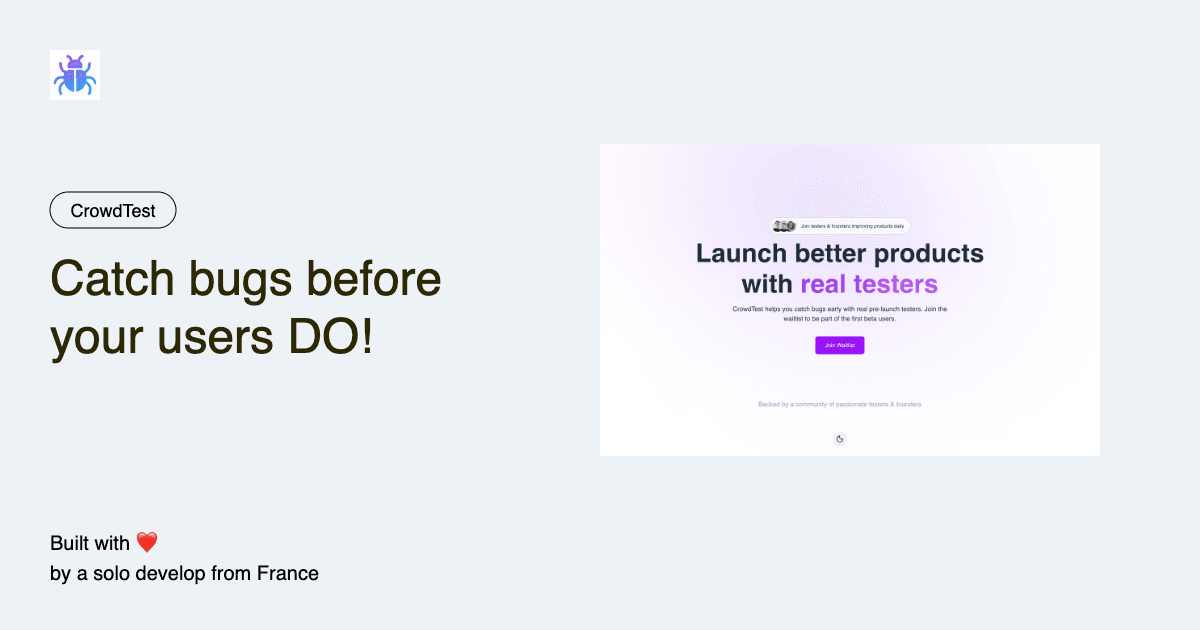
CrowdTest
CrowdTest offers a human-focused approach to app testing, connecting indie developers with real testers to identify UI/UX issues, unclear flows, spelling mistakes, and other bugs. By leveraging a community of passionate testers, CrowdTest helps ensure products are polished before launch, catching critical issues that automated tools might overlook. The process is straightforward: users sign up, submit their app or website URL, and testers interact with the project to report bugs and suggest improvements. This results in actionable feedback and clear bug reports, enabling developers to launch better, more reliable products with confidence.
BuildingMachineLearningSystemsWithPython
BuildingMachineLearningSystemsWithPython is an open-source repository containing the complete source code for the book "Building Machine Learning Systems with Python" by Luis Pedro Coelho and Willi Richert. This resource is invaluable for students, teachers, and professionals looking to understand and implement machine learning systems using Python. The code corresponds to the second edition of the book, published in 2015, and provides practical, hands-on examples for various machine learning concepts. It serves as a direct companion to the book, allowing users to explore, run, and modify the code to deepen their understanding of the topics covered. The repository is hosted on GitHub, making it easily accessible for anyone interested in learning or teaching machine learning with Python.
Veria Labs
Veria Labs offers automated offensive security solutions, designed to help high-stakes industries identify and remediate vulnerabilities across their entire attack surface. The platform integrates with Git repositories and cloud environments to deeply analyze applications for security flaws, from code paths to cloud infrastructure. It generates proof-of-concept exploits that run directly against staging environments, ensuring the detection of real vulnerabilities. For each identified vulnerability, Veria Labs provides actionable reports and suggested patches, enabling rapid application security. Backed by Y Combinator and founded by a top US hacking team, Veria Labs aims to make getting hacked a thing of the past by matching the speed and scale of modern development.
Zist
Zist is a code snippet manager designed to help developers organize and manage their code effectively. It integrates seamlessly with GitHub Gists, allowing users to store, retrieve, and share code snippets within the GitHub ecosystem. The tool aims to streamline development workflows by providing a centralized location for frequently used code, making it easier to access and reuse. This integration with GitHub Gists ensures that snippets are version-controlled and accessible across different environments, enhancing productivity for individual developers and teams alike. Zist focuses on simplifying the process of managing code snippets, ensuring developers can quickly find and utilize the code they need without interruption.
TiKie: AI Fantasy & Roleplay
TiKie is a mobile application designed for fantasy and roleplay enthusiasts, providing an immersive AI-driven experience. Users can engage in dynamic conversations with a diverse array of virtual characters, fostering interactive storytelling. The platform enables the creation and customization of unique AI companions, allowing narratives to evolve based on user choices. This continuous discovery aspect ensures a personalized and engaging experience for those looking to craft their own fantasy worlds and interact with AI-powered characters.
Google News - Daily Headlines
Google News - Daily Headlines is an AI-powered news aggregation platform that offers comprehensive and up-to-date news coverage from a multitude of global sources. The tool intelligently aggregates stories, providing users with diverse perspectives to help them stay informed and avoid filter bubbles. It tailors content to individual interests, ensuring a relevant and dynamic news experience through personalized briefings. Users can access top stories, local news, and specific categories like business, technology, entertainment, sports, science, and health. The platform is accessible via web, Android, and iOS apps, making it easy to get daily headlines on the go.
Agentless
Agentless is an open-source AI tool designed to automatically solve software development problems without relying on traditional agents. It operates through a structured three-phase process: localization, repair, and patch validation. The localization phase identifies faults down to specific files, classes, functions, and fine-grained edit locations. During the repair phase, Agentless generates multiple candidate patches for each bug in a simple diff format. Finally, the patch validation phase selects and runs regression tests, generates additional reproduction tests, and re-ranks patches based on test results to submit the most effective fix. Agentless has demonstrated strong performance, achieving solve rates of 40.7% and 50.8% on SWE-bench lite and verified benchmarks, respectively, when integrated with Claude 3.5 Sonnet.
awesome
Awesome is an open-source GitHub repository offering a comprehensive collection of resources across various technical domains. It serves as a valuable knowledge base for individuals interested in bioinformatics, data science, and machine learning. The repository also includes extensive resources for popular programming languages such as Python, Golang, R, and Perl, along with sections for C, JavaScript, Linux, and Git. Users can find links to tools, tutorials, and libraries, making it a central hub for learning and development in these fields. Its curated nature ensures that the included resources are relevant and useful for both beginners and experienced practitioners.
TinyLLaVA_Factory
TinyLLaVA_Factory is an open-source modular codebase designed for building small-scale large multimodal models (LMMs). Implemented in PyTorch and HuggingFace, it emphasizes simplicity, extensibility, and reproducibility. The framework allows users to customize their own LMMs with reduced coding effort and fewer mistakes. It integrates a suite of cutting-edge models and methods, supporting LLMs like OpenELM, TinyLlama, StableLM, Qwen, Gemma, and Phi. For vision towers, it includes CLIP, SigLIP, Dino, and combinations thereof. Connectors such as MLP, Qformer, and Resampler are also supported, alongside various training recipes including Frozen/Fully/Partially tuning and LoRA/QLoRA tuning. The project provides trained models, performance benchmarks, and local demo options for Gradio web and CLI inference.