
Coding & Development
Browsing page 389 of AI tools for Coding & Development. Sorted by confidence score — our independent quality rating.

MLOPs-Primer
MLOPs-Primer is a comprehensive collection of resources designed to educate individuals on Machine Learning Operations (MLOps). It serves as a foundational guide for understanding the best practices and technologies essential for deploying machine learning models effectively in real-world scenarios. The primer includes various educational materials such as blogs, guides, books, community resources, courses, and academic papers, covering topics from risk assessment to building, testing, and monitoring ML systems. It aims to help ML teams build responsible and scalable machine learning infrastructure, making it a valuable starting point for anyone looking to upskill in the evolving MLOps landscape.
keras-mmoe
keras-mmoe provides a TensorFlow Keras implementation of the "Modeling Task Relationships in Multi-task Learning with Multi-gate Mixture-of-Experts" paper (KDD 2018). This open-source repository offers a Python 3.6 implementation, also compatible with Python 2.7, making it accessible for various development environments. It includes an example demo for running the model with the census-income dataset from UCI, which is the same dataset used in Section 6.3 of the original paper. The code is well-documented and designed for easy extension, encouraging contributions from the community for performance improvements, benchmark accuracy, and training on other public datasets. This tool is ideal for developers and researchers working on deep learning and multi-task learning applications.
deep-motion-editing
Deep-motion-editing is an open-source library built with PyTorch, designed for editing and rendering 3D character animations using deep learning. It offers fundamental and advanced functions, covering everything from reading and editing animation files to visualizing and rendering them, including integration with Blender. The library's core deep editing operations include motion retargeting and motion style transfer, based on research published at SIGGRAPH 2020. It supports both intra-structural and cross-structural retargeting, and allows for style transfer from video to animation. The library provides pretrained models and instructions for training models from scratch, making it a comprehensive tool for developers working with 3D character animation.
artyom.js
artyom.js is a robust and constantly updated open-source JavaScript library that wraps the webkitSpeechRecognition and speechSynthesis APIs. It enables developers to integrate voice control, voice commands, speech recognition, and speech synthesis into their web applications. Key features include quick recognition of voice commands, easy addition of dynamic commands, smart commands with wildcards and regular expressions, and the ability to convert voice to text. The library supports synthesizing large blocks of text and works on both desktop browsers and mobile devices. It offers support for multiple languages and provides options for continuous listening, soundex algorithm for accuracy, and a remote command processor. Developers can create custom voice assistants similar to Siri, Google Now, or Cortana within their websites.

FOURIER-Robotics GR-2
FOURIER-Robotics GR-2 is a cutting-edge humanoid robot designed to push the boundaries of agility, precision, and perception. Built upon customer feedback, GR-2 integrates advanced hardware, design, and software enhancements. Its next-level hardware design includes integrated cabling for power and communication, resulting in concealed wires and a more compact form factor. The improved joint configuration simplifies debugging, reduces manufacturing costs, and enhances the robot's ability to transition from AI simulation to real-world applications. GR-2 features 12-DoF dexterous hands, doubling the dexterity of previous models, and is equipped with six array-type tactile sensors for real-time force sensing and object manipulation. Powered by seven types of distinct FSA actuators, including FSA 2.0 with peak torques exceeding 380 N.m, GR-2 achieves dynamic mobility and precise movements. The Fourier Toolkit provides developers with an upgraded Software Development Kit, offering easy access to pre-optimized modules via intuitive APIs and supporting frameworks like NVIDIA Isaac Lab, ROS, and Mujoco.
Applying_EANNs
Applying_EANNs is a 2D Unity simulation designed to showcase how cars can learn to navigate various courses. The cars are controlled by a feedforward neural network, whose weights are optimized using a modified genetic algorithm. This project provides a practical demonstration of evolutionary artificial neural networks in a simulated environment. Users can tinker with simulation parameters in the Unity Editor or run the built executable with default settings. The neural network architecture includes an input layer, two hidden layers, and an output layer, with its training managed by a customizable genetic algorithm. The user interface displays real-time data for the best performing car, including neural network output, evaluation value, and a generation counter, along with a visual representation of the neural network's weights.

Kinisi
Kinisi is a robotics company founded in 2024, specializing in the development of humanoid robots designed for real-world applications in warehouses and storerooms. Their flagship robot, KR1, is engineered to perform a wide range of physical tasks, including heavy lifting, precise assembly, picking, loading, and transporting items. The KR1 operates with onboard intelligence, allowing for fast decision-making without reliance on cloud connectivity, ensuring greater reliability and privacy. It is designed for easy deployment with minimal setup and quick training through simple demonstrations, making it adaptable to various workflows and environments. Kinisi emphasizes building robots that solve real-world problems, focusing on function, iteration, and live deployment to refine performance, safety, and usability.
LogicStar AI
LogicStar AI is an advanced Coding & Development tool designed to help engineering teams identify and prioritize bugs based on their potential revenue and customer impact. It integrates with existing tools across your stack, such as Sentry, Datadog, Jira, and Git repositories, to connect weak signals and trace issues to their root causes. The platform provides a daily priority queue of bugs, complete with validated fixes and tests to reproduce the bug and confirm its resolution. LogicStar AI aims to reduce the time engineers spend investigating noisy bugs, allowing them to focus on high-impact issues and feature development. It leverages static and dynamic analysis, production signals, and customer usage patterns to build a system-level understanding of your codebase.
Kairos
Kairos is a US nonprofit dedicated to accelerating talent in the fields of AI safety and policy. The organization offers several programs, including SPAR, a part-time remote research fellowship that matches aspiring AI safety researchers with experts for impactful projects. Pathfinder provides funding, mentorship, and resources to organizers of AI safety student groups at universities worldwide. The Generator Residency is a three-month program for highly agentic executors to build infrastructure for the AI safety ecosystem. Additionally, Kairos hosts intensive three-day workshops through the Global Challenges Project, focusing on critical thinking about AI safety and biosecurity. Kairos aims to build a robust ecosystem of researchers, policymakers, and technical professionals to navigate the challenges of transformative AI.
machine_learning
The machine_learning repository on GitHub offers a comprehensive collection of Python-coded examples and detailed documentation for various machine learning algorithms. It is structured around the mathematical principles taught in Dr. Andrew Ng's Machine Learning course at Stanford University and Dr. Tom Mitchell's course at Carnegie Mellon, alongside concepts from Christopher M. Bishop's "Pattern Recognition And Machine Learning." The Python code is original, providing a hands-on resource for understanding and implementing these algorithms. Each IPython notebook includes a list of pertinent reading materials, suggesting a sequential approach to learning. This resource is ideal for those looking to deepen their understanding of machine learning through practical application.
Docker Image
The krohling/bondai Docker Image offers a convenient and isolated environment for deploying and running BondAI applications. BondAI is an open-source framework designed for building AI agents, and this Docker image simplifies the process by providing a pre-configured setup. Users can easily pull the image, mount a volume for their agent data, and run BondAI with their OpenAI API key. This eliminates the need for manual dependency installation and configuration, allowing developers to quickly get started with their AI agent projects. The image is regularly updated, ensuring access to the latest features and improvements of the BondAI framework.
logparser
Logparser provides a comprehensive machine learning toolkit designed for automated log parsing, a critical step in structured log analytics. It enables users to automatically extract event templates from unstructured logs and transform raw log messages into a sequence of structured events. This process is also known as message template extraction, log key extraction, or log message clustering. The toolkit includes various log parsers, such as SLCT, AEL, IPLoM, LKE, Spell, Drain, and DivLog, each backed by academic research. It supports Python 3 and offers benchmarks for evaluating parsing accuracy, making it suitable for both research and practical application in log analysis.
Quantle
Quantle is a no-code trading platform designed for both retail traders and institutional investors, enabling them to easily create and deploy automated trading bots. Users can build powerful strategies using an intuitive visual drag-and-drop interface, eliminating the need for coding skills. The platform features instant risk-free backtesting with historical market data, allowing users to analyze equity curves, drawdowns, and risk metrics before live trading. Quantle also provides real-time alerts and performance tracking for continuous strategy monitoring. A key differentiator is its AI-powered Genetic Algorithm Optimizer, which analyzes thousands of strategy variants to maximize profitability and Sharpe ratio. Strategies can be deployed with one click across 10+ brokers and exchanges, with options for real-time monitoring or safe paper trading. The platform emphasizes enterprise-level security, OAuth2 authentication, and secure read-only API keys.
EverSQL
EverSQL is an AI-powered SQL optimizer designed to enhance the performance of PostgreSQL and MySQL databases. It serves as a personal AI-powered DBA, automatically rewriting and indexing SQL queries to improve efficiency. Trusted by over 100,000 engineers, EverSQL helps users achieve significantly faster query execution, with customers reporting an average 25X speed increase. The tool offers ongoing AI-based performance insights through a non-intrusive sensor, monitoring database performance and generating easy-to-understand optimization recommendations. Additionally, EverSQL aids in cost reduction by identifying and suggesting the deletion of redundant indexes and schema optimizations, thereby reducing CPU, memory, and storage costs. It is 100% non-intrusive and does not access sensitive database data.
Granite-4.0 WebGPU
Granite-4.0 WebGPU offers a unique capability to run the Granite-4.0-Micro AI model entirely within your web browser, leveraging WebGPU technology for local execution. This eliminates the need for cloud-based inference, providing a private and potentially faster solution for AI model deployment. It's particularly well-suited for developers and researchers who require a self-contained environment for testing and utilizing AI models without external dependencies. The tool is designed for ease of access and local processing, making it an excellent choice for those focused on privacy, offline capabilities, or reducing computational costs associated with remote servers. It enables detailed and descriptive text generation about products from images, making it useful for e-commerce or inventory management applications.
Miniworld
MiniWorld is a minimalistic 3D interior environment simulator specifically designed for reinforcement learning and robotics research. It allows users to simulate environments featuring rooms, doors, hallways, and various objects, making it suitable for tasks like training AI agents in office, home, or maze-like settings. Written 100% in Python, MiniWorld is easily modifiable and extensible, offering features such as few dependencies, good performance, lightweight design, and support for domain randomization for sim-to-real transfer. It also provides fully observable top-down views, depth map production, and the ability to display alphanumeric strings on walls. This project has been deprecated as of August 11, 2025, and is no longer receiving updates or support.
Lux-Design-S1
Lux-Design-S1 serves as the core design and engine for the Lux AI Challenge Season 1, hosted on Kaggle. This competition challenges participants to develop AI agents capable of tackling complex multi-variable optimization, resource gathering, and allocation problems within a 1v1 game scenario. Agents must strategically manage resources during the day to build and expand, ensuring their cities produce enough light to survive the impending darkness. The platform supports various programming languages through starter kits, including Python, JavaScript, Rust, C++, Java, and Kotlin, making it accessible to a wide range of developers. It also offers command-line tools for running matches, generating replays, and evaluating agents through local leaderboards, providing a comprehensive environment for AI game development and competitive learning.
luminoth
Luminoth is an open-source deep learning toolkit tailored for computer vision tasks, with a primary focus on object detection. Built on Python, TensorFlow, and Sonnet, it offers support for models like Faster R-CNN and SSD, and provides pre-trained checkpoints on popular datasets such as COCO and Pascal. While it was a promising project, Luminoth is no longer actively maintained, and its developers recommend transitioning to Facebook's Detectron2 for more modern algorithms and broader use cases. The toolkit was designed to be extensible, allowing users to adapt datasets and train their own models either locally or via Google Cloud ML Engine, with robust visualization tools for monitoring and understanding model performance.
lite.ai.toolkit
lite.ai.toolkit is a comprehensive C++ AI toolkit offering over 100 pre-trained AI models for a wide range of computer vision tasks. It supports multiple inference engines including MNN, ONNX Runtime (ORT), and TensorRT (TRT), allowing for flexible deployment across different platforms like Linux, macOS, Windows, and Android. The toolkit includes models for object detection (YOLO series, SSD, EfficientDet), face detection and recognition (RetinaFace, ArcFace), segmentation (MODNet, RobustVideoMatting), and other advanced functionalities like Stable Diffusion and Face Fusion. It emphasizes simplicity and user-friendliness with consistent syntax, minimal dependencies, and detailed build instructions for easy integration into C++ projects.
lix
Lix is a semantic version control system specifically designed for AI agents, offering a unique approach to tracking changes beyond traditional line-based diffs. Unlike Git, Lix understands and tracks semantic changes within documents, such as "This paragraph changed" or "property theme: light -> dark," rather than just line numbers or binary differences. It supports a wide range of file formats, including .docx, .pdf, and .json, through a plugin-based architecture. Lix can be embedded as a standalone repository or integrated with existing SQL databases, providing features like branching, merging, and audit trails. It's ideal for AI agent sandboxing, context management, and in-app version control where agents modify documents, offering a robust solution for managing the evolution of AI-generated content.
DeepCTR-Torch
DeepCTR-Torch is a comprehensive, open-source Python package designed for building and experimenting with deep learning-based Click-Through Rate (CTR) models, leveraging the PyTorch framework. It offers a modular and extensible architecture, allowing users to easily implement and customize a wide range of CTR models, including popular architectures like DeepFM, xDeepFM, and Wide & Deep. The package includes numerous core component layers, enabling data scientists and researchers to construct their own custom models efficiently. With its user-friendly API, DeepCTR-Torch simplifies the process of training and predicting with complex models using standard `model.fit()` and `model.predict()` functions, making it an invaluable tool for recommendation systems and advertising applications.
kubetorch
Kubetorch offers a Pythonic, "serverless" interface for building, iterating, and deploying machine learning applications on Kubernetes at any scale. It integrates your cluster's compute power directly into your local development environment, enabling rapid iteration times of 1-2 seconds. The tool automatically propagates logs, exceptions, and hardware faults back to the user in real-time. With no local runtime or code serialization, Kubetorch allows access to large-scale cluster compute from any Python environment, including IDEs, notebooks, CI pipelines, or production code, much like a local process pool. This approach aims to achieve 100x faster iteration for complex ML applications and over 50% compute cost savings through intelligent resource allocation and dynamic scaling.
ormGPT
ormGPT is an open-source Object-Relational Mapper (ORM) that leverages OpenAI's capabilities to convert natural human language into executable SQL queries. This tool simplifies database interactions by allowing users to describe their data needs in plain English, German, French, Spanish, Polish, Italian, Dutch, Portuguese, Ukrainian, Arabic, Chinese, Japanese, Korean, Turkish, and many more languages. It currently supports popular database dialects such as MySQL, PostgreSQL, and SQLite. Developers can easily integrate ormGPT into their projects using npm, yarn, or pnpm, providing a flexible solution for generating and executing SQL based on natural language input.
Aquiline Drones Corporation
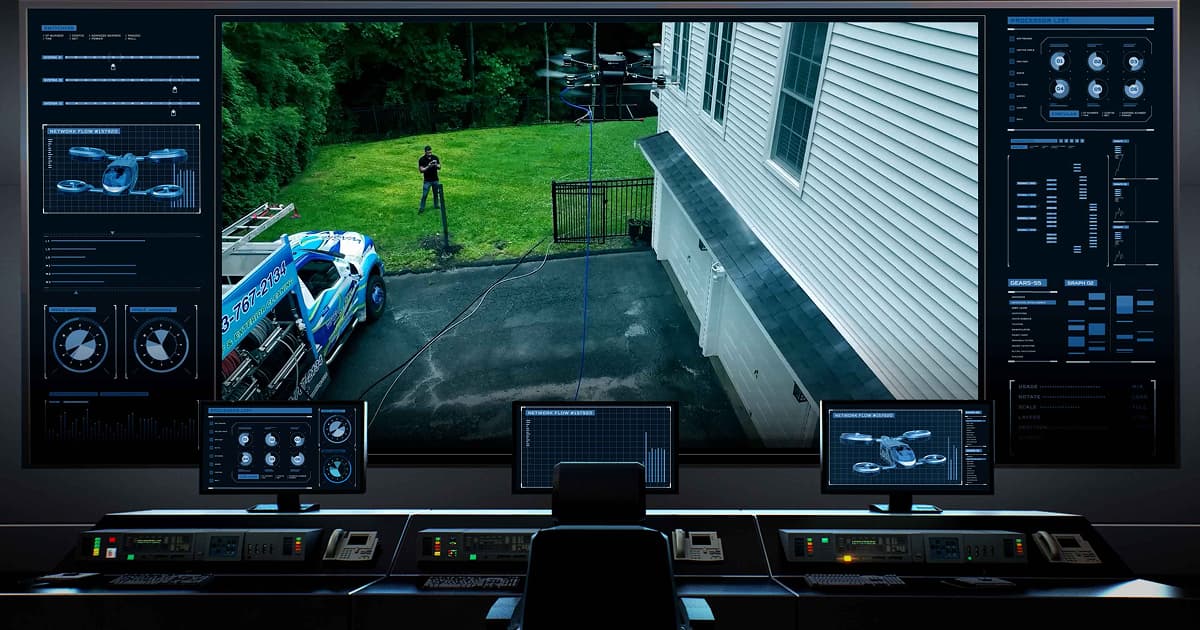
Aquiline Drones Corporation is a U.S.-based company specializing in intelligent drones, AI cloud software, and comprehensive drone solutions. Their offerings span from manufacturing and maintenance of U.S.-made drones like the AD Kobra and AD Endure, to specialized services such as graffiti removal, spray washing, and E&U inspection. The company also provides a unique Virtual Drone Franchise ecosystem, allowing individuals to operate drone manufacturing, MRO, or service-based franchises. Additionally, Aquiline Drones offers FAA Part 107 training and drone insurance, creating a full-spectrum solution for both commercial and defense applications. Their VDF Control Room integrates cloud, IoT, and AI technologies to power a distributed manufacturing framework.