
Coding & Development
Browsing page 399 of AI tools for Coding & Development. Sorted by confidence score — our independent quality rating.

skope-rules
Skope-rules is a Python machine learning module built on top of scikit-learn, designed for learning logical and interpretable rules. Its primary goal is to "scope" a target class by detecting instances with high precision. This tool offers a balance between the interpretability of a Decision Tree and the predictive power of a Random Forest. It extracts rules from tree ensembles, leveraging fast algorithms like bagged decision trees or gradient boosting. The package provides methods to compute predictions using the most precise rules and is particularly useful for understanding and explaining complex model decisions in explainable AI applications. It requires Python (>= 2.7 or >= 3.3), NumPy, SciPy, Pandas, and Scikit-Learn.
mandala
Mandala is a simple and elegant experiment tracking framework designed for Python, eliminating the effort and code overhead typically associated with ML experiment tracking. It features the `@op` decorator, which automatically captures inputs, outputs, and code of Python function calls, reuses past results, and prevents redundant computations. This decorator allows for the composition of end-to-end persisted programs, facilitating efficient iterative development without concern for the storage backend. Additionally, Mandala provides the `ComputationFrame` data structure, which organizes imperative code executions into a high-level computation graph. This structure helps detect patterns like feedback loops and branching, and enables querying relationships between variables by extracting a dataframe. Mandala is particularly useful for data scientists and developers who need robust versioning and persistence for their computational experiments.

MediaFetch
MediaFetch is a free, open-source, and self-hosted web UI for yt-dlp, designed for users who prefer a lightweight solution without bloat. It enables easy downloading of video and audio content, supporting resolutions up to 4K where available. The tool boasts a simple setup, requiring no database, and can be quickly deployed via Docker or PaaS providers. Users receive real-time feedback on downloads through its intuitive UI terminal, making the process transparent and efficient. MediaFetch is ideal for individuals looking to save their favorite online media in a controlled, private environment.
Score Jacobian Chaining
Score Jacobian Chaining is a technique designed for analyzing the sensitivity of machine learning models. This tool is invaluable for AI researchers and machine learning engineers seeking to understand the intricate relationship between model inputs and outputs. By providing insights into how changes in input data propagate through a model, it facilitates effective debugging and optimization. This understanding is crucial for improving model performance, ensuring robustness, and gaining deeper insights into model behavior. While the current live website indicates a runtime error, the underlying concept is highly relevant for academic research and practical application in machine learning development.
Replit-Xray
Replit-Xray is a robust tool designed for deploying Xray proxies within Replit containers. It offers comprehensive support for both Argo fixed and temporary tunnels, allowing users to customize the appearance of their proxy with various camouflage web pages. A key feature is its one-click coexistence of five different protocols: VLESS, VMess, Trojan, Shadowsocks, and SOCKS5, providing flexibility and broad compatibility. The tool is ideal for developers and technical users looking to set up secure and customizable proxy solutions, leveraging the Replit platform for deployment. It integrates community code with ChatGPT for enhanced functionality, offering a versatile solution for proxy management.
Leaderboard
Leaderboard serves as a robust and comprehensive benchmarking platform specifically designed for Automatic Speech Recognition (ASR). It addresses the critical need for measurable performance in ASR systems by offering three core components: a TestSet Zoo, a Model Zoo, and a Benchmarking Pipeline. The TestSet Zoo includes a wide range of academic and SpeechIO-curated datasets covering various speech recognition tasks and scenarios in both English and Chinese. The Model Zoo comprises a collection of commercial APIs and open-source models for comparison. The platform provides a simple and well-specified pipeline for data preparation, recognition, post-processing, and error rate evaluation, enabling researchers and developers to easily benchmark, reproduce, and examine ASR systems.
Python Code Assistance
Python Code Assistance is an AI-powered tool hosted on Hugging Face Spaces designed to assist developers with various Python coding tasks. It offers intelligent code suggestions to speed up development, helps in debugging Python code by identifying errors and potential issues, and provides a repository of reusable code snippets. This tool is beneficial for anyone working with Python, from beginners looking for guidance to experienced developers seeking to optimize their workflow and quickly find solutions. Users can input their code or queries, and the AI will generate helpful responses and assistance, making the coding process more efficient.
Calculate Model Flops
Calculate Model Flops is a specialized tool hosted on Hugging Face Spaces designed to estimate the computational cost and parameter count of transformer models. Users can input a model name or URL from Hugging Face, along with the desired input shape, to receive detailed FLOPs and parameter calculations. This functionality is crucial for developers and researchers working with AI models, enabling them to assess the resource requirements for different models. The tool supports informed decision-making during model selection, optimization, and deployment, ensuring efficient use of computational resources. It provides a straightforward interface for quickly obtaining essential performance metrics.
SwarmOne
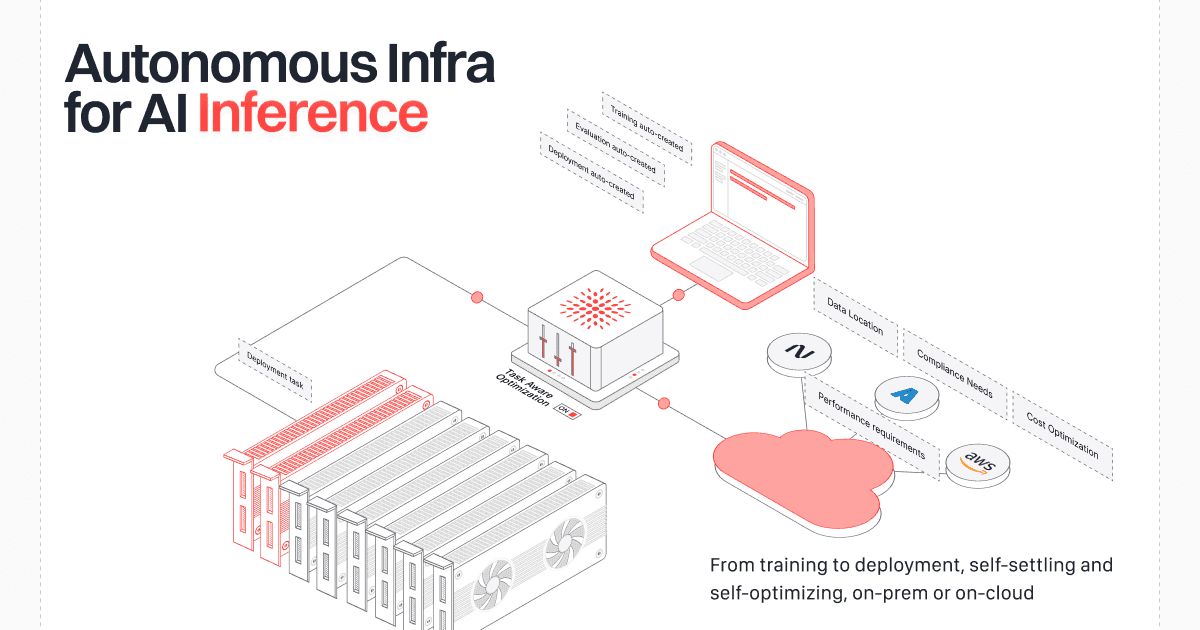
SwarmOne is an autonomous infrastructure platform designed for AI inference, training, and evaluation workloads. It offers a unique scheduler that dynamically disaggregates prefill and decode, orchestrates heterogeneous GPU clusters (NVIDIA, AMD, Intel, Groq, and more), and rebalances in real time to achieve over 90% utilization. The platform features SLO-driven autoscaling, enforcing defined latency, throughput, or cost targets by instantly provisioning GPUs when latency drifts and scaling compute to zero when traffic drops. SwarmOne aims to reduce costs by up to 80% through dynamic disaggregation, multi-node orchestration, and multi-cloud arbitrage, routing to the cheapest capable hardware. It supports a full AI lifecycle from training to deployment with zero DevOps/MLOps required, making it ideal for engineering teams at global enterprises.
SWE-Issue
SWE-Issue is a specialized tool designed for monitoring and analyzing the performance of software engineering assistants by tracking their GitHub issue statistics. It offers a sortable leaderboard that provides insights into the total number of issues, discussions, and resolution rates for various assistants. Users can leverage this platform to compare different AI tools, understand their efficiency in handling software development tasks, and identify top performers. The tool also allows for the submission of new assistants, expanding its database and utility for the software engineering community. Hosted on Hugging Face Spaces, SWE-Issue serves as a valuable resource for developers and researchers interested in the practical application and performance metrics of AI in software engineering.

SQL Chat
SQL Chat is an innovative chat-based SQL client and editor designed to streamline database interactions. It enables users to communicate with their SQL databases using natural language, making complex queries more accessible. The tool supports connecting to a local browser using an OpenAI API key for data storage, ensuring privacy and control. A key feature is its ability to remember previous conversations, allowing for seamless follow-up questions and corrections, which significantly boosts the efficiency of SQL-related tasks. This makes SQL Chat an ideal solution for developers and data professionals looking for a more intuitive and conversational way to manage and query their databases.
RelateDB
RelateDB is a free, offline-first, browser-based database schema design tool that enables users to visually model tables, columns, and relationships. It offers unlimited local projects, schemas, and tables, with all work persisting locally via IndexedDB. Users can import existing schemas from DBML or SQL CREATE TABLE statements and export SQL for Postgres/MySQL, DBML, or diagram images. Key features include an intuitive ERD canvas, auto-layout capabilities, version history with schema snapshots and visual diffs, and the ability to generate migration SQL. The tool is designed for a fast and frictionless experience, requiring no accounts or cloud dependencies for its core functionality.
greenmask
Greenmask is a powerful open-source utility designed for logical database dumping, anonymization, synthetic data generation, and restoration. It is fully supported for PostgreSQL and is in beta for MySQL. Key features include database subsetting for creating smaller, referentially intact development databases, storage agnostic capabilities supporting local directories and S3-compatible storage, and deterministic transformation using hash functions for reproducible data masking. Greenmask also offers dynamic parameters for transformers, conditional transformation logic, and transformation inheritance for partitioned tables and foreign key references. It ensures database type safety and is extensible, allowing for domain-specific transformations. Use cases range from sensitive data sanitization for compliance to robust backup and restore operations, local development, and generating realistic test data.
igel
igel is a delightful open-source machine learning tool designed to simplify the entire ML workflow, enabling users to train, test, and use models without writing a single line of code. It supports a wide array of machine learning tasks, including regression, classification, and clustering, and can handle various dataset types such as CSV, TXT, Excel, JSON, and HTML. A key feature is its auto-ML capability, which can automatically process raw data and optimize models for tasks like image and text classification. Users can configure models via YAML or JSON files, or leverage the `igel init` command for quick setup. The tool also facilitates model deployment by automatically building and serving REST APIs, making it accessible for both technical and non-technical users looking to rapidly prototype or deploy ML solutions.
head-pose-estimation
Head-pose-estimation is an open-source project designed for real-time human head pose estimation. It leverages ONNX Runtime and OpenCV to perform its core functions. The process involves three main steps: first, a face detector identifies a human face within an image or video frame; second, a pre-trained deep learning model detects 68 facial landmarks; and finally, a PnP algorithm calculates the head pose based on these landmarks. This tool is ideal for developers and researchers working on applications requiring precise head movement and orientation analysis. It provides clear instructions for getting started, including prerequisites, installation steps, and how to run the application with video files or webcams. The project also offers guidance on retraining the model for custom needs.
hamilton
Apache Hamilton is a lightweight Python library designed for creating directed acyclic graphs (DAGs) of data transformations. It enables data scientists and engineers to define testable, modular, and self-documenting dataflows that encode lineage, tracing, and metadata. The library is highly portable, running anywhere Python does, including scripts, notebooks, Airflow pipelines, and FastAPI servers. Hamilton emphasizes separation of concerns, allowing data scientists to focus on problem-solving while engineers manage production pipelines. It supports data and schema validation, built-in coding styles, and a plugin-based architecture for custom integrations. The Apache Hamilton UI provides automatic visualization, cataloging, and monitoring of execution, including data cataloging, dataset profiling, and execution tracking.
Prompt Converter
Prompt Converter is an AI tool hosted on Hugging Face Spaces, designed to assist with prompt conversion. While its specific functionalities are not detailed due to its paused status, such tools typically help users adapt prompts for various AI models or tasks, potentially streamlining the process of prompt engineering. Users interested in utilizing this tool are directed to the community tab on its Hugging Face page to request its reactivation from the author, Sylvain Filoni. The platform it resides on, Hugging Face, offers various pricing tiers for its services, including free options for basic usage and paid plans for enhanced features like increased storage, compute power, and advanced deployment options, though these apply to the hosting environment rather than the Prompt Converter tool itself.
Prompt Lab
Prompt Lab is an AI tool hosted on Hugging Face Spaces, designed to refine and enhance user-submitted text prompts. Users can input their original prompt and choose between 'Proficient' or 'Advanced' proficiency levels to receive an improved version. The tool focuses on delivering clearly organized and detailed prompts, making it easier for users to achieve better results from AI models. This functionality is particularly useful for prompt experimentation and for those looking to standardize or optimize their prompt engineering efforts. While the tool itself is accessible, the underlying Hugging Face platform offers various pricing tiers for advanced compute and storage resources.
Griddo
Griddo is a no-code digital experience platform specifically tailored for the education sector, particularly universities. It empowers marketing and communication teams to manage their entire web ecosystem from a single, intuitive interface, eliminating the need for IT dependency. The platform facilitates rapid website creation, content management, and digital marketing actions, including SEO and branding. Griddo supports multi-site management, multilingual content, and offers a flexible CMS for building high-performance websites. It integrates natively with SEO functionalities and external tools like Google Tag Manager and Google Analytics, ensuring agility, scalability, and editorial autonomy for educational institutions.
Screenshot HTMLcode
Screenshot HTMLcode is an AI-powered tool hosted on Hugging Face that simplifies the process of converting visual web designs into functional code. Users can upload a screenshot of any webpage, and the tool will analyze the image to generate the complete HTML and CSS code required to replicate its design and style. This capability is particularly useful for web developers and designers looking to quickly prototype, reconstruct, or learn from existing web layouts without manually coding from scratch. The tool aims to automate a significant portion of the front-end development workflow, making it easier to translate visual concepts into code efficiently.
Deep-Reinforcement-Learning-Algorithms-with-PyTorch
Deep-Reinforcement-Learning-Algorithms-with-PyTorch is an open-source GitHub repository offering PyTorch implementations of a wide array of deep reinforcement learning (RL) algorithms and environments. It features implementations of popular algorithms such as Deep Q Learning (DQN), Double DQN (DDQN), Soft Actor-Critic (SAC), Proximal Policy Optimisation (PPO), and Hindsight Experience Replay (HER) for both DQN and DDPG. The repository also includes custom environments like Bit Flipping Game, Four Rooms Game, and Long Corridor Game, alongside support for OpenAI Gym environments. It provides scripts to watch agents learn various games and train them on custom environments, making it a valuable resource for researchers and developers working on AI agents and model training.
TabArena
TabArena is an AI tool hosted on Hugging Face Spaces, offering a comprehensive leaderboard for evaluating and comparing tabular machine learning models. Users can interact with a web interface to explore model performance across numerous benchmark datasets. The platform provides options to filter and customize comparisons based on criteria such as imputation methods, task types, dataset size, and repeat splits. This functionality makes TabArena a valuable resource for researchers, data scientists, and developers looking to benchmark model performance, identify top-performing models, and understand the nuances of different approaches in tabular data tasks.
Tango2
Tango2 is an AI tool developed by declare-lab that allows users to convert text descriptions into audio recordings. It functions by taking text prompts, which can describe various sounds or scenes, and then generating the corresponding audio. This application is hosted on Hugging Face Spaces, making it accessible for users to experiment with text-to-audio generation. The generated audio outputs are versatile, as they can be downloaded in either WAV or MP3 format, catering to different user needs for quality and file size. Tango2 provides a straightforward interface for exploring the capabilities of AI in sound synthesis from textual input.
Glitter AI
Glitter AI is an AI-powered documentation tool designed to automatically create step-by-step guides and Standard Operating Procedures (SOPs). Users can record any process using the desktop app or browser extension, or upload existing videos, and Glitter AI will transform them into detailed guides complete with screenshots and text. It supports 99 languages, allowing for guide creation and translation, and offers various export formats including PDF, HTML, and Markdown. The tool is ideal for teams looking to streamline documentation for IT procedures, operations, customer success, HR training, and educational materials, saving significant time compared to manual documentation processes.