
Coding & Development
Browsing page 401 of AI tools for Coding & Development. Sorted by confidence score — our independent quality rating.

Candle Phi Wasm Demo
Candle Phi Wasm Demo is a demonstration application built on Hugging Face Spaces that allows users to generate text from prompts. This tool showcases the capabilities of the Candle Phi model within a WebAssembly (Wasm) environment, enabling efficient execution directly in the browser. Users can input any text prompt and receive a generated response or continuation, making it suitable for exploring AI text generation. The application supports various models and advanced operations, providing a flexible platform for experimenting with different text-based AI outputs. It is an open-source project, highlighting its accessibility and potential for further development and integration.
Senna
Senna is an open-source project designed to integrate large vision-language models (LVLMs) with end-to-end autonomous driving systems. Developed by researchers from Huazhong University of Science and Technology and Horizon Robotics, Senna aims to enhance planning safety, robustness, and generalization in autonomous vehicles. The project provides comprehensive resources including code, model weights for Senna-VLM, and scripts for training and evaluation. It supports data preparation by generating QA data using models like LLaVA-v1.6-34b for scene descriptions and planning explanations. Senna offers both full-parameter and LoRA fine-tuning options, with full-parameter fine-tuning recommended for optimal performance. Researchers and developers can utilize Senna to build and evaluate advanced AI-driven vehicle control systems, demonstrating strong cross-scenario generalization and transferability.
sig-mlops
sig-mlops is a Special Interest Group (SIG) within the Continuous Delivery Foundation (CDF) dedicated to Machine Learning Operations (MLOps). This open-source initiative aims to foster collaboration and drive standardization within the MLOps community. The group focuses on sharing best practices, developing documentation, and providing resources for professionals involved in the deployment, monitoring, and management of machine learning models. It serves as a hub for discussions, knowledge exchange, and contributions to the evolving field of MLOps, helping to streamline processes and improve efficiency in AI/ML development workflows.
pyRiemann
pyRiemann is an open-source Python machine learning package designed for processing and classifying real or complex-valued multivariate data. It leverages the Riemannian geometry of symmetric or Hermitian positive definite matrices, offering a high-level interface that mimics the scikit-learn API. While generic for multivariate data analysis, it's specifically tailored for biosignals like EEG, MEG, or EMG in brain-computer interface (BCI) applications, including motor imagery, event-related potentials, and steady-state visually evoked potentials. It also supports multisource transfer learning and remote sensing applications, such as processing radar images. The package provides functionalities for estimating covariance matrices and classifying them, making it a powerful tool for researchers and developers in these fields. It can be easily integrated into scikit-learn pipelines for comprehensive data analysis workflows.
resources
resources is an open-source repository dedicated to curating and organizing Go-based data science resources. It serves as a central hub for developers and data scientists working with the Go programming language, offering a comprehensive collection of links to various community resources such as events, conferences, and blogs. Additionally, it provides an extensive list of tooling resources, including essential packages, libraries, and development tools specifically designed for data analysis, visualization, and machine learning tasks within the Go ecosystem. This makes it an invaluable asset for anyone looking to explore or deepen their work in data science using Go.
RealMirror
RealMirror is a comprehensive, open-source embodied AI VLA (Vision-Language-Action) platform designed to address fundamental challenges in humanoid robotics, such as high data acquisition costs, lack of standardized benchmarks, and the simulation-to-real-world gap. It offers an efficient, low-cost system for data collection, model training, and inference, allowing researchers to conduct VLA studies without needing a physical robot. The platform includes a dedicated VLA benchmark with multiple scenarios and extensive trajectories to facilitate model evolution and fair comparison. RealMirror also integrates generative models and 3D Gaussian Splatting for realistic environment and robot model reconstruction, enabling zero-shot Sim2Real transfer where models trained in simulation can perform tasks on real robots seamlessly. Recent updates include the Seed2Scale scheme for automatic large-scale upper limb trajectory generation and MirrorLimb with gesture teleoperation functionality.

Raion
Raion is an exclusive private forum designed for the tech and business elite involved in building AI companies across the US, UK, and Europe. It offers reliable access to global compute and GPU capacity, addressing critical infrastructure needs for high-performance AI workloads. The platform connects members with decision-makers at hardware giants and cloud providers, facilitating strategic integration and global scaling. Raion emphasizes a rigorous selection process, admitting only well-capitalized enterprise companies and elite startups to ensure a community of proven visionaries. It supports ambitious plans for sustainable data centers and next-gen compute architectures, requiring deep expertise in areas like AI chip design, edge computing, and cybersecurity.
Browser
Browser is an AI tool hosted on Hugging Face Spaces, designed to help users explore and understand various AI models. It offers a user-friendly interface to search, filter, and browse a comprehensive collection of models. Users can view detailed information about each model, including statistics and descriptions, within a convenient pop-up window. The tool also provides preview images, making it easier to visualize and assess models. This platform is ideal for anyone looking to discover, compare, and learn about different AI models in an organized and accessible manner.
UiMagic
UiMagic is an AI-powered full-stack app builder designed to streamline the creation of web applications. It enables users to build, edit, and deploy production-ready apps simply by providing text prompts, eliminating the need for traditional coding. The platform leverages AI to generate the necessary components, offering a no-code solution for rapid development. While specific features are noted as "coming soon," the core promise is to provide everything needed to build full-stack applications with AI, including capabilities for landing pages, SaaS apps, and portfolios. This tool aims to empower users to bring their web application ideas to life quickly and efficiently.
Mechanix
Mechanix, powered by ExpiredDomains.com, is a platform dedicated to the buying and selling of expired domain names. It offers a comprehensive database of over 1 million domains across 677+ TLDs, updated daily. The platform provides exclusive data metrics to highlight true domain value, including SEO scores, traffic estimates, and backlink profiles. Users can filter domains by TLD, keyword, length, and other criteria, making it easier to find domains with SEO authority, existing traffic, or strong brand potential. While ExpiredDomains.com itself is free to use, it connects users to external registrars like GoDaddy to complete purchases, with prices clearly listed for each domain.
Shopless
Shopless Business Solutions is a digital agency with over 5 years of experience, specializing in a comprehensive range of digital services. These include web design, mobile development, branding services, social media marketing, and management. They focus on building bright brands, unique visual systems, and digital experiences, offering future-ready solutions from branding and customer experiences to e-commerce and emerging technologies. Shopless also provides AI-integrated products such as e-commerce platforms, e-learning platforms, ERP systems, healthcare systems, and virtual tour builders, designed to unlock efficiency, innovation, and growth. Their services aim to optimize workflows, enhance efficiency, and foster collaboration for businesses.
CameraCtrl Svd Xt
CameraCtrl Svd Xt is a tool designed for camera control and automation, hosted on Hugging Face Spaces. It is primarily aimed at AI enthusiasts, developers, and researchers interested in experimenting with camera controls within an AI context. The tool is provided free of charge under an MIT license, making it accessible for academic and experimental use. While the current live website indicates a runtime error, suggesting it may not be fully operational at this moment, its intended purpose is to facilitate advanced camera manipulation and integration with AI models. Users can explore its files and community sections on Hugging Face to understand its underlying structure and potential applications.
Quizzle AI
Quizzle AI is an innovative mobile application that combines artificial intelligence with adult humor to create a unique quiz experience. It offers a variety of game modes, including QuizzleMania for fast-paced challenges, QuizzleLarnia for story-driven quests, and QuizzleQuest for engaging mini-games. Users can adopt virtual companions called Quizzlings, earn rewards, and climb leaderboards. The platform is designed to be interactive and entertaining, allowing users to test their knowledge across diverse subjects with a quirky twist. Quizzle AI aims to provide endless entertainment and a challenging yet fun way to learn new facts.
jBrowserDriver
jBrowserDriver is a programmable, embeddable web browser driver designed for compatibility with the Selenium WebDriver specification. Implemented entirely in Java, it offers a headless, WebKit-based browser environment, making it suitable for automated web interactions. Developers can use it for tasks such as web testing, scraping, and automating browser-based workflows. It supports various configurations, including proxy settings, request headers, time zones, and user agents, and can be integrated with Selenium Server and Selenium Grid for remote execution. Each instance runs in a separate Java process, ensuring isolation and stability for complex automation scenarios.
Bites: AI-Powered Studying!
Bites: AI-Powered Studying! (part of the Shaguf educational platform) is designed to enhance the learning experience for students from high school through university. It leverages AI to convert study materials into engaging and interactive content, including multiple-choice questions, dynamic flashcards, and instant explanations. The platform supports various academic levels, from general courses and university subjects to specialized training camps. Students can also interact with a personal AI tutor and organize their notes for efficient revision, making the study process more enjoyable and effective. Shaguf aims to provide a smart and interactive learning environment with top instructors and trainers.
Study AI: Your Smart Companion
Study AI is an AI-powered mobile application designed to be a smart study companion, offering instant homework help and personalized tutoring. Students can quickly get solutions by scanning any question with their camera, typing it, or using voice input. The app provides step-by-step explanations to break down complex problems and clarify concepts. It supports a wide range of subjects including Mathematics, Physics, Biology, Chemistry, and Literature, making it a versatile tool for academic assistance. Study AI also allows users to chat with an AI tutor for follow-up questions and keeps a complete history of all questions and solutions for easy review and continued learning, aiming to deepen understanding and improve problem-solving skills.
Calculate Model Flops
Calculate Model Flops is a specialized tool hosted on Hugging Face Spaces designed to estimate the computational cost and parameter count of transformer models. Users can input a model name or URL from Hugging Face, along with the desired input shape, to receive detailed FLOPs and parameter calculations. This functionality is crucial for developers and researchers working with AI models, enabling them to assess the resource requirements for different models. The tool supports informed decision-making during model selection, optimization, and deployment, ensuring efficient use of computational resources. It provides a straightforward interface for quickly obtaining essential performance metrics.
GraphSAINT
GraphSAINT is an open-source framework designed for efficient and accurate training of Graph Neural Networks (GNNs) on large-scale graphs. It introduces a novel minibatch method that samples small subgraphs from the full training graph, allowing for complete GNN construction and propagation on these subgraphs without further layer sampling. This approach addresses the 'neighbor explosion' problem common in other methods, leading to linear computation cost with GNN depth and improved scalability. GraphSAINT supports various GNN architectures like GraphSAGE, GAT, JK-Net, GaAN, and MixHop, and offers multiple graph samplers including Node, Edge, RW, MRW, and Full graph. It provides implementations in both TensorFlow and PyTorch, making it flexible for researchers and developers working with deep GNNs.
gemini-business2api
Gemini Business2API functions as an OpenAI-compatible API gateway, enabling users to leverage Gemini Business capabilities through a familiar interface. This tool is designed with multi-account load balancing, ensuring efficient distribution of requests across multiple Gemini Business accounts. It supports advanced multimodal features, including image and video generation, as well as comprehensive file parsing. The platform includes a built-in management panel for streamlined administration, allowing for unified management of account pools, system settings, and operational status. Key features like account import/export, batch operations, and status filtering enhance usability. It also offers flexible deployment options via Docker Compose or an interactive installation script, making it accessible for various technical setups.

Octave Melody AI
Vercel offers a comprehensive AI Cloud platform designed for developers to build, scale, and secure web experiences. It provides essential developer tools and cloud infrastructure, enabling teams to ship features faster and more efficiently. Key offerings include the AI Gateway for managing multiple AI models, Sandbox for isolated code execution, and Vercel Agent for stack-aware assistance. The platform also features an AI SDK for TypeScript, robust CI/CD capabilities, fast content delivery, and fluid compute for serverless functions. Vercel emphasizes security with bot management, DDoS protection, and a Web Application Firewall, making it suitable for deploying AI apps, composable commerce, marketing sites, and multi-tenant platforms.
Voiden
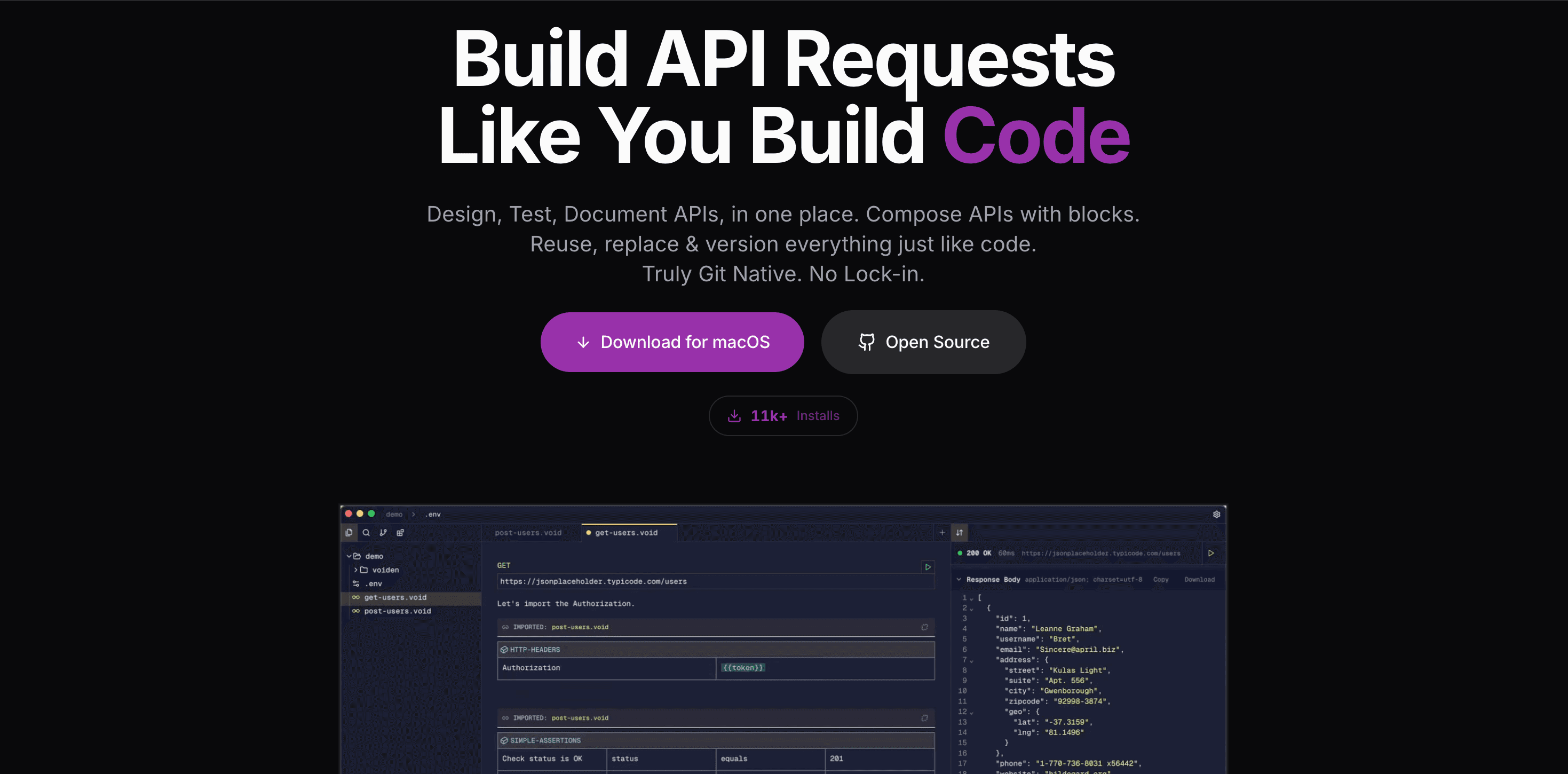
Voiden is an innovative, offline-first API workspace designed for developers who want to manage their API lifecycle like code. It unifies API specifications, documentation, testing, and mocking within a single Git-native environment. By leveraging programmable Markdown blocks, Voiden allows users to design, test, and document APIs in one place, ensuring everything is version-controlled and diffable. Key features include executable API documentation, block-based API composition for reusability, and true Git-native workflows without proprietary formats or sync integrations. Voiden supports multiple protocols like REST, WebSocket, gRPC, and GraphQL, and offers advanced features such as pre/post request scripts, YAML environment support, and community extensions, making it a comprehensive solution for modern API development.

MediaFetch
MediaFetch is a free, open-source, and self-hosted web UI for yt-dlp, designed for users who prefer a lightweight solution without bloat. It enables easy downloading of video and audio content, supporting resolutions up to 4K where available. The tool boasts a simple setup, requiring no database, and can be quickly deployed via Docker or PaaS providers. Users receive real-time feedback on downloads through its intuitive UI terminal, making the process transparent and efficient. MediaFetch is ideal for individuals looking to save their favorite online media in a controlled, private environment.
monk_v1
Monk is a low-code deep learning tool designed to simplify computer vision development by providing a unified wrapper for various deep learning libraries. It allows users to write less code and create end-to-end applications using a single syntax across frameworks like PyTorch, MXNet, and Keras. Monk helps manage entire projects with multiple experiments, making it ideal for students, researchers, developers, and competition participants. Key features include project management, hyper-parameter analysis, and a comprehensive study roadmap for learning computer vision. It supports real-world image classification applications across diverse domains such as medical, fashion, autonomous vehicles, and retail.
workflow
The Workflow SDK is designed for developers to build robust and observable applications and AI agents using TypeScript. It enables the creation of apps that can suspend, resume, and maintain state with ease, ensuring durability and reliability. This open-source project, built by engineers at Vercel and the Open Source Community, streamlines the development process for complex asynchronous JavaScript applications. It is particularly useful for managing long-running processes and AI agents that require consistent state management and fault tolerance. The SDK provides a foundational framework for building resilient systems, making it a valuable tool for modern software development.