
Coding & Development
Browsing page 53 of AI tools for Coding & Development. Sorted by confidence score — our independent quality rating.

calculate-flops.pytorch
calflops is a Python-based tool designed to accurately calculate the theoretical amount of Floating-Point Operations (FLOPs), Multiply-Add Operations (MACs), and Parameters within a wide range of neural networks. It supports common architectures like Linear, CNN, RNN, and GCN, as well as advanced Transformer models, including large language models such as Bert and LlaMA. The tool is built on PyTorch and can analyze any custom models implemented using `torch.nn.function.*`. A key feature is its ability to print FLOPs, Parameter values, and their proportions for each submodule, offering detailed insights into model performance consumption. It also provides a convenient way to calculate FLOPs for Hugging Face models online without downloading full weights, making it particularly useful for LLM analysis.
chat.js
chat.js offers a comprehensive, production-ready foundation for building AI chat applications, allowing developers to bypass the need to rebuild common AI chat infrastructure. It supports over 120 AI models, including Claude, GPT, Gemini, and Grok, all accessible via a unified API. Key features include robust authentication options (GitHub, Google, anonymous), support for various attachments like images and PDFs, and resumable streams for continuous generation. The platform also enables conversation branching, public sharing of chats, real-time web search integration, and AI-powered image generation. Developers can also leverage code execution in a sandbox, Model Context Protocol (MCP) support, and even package their applications as native desktop apps using Electron. The stack is built on Next.js, TypeScript, AI SDK, and other modern technologies, providing a full-featured environment for creating unique AI chat experiences.
chatbox
Chatbox is a powerful, open-source AI client designed for desktop use, supporting a wide array of large language models including OpenAI (ChatGPT), Azure OpenAI, Claude, Google Gemini Pro, and Ollama for local models. It provides advanced prompting features, image generation with DALL-E-3, and local data storage to ensure user privacy. The tool is available as a desktop application for Windows, macOS, and Linux, with no-deployment installation packages for quick setup. Additionally, Chatbox offers a web version and native iOS/Android mobile apps, ensuring accessibility across various platforms. Key features include an ergonomic UI with a dark theme, keyboard shortcuts, streaming replies, and comprehensive content formatting with Markdown, Latex, and code highlighting. It also includes a prompt library, message quoting, and team collaboration features for sharing OpenAI API resources. With multilingual support, Chatbox caters to a global audience, making it a versatile AI copilot for diverse users.
Lecca.io
Lecca.io is a no-code AI agent and automation platform designed for businesses to build and deploy AI operators without complex workflows. The platform emphasizes ease of use, allowing users to create and manage AI agents efficiently. It offers broad compatibility by supporting integration with any Large Language Model (LLM) provider, giving users flexibility in their AI choices. Deployment options are versatile, enabling users to integrate their AI operators into Slack for team collaboration, embed them directly onto websites for customer interaction, or access them via an API for custom applications. This makes Lecca.io suitable for various business needs, from automating customer service to streamlining internal operations.
cognita
Cognita is an open-source RAG (Retrieval Augmented Generation) framework designed to streamline the development and deployment of modular, scalable, and extensible AI applications. While leveraging Langchain/LlamaIndex, Cognita addresses the challenges of moving RAG systems from experimentation to production by offering an organized codebase where each RAG component is API-driven. It supports various features like multiple document retrievers, incremental indexing, and integration with open-source LLMs and embedding models. Cognita also includes a no-code UI for easier configuration and experimentation, making it suitable for both local development and production environments, with optional support for Truefoundry components for enhanced scalability.
Accretional
Accretional offers a comprehensive platform designed to take ideas from concept to deployed application with cutting-edge tools and zero-friction integration. Key features include Hosted Version Control with Git, providing managed repositories and deep IDE integrations. The Brilliant Agentic IDE enables AI coding directly in your browser within secure, remote, cloud-based Linux development environments. Additionally, the Statue Static Site Generator allows for quick setup and customization of modern websites. Accretional aims to be an open, modular ecosystem for software development, catering to hackers, professionals, and builders alike, facilitating the creation and management of AI-driven software.
ctransformers
ctransformers is a Python library designed to provide efficient bindings for Transformer models, leveraging C/C++ implementations and the GGML library. This allows for optimized local execution of various large language models, including GPT-2, LLaMA, Falcon, and more. The library offers a unified interface for model loading and generation, supporting both local files and Hugging Face Hub repositories. It integrates seamlessly with popular AI frameworks like Hugging Face Transformers and LangChain, making it versatile for different development workflows. ctransformers also provides GPU acceleration for compatible models, with support for CUDA, Metal, and ROCm, and includes experimental GPTQ quantization support for LLaMA models, enhancing performance and reducing memory footprint.
datapizza-ai
Datapizza-ai is a Python-based framework designed to streamline the development and deployment of reliable Generative AI solutions. It emphasizes speed and efficiency, aiming to reduce overhead and accelerate the transition of AI agents from development to production environments. The framework offers an API-first design, multi-provider support for LLMs like OpenAI, Google Gemini, and Anthropic, and robust tool integration including web search and document processing. Key features include composable and reusable blocks, smart chunking for document processing, and built-in reranking. Datapizza-ai also provides comprehensive observability with OpenTelemetry tracing, allowing developers to monitor performance and debug execution flow effectively. Its vendor-agnostic approach ensures flexibility, enabling users to swap models and providers without extensive code changes, making it a migration-friendly option for various AI projects.

Unframe
Unframe is a managed AI delivery platform specializing in tailored enterprise AI solutions. It goes beyond generic tools by offering secure, governed, and production-ready AI systems designed to deliver measurable ROI quickly. The platform emphasizes rapid deployment, often within days, without requiring upfront costs or full-time developers. Unframe's core consists of feature-rich building blocks for search, reasoning, automation, and agents, configured by blueprints to orchestrate solutions for specific use cases. It integrates with existing tech stacks, supports various LLMs and infrastructure choices (on-prem, private cloud), and ensures data security by allowing solutions to be hosted within the client's perimeter. Unframe aims to provide compounding value, where each new use case builds on the last, leading to faster deployments and higher accuracy.
Spiral
Spiral is an AI-powered platform designed to analyze customer feedback from various sources, including reviews, live chats, and phone calls. It acts as an AI agent, processing millions of feedback pieces to identify key insights such as common complaints, frequently requested features, and sentiment trends over time. The tool offers different plans, from a free tier for basic review analysis to enterprise solutions with unlimited feedback processing, advanced KPI tracking, and custom integrations. Spiral aims to transform customer support data into actionable intelligence, helping businesses understand their customers better and drive proactive improvements. It supports over 76 languages and ensures data security with SOC 2 compliance and PII redaction.

XFactr.AI
XFactr.AI is a comprehensive AI solutions and IT consulting company dedicated to helping businesses unlock their full potential through advanced technology. The platform offers three core hubs: AI X for building and scaling production-ready ML, GenAI, and agentic AI solutions; Edge Foundry for deploying connected devices and edge intelligence; and Digital Arena for full-stack platforms, enterprise integrations, and automation. XFactr.AI specializes in custom ML/DL models, computer vision, predictive maintenance, multimodal AI, RAG-based solutions, and data engineering. They also provide services in DevOps, MLOps, LLMOps, and industry-specific AI applications, catering to sectors like energy, industrial automation, construction, PropTech, and retail.
Tribe AI
Tribe AI serves as an AI delivery layer for large enterprises, bridging the gap between cutting-edge AI models and practical, real-world applications. The platform is dedicated to helping the world's largest companies rewire their operations, compete more effectively, and create significant value through AI. Tribe AI offers deep partnerships with frontier AI providers like OpenAI and Anthropic, aiming to transform large enterprises into AI-native organizations. Their expertise lies in end-to-end AI product development, ensuring rapid deployment and proven value creation, tackling high-stakes projects with potential for $100M+ enterprise value. They focus on specialization, speed, quality of delivery, and tangible impact.
Agumbe
Agumbe.AI is a comprehensive platform designed to simplify machine learning operations for developers and enterprises. It offers a unified gateway for managing LLM access, including authentication, guardrails, routing, and usage visibility. The platform allows users to build and deploy full AI applications, agents, and policies, abstracting away infrastructure complexities. Agumbe supports hybrid cloud deployments on Kubernetes across AWS, GCP, and Azure, and provides a fully-managed developer API. Key features include a reactive core for low-latency performance, ephemeral environments for testing, and robust data platform capabilities for data preparation, feature stores, and experimentation, ensuring secure and scalable AI application development.
embedbase
embedbase is an open-source API designed to streamline the development of LLM-powered applications by abstracting away the complexities of VectorDBs and LLMs. It allows users to generate text using over nine different LLMs and implement semantic search capabilities. Developers can easily add semantically searchable information and run queries, making it ideal for creating features like recommendation engines, chat with data applications, and smart contract integrations. The platform offers a hosted version and an SDK, simplifying installation and integration into existing projects. It supports various use cases, from finding related notes to powering ChatGPT-like search for documentation.
embedJs
embedJs is an open-source framework designed to streamline the development of Retrieval-Augmented Generation (RAG) and Large Language Model (LLM) applications using Node.js. It provides a comprehensive toolkit for personalizing LLM responses by segmenting data into manageable chunks, generating relevant embeddings, and storing them in a vector database for optimized retrieval. This framework enables users to extract contextual information, find precise answers, and engage in interactive chat conversations, all tailored to their specific data. With extensive documentation and examples, embedJs aims to make working with LLMs and embeddings accessible and efficient for developers.

Streamdown
Streamdown is a React component library designed as a drop-in replacement for `react-markdown`, specifically optimized for streaming content from AI models. It addresses unique challenges like incomplete syntax, partial code blocks, and unterminated links that traditional Markdown renderers struggle with during real-time streaming. Streamdown intelligently parses incomplete blocks, applies progressive formatting, and ensures seamless transitions from incomplete to complete states, providing a smooth user experience. It features built-in typography, streaming carets, animations, and a robust plugin system for features like syntax highlighting (Shiki), LaTeX math (KaTeX), interactive Mermaid diagrams, and CJK support. The tool also includes security hardening for links and images, and is fully customizable through components, styles, and configuration, while maintaining a lean bundle size with tree-shakeable plugins.
full-stack-fastapi-nextjs-llm-template
The full-stack-fastapi-nextjs-llm-template is a production-ready project generator for AI applications, featuring a FastAPI backend and a Next.js 15 frontend. It supports six AI agent frameworks including PydanticAI, LangChain, and CrewAI, alongside a robust RAG pipeline with multiple vector stores like Milvus and Qdrant. Key features include WebSocket streaming for real-time chat UIs, conversation sharing, and enterprise-grade integrations for authentication, background tasks, and observability. The template is designed to accelerate the development of AI chatbots, ML applications, and enterprise SaaS solutions, providing a comprehensive foundation to minimize boilerplate and allow developers to focus on core AI product features.
BaseAI
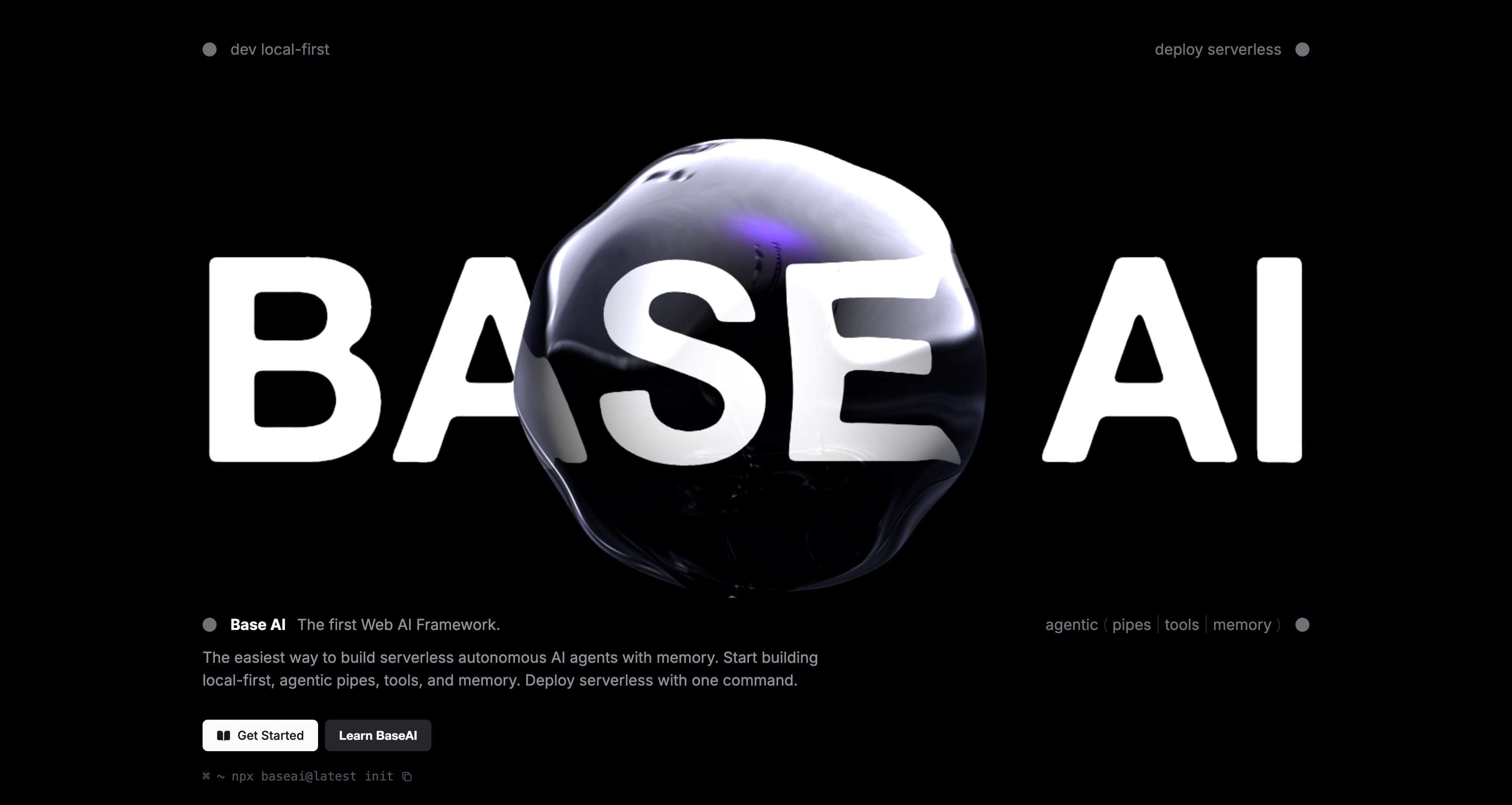
BaseAI is the first web AI framework designed for building and deploying serverless autonomous AI agents with memory. It emphasizes simplicity and composability, allowing developers to start building local-first with agentic pipes, tools, and memory. The framework integrates seamlessly with Langbase, a composable serverless AI cloud, enabling one-command deployment. BaseAI provides a straightforward API for creating and deploying various AI agents and features, supporting RAG (Retrieval Augmented Generation) for memory. It's an ideal solution for developers looking to streamline the creation and deployment of intelligent AI applications.
InsForge
InsForge is an open-source backend development platform specifically designed for AI coding agents and AI code editors. It simplifies full-stack application development by exposing backend primitives such as databases, authentication, storage, and functions through a semantic layer. This layer allows AI agents to understand, reason about, and operate these backend systems end-to-end. Key features include fetching backend context, configuring primitives directly, and inspecting backend state and logs via structured schemas. InsForge supports core products like user management, Postgres relational databases, S3 compatible file storage, an OpenAI compatible API across multiple LLM providers, serverless edge functions, and site deployment. It can be run locally via Docker Compose or deployed with one-click solutions like Railway, Zeabur, and Sealos.
tidi.studio
mx.works is an independent AI product studio dedicated to designing, building, and shipping AI-native software products. Founded in 2024 by Andrés Max, the studio emphasizes a small team, fast iteration, and building products they would personally use. They specialize in AI-native tools, productivity apps, and automation systems, focusing on problems where AI can make a meaningful difference. The studio prides itself on creating simple, craft-focused applications without feature bloat or subscription traps, ensuring tools do one thing well. They utilize OpenAI, Anthropic, and Gemini models for AI, React and Rails for applications, n8n and custom pipelines for automation, and Figma for design, selecting technology based on the problem at hand.

DKube
DKube helps enterprises design, deploy, and scale secure, private AI systems across on-premise, private cloud, and hybrid environments. It ensures full control, compliance, and ownership of AI initiatives. The platform offers solutions like DKubeX for Generative AI and ML, and DKube for MLOps, enabling AI/ML and data engineering teams to build, train, and deploy complex models. DKube also provides AI Blueprints such as QueriLynx for data exploration, Virtual Teaching Assistant for education, and DocMind for document processing, all designed for real-world impact and rapid deployment within weeks.
korvus
Korvus is an all-in-one, open-source RAG (Retrieval-Augmented Generation) pipeline built specifically for Postgres. It integrates LLMs, vector memory, embedding generation, reranking, summarization, and custom models into a single SQL query, significantly boosting performance and simplifying search architecture. By leveraging Postgres's robust capabilities, Korvus eliminates the need for external services and API calls, reducing latency and complexity. It provides SDK support for Python, JavaScript, Rust, and C, allowing seamless integration into existing tech stacks. This approach offers a simplified architecture, high performance, and scalability, making it ideal for developers looking to build efficient RAG applications directly within their database.
kogpt
KoGPT, developed by KakaoBrain, is a Korean Generative Pre-trained Transformer (GPT) model. It is primarily trained on Korean texts, making it highly effective for tasks such as classifying, searching, summarizing, and generating Korean language content. The project offers different model descriptions, including KoGPT6B-ryan1.5b, with specific hardware requirements for GPU memory. Researchers and developers can utilize KoGPT for various AI community projects, with usage examples provided for inference and integration with the Hugging Face Transformers library. It's important to note that KoGPT was trained on raw data and may generate socially unacceptable texts, and its performance is optimized for Korean language inputs.
lemonade
Lemonade is an open-source local AI server designed to help users discover and run AI applications directly on their own hardware. It optimizes and serves large language models (LLMs), image generation models, and speech models using the user's GPUs and NPUs, offering capabilities similar to cloud APIs but with 100% privacy and no cost. Lemonade comes in two forms: a server that connects to apps via standard OpenAI, Anthropic, and Ollama APIs, and an embeddable binary for developers to integrate multi-modal local AI into their own applications. It supports a wide range of models including GGUF, FLM, ONNX, Whisper, and Stable Diffusion across various platforms like Windows, Linux, and macOS, with specific optimizations by AMD engineers for Ryzen AI, Radeon, and Strix Halo PCs.