
Coding & Development
Browsing page 26 of AI tools for Testing & QA in Coding & Development. Sorted by confidence score — our independent quality rating.

Page Canary
Page Canary is an AI-powered website quality assurance bot designed to proactively identify issues on your website. It leverages AI to control a web browser, mimicking a real user's interaction to uncover problems. The tool offers over 10 custom web page audits, including checks for SSL certificate validity, link functionality, accessibility, security best practices, and spelling errors. By catching defects early, Page Canary helps prevent website downtime and ensures a smooth user experience. It's suitable for businesses looking to maintain high website quality and save developer hours on manual testing.
AgileAI Labs
AgileAI Labs offers an all-in-one DevOps SaaS platform designed for agile software development, focusing on defect prevention, task automation, and real-time analytics. Its core product, Spec2TestAI™, enhances requirements with AI, generates test cases, and provides predictive code analysis to identify fail points. The platform supports various SDLC roles, including Product Owners, Project Managers, Scrum Masters, Business Analysts, Quality Engineers, and Developers, by offering tailored functionalities like AI-enhanced story definition, project health metrics, automated security requirements, and one-click test case generation. It aims to accelerate development cycles and deliver high-quality software with confidence.
TestPilotAI
TestPilotAI offers automated Shopify checkout testing, running a full homepage to checkout flow after every release to prevent regressions. It provides a live health score for each managed store, indicating what's working, degraded, or failing. The tool requires no coding or scripts, with a 60-second setup by simply pasting a URL. It performs real browser-based testing, monitoring product discovery, variant selection, add to cart, checkout reachability, and payment form integrity. Unlike basic uptime monitoring, TestPilotAI ensures customers can actually complete orders, catching silent failures that traditional checks miss. It alerts users instantly with screenshots and HTML snapshots when issues are detected, allowing for quick debugging before clients or customers notice.
agenta
agenta is an open-source LLMOps platform designed to accelerate the development of reliable LLM applications. It offers a comprehensive suite of tools for prompt management, evaluation, and observability, all in one place. Key features include an interactive LLM playground for side-by-side prompt comparison, multi-model support, and version control for prompts and configurations. For evaluation, Agenta provides flexible test set creation, pre-built and custom evaluators, and human feedback integration. The platform also offers robust observability with cost and performance tracking, detailed LLM tracing, and OpenTelemetry native compatibility. It's ideal for teams looking to streamline their LLM development workflow from experimentation to production.
Gologin Cloud Browser
Gologin Cloud Browser offers a robust cloud browser infrastructure designed for AI teams and automation. It enables users to launch secure, isolated browser instances either through its application or via API. Each browser profile comes with a unique digital fingerprint, cookies, browsing history, and settings, making it appear as a distinct user to websites. This functionality is crucial for tasks requiring multiple online identities, such as affiliate marketing, social media management, and web scraping, while maintaining privacy and avoiding detection. The tool supports automation with Selenium and Puppeteer, and offers features like headless or headful modes, proxy attachment, and cloud server launching. It also includes team management capabilities for account sharing and collaboration.
latitude-llm
Latitude-llm is an open-source platform designed for building and operating LLM features in production. It emphasizes observability and evaluation, allowing users to instrument existing LLM calls to capture prompts, inputs/outputs, tool calls, latency, token usage, and cost. The platform supports a reliability loop that turns production failures into repeatable fixes through features like issue discovery, automatic evaluations, and a prompt optimizer. Users can start with observability and evaluations, then progress to a reliability loop to continuously improve prompts. Latitude-llm works with most model providers and frameworks out of the box and offers both a managed cloud product and a self-hosted deployment option.
Deep-Learning-Approach-for-Surface-Defect-Detection
Deep-Learning-Approach-for-Surface-Defect-Detection is an open-source project offering a Tensorflow implementation of a segmentation-based deep learning approach for surface defect detection. This tool is designed for automated visual inspection and quality control, particularly relevant in manufacturing processes. It allows users to train a deep learning model on datasets like KolektorSDD to identify and classify surface imperfections. The implementation supports independent training of segmentation and decision networks, providing flexibility for model optimization. It includes scripts for testing, training, and visualization of results, making it a practical resource for researchers and developers working on computer vision applications for industrial quality assurance.
DeepfakeBench
DeepfakeBench serves as a comprehensive benchmark for deepfake detection, addressing the lack of standardization in the field. It features a unified data management system to ensure consistent input across detection models and an integrated framework for implementing state-of-the-art detection methods. The platform introduces standardized evaluation metrics and protocols, enhancing transparency and reproducibility of performance assessments. DeepfakeBench also facilitates extensive analysis to provide new insights for technological advancements. It supports 36 detectors, including both image and video detectors, and integrates with 9 datasets like FaceForensics++ and Celeb-DF. The tool offers multi-GPU training and comprehensive evaluation metrics such as frame-level AUC, video-level AUC, ACC, EER, PR, and AP.
Createmytest
Createmytest is an AI-powered platform designed to automatically convert documents and YouTube videos into customizable tests in seconds. This tool simplifies test creation, making it easier for users to study and confirm knowledge retention. It supports various question types, including multiple choice, true/false, matching, and fill-in-the-blank, allowing for diverse assessment methods. Createmytest aims to reduce test anxiety by providing unlimited practice sessions, enabling users to test themselves repeatedly without additional cost. The platform is ideal for anyone looking to efficiently transform study materials into interactive tests to improve learning outcomes.
Allyzio Copilot
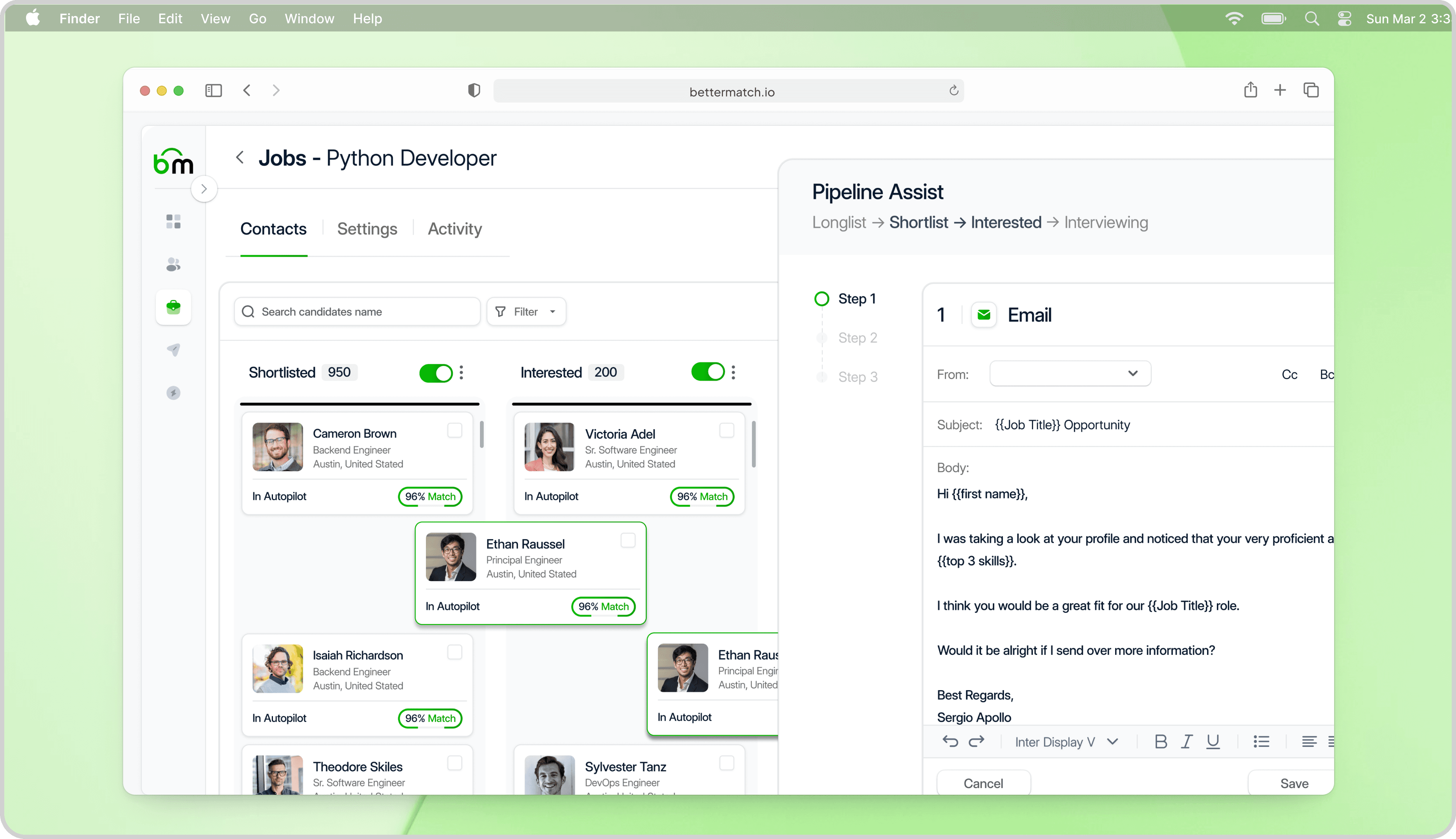
Better Match is an intelligent AI recruiting platform designed to revolutionize the hiring process for businesses of all sizes. It leverages AI to find, research, and match with candidates from a global talent pool of over 800 million people. Users can describe their ideal candidate in plain English, and the system will analyze and rank the best matches. The platform includes a Research Assistant for automated candidate research, inferring experiences, skills, and company fit, and an Outreach Engine to create intelligent engagement workflows, automated sequences, and meeting coordination. Better Match aims to cut costs and improve results by replacing traditional hiring stacks, making it ideal for recruiters, agencies, and startups looking to scale their hiring efforts.
PiML-Toolbox
PiML-Toolbox (Python Interpretable Machine Learning) is a comprehensive Python toolbox designed for the development and diagnostics of interpretable machine learning models. It offers both low-code interfaces and high-code APIs, supporting a growing list of inherently interpretable ML models such as GLM, GAM, Tree, FIGS, XGB1, XGB2, EBM, GAMI-Net, and ReLU-DNN. The toolbox facilitates various outcome testing, including accuracy, explainability (PFI, PDP, ALE, LIME, SHAP), fairness, weak spot identification, overfitting detection, reliability assessment, robustness, and resilience evaluation. PiML-Toolbox aims to empower model developers and validators with tools for transparent, interpretable, and robust machine learning, particularly in high-stakes regulatory settings.
TextGAN-PyTorch
TextGAN-PyTorch is a comprehensive PyTorch framework designed for Generative Adversarial Networks (GANs) based text generation models. It supports both general and category-specific text generation, making it a versatile tool for researchers and developers. The framework serves as a benchmarking platform, facilitating the evaluation and comparison of various GAN-based text generation models. It is particularly beneficial for those familiar with PyTorch, enabling them to quickly engage with the text generation field. The repository includes implementations of several prominent models like SeqGAN, LeakGAN, and RelGAN, along with detailed instructions for setup and usage, including real data experiments and visualization tools.
Capture.dev
Capture.dev is a comprehensive bug reporting tool designed to streamline the process of identifying and fixing software issues. It offers a tiny yet powerful bug reporting toolbar that works on any website, allowing teams to capture developer-friendly bug reports without leaving their current workflow. The tool automatically collects crucial context, including screen captures, user information, inspector details, console logs, and network requests, ensuring that developers receive all necessary information to fix bugs efficiently. Capture.dev integrates seamlessly with popular tools like Slack, Linear, Jira, Asana, Trello, ClickUp, and Zapier, enabling teams to send bug reports directly to their existing project management systems. It also features auto-history for step-by-step playback of issues and auto-summaries for quick prioritization, making it an essential tool for product, QA, and support teams.
Codespell
SoftSpell, formerly CodeSpell, is an AI-powered SDLC platform designed to accelerate software development and modernize legacy systems. It provides a suite of tools including ReqSpell for requirement extraction and breakdown, CodeSpell for AI-assisted code generation and documentation, and TestSpell for AI-driven test automation. The platform helps engineering teams streamline their entire SDLC, from requirements to deployment, by mapping dependencies, identifying repeated refactors, and generating reusable refactoring patterns. SoftSpell aims to improve code consistency, reduce time-to-market, and minimize risks during modernization, integrating seamlessly with existing IDEs, languages, and deployment pipelines.
testRigor
testRigor is an AI-based test automation tool designed to simplify software testing by allowing users to build and maintain tests using plain English. It eliminates the need for complex coding, such as Selenium or Cucumber/Gherkin, by translating high-level instructions into specific steps. The platform supports comprehensive testing across web, mobile (iOS and Android), desktop, API, email, SMS, phone calls, 2FA, and mainframe applications. testRigor boasts ultra-stable tests not dependent on XPath, leading to significantly less maintenance compared to traditional methods. It integrates with popular tools like Gitlab, Github Actions, Jenkins, Jira, and Azure DevOps, and adheres to high security standards including ISO/IEC 27001:2022, SOC 2, HIPAA, and GDPR.

TestFlight
TestFlight is Apple's official platform for distributing and testing beta versions of iOS, iPadOS, macOS, tvOS, visionOS, and watchOS apps, as well as App Clips and iMessage apps. Developers can invite testers via email or public links, allowing them to install and test pre-release builds for up to 90 days. Testers can provide valuable feedback directly through the TestFlight app, including screenshots and crash reports, helping developers refine their applications. The platform supports automatic updates for beta builds and allows testers to access previous versions. TestFlight is crucial for ensuring app quality and user experience across various Apple devices before an app is launched on the App Store.
TextFooler
TextFooler is an open-source model designed for natural language attack on text classification and inference tasks. It provides the source code and datasets necessary to reproduce research findings related to adversarial attacks on NLP models. This tool is particularly useful for evaluating the robustness of models like BERT, LSTM, and CNN against various adversarial techniques. Researchers and developers can use TextFooler to generate adversaries for text classification and natural language inference, helping them understand and improve the security of their NLP systems. The repository includes detailed instructions for setup, prerequisites, and running attack simulations, making it a valuable resource for adversarial NLP research.
torchmetrics
TorchMetrics is a comprehensive open-source library designed for machine learning metrics within distributed and scalable PyTorch applications. It provides a standardized interface for over 100 built-in metric implementations, covering domains like audio, image, text, and classification. The library reduces boilerplate code by offering automatic accumulation over batches and synchronization across multiple devices, making it ideal for distributed training. Developers can also easily create custom metrics using its API. TorchMetrics integrates seamlessly with PyTorch Lightning, providing additional features like automatic metric placement on the correct device and native logging support. It also includes built-in plotting support for metric visualization.
Transformer-MM-Explainability
Transformer-MM-Explainability is an official PyTorch implementation for Generic Attention-model Explainability for Interpreting Bi-Modal and Encoder-Decoder Transformers. This open-source project offers a novel method to visualize and understand the decision-making processes of any Transformer-based network. It includes practical examples for popular models such as DETR, VQA, CLIP, and LXMERT, making it a valuable resource for researchers and developers working with multi-modal and encoder-decoder architectures. The tool provides notebooks for easy experimentation and reproduction of results, with clear instructions for setting up environments and running examples on GPUs, including Colab support.
yellowbrick
Yellowbrick is an open-source suite of visual diagnostic tools, known as "Visualizers," designed to enhance the machine learning model selection process. It seamlessly integrates with scikit-learn and matplotlib, allowing users to generate insightful visualizations for their machine learning workflows. The tool supports various visualizers for feature analysis, such as Rank2D for pairwise feature comparisons, and model evaluation, like ROCAUC for classifier sensitivity and specificity. Yellowbrick is compatible with Python 3.4 or later and can be easily installed via pip or conda. It also provides access to several datasets for examples and testing, making it a comprehensive solution for data scientists and developers looking to visually steer their model development.
temperature_scaling
temperature_scaling is an open-source Python module designed to calibrate neural networks by adjusting their confidence scores. Originally created as a demonstration for PyTorch 0.3, it implements temperature scaling, a post-processing technique that divides logits by a learned scalar parameter to minimize negative log-likelihood on a validation set. This helps address the common issue of neural networks outputting overconfident probabilities, ensuring that confidence scores better match true correctness likelihood. While the repository is unmaintained, it offers a clear example of how to integrate temperature scaling into a project for improved model calibration.

Composo
Composo is a quality layer for production AI, designed to identify and rectify silent AI failures before they impact customers. It connects to production traces to generate a detailed failure report, categorizing issues by type, severity, and frequency. The system learns from domain expert corrections, adapting to evolving quality standards and improving over time. Composo replaces lengthy internal evaluation infrastructure builds, deploying in 2-4 weeks compared to 3-6 months. It creates custom failure taxonomies for specific domains, leveraging insights from over 30 deployments across various industries. Confirmed failure patterns are converted into guardrails that block bad outputs at runtime with sub-second latency, ensuring quality enforcement on 100% of outputs.
Aival
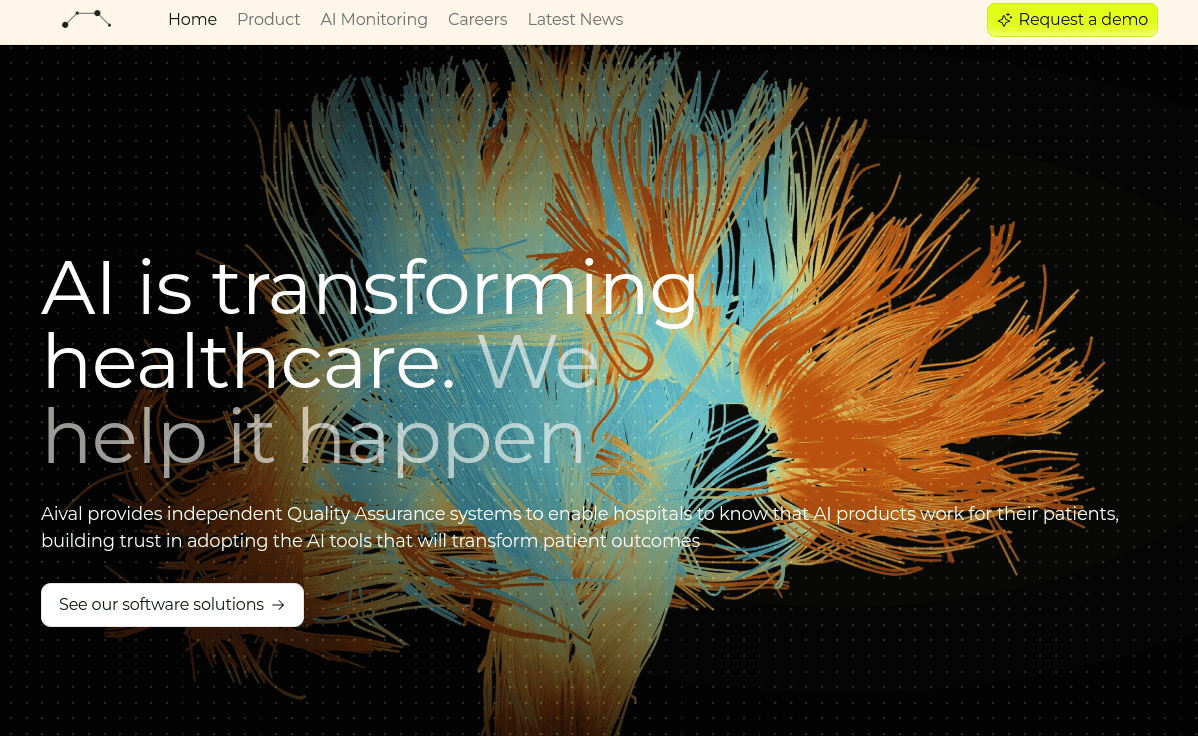
Aival offers independent Quality Assurance systems designed for healthcare organizations to evaluate and monitor AI products. Its vendor- and platform-neutral software allows hospitals to objectively assess and compare AI solutions using their local data. This ensures that AI tools work effectively and safely for patients, building trust in their adoption. Aival also provides continuous monitoring of AI product performance to guarantee ongoing reliability once in use, helping teams make informed procurement decisions and maintain the benefits of AI over time. The Aival Analysis Lab suite can be installed on-site to standardize AI assurance processes.
whylogs
whylogs is an open-source data logging library designed to provide visibility into data quality and machine learning model performance over time. It allows users to generate summaries of datasets, called whylogs profiles, which capture key statistical properties like distributions, missing values, and custom metrics. These profiles are efficient, customizable, and mergeable, enabling logging for distributed and streaming systems. whylogs facilitates the detection of data drift, training-serving skew, and model performance degradation. It also supports data quality validation in model inputs or data pipelines, exploratory data analysis of massive datasets, and data auditing and governance across organizations. The library integrates with various data and ML pipeline tools and offers a profile visualizer for interactive reports.