
Coding & Development
Browsing page 29 of AI tools for Testing & QA in Coding & Development. Sorted by confidence score — our independent quality rating.

dataspan.ai
dataspan.ai offers a Visual Agentic AI platform designed for 24/7 real-time monitoring of production and packaging lines. It utilizes novel vision technology and low-touch Visual AI Agents to identify issues that traditional systems often miss. The platform enables expert-guided Root Cause Analysis (RCA), significantly reducing downtime and improving Overall Equipment Effectiveness (OEE). Shopfloor experts can define monitoring parameters using plain language, allowing the system to instantly create Visual Agents, backfill historical data, and refine accuracy. dataspan.ai aims to provide continuous vision without requiring new physical sensors, offering quick setup and high impact through fast root cause insights. It serves industries like automotive, medical devices, aerospace, and food & beverage, helping to prevent micro-stoppages and process drifts.
Scaling test-time compute
Scaling test-time compute is a Hugging Face Space designed for exploring and comparing different search methods for generating candidate answers to text-based problems, such as math questions. Users can input a text problem, and the tool provides options to select from various smart search methods, including best-of-N, beam search, and diverse verifier tree search. This functionality allows researchers and developers to evaluate the effectiveness of different computational strategies in generating multiple potential solutions, making it a valuable resource for AI research and experimentation in areas like natural language processing and problem-solving. The tool is hosted on Hugging Face, indicating its focus on open-source AI development and community collaboration.
Starcoder Memorization
Starcoder Memorization is a tool hosted on Hugging Face designed to identify memorization issues within code. While its primary function is to analyze code for such instances, the current status indicates a runtime error, preventing its immediate use. The tool is provided by Mithril Security and is accessible via a Hugging Face Space. It is intended for users interested in code analysis, particularly in the context of large language models and code generation, to ensure originality and prevent unintended replication.
Streamlit Image Comparison
Streamlit Image Comparison is a web-based tool designed for visually comparing two images. Users can upload images directly or provide URLs, and the application will display them side-by-side with an interactive slider. This feature is particularly useful for identifying subtle differences between images, making it suitable for tasks such as quality control, A/B testing of visual assets, or analyzing the effects of image processing algorithms. The tool offers customization options, including the ability to adjust the slider's initial position, its width, and to add labels for the left and right images, enhancing the clarity and precision of the comparison process. It operates within a Streamlit application environment, providing a straightforward and accessible interface.
SwarmOne
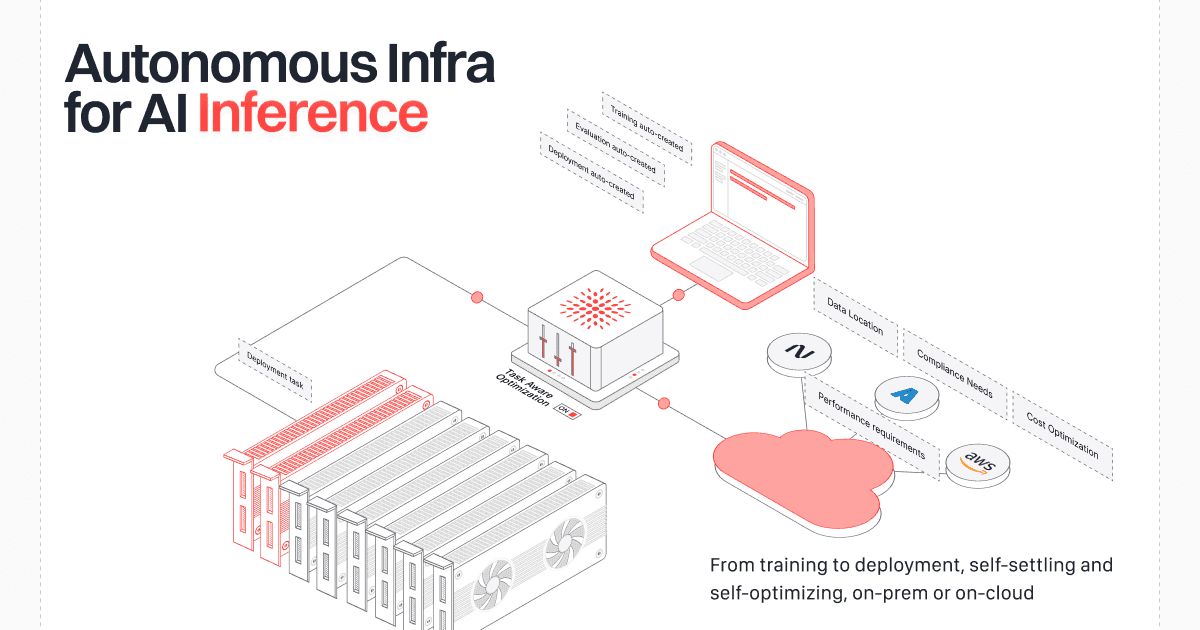
SwarmOne is an autonomous infrastructure platform designed for AI inference, training, and evaluation workloads. It offers a unique scheduler that dynamically disaggregates prefill and decode, orchestrates heterogeneous GPU clusters (NVIDIA, AMD, Intel, Groq, and more), and rebalances in real time to achieve over 90% utilization. The platform features SLO-driven autoscaling, enforcing defined latency, throughput, or cost targets by instantly provisioning GPUs when latency drifts and scaling compute to zero when traffic drops. SwarmOne aims to reduce costs by up to 80% through dynamic disaggregation, multi-node orchestration, and multi-cloud arbitrage, routing to the cheapest capable hardware. It supports a full AI lifecycle from training to deployment with zero DevOps/MLOps required, making it ideal for engineering teams at global enterprises.
SWE-Issue
SWE-Issue is a specialized tool designed for monitoring and analyzing the performance of software engineering assistants by tracking their GitHub issue statistics. It offers a sortable leaderboard that provides insights into the total number of issues, discussions, and resolution rates for various assistants. Users can leverage this platform to compare different AI tools, understand their efficiency in handling software development tasks, and identify top performers. The tool also allows for the submission of new assistants, expanding its database and utility for the software engineering community. Hosted on Hugging Face Spaces, SWE-Issue serves as a valuable resource for developers and researchers interested in the practical application and performance metrics of AI in software engineering.
TraceMind AI
TraceMind AI provides a comprehensive platform for evaluating AI agents, offering detailed metrics and insights into their performance. Users can effectively filter and compare different agent runs, gaining a clear understanding of their behavior and efficiency. The tool features performance charts for visual analysis and allows users to ask specific questions about traces, facilitating deeper understanding and debugging. Powered by MCP intelligence, TraceMind AI is designed to help developers and researchers assess and optimize their AI agents, ensuring robust and reliable operation. It is available as a Hugging Face Space, making it accessible for immediate use and experimentation.
TraceMind MCP Server
TraceMind MCP Server is designed for evaluating AI agents, offering a robust platform to analyze their performance data. Users can input various data sources, including leaderboard repositories, trace IDs, or specific model information, to gain intelligent insights into agent behavior and effectiveness. The tool leverages Gemini 2.5 Flash for agent assessment, ensuring advanced analytical capabilities. Hosted on Hugging Face Spaces, it provides an accessible environment for developers and researchers to monitor and understand the performance of their AI agents, facilitating iterative improvements and informed decision-making in AI development.
Vae Comparison
Vae Comparison is a Hugging Face Space designed for analyzing and comparing various Variational Autoencoders (VAEs). Users can upload an image to observe how different VAE models reconstruct it. The tool provides visual difference maps, highlighting changes between the original and reconstructed images. Additionally, it offers scores indicating the accuracy of the reconstruction and the processing time taken by each VAE model. This makes it a valuable resource for AI researchers and machine learning engineers who need to evaluate and benchmark the performance of different VAE architectures in image reconstruction tasks.
Video-Bench Leaderboard
Video-Bench Leaderboard is a specialized AI tool hosted on Hugging Face, designed to benchmark and compare the performance of various video models. Users can upload JSON files containing their model evaluation data to submit it to the leaderboard. The platform then displays these metrics in a sortable and filterable table, offering a clear overview of how different AI models perform on video-related tasks. This makes it an invaluable resource for AI researchers and machine learning engineers who need to assess, track, and improve the capabilities of their video models against others in the field. The tool fosters transparency and competition, driving innovation in video AI.
VideoLLaMA3-Image
VideoLLaMA3-Image is an AI tool designed for processing images and text inputs to produce detailed descriptive or analytical responses. This Hugging Face Space application leverages frontier foundation models for advanced video understanding, allowing users to explore and test AI models for video analysis. While the current live website indicates a runtime error, its intended functionality is to provide insights and answers based on visual and textual data, making it valuable for research and development in AI and video processing. The tool is developed by Xin Li and is available under an Apache 2.0 license.
Unicl Image Recognition Demo
Unicl Image Recognition Demo is an AI tool designed to showcase image recognition functionalities. Users can upload various images to the platform and observe the AI's predictions regarding the content within those images. This tool serves as a practical demonstration for understanding how AI models interpret visual data. It is particularly useful for individuals involved in research, development, or educational pursuits within the field of computer vision, offering a hands-on experience with image classification and analysis.
Uniformer_video_demo
Uniformer_video_demo is an AI tool designed to showcase video analysis capabilities. Hosted on Hugging Face Spaces, it provides a platform where users can upload video files and observe the AI's processing and interpretation of the content. This demonstration tool is particularly useful for individuals involved in research, development, or educational pursuits related to video understanding and computer vision. While the current live website indicates a runtime error, suggesting it may not be fully operational at this moment, its intended purpose is to offer a practical insight into how AI can analyze and extract information from video footage.
VEO3 Directors
VEO3 Directors is an AI-powered tool designed to assist users in generating highly detailed video prompts. By simply providing a topic and an initial sentence, the application constructs a comprehensive prompt that covers various aspects of video production. This includes intricate scene settings, specific camera movements and angles, character descriptions, and detailed lighting instructions. The tool leverages advanced models like Wan2.1-T2V-14B, combined with a Fast 4-step process using NAG and Automatic Audio, to ensure rich and actionable output. Hosted on Hugging Face Spaces, VEO3 Directors aims to streamline the pre-production phase for video creators, offering a structured approach to conceptualizing video content.
Video Classification UCF101 Subset
Video Classification UCF101 Subset is an AI tool designed for video content analysis, specifically utilizing the UCF101 dataset. This tool enables users to explore and classify videos, making it valuable for tasks such as action recognition and the training of AI models. While the live website indicates a runtime error and scheduling failure due to insufficient hardware capacity, suggesting it may not be fully operational at the moment, its intended purpose is to provide a platform for researchers and developers to work with video classification tasks. The tool is hosted on Hugging Face Spaces, indicating a focus on community and accessibility for machine learning applications.
WritingBench
WritingBench is a comprehensive benchmark tool designed for evaluating generative writing models. Users can upload Excel files containing evaluation results, which the application then processes to generate interactive leaderboards, detailed performance tables, and heat-maps. This allows for a clear visualization and comparison of different model performances, highlighting strengths and weaknesses. Hosted on Hugging Face Spaces, WritingBench aims to provide a standardized and accessible platform for researchers and developers to assess and improve their AI writing models. The tool is free to use and offers a structured approach to understanding the nuances of generative writing outputs.
VPTQ Demo
VPTQ Demo is a Hugging Face Space application designed for generating text with a highly compressed language model. It serves as a demonstration of Vector Post Training Quantization (VPTQ), a technique aimed at reducing the size of AI models while striving to maintain performance. Users can input text prompts and receive generated responses, exploring how quantization impacts model efficiency. The platform is hosted on Hugging Face, offering various pricing tiers for enhanced features, storage, and compute resources, including options for PRO accounts, team subscriptions, and enterprise solutions. It provides a practical environment for developers and researchers to experiment with compressed language models.
VulnLLM R
VulnLLM R is a specialized reasoning LLM designed for detecting security vulnerabilities in code. Users can upload their code, specify the programming language, and choose a model to initiate a security scan. The tool then provides a detailed analysis report, indicating the presence and types of vulnerabilities found. This functionality is particularly useful for security researchers and software developers who aim to enhance the security posture of their codebases. Hosted on Hugging Face Spaces, VulnLLM R leverages advanced AI reasoning to identify potential security flaws, making it a valuable asset for proactive security measures in software development.
Yolov9
Yolov9 is a cutting-edge AI tool hosted on Hugging Face Spaces, designed for advanced object detection within images. Users can upload an image and leverage various models to identify objects, with the flexibility to adjust parameters such as image size, confidence scores, and Intersection over Union (IoU) thresholds. This allows for fine-tuning the detection process to achieve highly accurate results, complete with bounding boxes around detected objects. While the current live demo is experiencing a runtime error related to CUDA device availability, the underlying technology is geared towards providing a robust platform for testing and implementing object detection capabilities, making it suitable for applications requiring precise real-time object recognition.
OpenHands Index
OpenHands Index is a comprehensive benchmark tool designed for evaluating AI coding agents within the software engineering domain. Hosted on Hugging Face, this application provides a leaderboard that displays various AI models, detailing their average performance scores and associated costs. Users can filter the view to customize their analysis, for example, by hiding incomplete entries or focusing on specific criteria. This tool aims to offer a holistic evaluation, enabling developers and researchers to compare and understand the capabilities and economic implications of different AI coding solutions.
AIX360
AIX360 is an open-source Python library designed to support the interpretability and explainability of datasets and machine learning models. It includes a wide range of algorithms covering different dimensions of explanations, along with proxy explainability metrics. The toolkit supports various data types, including tabular, text, images, and time series data. It provides guidance material and a taxonomy tree to help users select appropriate algorithms for their use cases. The library is developed with extensibility in mind, encouraging contributions from the community. It also offers interactive experiences, tutorials, and example notebooks for both gentle introductions and deeper, data scientist-oriented learning.
LLM Leaderboard for SEA
The LLM Leaderboard for SEA is a Hugging Face Space dedicated to evaluating and comparing language models, specifically focusing on the Southeast Asian region. Users can access a comprehensive leaderboard that displays various language models and their performance metrics. The platform offers filtering capabilities, allowing users to narrow down results by model type, openness, and parameters. Additionally, a search function enables quick retrieval of specific models by name. This tool is designed to help track progress in LLM development for SEA languages and identify top-performing models for particular tasks.
Llm Robustness Leaderboard
Llm Robustness Leaderboard is an AI model evaluation platform developed by NVIDIA, designed to assess and compare the resilience of various language models. The platform enables users to benchmark LLMs against adversarial attacks and noisy data, helping to identify potential vulnerabilities and improve overall model robustness. While the live website currently displays a runtime error, its stated purpose is to provide a comprehensive leaderboard for evaluating language model performance under stress. This tool is crucial for developers and researchers focused on building more reliable and secure AI systems, offering insights into how different models perform when faced with challenging inputs. It aims to foster the development of more robust and trustworthy AI applications by highlighting areas for improvement in existing models.
Lmgame Bench
Lmgame Bench is an AI model evaluation platform designed to assess the performance of AI models within various game environments. Users can explore and compare leaderboards for popular games such as Super Mario Bros, Sokoban, 2048, Candy Crush, Tetris, and Ace Attorney. The platform facilitates the benchmarking of AI game-playing agents, providing insights into their decision-making abilities and overall performance. By offering a centralized space to evaluate and compare models across different games, Lmgame Bench helps developers and researchers understand the strengths and weaknesses of their AI agents, fostering advancements in game AI.