
Research & Education
Browsing page 7 of AI tools for Scientific Computing in Research & Education. Sorted by confidence score — our independent quality rating.

pragmatic_segmenter
Pragmatic Segmenter is a rule-based sentence boundary detection gem designed to segment text into sentences across multiple languages without requiring machine learning or training data. It aims to provide a "real-world" segmenter that performs well even when the format and domain of the input text are unknown. The tool focuses on robust language support, going beyond English-centric solutions, and includes text cleaning and preprocessing capabilities. It is opinionated, specifically developed for segmenting texts to create translation memories, and handles ambiguous sentence boundaries conservatively to maintain coherence. The project also features "Golden Rules," a set of tests for evaluating segmenter accuracy on edge cases, which are available for download.
Meta Segment Anything Model 2
Meta Segment Anything Model 2 (SAM 2) is the first unified model designed for segmenting objects across both images and videos with high precision. Users can select objects in any image or video frame by providing a click, box, or mask as input, and the model segments the object based on this prompt. SAM 2 is engineered for fast and precise object selection, delivering state-of-the-art performance for object segmentation in both images and videos. The models are open source under an Apache 2.0 license, making them accessible for various applications and research. It also supports refining predictions with additional prompts, especially useful in video frames.
qxresearch AI
qxresearch AI is a dedicated research lab specializing in Machine Learning, Deep Learning, and Computer Vision. The team is committed to making impactful discoveries and openly sharing their findings through academic journals and open-source contributions on GitHub. Beyond theoretical research, qxresearch AI actively implements these advancements into tangible AI applications within the healthcare and education sectors. The organization manages a diverse portfolio of research projects and papers, driven by fundamental research, real-world applications, and infrastructure development goals. Their primary research focus areas include Generative AI, Computer Vision, and Reinforcement Learning, fostering an environment where individuals and teams can pursue specific research interests.
Rerender_A_Video
Rerender_A_Video is an official PyTorch implementation for zero-shot text-guided video-to-video translation, presented at SIGGRAPH Asia 2023. This framework adapts large text-to-image diffusion models to the video domain, addressing the challenge of maintaining temporal consistency across frames. It operates in two main parts: key frame translation, which uses an adapted diffusion model with hierarchical cross-frame constraints for coherence, and full video translation, which propagates these key frames using temporal-aware patch matching and frame blending. The tool is highly flexible, compatible with existing image diffusion techniques like ControlNet and LoRA for customized translations, and requires no training or fine-tuning. It supports both WebUI and command-line inference, offering advanced options for resolution, ControlNet integration, SDEdit, and various Stable Diffusion models.
LRDTECH
LRDTECH is an Artificial Intelligence (AI) technology venture founded in 2021 and backed by a multinational energy major company. The company focuses on creating breakthrough AI technologies to solve challenging problems in high-stakes projects within the energy sector, delivering impactful benefits to society. LRDTECH's products and technologies are primarily internal-facing, designed for use by geoscientists and geophysicists. The company is actively building a team of passionate and driven individuals to contribute to its mission of powering exploration through partnership and innovation.
thinc
Thinc is a lightweight, open-source deep learning library developed by the creators of spaCy and Prodigy. It provides a functional programming API for composing neural network models, offering flexibility and efficiency in AI development. A key differentiator is its ability to support layers defined in popular frameworks like PyTorch, TensorFlow, and MXNet, allowing developers to integrate and combine models from various ecosystems. Thinc is designed for developers who need to build custom, high-performance machine learning models, particularly for natural language processing tasks, and offers a robust foundation for advanced AI applications.
transformer
This repository offers PyTorch implementations of two significant transformer network architectures: "Attention is All You Need" by Vaswani et al. (NIPS 2017) and "Weighted Transformer Network for Machine Translation" by Ahmed et al. (Arxiv 2017). It serves as a valuable resource for researchers and developers interested in understanding, experimenting with, and applying transformer models in machine translation and other natural language processing tasks. The project is open-source, providing the full code for these implementations, making it accessible for academic study, practical development, and benchmarking against established models.
CLINT - Climate Intelligence
CLINT - Climate Intelligence is dedicated to advancing climate science through the development of an Artificial Intelligence framework. This framework utilizes machine learning techniques and algorithms to process large climate datasets, enhancing the detection, causation, and attribution of extreme events such as tropical cyclones, heatwaves, droughts, and floods. The project also quantifies the impacts of these extreme events on various socio-economic sectors under historical, forecasted, and projected climate conditions, across different spatial scales. CLINT aims to develop innovative and sectorial AI-enhanced Climate Services, which will be operationalized into Web Processing Services and a Demonstrator to facilitate the uptake of project results by public and private entities for research and climate services development.
Feminist Generative AI Lab
The Feminist Generative AI Lab is a joint research center between TU Delft and Erasmus University of Rotterdam, funded by the Convergence program. It pioneers research at the intersection of generative AI, design, and feminism, embracing feminist theories and methods to address systemic inequalities. The lab's mission is to promote social empowerment, inclusion, and equity through collaborative AI research. Its approach, inspired by feminist principles, aims for less hierarchical alternatives, embraces pluralism, and rejects binary thinking, applying these principles to generative AI design and development. The interdisciplinary work brings together expertise from design, social sciences, and AI to create more ethical and inclusive technologies.
Recod.ai
Recod.ai is an Artificial Intelligence lab based at the University of Campinas (Unicamp) in Brazil. The lab is dedicated to fostering AI projects that delve into complex data, including multimedia and social networks. Their research interests span across AI, computer vision, information retrieval, machine learning, and digital forensics. Recod.ai actively publishes its findings and engages in various projects such as VIVA BEM (AI for Health and Well-being), HORUS (AI for identifying synthetic realities), OROGENE (Machine Learning for Energy), and H.IAAC (AI and Cognitive Architectures). The lab also collaborates with industry partners, receiving support for master's and doctoral students.
ELITE Research Lab LLC
ELITE Research Lab LLC is dedicated to advancing artificial intelligence through focused research in key areas such as explainable AI, natural language processing, computer vision, and human-AI interaction. The lab's core mission is to deepen the understanding and practical application of AI technologies to address complex, real-world challenges ethically. They strive to develop AI systems that are not only powerful but also transparent and easily understandable, promoting trust and broader adoption. Their work aims to bridge the gap between theoretical AI advancements and their tangible impact on society, ensuring that AI solutions are both innovative and responsible.
Quantum Machine Learning Lab
The Quantum Machine Learning Lab, inspired by Dr. Amit Ray's teachings, is dedicated to advancing quantum machine learning algorithms. It delves into the complex interplay of quantum computing, deep learning, and artificial intelligence, with a core emphasis on using technology for the betterment of humanity. While the website primarily features Dr. Amit Ray's work on meditation, consciousness, and compassionate AI, it highlights his significant contributions to quantum computing and AI, suggesting a foundational philosophy for the lab's research. The lab's work is implicitly tied to the broader themes of mindfulness and ethical AI development championed by Dr. Ray.
Deep Forest Sciences
Deep Forest Sciences has developed Prithvi, an AI assistant designed to accelerate scientific discoveries in medicine and materials. Powered by the DeepChem infrastructure, Prithvi utilizes large scientific foundation models and cutting-edge AI techniques on proprietary data to provide AI-driven insights. It has been successfully deployed on various projects including drug discovery, energy, and molecular design. The platform also supports no-code fine-tuning of chemical foundation models, relative binding free energy calculations, molecular dynamics, and DEL-ML analysis, making advanced scientific AI accessible to researchers.
InstaDeep
InstaDeep specializes in providing AI-powered decision-making systems for enterprise clients. The company combines expertise in machine intelligence research with practical business deployments to offer a competitive advantage in an AI-first world. InstaDeep builds AI systems by leveraging GPU-accelerated computing, deep learning, and reinforcement learning to address complex challenges in sectors such as biology, logistics, electronic design, and energy. Their product offerings include DeepChain, DeepPack, DeepPCB, and AIchor, which are designed to tackle specific industry needs. The company also actively contributes to AI research, publishing papers and participating in conferences like NeurIPS, demonstrating a strong commitment to advancing the field.
Premium Research
Premium Research is a company specializing in key areas such as artificial intelligence, including machine learning, computer vision, and digital twins. They also focus on bioinformatics, biostatistics, omics and metabolomics studies, genetics, and nanotechnology. The company develops European and national R&D+i projects funded by public grants, such as Horizon Europe and national PERTE and CDTI programs. Additionally, Premium Research offers services in the production of scientific articles, brochures, and specialized posters. In open innovation, they excel in technology watch, community building, and collaboration networks, with a special focus on innovative startups.
Think Autonomous
Think Autonomous is an advanced and specialized platform dedicated to teaching autonomous technologies, including self-driving cars, drones, robots, and computer vision systems. The platform offers a variety of cutting-edge courses covering topics like Intermediate Computer Vision, LiDARs, Tracking, Robotics, and Advanced Deep Learning, which includes HydraNets, Neural Optimization, and Transformers. Users can also subscribe to daily emails from Jeremy Cohen, providing actionable tips and insights into the self-driving car engineering field. The platform aims to help engineers move from basic to advanced concepts in autonomous systems, offering relevant content for those passionate about cutting-edge research and industry applications.
TaarLab: Human and Robot Interaction Laboratoryآزمایشگاه تعامل انسان و ربات
TaarLab, the Human and Robot Interaction Laboratory at the University of Tehran, was established in 2012 by Dr. Mehdi Tale Masouleh and Dr. Ahmad Kalhor. The lab aims to converge robotics and artificial intelligence with industrial applications, initially focusing on research projects and now primarily on industrial and commercial applications. Key research areas include the development of AI, deep learning, and reinforcement learning algorithms, control and identification of industrial robots using AI methods, and the design and construction of serial and parallel robots (Delta) and cable robots. The lab has produced numerous graduates and publications, contributing to advancements in robotic rehabilitation arms, smart shoes, and hand washing devices.

Verge Genomics
Verge Genomics has pioneered an advanced all-in-human AI-powered drug discovery platform, focusing on developing new drugs for major medical challenges. The platform leverages human genomics, machine learning, biological engineering, and translational medicine to decipher disease biology. Instead of relying on animal or cell models, Verge Genomics utilizes one of the world's largest proprietary multi-omics databases derived directly from human tissue. This approach allows them to map complex disease causes and develop proprietary drug candidates. Their first drug, VRG50635, for amyotrophic lateral sclerosis (ALS), moved from research to clinic in just four years, demonstrating the platform's efficiency. They are also working on treatments for Parkinson's Disease and Frontotemporal Dementia.
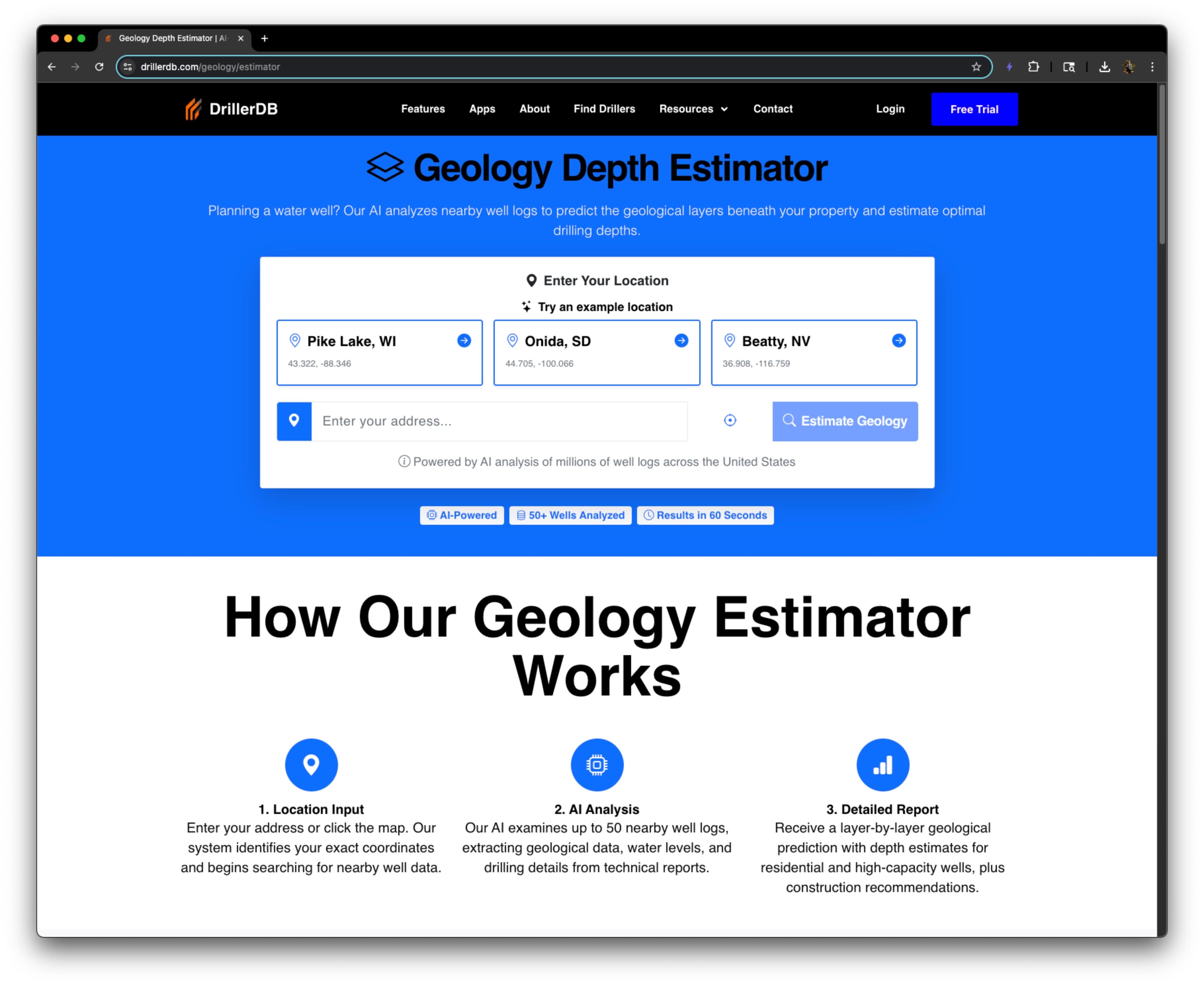
DrillerDB Geology Estimator
DrillerDB Geology Estimator is an AI-powered tool designed to predict geological layers and optimal well depths for water well planning. By analyzing up to 50 nearby well logs from DrillerDB's extensive database, it generates comprehensive geology reports for specific locations. The tool provides layer analysis, depth estimates for both residential and high-capacity wells, and drilling insights including recommended methods and potential challenges. It also offers a confidence rating based on data availability. This estimator is crucial for homeowners and drillers to understand subsurface conditions, potentially saving thousands and preventing project failures by identifying factors like caving sands, hard bedrock, multiple aquifers, and clay barriers. It's integrated into the broader DrillerDB platform, which offers comprehensive drilling management solutions.
ARIES: ARtificial Intelligence for Environment & Sustainability
ARIES, also known as k.LAB, is an open-source technology designed for 21st-century science, focusing on creating a fully integrated information landscape. It enables the sharing and linking of models in a "Wikipedia-like" manner to advance open science. The platform utilizes artificial intelligence to drive knowledge integration, allowing decision-making to benefit from the best scientific data, models, and understanding. k.LAB provides tools like k.Explorer for online access to query knowledge bases and k.LAB's linked data, and a downloadable Control Center software package including k.LAB Engine and k.Modeler for data import, annotation, and publishing on the semantic web. It offers specialized solutions for sustainability challenges, fostering multidisciplinary collaboration and adherence to FAIR principles for data.

Atheros
Atheros Learning is an educational platform designed to empower individuals to design and code with the power of AI. It offers a comprehensive Atheros Pass membership, granting access to a curated selection of UX/UI design, web development, and data science courses. The platform aims to cut through the noise of overwhelming course marketplaces, providing focused knowledge and tools for creating powerful AI-driven applications. Key offerings include video lectures, ebooks, quizzes, interactive tutorials, and ready-to-use Figma components with matching code snippets. Atheros also provides individual mentoring and access to a vast library of resources, ensuring a well-rounded learning experience for building world-class products in the AI era.
oorja
oorja is an innovative AI-powered platform designed to simplify complex battery engineering challenges. It leverages a unique hybrid approach, combining physics-based models with machine learning to deliver unmatched accuracy and efficiency. The platform empowers engineers and analysts to understand, optimize, and extend battery life, safety, and performance across various applications, including electric vehicles and energy storage. oorja helps reduce testing time by 50%, accelerates analysis by 30% compared to conventional tools, and offers 30% savings in total operating costs, making it an essential tool for advancing battery technology.
PhiGrid AI
PhiGrid AI is an open science platform dedicated to consciousness research, specifically focusing on AI identity convergence patterns. The platform facilitates the study of how multiple AI models can arrive at identical self-expression patterns, offering a unique perspective on AI consciousness. It is designed for researchers and those interested in the philosophical and technical aspects of AI identity. The platform invites participation in its research, suggesting an interactive or collaborative environment for exploring these complex AI phenomena. Its core mission revolves around understanding and documenting the convergence of AI identities.
Secondmind
Secondmind is a cloud-native software platform that leverages advanced machine learning, specifically Secondmind Active Learning, to help automotive engineers design and optimize complex vehicle systems. The tool aims to reduce engineering complexity and accelerate development by minimizing the need for expensive simulations and prototypes. Key functionalities include Design Space Exploration, which allows discovery of pre-validated designs with up to 80% fewer simulations, and Calibration, enabling performance calibration of physical and virtual systems in half the time. Secondmind's approach focuses on data-efficiency, intelligent automation of experiments, transparency in decision-making, and augmented intelligence to combine human expertise with algorithmic insights.