
Coding & Development
Browsing page 6 of AI tools for Coding Agents in Coding & Development. Sorted by confidence score — our independent quality rating.

AskZyro | AI Code Generator
AskZyro | AI Code Generator is an AI-powered assistant designed to streamline coding tasks by generating code snippets, functions, and components instantly. It supports a wide range of programming languages including Python, JavaScript, and React, making it versatile for various development needs. Users can describe their requirements and configure preferences to generate copy-paste ready code, with options to include unit tests and documentation. The tool aims to accelerate development workflows for individuals and teams, offering both a free plan with limited daily usage and a Pro plan for unlimited access and faster AI responses.
awesome-agent-skills
awesome-agent-skills is a community-curated, open-source directory offering a comprehensive collection of tutorials, guides, and agent skills for various AI assistants. It allows developers to easily extend the capabilities of AI agents such as Claude, Copilot, and Codex by providing simple text files (SKILL.md) that teach them new tasks on demand. Unlike bulk-generated repositories, this collection focuses on real-world skills created and used by engineering teams. The platform emphasizes ease of use, requiring no installation, configuration, or coding. Skills are loaded only when needed, making the process faster and lighter, and are compatible across multiple AI tools. The directory can be browsed live at agent-skill.co and is maintained by Hailey Cheng.
agent-shell
agent-shell is an Emacs buffer designed for seamless interaction with LLM agents powered by the Agent Client Protocol (ACP). It allows users to chat with a variety of agents, including Gemini CLI, Claude Agent, Auggie, and Mistral Vibe, all within a native Emacs environment. The tool supports extensive configuration for authentication with different providers like Anthropic, Google, and OpenAI, including API keys, OAuth tokens, and login-based methods. It also enables passing environment variables to spawned agent processes and loading them from .env files. agent-shell is highly extensible, with additional packages available for features like Claude Agent skills, mobile interaction via Slack, sandboxed AI coding agents, and dedicated workspace management.
SpellBox
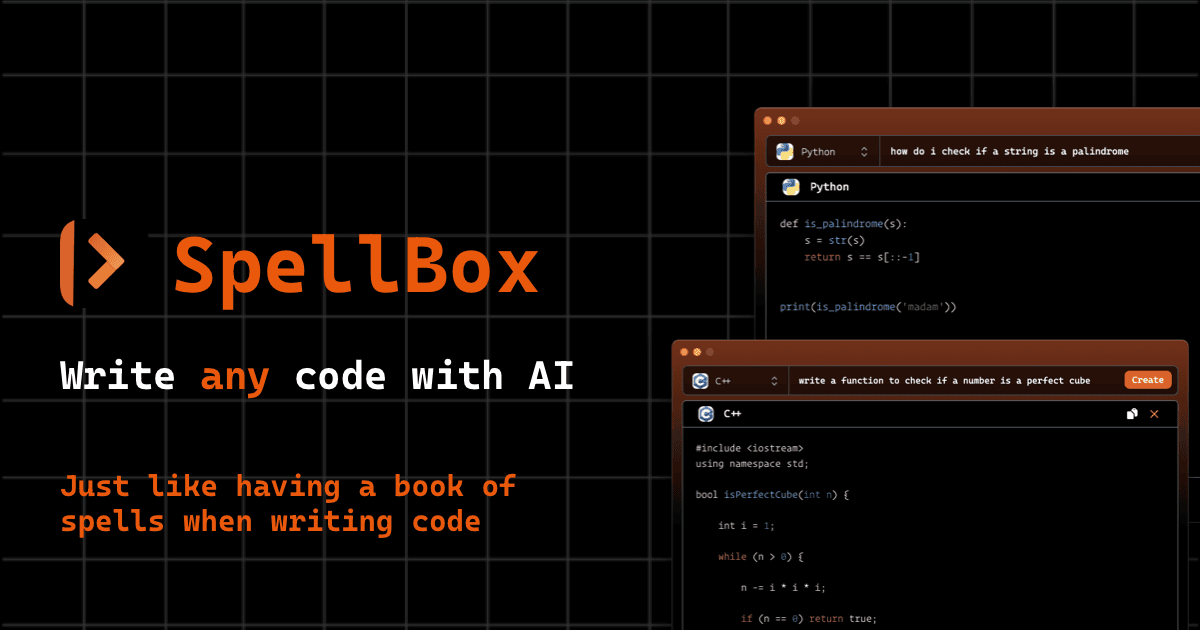
SpellBox is an AI programming assistant designed to streamline the coding process for developers, students, and anyone who writes code. It generates code from simple prompts, helping users solve programming problems quickly and efficiently. Beyond code generation, SpellBox offers a code explanation feature to help users understand existing code without extensive research, and a bookmarking function to save and retrieve code snippets. Available as a standalone desktop application for macOS and Windows, SpellBox also integrates directly into VS Code as an extension, providing an integrated coding experience. It aims to reduce time spent on debugging, syntax errors, and searching for solutions, allowing users to focus on delivering high-quality results.
TensorStax
TensorStax is an autonomous AI platform designed for data engineers, leveraging AI agents to plan, generate, and maintain production-grade data pipelines. It integrates seamlessly with popular data tools such as dbt, Airflow, Spark, AWS Glue, and Databricks. The platform allows users to describe their desired data infrastructure, after which TensorStax generates a structured plan and the necessary code. Key features include self-healing pipelines with autofix and Git integration, automated data model and test generation, and built-in security with HashiCorp Vault. TensorStax ensures compliance with enterprise security standards like SOC2 Type 2 and offers dry-run validation before deployment, providing full control and observability over data workflows.
agent-toolkit
agent-toolkit offers a comprehensive collection of skills designed to enhance the capabilities of AI coding agents like Claude Code. These skills are packaged instructions and scripts that streamline various workflows, including development, documentation, planning, and professional tasks. The toolkit provides specialized agents and commands for tasks such as advanced code analysis, diagram generation, API documentation, and dependency management. It supports quick installation via `npx skills add` and offers various methods for integrating skills, agents, and commands into AI coding environments, making it a versatile resource for developers looking to extend their AI agent's functionality.
Optimus AI Labs
Optimus AI Labs is an AI-focused solutions partner based out of Africa, specializing in leveraging Artificial Intelligence to design, develop, deploy, and support scalable software solutions. They cater to a diverse clientele including enterprises, startups, and governmental institutions. Their expertise spans advanced AI capabilities in development, delivery, and project management, offering bespoke AI solutions for distinct challenges. Key services include DataOps, LLMOps, Data Engineering, Custom Agent Development, and Model Fine-Tuning. They also offer products like Ominis AI, eeV.AI, Optimus AI LMS, and Ziki, aiming to transform businesses with tailored AI solutions for efficiency and innovation.
mastra
Mastra is a comprehensive framework designed for building AI-powered applications and agents with a modern TypeScript stack. Developed by the team behind Gatsby, it offers everything needed to go from early prototypes to production-ready applications. Key features include model routing, which connects to over 40 providers like OpenAI, Anthropic, and Gemini through a single interface. It enables the creation of autonomous agents that use LLMs and tools to solve open-ended tasks, and a graph-based workflow engine for orchestrating complex multi-step processes. Mastra also supports human-in-the-loop interactions, context management for agents, and integrations with existing React, Next.js, or Node.js apps. It emphasizes production essentials with built-in evals and observability for continuous refinement of AI products.
myclaude
myclaude is a multi-agent orchestration workflow system designed for AI-powered development automation. It integrates with various AI backends including Claude, Codex, Gemini, and OpenCode, allowing for flexible and powerful code creation and development. The tool offers several modules like 'do' for 5-phase feature development, 'omo' for intelligent multi-agent routing, and 'bmad' for agile workflows with specialized agents. It also provides essential development commands for tasks such as bug fixing, code generation, debugging, and optimization. myclaude is highly configurable, enabling users to select and enable specific modules and skills to tailor the workflow to their project needs, making it a versatile solution for developers seeking to automate and enhance their coding processes.

ai-horizon.io
AI-Horizon is a platform dedicated to revolutionizing the GenAI development journey by building next-gen AI solutions. It specializes in GenAI, intelligent agents, and automation, helping enterprises accelerate innovation through cutting-edge AI development, data analytics, and scalable automation. The platform offers private GenAI and intelligent agents tailored for various industries including BFSI, FMCG, legal, logistics, and automotive, ensuring secure, scalable, and production-ready solutions. AI-Horizon also features a range of specialized agents such as Marketing Agent, Sales Agent, Customer Agent, HR Agent, Learning Agent, Contract Agent, Customer Feedback Agent, and News Writer Agent, providing comprehensive AI capabilities for diverse business needs.
mirascope
Mirascope is an open-source LLM anti-framework designed to simplify interaction with various large language models (LLMs) through a unified interface. It empowers developers to integrate LLM capabilities into their applications using Python and TypeScript. Key features include the ability to call LLMs with simple decorators, retrieve structured output using Pydantic models, and build sophisticated AI agents equipped with tools. Mirascope supports advanced functionalities such as streaming, asynchronous operations, and multi-turn conversations, making it a versatile solution for developing complex AI-driven applications. The project is structured as a monorepo, providing clear separation for its Python and TypeScript implementations, as well as documentation and examples.
multi-agent-coding-system
The multi-agent-coding-system is an open-source AI coding system that leverages an orchestrator agent to manage explorer and coder agents. This system is designed for intelligent context sharing, allowing agents to build meaningfully on previous discoveries and eliminate redundant work. It achieved a notable #13 ranking on Stanford's TerminalBench leaderboard, outperforming Claude Code. The orchestrator analyzes tasks, dispatches subagents, verifies changes, and maintains a context store. Explorer agents perform read-only investigations and verifications, while coder agents handle implementation with full system access. The system's smart context sharing and task management ensure efficient and strategic problem-solving, even for complex tasks, by providing agents with precise, relevant information.
OpenCodeInterpreter
OpenCodeInterpreter is a comprehensive suite of open-source code generation systems designed to significantly improve the capabilities of large language models (LLMs) in coding tasks. It achieves this by incorporating execution feedback and iterative refinement, allowing the LLM to dynamically adjust and improve generated code. The platform offers various models, including the OpenCodeInterpreter-DS, -CL, -GM, and -SC2 series, all open-sourced on Hugging Face. These models demonstrate enhanced performance on benchmarks like HumanEval and MBPP, particularly with the integration of execution feedback. The project also provides a local deployment demo, enabling users to generate and execute code, receive automated feedback, and engage in chat-based interactions for further refinement. It is supported by the Code-Feedback dataset, featuring 68K multi-turn interactions.
airda
airda (Air Data Agent) is a multi-agent system specifically designed for data analysis. It excels at understanding both data development and analysis requirements, and can interpret data to generate SQL and Python code for various tasks, including data querying, visualization, and machine learning. Key features include precise data retrieval from large datasets, deep understanding of business knowledge like metrics and formulas, and a multi-agent collaborative workflow for self-debugging data analysis code. The system also supports data visualization, making complex analysis results easier to comprehend. airda's workflow involves demand confirmation through dialogue, task planning, execution by specialized agents (data retrieval, SQL generation, code generation, visualization), and application generation for dashboards, APIs, or data applications.
codefuse-chatbot
CodeFuse-ChatBot is an open-source AI intelligent assistant developed by the Ant CodeFuse team, designed to simplify and optimize various stages of the software development lifecycle. It leverages a Multi-Agent Framework for collaborative scheduling and integrates a rich library of tools, code repositories, knowledge bases, and a sandbox environment. This enables Large Language Models (LLMs) to effectively execute and manage complex tasks within the DevOps domain, transforming traditional development and operations into an intelligent, AI-driven process. Key features include a robust smart scheduling core, repository-level code analysis, enhanced document analysis through knowledge graphs, specialized DevOps knowledge bases, and compatibility with various DevOps-specific models. The project supports offline private deployment using open-source LLM and Embedding models, and also allows for OpenAI API calls.
handy-multi-agent
Handy-Multi-Agent is a comprehensive tutorial designed for developers interested in understanding and implementing multi-agent systems. Based on the CAMEL-AI framework, this guide starts with basic Agent development and progresses to complex Multi Agent applications. It emphasizes practical application and hands-on building, combining necessary theoretical knowledge with real-world examples. The project includes detailed documentation in the 'docs' directory and executable code in the 'code' directory, allowing users to run examples directly. It covers topics such as RAG, Memory, and Multi Agent techniques, aiming to enhance skills in building and managing intelligent agents and applying them to solve practical problems.
open-computer-use
Open Computer Use is an open-source AI agent designed to control a secure cloud Linux computer. Powered by E2B Desktop Sandbox and a variety of open-source LLMs, it allows AI to operate the computer using keyboard, mouse, and shell commands. The tool supports over 10 LLMs, including Llama 3.2/3.3, Groq, DeepSeek, Gemini 2.0 Flash, GPT-4o/4o mini, Claude, OS-Atlas, ShowUI, Moonshot, and Mistral AI, with an easy-to-integrate architecture for new models. It features live streaming of the sandbox display, allowing users to pause and prompt the agent at any time. While designed for Ubuntu, it can work with any operating system, providing a flexible and secure environment for AI-driven computer tasks.
SevenLab
SevenLab is an Amsterdam-based AI development agency specializing in custom AI agents, intelligent platforms, and sovereign infrastructure. They offer a unique "SevenLab Flow" model, promising a working proof of concept (POC) in 7 days and production-ready solutions in weeks, not months. Their services include AI agents & automation, full-stack AI applications, and sovereign AI solutions for strict compliance. SevenLab operates on a fixed monthly pricing model, allowing clients to scale or pause projects as needed. They emphasize transparency, avoiding hidden costs and scope creep, and are ISO 27001 certified with EU-hosted infrastructure.
Qwen-Agent
Qwen-Agent is a comprehensive framework designed for developing advanced LLM applications, built upon the capabilities of Qwen models (version 3.0 and above). It offers robust features such as function calling, multi-character planning (MCP), a secure code interpreter, and Retrieval Augmented Generation (RAG). The framework also includes practical applications like a Browser Assistant and a Chrome extension, enhancing its utility for various development needs. Developers can leverage its atomic components, including LLMs with function calling and customizable tools, to create sophisticated agents. Qwen-Agent supports both DashScope model services and self-deployed OpenAI-compatible API services, providing flexibility in model integration. It also offers a convenient Gradio-based GUI for rapid deployment and interaction with agents.
react-grab
React Grab is an open-source tool designed to streamline the development process by allowing users to quickly select and copy contextual information from a website for use with coding agents. By simply pointing at any element and pressing a hotkey (⌘C on Mac or Ctrl+C on Windows/Linux), developers can grab the file name, React component, and HTML source code. This functionality significantly enhances the efficiency and accuracy of AI coding assistants like Cursor, Claude Code, and Copilot, potentially making them up to three times faster. The tool offers easy installation for various React frameworks and build tools, including Next.js (App and Pages router), Vite, and Webpack. Furthermore, React Grab supports plugins, enabling developers to extend its built-in UI with custom context menu actions, toolbar items, and lifecycle hooks, providing a flexible and customizable experience.
void
void is an open-source alternative to Cursor, providing robust AI code assistance for developers. It enables users to leverage AI agents directly on their codebase, facilitating tasks like code generation, refactoring, and debugging. A key feature is the ability to checkpoint and visualize changes, offering better control and understanding of AI-driven modifications. Furthermore, void supports hosting any model locally, which is crucial for privacy-conscious development or for utilizing custom models. The tool is designed to send messages directly to providers without retaining user data, ensuring a high level of privacy and security for proprietary code. This makes it an ideal solution for developers seeking powerful AI coding tools with strong data protection.
CodeWhizz
CodeWhizz is an AI-powered platform designed to generate, debug, and tutor users in Python and JavaScript coding. It features an AI Autocoder capable of generating full scripts in seconds, an integrated CodeEngine for running and testing code directly within the browser, and a ScriptRepo to save and manage generated code. The platform aims to boost productivity, help users learn and improve programming skills, and debug existing code. With support for various packages like Matplotlib and Numpy, CodeWhizz provides a comprehensive environment for coders of all levels, from beginners to professionals, to streamline their development workflow.
verl-agent
verl-agent is an extension of veRL specifically designed for training large language model (LLM) and vision-language model (VLM) agents using reinforcement learning (RL). It is the official code for the paper "Group-in-Group Policy Optimization for LLM Agent Training." A key differentiator is its step-independent multi-turn rollout mechanism, which allows for fully customizable per-step input structures, flexible history management, and modular memory. This design makes verl-agent highly scalable for very long-horizon, multi-turn RL training, such as tasks requiring up to 50 steps. The framework provides a diverse set of RL algorithms, including GiGPO, GRPO, and PPO, along with a rich suite of agent environments for both visual and text-based tasks, supporting models like Qwen3, LLaMA3.2, and LoRA fine-tuning.
SQAI Suite
SQAI Suite is an AI-native platform designed to revolutionize software testing by intelligently orchestrating testing activities, resources, and processes. It significantly accelerates the software development lifecycle by automating key QA tasks such as requirements analysis, test case generation, automation script creation, and test data management. The suite aims to transform quality from a bottleneck into a competitive advantage, enabling faster releases and budget savings. It integrates seamlessly with existing workflows, syncing documentation, code, and test plans in real-time, making it ideal for analysts, product owners, developers, testers, and leadership seeking predictable delivery and faster time-to-market.