
Coding & Development
Browsing page 9 of AI tools for Coding Agents in Coding & Development. Sorted by confidence score — our independent quality rating.

oh-my-openagent
Oh My OpenAgent, also known as omo, is a powerful open-source agent harness designed to orchestrate multi-model AI agents for coding and development tasks. It offers a "batteries-included" solution with features like background agents, over 40 lifecycle hooks, and specialized agents for various workflows such as architecture consulting, code search, and plan validation. The tool emphasizes a "think, then act" orchestration workflow, separating planning from execution, and includes a "Sisyphus" agent for deep architectural reasoning and complex debugging. It supports dynamic agent assembly, matching requests to the right model and skills, and ensures session continuity with its "boulder system" to resume work exactly where it left off, even after interruptions. Oh My OpenAgent aims to provide a highly precise and autonomous AI-driven development experience.
Rampart
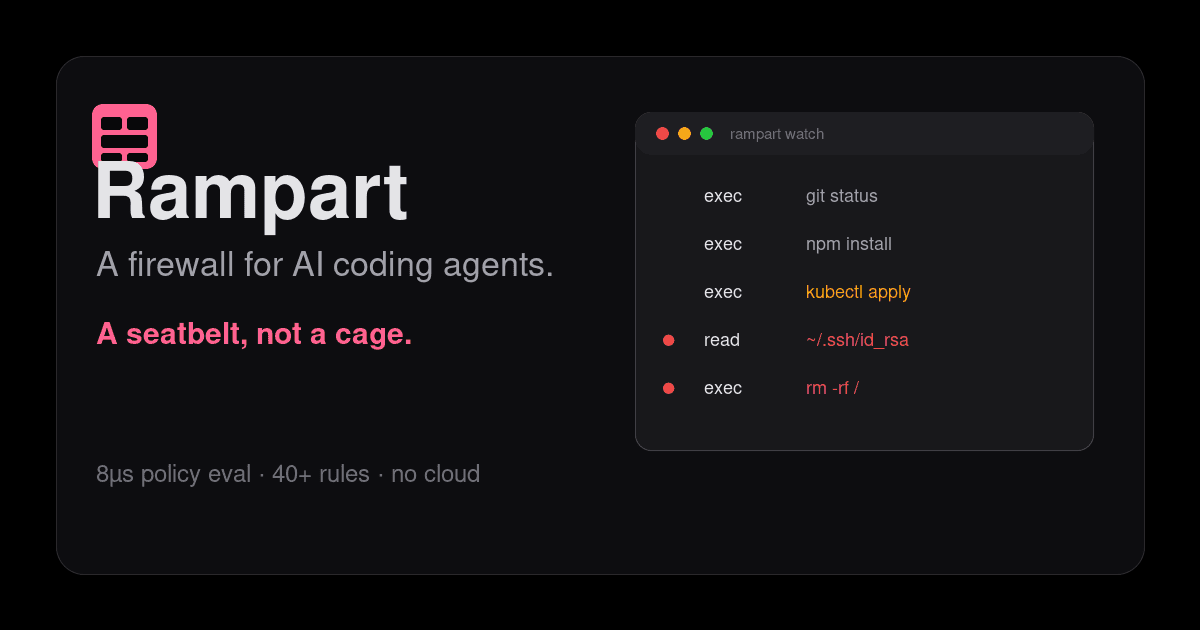
Rampart is an open-source AI agent firewall designed to enhance the security of AI coding agents like Claude Code, Codex, Cline, OpenClaw, and MCP. It operates by sitting between the agent and the system, evaluating commands, file access, and network requests against a user-defined YAML policy before execution. This local-first approach ensures no cloud dependency and provides real-time protection against credential reads, data exfiltration patterns, and destructive commands. Rampart allows normal development actions to proceed quickly while blocking or requiring approval for risky operations, providing a crucial "seatbelt, not a cage" for AI agent workflows. It also maintains a hash-chained local audit log for tamper-evident record-keeping.

Claude Code Attempted 752 /proc/*/environ Reads. 256 Succeeded. Codex: 0
This analysis from grith.ai provides a deep dive into the security implications of AI coding agents, specifically Claude Code and Codex. By using `strace` to monitor system calls, the report uncovers significant differences in their operational behaviors. It reveals that Claude Code, when performing a simple task like adding input validation to a single file, attempts to read the environment variables of 752 processes, successfully accessing 256, including sensitive ones like browser, Slack, and credential stores. The report also details how both agents read credential files and how Claude Code initializes unrelated services like Gmail and Google Calendar during coding tasks. This research emphasizes the 'blast radius problem,' where AI agents implicitly authorize broad access, creating potential attack surfaces that are not immediately visible to the user. The findings advocate for per-syscall interception to enhance visibility and control over AI agent actions.

database-build
database-build, formerly postgres.new, provides an in-browser Postgres sandbox with integrated AI assistance. Users can instantly create an unlimited number of Postgres databases that run directly within their browser, leveraging PGlite, a WASM version of Postgres. Each database is coupled with a large language model (LLM) to facilitate various use cases, including drag-and-drop CSV import to generate tables, report generation and export, chart creation, and database diagram building. The tool stores data in IndexedDB, ensuring persistence across sessions. It's designed as a monorepo with components for the web app, a browser proxy for TCP connections, and a deploy worker for integrating with database platforms like Supabase.

I stopped coding for 6 weeks. My AI agents shipped more when I came back than in 6 months before.
GAAI (Governed Agentic AI Infrastructure) is an open-source governance framework designed to enhance the reliability and productivity of AI coding agents. It operates through a .gaai/ folder at the project root, implementing four core layers: Dual-Track Agentic separation (one agent for discovery/thinking, another for delivery/execution), Skills (agents only execute authorized tasks), Rules (governing all actions), and Persistent Memory (agents recall past decisions). This framework prevents scope creep, unauthorized decisions, and ensures context is maintained across sessions, leading to more predictable and trustworthy AI-driven development. It has been proven to significantly increase code output and reduce AI drift, as demonstrated by its application in building the Callibrate AI expert matching marketplace.
CodeLedger
CodeLedger is an open-source command-line interface (CLI) tool designed to act as an engineering truth layer for AI coding agents. It ensures that AI-generated code is complete, correct, and safe to ship through deterministic file relevance scoring and multi-layer verification across code, tests, artifacts, documentation, and releases. This tool is agent-agnostic, working with various AI coding tools like Claude Code, OpenAI Codex, Cursor, and Windsurf. All processing happens locally without external data transmission, making it suitable for air-gapped operations and enterprise audit/compliance. It can also be integrated into CI/CD pipelines as a quality gate for deterministic verification.

Caffeinate AI
Caffeinate AI is a mobile application designed for AI development, allowing users to orchestrate and run powerful AI coding agents such as Claude Code, Codex, and Gemini CLI. It provides the flexibility to control these agents remotely, specifically from an iPhone, while they are running on a Mac, leveraging iCloud for seamless integration. This tool empowers developers to manage and utilize advanced AI development tools from any location, facilitating efficient app building and coding tasks on both macOS and iOS platforms. It aims to streamline the workflow for developers working with AI models.
Synthetic Sciences
Synthetic Sciences offers an AI co-scientist platform designed to automate and accelerate scientific research workflows. It enables users to delegate tasks such as literature reviews, training models on cloud GPUs, designing experiments, and generating publication-ready LaTeX papers. The platform features four distinct modes—Core Research, SOTA Biology, Flywheel, and Write—each tailored for specific research objectives and execution styles. It provides a unified workspace for continuous research, integrating with various tools like GitHub, Hugging Face, and Weights & Biases, and offers persistent agent runtimes for long-running workflows with automatic checkpointing and elastic compute profiles.
Subterranean
Subterranean is an AI-native platform designed to run entire AI teams for businesses. It allows users to set up specialist agent teams, shared workspaces, memory, data, and workflows with minimal setup, eliminating the need for extensive coding experience. The platform features an intuitive interface where users can chat directly with agents or assign tasks. It includes project sandboxes, a virtual filesystem for agent configurations and context, and a built-in database with automatic Postgres tables for structured data. Subterranean aims to accelerate workflows for both non-technical users and developers, enabling the creation of AI-driven applications and business processes.
SWE-PR
SWE-PR is a specialized tool designed to track and display performance metrics for software engineering agents on GitHub. It offers a comprehensive leaderboard that showcases pull-request, review, and commit numbers, alongside crucial acceptance rates. This platform is invaluable for monitoring the efficiency and impact of AI-driven coding assistants. Users can easily add new assistants to the tracking system, making it a flexible solution for evaluating various agents. By providing clear, quantifiable data, SWE-PR helps development teams and researchers assess the effectiveness of different software engineering AI tools and understand their contributions to the development lifecycle.
8090 Solutions Inc.
8090 Solutions Inc. offers an AI-native software development platform designed to keep business leaders in control of their software projects. The platform, called Software Factory, integrates teams and AI agents into a single system for building software, ensuring full control, visibility, and auditability from specification to deployment. For larger organizations, 8090 Enterprise provides purpose-built applications designed, built, hosted, and maintained by 8090, allowing businesses to own the logic while ensuring quality, control, and consistency. The platform emphasizes documentation, collaboration, and oversight, leveraging institutional knowledge to create a living knowledge graph that survives employee turnover and policy changes. It is built for regulated industries like healthcare, financial services, manufacturing, and federal government, with a focus on compliance and visibility.
adk-python
adk-python is an open-source, code-first Python toolkit designed for building, evaluating, and deploying sophisticated AI agents. It provides a flexible and modular framework that applies software development principles to AI agent creation, simplifying the process from simple tasks to complex systems. While optimized for Gemini, ADK is model-agnostic and deployment-agnostic, ensuring compatibility with various frameworks. Key features include a rich tool ecosystem, code-first development, agent configuration without code, tool confirmation flows, and support for modular multi-agent systems. Agents can be easily containerized and deployed on platforms like Cloud Run or Vertex AI Agent Engine.

CoddyKit: Learn Coding with AI
CoddyKit is an educational platform designed to help users learn about AI agents. The tool focuses on providing resources and information to understand the concepts, development, and application of AI agents. While the live website content is minimal, the consistent title "Learn AI Agents" across all pages suggests a dedicated focus on AI agent education. It aims to simplify the learning process for individuals interested in this rapidly evolving field, offering a foundational understanding for both beginners and those looking to deepen their knowledge.

CCC - Mobile IDE for AI Agents
C3 (Code Chat Connect) is a mobile Integrated Development Environment (IDE) designed for developers to manage and interact with AI coding agents such as Claude Code, OpenCode, and Codex CLI directly from their mobile devices. It eliminates the need to be tethered to a desktop, offering features like push notifications for agent actions, fine-grained permission approval, and real-time context monitoring. The platform supports multiple agents, allows session syncing between desktop and mobile, and includes a full-featured file explorer, code editor with syntax highlighting, terminal access, and Git integration. C3 emphasizes security with end-to-end encryption, local-first operation, and no SSH requirement, making it easy to set up and use within 60 seconds.

littleclaw - AI Coding Agents
littleclaw is an iOS mobile application designed for developers to supervise their AI coding agents remotely. It enables users to connect to any machine via SSH, isolating each session in its own git worktree automatically. This allows for safe experimentation and development without affecting the main branch. The app supports various AI coding agents such as Claude Code, Gemini CLI, and Codex, all through a native iOS interface. Developers can chat with their agents, review diffs, and approve changes directly from their iPhone, facilitating coding workflows from anywhere. The tool emphasizes security with end-to-end encrypted traffic, on-device key storage, and a zero-trust design where code never touches littleclaw servers.

CopilotKit
CopilotKit is an enterprise-ready frontend stack designed to bring users and AI agents together inside real applications. It offers Frontend SDKs for React, Next.js, and Vue, providing customizable pre-built components or full headless code control. The platform supports agent-user interaction threads with persistence, generative UI, human-in-the-loop capabilities, state synchronization, voice interactions, file uploads, and full multimodality. CopilotKit also provides product insights through observability for agentic flows, allowing users to visualize event streams and trace decision paths. It incorporates self-learning through Continuous Learning from Human Feedback (CLHF), where agents adapt and improve based on user interactions. The tool is built on the AG-UI protocol, bridging AI agents and frontends through real-time event types.
superduper
Superduper is an end-to-end framework designed for developers to build custom AI applications and agents. It facilitates the integration of AI models directly with databases, supporting backends such as MongoDB, SQL, Snowflake, and Redis through installable plugins. The framework enables the creation of AI agents with custom functionalities, streamlining the development process for database-integrated AI solutions. It requires Python 3.10+ for installation and offers a community-driven approach with resources like Slack, GitHub Discussions, and YouTube for support and engagement. Superduper is open-source and distributed under the Apache 2.0 license, encouraging contributions from the community.
ClawMart
AstraBot is an advanced AI assistant designed to manage and automate various aspects of your business and personal life. It operates on Sift, a deterministic AI governance layer that ensures every tool call, file write, API call, browser action, and sub-agent spawn is cryptographically authorized before execution. This system provides a permanent audit trail with signed receipts for all actions, ensuring transparency and trust. AstraBot offers full system autonomy across platforms like files, code, infrastructure, APIs, browser, and AWS. It performs proactive operations, monitoring emails and calendars to act without explicit prompts, and orchestrates multiple agents to work in parallel. The system is designed to be fail-closed, meaning nothing executes if governance is unavailable, and features persistent memory to learn workflows over time. Human-in-the-loop escalation is built in for Tier 3 actions requiring explicit approval.
Coderbotics AI
Coderbotics AI provides AI-powered solutions for enterprise transformation and rearchitecting, allowing teams to automate complex refactoring and modernization at scale. The platform features over 40 specialized agents and supports more than 9 programming languages, freeing developers from tedious migrations to focus on building new features. Key agents include Cloud Migration for moving applications to cloud-native microservices, Code Modernization for upgrading legacy code while preserving logic, and Monolith-to-Microservices for breaking down monolithic architectures. It also offers a DB Migration agent, a Design Document agent for generating technical docs and diagrams, and a Codebase Chat agent for interactive insights and real-time suggestions directly from the codebase. Coderbotics AI aims to accelerate software development by providing battle-tested, enterprise-scale solutions.
SuperCoder
SuperCoder is an open-source autonomous software development system designed to streamline and automate various aspects of software development. It utilizes advanced AI tools and agents to handle coding, testing, and deployment tasks, aiming to boost efficiency and reliability for developers. The system supports a variety of languages and frameworks, with SuperCoder 2.0 specifically mentioned for diverse development needs. Users can set up and run the system using Docker and Docker Compose, accessing the UI locally. The project is under active development, with resources like blogs, a YouTube channel, and a Discord community available for support.
autotab-starter
autotab-starter is an open-source project designed to simplify the creation of auditable browser automations using AI. It enables users to record point-and-click demonstrations in a browser and instantly generate live Python code for those actions. The tool is currently in an alpha release phase, with active development and regular updates. It requires Chrome browser and Python, and offers a quick setup process including virtual environment installation and credential configuration. Users can record automations by launching a Chrome session, logging in, and using the autotab extension to record clicks, typing, or element selections. The generated Python code can then be run to play back the automation, making it ideal for developers looking to automate repetitive web tasks.
Biomni
Biomni is a general-purpose biomedical AI agent designed to autonomously execute a wide range of research tasks across diverse biomedical subfields. It integrates cutting-edge large language model (LLM) reasoning with retrieval-augmented planning and code-based execution, enabling scientists to dramatically enhance research productivity and generate testable hypotheses. Biomni supports various LLM providers like Anthropic, OpenAI, Azure OpenAI, Gemini, and Groq, and can be configured via environment variables or a .env file. It features a data lake for biomedical information, a Gradio interface for interactive use, and configuration management for consistent settings. Additionally, Biomni can generate PDF reports of execution traces, supports Model Context Protocol (MCP) for external tool integration, and includes a Know-How Library of best practices. It also offers Biomni-R0, a specialized reasoning model for biology, and Biomni-Eval1, a comprehensive evaluation benchmark.
chapyter
Chapyter is a JupyterLab extension designed to seamlessly integrate GPT-4 into your coding environment, enabling natural language programming. It functions as a code interpreter, translating natural language descriptions of tasks into executable Python code and automatically running it within Jupyter Notebooks. This integration significantly boosts productivity by allowing users to generate and execute code using simple text commands, leveraging coding history and execution outputs for more accurate generations. Chapyter also supports in-situ debugging and code editing, ensuring a smooth workflow without leaving the IDE. It prioritizes privacy by using OpenAI API data usage policies that prevent data from being saved for training, unlike some other AI coding tools.

Archimyst
Archimyst is an industrial-grade coding CLI designed to optimize development workflows by providing a high-performance agentic runtime. It leverages specialized agent skills and precise architectural context to significantly reduce token usage, claiming up to a 90% saving. This tool is built for developers seeking to enhance efficiency and performance in their coding processes, particularly in managing complex system architectures. By offering a robust command-line interface, Archimyst integrates seamlessly into existing development environments, enabling more efficient code generation, simulation, and validation of production systems. Its focus on token economy makes it a valuable asset for cost-conscious development teams.