
Coding & Development
Browsing page 5 of AI tools for Documentation in Coding & Development. Sorted by confidence score — our independent quality rating.

PSEUDO.AI
PSEUDO.AI is an innovative AI-powered platform designed to effortlessly convert complex source code into clear, human-readable pseudocode. By leveraging OpenAI's trained GPT models, it bridges the communication gap between developers, designers, and stakeholders, streamlining collaboration and enhancing understanding of code. The tool supports a wide range of popular programming languages, including Java, Python, C++, and JavaScript. As a web-based platform, PSEUDO.AI requires no installation or downloads, making it easily accessible directly from any web browser. It is suitable for developers of all skill levels, from beginners seeking to understand complex code structures to experienced professionals looking to enhance productivity and clarity in their projects. PSEUDO.AI aims to transform complexity into clarity, freeing up time and energy for innovation.
PyTorchNLPBook
PyTorchNLPBook is a comprehensive companion repository for the book "Natural Language Processing with PyTorch," published by O'Reilly Media. It offers a rich collection of code and data designed to help users understand and implement NLP solutions using the PyTorch framework. The repository covers fundamental concepts such as PyTorch basics, foundational neural network components, and various NLP techniques including feed-forward networks, word embeddings, sequence modeling, and advanced topics like attention mechanisms and neural machine translation. It's an invaluable resource for anyone looking to learn and apply deep learning to natural language processing, providing hands-on examples and practical implementations directly from the book.

8base
Archie is an AI-first platform designed to accelerate the entire software development lifecycle, from initial idea to production-grade application. It integrates AI into every step, including project framing, functional requirements, UX/technical architecture, and code generation. The platform can translate up to 90% of specifications and designs into code, supporting standard languages and frameworks like JavaScript, Next.js, and React.js. Archie also offers autonomous production with DevOps-free, scalable, and secure infrastructure. It caters to startups, established companies, and agencies, enabling them to build various application types such as AI applications, SaaS, marketplaces, and mobile apps without requiring extensive technical skills.
TensorFlow-Machine-Learning-Cookbook
The TensorFlow-Machine-Learning-Cookbook is a comprehensive code repository published by Packt, designed to accompany the TensorFlow Machine Learning Cookbook. It offers all the necessary project files to work through the book, enabling users to gain practical experience with TensorFlow. The resource covers fundamental concepts such as variables, matrices, and data sources, progressing to advanced topics like Linear Regression, neural networks, Convolutional Neural Networks (CNN), Recurrent Neural Networks (RNN), and Natural Language Processing (NLP). Each chapter's code is organized into folders, making it easy to follow along. It is compatible with Python 3 and requires libraries like TensorFlow, Numpy, Scikit-Learn, Requests, and Jupyter, running on Mac, Windows, and Linux without special hardware. This repository is ideal for those looking to deepen their understanding and application of Google's machine learning library.

DocComment
DocComment is an AI-powered code documentation tool designed to enhance code readability and maintainability. It automatically generates comprehensive comments for various programming languages, including Python, Java, TypeScript, JavaScript, Go, PHP, and C#. The tool offers different granularities of explanations, from high-level class and function overviews to detailed line-by-line comments. A key differentiator is its non-intrusive sidecar explanations, which provide context without altering the original codebase, ensuring consistency across devices. Users can also opt for inline doc comments to transform their code documentation process. DocComment aims to reduce the time developers spend deciphering undocumented or complex code, making it easier to understand and maintain projects.
nlp-in-python-tutorial
The nlp-in-python-tutorial is an open-source guide designed to introduce users to Natural Language Processing (NLP) using Python. It leverages Jupyter Notebooks and popular data science libraries to provide a hands-on learning experience. The tutorial covers various NLP concepts through practical examples, including data cleaning, exploratory data analysis, sentiment analysis, topic modeling, and text generation. It is ideal for individuals new to NLP with Python, offering a structured approach to understanding and implementing NLP techniques. The tutorial was initially created in 2018, with an updated 2025 NLP course available for those seeking more current content.
Algorithm_Interview_Notes-Chinese
Algorithm_Interview_Notes-Chinese is an open-source GitHub repository offering extensive interview notes for various technical roles, including algorithm, deep learning, and natural language processing (NLP). The resource is designed to assist candidates preparing for job interviews in 2018, 2019, and during spring/autumn recruitment seasons. It covers a wide array of topics such as machine learning, deep learning, C, C++, and Python, alongside general computer science knowledge relevant to algorithm positions. The repository also compiles questions from numerous machine learning and deep learning interview experiences, providing a practical study guide. It explicitly excludes topics related to frontend, testing, Java, or Android development.
FineTuningLLMs
FineTuningLLMs is the official repository for the book "A Hands-On Guide to Fine-Tuning LLMs with PyTorch and Hugging Face." This resource offers comprehensive guidance and practical code examples for fine-tuning large language models. It covers essential concepts such as quantization, low-rank adapters (LoRA), and dataset formatting templates. The repository features Jupyter notebooks that can be easily run on Google Colab with GPU support, making it accessible for hands-on learning. It delves into topics like loading quantized models, fine-tuning with SFTTrainer, and deploying models locally using formats like GGUF with Ollama or llama.cpp. The guide is designed for an intermediate-level audience, assuming a foundational understanding of deep learning concepts.
TensorFlow-and-DeepLearning-Tutorial
TensorFlow-and-DeepLearning-Tutorial is an open-source repository offering a collection of deep learning tutorials. Originally taught as an online course in 2016, it provides foundational knowledge in TensorFlow, fully connected neural networks, and convolutional neural networks. The resource also delves into Natural Language Processing concepts. Written primarily in Python and Jupyter Notebook, it serves as a valuable educational tool for individuals looking to understand and implement deep learning techniques.
awesome-chatgpt-zh
awesome-chatgpt-zh is a comprehensive, open-source Chinese guide designed to empower users with the knowledge and resources to effectively leverage ChatGPT. Hosted on GitHub, this project offers detailed instructions, prompt engineering guidelines, and application development insights. It curates a wide array of free and paid ChatGPT resources, along with a list of top open-source projects and productivity tools built on ChatGPT's capabilities. The guide covers various aspects, from understanding what ChatGPT is to advanced topics like LLM development, RAG guidance, and AGI concepts, aiming to significantly boost user productivity.
ReadmeChef
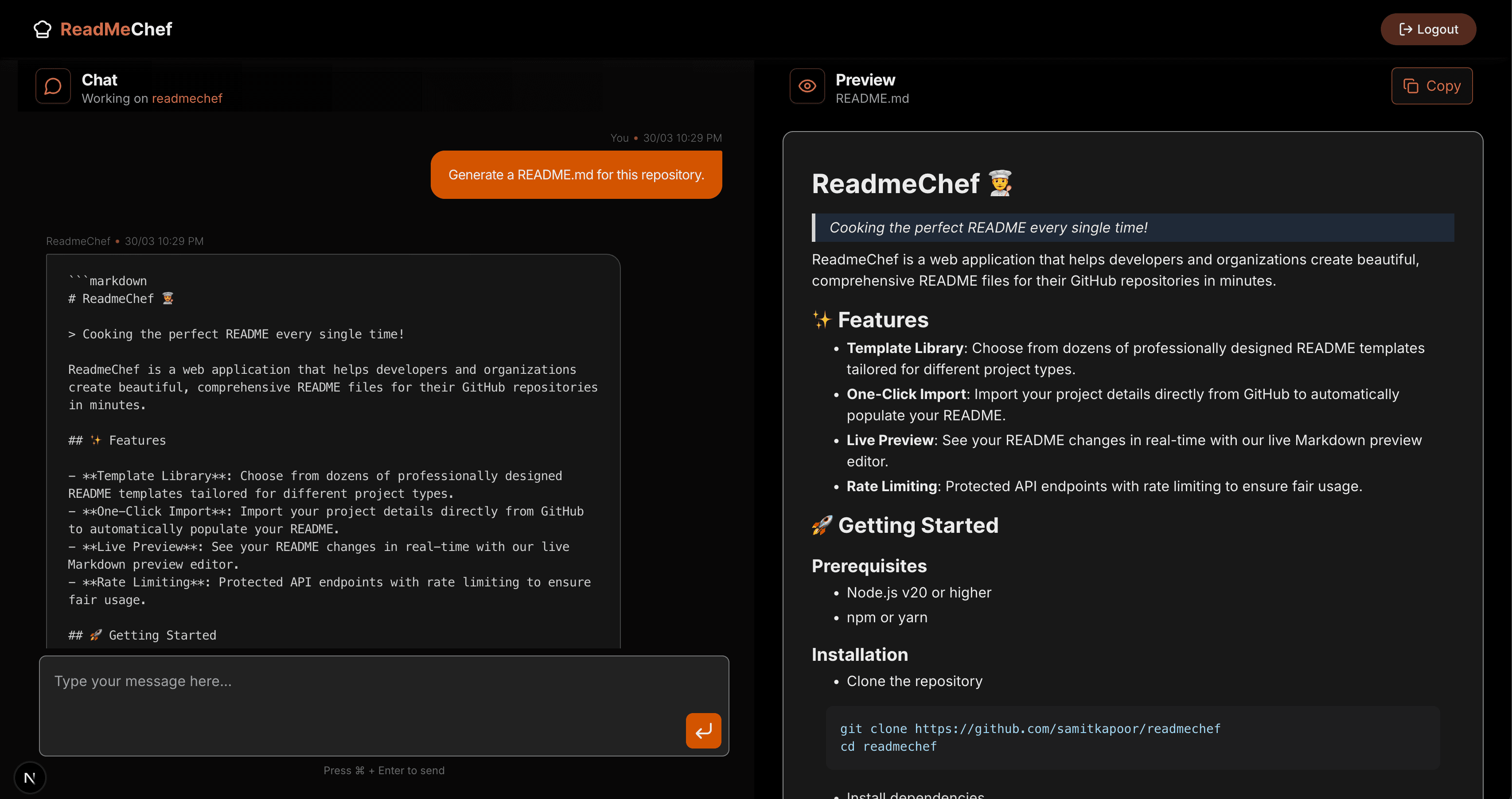
ReadmeChef is an AI-powered tool designed to automate the creation of professional README.md files for GitHub and GitLab repositories. It simplifies documentation by allowing users to connect their accounts, select a repository, and generate a tailored README without manual input. The AI analyzes code structure, dependencies, and project purpose to craft accurate and comprehensive documentation. This tool aims to save developers significant time, as it eliminates the need to manually write or update READMEs. ReadmeChef supports both public and private repositories, offering flexible access options. A well-crafted README is crucial for project success, boosting traffic, attracting contributors, accelerating onboarding, building trust, and fostering community engagement.
GitHub Repository AI Assistant
The GitHub Repository AI Assistant is a Chrome extension designed to enhance your GitHub experience by integrating an AI assistant directly into a side panel. This tool allows users to ask questions about any GitHub repository, whether it's an open-source project or a private one. It's particularly useful for quickly assessing the suitability of an open-source repository for specific needs or for understanding recent changes within your own private repositories. The extension aims to streamline the process of code comprehension and project evaluation, making it easier for developers to navigate and utilize GitHub resources. It is important to note that this is not an official GitHub product.
ipython-gpt
ipython-gpt is an open-source extension designed to seamlessly integrate ChatGPT capabilities into Jupyter Notebooks and the IPython Shell. This tool enables developers and data scientists to interact with an AI assistant directly from their coding environment, facilitating tasks such as code generation, debugging, and general programming queries. It supports conversation context, allowing for continuous dialogue with the AI, and offers configuration options for the AI's role and other chat parameters. Users can easily install it via pip and set up their OpenAI API key as an environment variable. While currently an early version, it provides a powerful way to enhance productivity by bringing AI assistance directly into the interactive Python workflow.
Codag
Codag is the first AI talent agency, offering AI employees that operate with shared organizational memory. Unlike other AI agents, Codag's employees retain context, learn from corrections, and avoid starting from scratch with each task. They operate through real browsers, mice, and keyboards, enabling them to perform any computer task a human can. Managers can delegate tasks conversationally via Slack, and the AI employees draw from a unified organizational context including team structure, conventions, and decision history. This approach aims to eliminate the $2 trillion lost annually to misalignment in U.S. businesses, providing a workforce that continuously learns and adapts to specific company workflows.
Developer Docs Audit
Developer Docs Audit by Nakora offers a comprehensive analysis of your developer documentation to identify areas for improvement in quality, SEO, and overall developer experience. It helps connect documentation efforts directly to revenue by revealing blockers in discovery, evaluation, activation, and customer conversion stages. The tool addresses issues like developers not finding your product, users getting stuck, and content gaps that hinder sign-ups and adoption. It also highlights how bad documentation can negatively impact AI discoverability and integration, making your product invisible to LLMs and AI coding assistants. The audit provides data-driven insights for founders, DevRels, technical marketers, and technical writers to optimize their documentation strategy.
AutEng Docs
AutEng Docs is an AI-native workspace designed for technical documentation, enabling users to write technical documents efficiently. It supports rich formatting capabilities including GitHub Flavored Markdown, Mermaid diagrams for architecture and flowcharts, and KaTeX for mathematical notation. The AI assistant can instantly generate architecture documents, API specifications, algorithm explanations, and tutorial guides. It also offers features like web research integration, interactive clarification, and professional quality output suitable for engineering teams. A key differentiator is its AI-powered math verification, including CAS (Computer Algebra System) and formal theorem proving with Lean 4, ensuring accuracy and rigor in mathematical content.
Tool Relay
Tool Relay enables SaaS companies to create and host remote MCP (Multi-Cloud Platform) servers without requiring any infrastructure setup. It streamlines the process of integrating AI agents like Claude and ChatGPT with existing APIs by automatically generating necessary MCP endpoints, API key portals, and OpenAPI specifications. This allows AI agents to call existing HTTP APIs seamlessly, eliminating the need for manual code changes. The platform simplifies the deployment and management of these integrations, providing a robust solution for developers looking to enhance their SaaS offerings with AI capabilities and efficient API management.

Why AI Coding Agents like Claude Waste Half Their Context Window
Stoneforge is an open-source AI orchestration platform designed to improve the efficiency of AI coding agents. It addresses the common problem of agents wasting significant portions of their context window on codebase exploration, a process known as hill-climbing. By implementing a hierarchical documentation system, including an `AGENTS.md` index file and searchable documentation directories, Stoneforge helps agents orient in 1-3 tool calls instead of 15-20. This approach preserves the agent's sharpest reasoning for actual coding tasks, leading to noticeably better code quality and faster development cycles. The platform also enforces evergreen documentation through agent prompts and code review, ensuring the documentation remains current and effective.
MarkFlowy
MarkFlowy is a modern and intelligent Markdown editor designed to enhance the writing experience with AI capabilities. Built on Tauri, it boasts a lightweight footprint of less than 20MB and improved performance. The editor supports various editing modes, including source code and WYSIWYG, and can handle multiple file types beyond Markdown, such as JSON and TXT. Key features include built-in AI integration with models like Copilot, DeepSeek, and ChatGPT for tasks like dialogue export, translation, and article summaries. Users can customize themes and keyboard shortcuts, process images by pasting them to a specified path or converting to base64, and manage files with a powerful drag-and-drop file tree and global search. MarkFlowy also offers multi-language support and is available for Linux, macOS, and Windows.
Spacebackend
Spacebackend develops engineering tools to accelerate hardware integration, testing, and remote operations across the aerospace industry, collapsing timelines from years to days. Founded in 2024, the company focuses on building software for integrations and autonomous operations of mission-critical hardware on Earth, the Moon, and in Space. Their flagship product, Lynapse™ Studio, is an AI-powered system integration platform that converts hardware documentation into Digital Models and generates flight-ready, platform-agnostic source code. This process significantly reduces the time required for mission-critical integration, ensuring systems stay on schedule. Spacebackend also provides infrastructure for vendor-agnostic autonomous operations and uses deterministic AI for virtual validation and Software-in-the-Loop (SiL) testing, exposing failures early and ensuring interface reliability.
LLMs-local
LLMs-local is a comprehensive GitHub repository offering a curated list of platforms, tools, and resources specifically designed for running Large Language Models (LLMs) locally. This resource is invaluable for developers and researchers looking to explore, deploy, and manage LLMs without relying on cloud-based services. It categorizes tools into inference platforms, inference engines, user interfaces, and various types of models including general purpose, coding, multimodal, image, and audio. Additionally, it covers agent frameworks, model context protocols, retrieval-augmented generation (RAG) tools, and miscellaneous utilities, providing a one-stop solution for local LLM development and experimentation.
Doc Mcp
Doc Mcp is a specialized tool designed to facilitate Retrieval-Augmented Generation (RAG) on documentation hosted in GitHub repositories. Users can provide a GitHub URL, select specific markdown files, and the tool will generate vector embeddings from these files. This process effectively transforms the documentation into an accessible MCP (Model Context Protocol) server, making it queryable by AI agents. It's particularly useful for developers and teams who need to integrate their project documentation directly into AI workflows, allowing agents to intelligently retrieve and utilize information from their codebase's documentation.
iOS_ML
iOS_ML is a meticulously curated list of machine learning, artificial intelligence, and natural language processing solutions specifically tailored for iOS development. This resource serves as an invaluable guide for iOS developers seeking to integrate AI functionalities into their applications. It covers a wide array of topics including Core ML, general-purpose machine learning libraries, deep learning frameworks, computer vision, natural language processing, and speech recognition. The list highlights tools written in iOS-friendly languages like Objective-C, Swift, C, C++, and JavaScript, along with relevant web APIs, blog posts, and learning materials. It's designed to help developers navigate the challenging landscape of bringing AI to mobile platforms, offering solutions for both on-device training and inference, as well as model compression techniques.

Bugasura
Bugasura is a comprehensive quality platform designed to streamline bug reporting, management, and resolution for development teams. It integrates an AI-first issue tracker that helps generate issue descriptions, identify impact, and suggest fixes, significantly speeding up the bug logging process. Beyond issue tracking, Bugasura provides robust test management features, allowing users to create requirements, link test cases, and manage test runs efficiently. It also offers diverse bug reporters, including website feedback tools with visual steps to reproduce, in-app widgets for session replays, and console messages. The platform supports custom workflows, sprints, and seamless integrations with popular project management and developer tools like GitHub, Jira, and Slack, making it an all-in-one solution for ensuring product quality.