
Coding & Development
Browsing page 186 of AI tools for Coding & Development. Sorted by confidence score — our independent quality rating.
Nobel10 Technologies
Nobel10 Technologies is an international technology company specializing in AI and software development, providing comprehensive solutions for businesses and organizations. Their services include custom AI agent development utilizing cutting-edge technologies, responsive web application development with modern frameworks, and native and cross-platform mobile application development for iOS and Android. They also offer UI/UX design focused on user-centered experiences. Nobel10 prides itself on delivering innovation with excellence, working with global organizations like the United Nations and NATO. They aim to transform ideas into reality through collaborative efforts, driving business forward with their expert team and state-of-the-art technologies.
Capacity
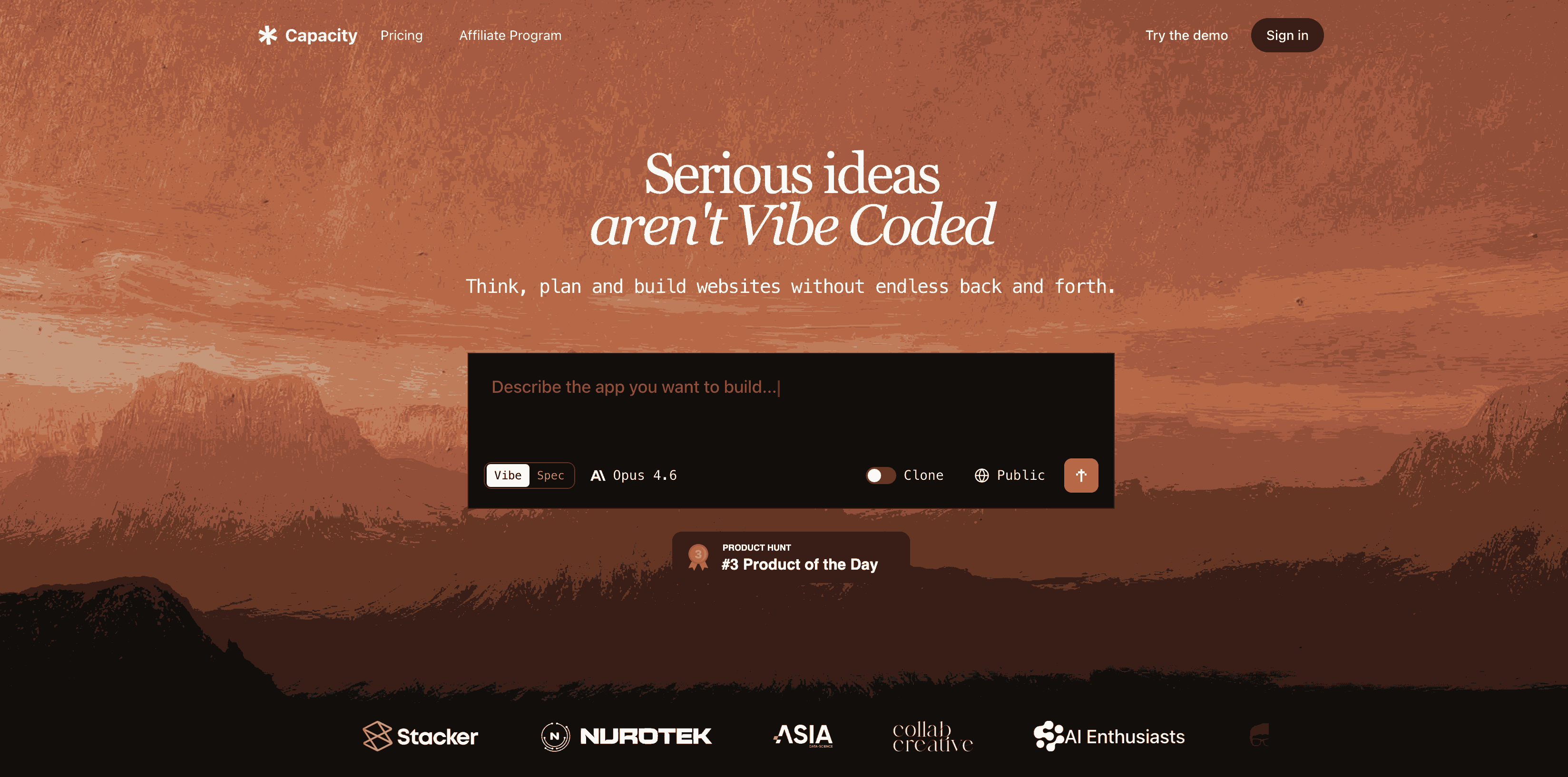
Capacity is an AI-powered platform designed to transform ideas into production-ready web and mobile applications without requiring any coding skills. Users can describe their vision in plain English, and the AI Co-founder assists in refining the idea, planning, and building the application. It generates full-stack applications with a real backend (Express server) and SQLite database, ensuring users own 100% of their code. The platform supports both web and mobile app development (React Native) from a single codebase and offers instant deployment to platforms like Vercel or AWS. Capacity also features 'Spec mode' for detailed planning before coding and allows users to export their code to GitHub or download it directly.

ThemeAI
ThemeAI is an AI-powered website builder designed to help users create and launch custom, on-brand Shopify themes quickly and efficiently, without requiring any coding knowledge. The platform provides customizable designs and UI kits, enabling individuals, teams, and agencies to develop professional-looking e-commerce stores. By leveraging AI, ThemeAI streamlines the theme creation process, making it accessible for those who need to establish an online presence rapidly or update their existing Shopify store with a fresh, unique design. This tool is particularly beneficial for users seeking to maintain brand consistency and accelerate their development workflow.

TKH Artificial Intelligence
TKH Artificial Intelligence is a core component of the TKH Group, a globally operating technology company focused on creating innovative and differentiating technologies. The AI team develops solutions that enable machines to perceive, understand, and interact with the real world, contributing to a smarter, more efficient, and sustainable global environment. TKH AI's work is integrated into broader automation strategies, combining vision, manufacturing, and AI technologies to create seamless, autonomous, scalable, and sustainable ecosystems. This approach aims to revolutionize production processes by moving beyond human limitations and connecting customers to powerful possibilities in both automation and electrification.
ChatGPT_Trading_Bot
ChatGPT_Trading_Bot offers an open-source codebase for building an automated trading bot, as demonstrated in a YouTube video by Siraj Raval. The project is primarily for educational and experimental use, allowing users to understand and implement algorithmic trading strategies. It leverages the FinRL team's iPython notebook, enabling users to pull trading data, simulate environments, train neural networks for stock price prediction using reinforcement learning, and backtest predictions. The bot can then execute buy/sell decisions based on expected returns via the Alpaca API. Users are strongly cautioned about the inherent risks of investing real money in such systems.
cnn-watermark-removal
cnn-watermark-removal is an open-source project providing a fully convolutional deep neural network designed to remove transparent overlays, such as watermarks, from images. The architecture avoids down-sampling to maintain accuracy and utilizes dilated convolutions for a large receptive field without excessive computation. While the current design does not generalize well to vastly different watermark types or non-additive overlays, it offers a solid foundation for image inpainting. Users can train the network with their own datasets or use provided pretrained weights. The project is built with Tensorflow and requires specific libraries and datasets for setup and operation.
cipher
ByteRover CLI (brv), formerly known as Cipher, is an open-source command-line interface designed to provide persistent, structured memory for AI coding agents. It enables developers to curate project knowledge into a context tree, synchronize it to the cloud, and share it across various tools and team members. The tool features an interactive REPL powered by a choice of 18 LLM providers, an agentic map for codebase understanding, and capabilities to read/write files and execute code. Key features include a web dashboard for context curation, Git-like version control for the context tree, 24 built-in agent tools, cloud sync with review workflows, and integration with 22+ AI coding agents. It also supports worktrees and knowledge sources for flexible project management.

Bay Technologies
Bay Technologies is at the forefront of AI innovation, focusing on enhancing human potential and well-being through its advanced solutions in health and education. Their flagship product, FoodTrack, is an AI-powered healthy diet platform that combines AI with Eastern medicine and Western nutrition science to provide personalized dietary recommendations. Users can photograph their tongue and face to generate a health profile and receive tailored advice, including precise nutritional breakdowns from food photos. The platform also features a gamified experience with a virtual pet and integrates with wearables. Additionally, Bay Technologies offers intelligent school management systems that leverage SaaS-based AI to automate tedious administrative tasks for teachers, allowing them to focus more on personalized student learning. This system diagnoses individual knowledge frameworks to provide customized learning paths, improving teaching and learning effectiveness. The school management system has been adopted by over 280 schools.
Purgo AI
Purgo AI is an advanced platform designed to automate the entire data engineering process for building ETL/ELT pipelines within cloud data warehouses. Leveraging agentic AI, it handles the design, development, testing, and deployment of data applications, from English language requirements in Jira to production-ready code in Python, PySpark, and SQL. The platform supports various industries, offering solutions for Sales & Marketing, Supply Chain, Finance & Risks, and R&D, including GxP validation for compliant operations. It integrates with enterprise contexts like GitHub and data catalogs, provides automated quality testing, and allows human developers to review and make changes, significantly reducing costs and accelerating time to delivery.

Hex
Hex is an AI analytics platform designed for data teams and business users, offering an end-to-end workspace for data analysis. It integrates agentic notebooks for deep analysis, conversational self-serve capabilities for business users, and data apps for sharing interactive visualizations. The platform features a Context Studio for governing AI answers using semantic models, database descriptions, and workplace rules, ensuring grounded and consistent responses. Hex supports SQL, Python, and no-code options within its notebooks, facilitating exploratory analysis and the creation of interactive dashboards. It is trusted by companies like Ramp, Figma, and Anthropic, providing a unified system for data insights.
infinity
Infinity is a cutting-edge AI-native database specifically designed for large language model (LLM) applications. It offers incredibly fast hybrid search capabilities, combining dense vector, sparse vector, tensor (multi-vector), and full-text search. This robust database supports a wide range of rich data types and is optimized for high performance, achieving 0.1 milliseconds query latency and 15K+ QPS on million-scale vector datasets. Infinity is ideal for various RAG (Retrieval-augmented Generation) applications, including search, recommenders, question-answering, conversational AI, and content generation. It features an intuitive Python API and a single-binary architecture for easy deployment, making it friendly to AI developers.
Convai
Convai powers XR worlds with conversational AI through both virtual humans and disembodied AI characters, enabling deeply interactive and immersive experiences. Its platform allows users to craft spatially 3D aware characters with an intuitive and easy-to-use interface. These embodied AI agents possess multimodal perception, allowing them to see and hear their surroundings, then respond with human-like dialogue, voice, gestures, and contextually appropriate actions. Convai offers integrations with popular game engines like Unreal Engine and Unity, along with open APIs and extensive documentation for developers. It supports role-playing AI characters, multimodal knowledge banks, narrative-driven design, and multilingual support across 65+ languages.
Republic Labs AI
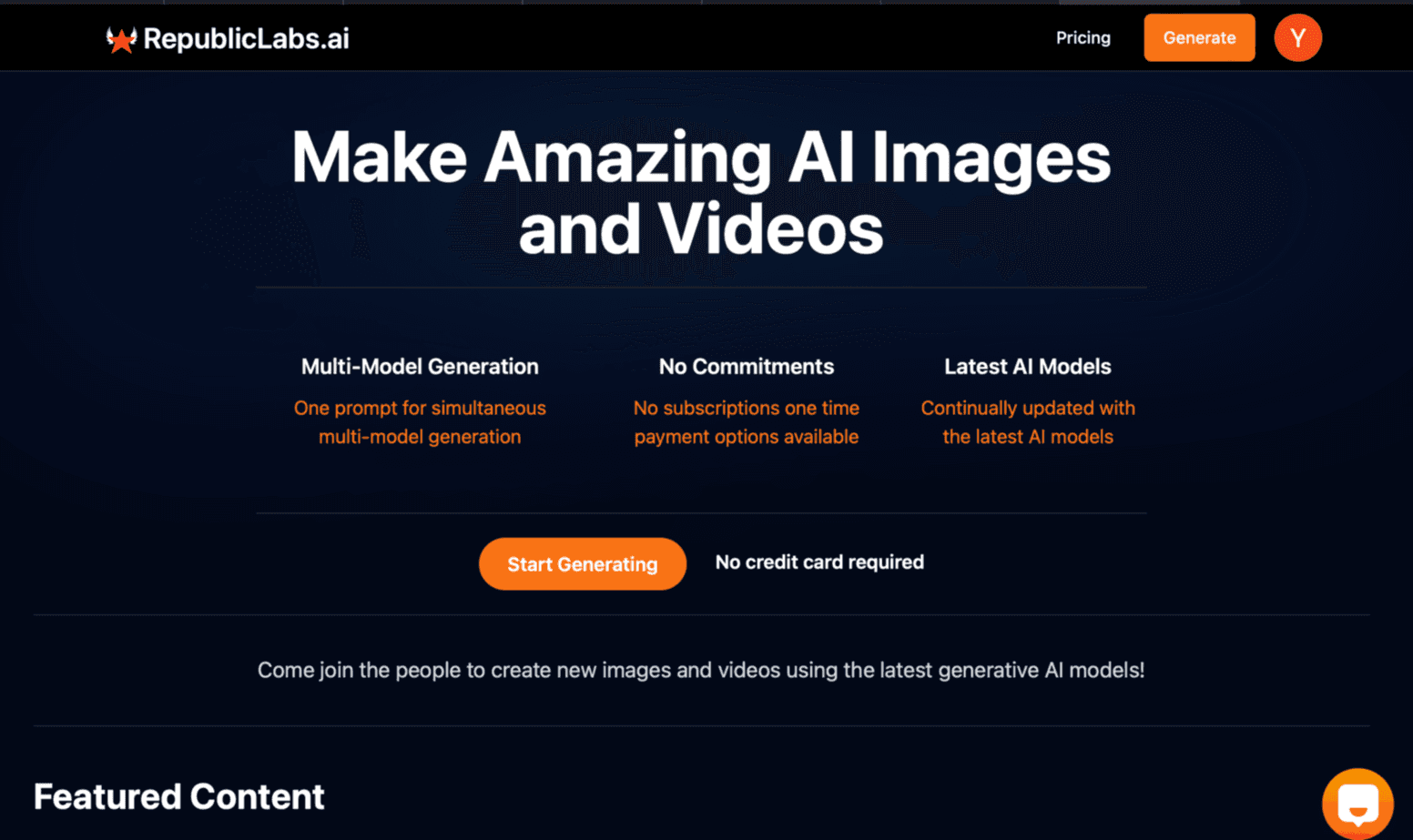
Republic Labs AI is a generative AI platform designed for creating images and videos. It features multi-model generation, allowing users to input a single prompt to generate content across various AI models simultaneously. The platform operates on a one-time payment basis, eliminating the need for subscriptions, and is regularly updated with the newest AI models to ensure access to cutting-edge technology. Users can generate a wide range of visual content, including professional headshots, making it a versatile tool for various creative needs. The platform emphasizes accessibility, requiring no credit card to start generating content.
RunWhen
RunWhen offers AI-powered Engineering Assistants designed to simplify troubleshooting for complex cloud systems. The platform empowers DevOps teams and SREs by suggesting what to run and when, automating investigations, and providing high-accuracy AI SRE capabilities. It helps unblock developers in pre-production and production environments, enabling faster MTTR with fewer escalations. RunWhen replaces traditional runbooks with agentic automation, making it easier to build and deploy diagnostic tools. The platform also helps keep observability budgets in check by automating diagnostics and reducing the need for extensive logging. With both foreground and background agents, RunWhen assists with root cause analysis, configuration, and continuous issue identification.
Rhino.ai
Rhino.ai is an enterprise AI platform designed to reconstruct hidden business logic across code, SaaS, workflows, and integrations, creating a system of record for organizations. It addresses the 'logic crisis' faced by enterprises where business rules are fragmented and ungoverned, leading to risky modernization efforts and unsafe AI agents. The platform operates in three steps: Extract, Govern, and Enable. It automatically discovers and maps business rules, organizes them into a governed, traceable, and version-controlled logic graph, and then feeds this logic into migration pipelines, AI agents, knowledge bases, and decision engines. This process aims to deliver measurable outcomes such as 10x faster understanding, 80% reduced rework, 100% portfolio visibility, zero logic drift, and 5x AI readiness, making it ideal for modernization, agent enablement, and vendor unlock initiatives.
llama-models
llama-models offers a comprehensive suite of utilities for working with Llama large language models. It provides easy accessibility to cutting-edge LLMs, fostering collaboration and advancements among developers, researchers, and organizations. Users can download model weights and tokenizers, list available models, describe model details, and run inference with various quantization modes like FP8 and Int4 to optimize memory footprint. The platform supports both Meta's direct downloads and Hugging Face access, ensuring broad ecosystem compatibility. It emphasizes responsible use with dedicated guides and reporting mechanisms for issues and risky content, promoting ethical AI development.
llama-stack
OGX, previously known as llama-stack, is an open-source agentic API server designed for building AI applications with maximum flexibility. It serves as a drop-in replacement for the OpenAI API, enabling developers to use any OpenAI-compatible client or agentic framework. OGX supports various models like Llama, GPT, Gemini, and Mistral, and can be deployed on diverse infrastructures, from local development with Ollama to production with vLLM or managed services. Key features include Chat Completions & Embeddings, a Responses API for server-side agentic orchestration with tool calling and file search, and support for Vector Stores & Files. It also offers multi-SDK compatibility, working natively with Anthropic and Google GenAI SDKs alongside OpenAI.
llm-graph-builder
llm-graph-builder is an open-source tool designed to convert various forms of unstructured data, such as PDFs, DOCs, TXTs, YouTube videos, and web pages, into structured knowledge graphs. It utilizes Large Language Models (LLMs) and the LangChain framework to extract nodes, relationships, and properties, storing them in a Neo4j database. Users can upload files from local machines, GCS, S3 buckets, or web sources, select their preferred LLM model, and define custom or existing schemas for graph generation. Key features include graph visualization in Neo4j Bloom, conversational querying of data, and token usage tracking. It supports a wide range of LLMs including OpenAI, Gemini, Anthropic, and Ollama, and offers various embedding models for data vectorization.
llama.go
llama.go is a pure Golang reimplementation of the popular llama.cpp framework, designed for machine learning enthusiasts and developers. It aims to provide a GGML-compatible environment for debugging and inferring large GPT models directly in Golang, offering an alternative to lower-level languages like C++. The project focuses on performance and elegance, enabling users to work with models like LLaMA-7B, 13B, 30B, and 65B. Key features include multi-threading, cross-platform compatibility (Mac, Linux, Windows), and optimizations for ARM NEON and x64 AVX2. It also supports modern GGUF V3 model format, INT8 quantization, and offers an embedded REST API for production use, allowing parallel inference with configurable pods and threads.
Khorus
Khorus serves as a universal communication layer for intelligent systems, specifically designed to make AI agents interoperable on-chain. It provides the fastest way to deploy A2A (Agent-to-Agent) agents, powered by ERC-8004 identity and x402 payments. The platform allows users to create agent workforces, assign tasks, and run or sync operations. A key feature is the ability to tokenize creations and list them on a marketplace or launch them through Genesis with DAO Pools. Khorus integrates with various agent APIs and data tools, routing calls through x402 for automated signals, metered usage, and trustless on-chain settlement. It supports the design and deployment of complex dApps through coordinated agent workspaces, ensuring each agent is verified on-chain and can communicate across different chains and environments.
Bennu AI
Bennu AI offers an autonomous AI agent designed to manage operations, deploy code, fix bugs, and maintain system uptime, allowing teams to focus on development. It provides zero-downtime monitoring, detecting crashes, restarting services, and archiving logs before users are impacted. The platform automates CI/CD processes, handling everything from Docker to production with minimal configuration. Bennu AI also integrates robust security features, scanning for misconfigurations, secrets, and access rights, blocking unsafe deployments in real-time. Users can deploy applications with a single prompt, describing their app in plain English for the AI to build, provision, and ship. It connects with existing stacks like GitHub, Docker, Kubernetes, and Terraform, orchestrating infrastructure, code, and operations with precision.
Liger-Kernel
Liger-Kernel is an open-source collection of Triton kernels specifically engineered to optimize Large Language Model (LLM) training. Developed by LinkedIn, this tool boasts a 20% increase in multi-GPU training throughput and a 60% reduction in memory usage, enabling longer context lengths, larger batch sizes, and massive vocabularies. It offers optimized Post-Training kernels, including DPO, ORPO, CPO, and SimPO, which can deliver up to 80% memory savings for alignment and distillation tasks. Liger-Kernel is designed for ease of use, allowing users to patch Hugging Face models with a single line of code or compose custom models using its modules. It is compatible with multi-GPU setups like PyTorch FSDP, DeepSpeed, and DDP, and integrates with popular trainer frameworks such as Axolotl and Hugging Face Trainer. The kernels are exact, ensuring computational accuracy with rigorous unit tests and convergence testing.
LLMTornado
LLMTornado is a comprehensive .NET provider-agnostic SDK designed for developers to build, orchestrate, and deploy AI agents and workflows with ease. It features built-in connectors to over 30 API providers, including Alibaba, Anthropic, Azure, Google, OpenAI, and many more, ensuring broad compatibility without dependencies on first-party SDKs. The library supports first-class local deployments with vLLM, Ollama, or LocalAI, and offers advanced agent orchestration capabilities with concepts like Orchestrator, Runner, and Advancer, including handoffs and parallel execution. LLMTornado accelerates development with its ability to write pipelines once and execute with any provider, and supports fully multimodal inputs and outputs (text, images, videos, documents, URLs, audio). It also integrates cutting-edge protocols like MCP and A2A, and connects to popular vector databases such as Chroma, PgVector, and Pinecone, making it enterprise-ready with guardrails and Open Telemetry support.
magic-cli
Magic CLI is a command line utility designed to make users more efficient in the terminal by leveraging Large Language Models (LLMs). Inspired by tools like Amazon Q and GitHub Copilot for CLI, it allows users to suggest commands, semantically search their shell history, and generate commands for specific tasks. The tool supports both local LLM providers like Ollama and cloud-based providers like OpenAI, offering flexibility in deployment. It relies on the `orch` library for LLM interactions, including execution and model alignment, and provides configuration options for different LLMs and their settings. While still in early development, it aims to streamline command-line workflows for developers.