
Coding & Development
Browsing page 187 of AI tools for Coding & Development. Sorted by confidence score — our independent quality rating.

LocalAIVoiceChat
LocalAIVoiceChat provides a completely local AI talk experience on your PC, integrating the powerful Zephyr 7B language model with real-time speech-to-text and text-to-speech libraries. It utilizes RealtimeSTT with faster_whisper for transcription and RealtimeTTS with Coqui XTTS for synthesis, allowing for customizable AI personalities and voices. This experimental alpha software requires a GPU with around 8 GB VRAM and specific NVIDIA CUDA or AMD ROCm installations. While not production-ready, it offers a fast and engaging voice-based local chatbot experience, with ongoing updates to improve stability and model performance.
DAILA
DAILA, the Decompiler Artificially Intelligent Language Assistant, provides a unified interface for AI systems within decompilers. This decompiler-agnostic plugin supports a wide range of AI models, including remote LLMs like GPT-4, Claude, and Gemini via LiteLLM, as well as local models such as VarBERT for variable renaming. It integrates with popular decompilers like IDA Pro, Ghidra, Binary Ninja, and angr-management, abstracting interactions through the LibBS library. DAILA offers both a GUI for interactive use and a scripting library for programmatic access, enabling tasks like function summarization, variable renaming, vulnerability identification, and free-form prompting. It can be installed via pip or used within a Docker container for offline environments.

Antrika Technologies
Antrika Technologies is an AI-first innovation hub dedicated to fostering the growth of AI-powered enterprises. They operate as a venture studio, offering funding, incubation, and expert growth strategies to AI startups. Antrika assists companies in leveraging AI, data, and automation to develop intelligent solutions, optimize advertising performance, and achieve global growth. Their portfolio includes successful AI products like Flostr (WhatsApp automation), Teptro (AI-powered customer support), and Qrrectly (billing automation). Antrika provides end-to-end support, from concept validation to market expansion, with a focus on performance optimization, targeted efficiency in ad-tech, and empowering workforces through AI solutions.
MCP-SuperAssistant
MCP-SuperAssistant is an open-source Chrome extension designed to bridge the gap between AI platforms and the Model Context Protocol (MCP). It enables users to seamlessly integrate and execute MCP tools within popular AI interfaces such as ChatGPT, Perplexity, Grok, Gemini, Google AI Studio, and more. Key features include automatic detection and execution of MCP tool calls, integration of tool results back into conversations, and support for various AI platforms. The extension also offers advanced modes like auto-execute and auto-submit for enhanced automation, making it a powerful tool for developers and technical users looking to extend the functionality of their AI assistants.
lux-ui
lux-ui is an open-source admin template designed to create the best Vuetify 3 admin experience. It is built upon Vue3.x, Vite5.x, TypeScript, and Vuetify3.x, incorporating an AI assistant for intelligent features. The project provides a clear and efficient structure, integrating the latest technology frameworks to address a wide range of common technical requirements. It ensures all pages are adaptive across multiple devices, achieving seamless cross-platform compatibility. Key features include component auto-importing, Pinia for state management, Iconify for icons, Firebase authentication, and charting libraries like Echarts and ApexChart. It also supports OpenAI/ChatGPT integration and internationalization with vue-i18n.
Arcanna.ai
Arcanna.ai delivers trustworthy AI solutions specifically designed for modern Security Operations Centers (SOCs). The platform aims to streamline operations and scale team capacity by automating human judgment in cybersecurity. It features a Decision Layer that triages alerts and enforces decisions, and an Investigation Layer that accelerates investigations using grounded GenAI. Arcanna.ai integrates with existing SIEM, SOAR, NDR, EDR, and XDR workflows, providing explainable decisions, full transparency with logged actions, strict data privacy, and compliance support through recorded decision history and human review points. This approach helps SOC teams achieve faster, more accurate decisions, significantly reducing response times and alert volumes.

BugRaptors
BugRaptors is a software testing company that provides AI-powered quality engineering services and top-notch QA solutions. The company leverages advanced AI, automation, and expert knowledge to deliver fast, reliable, and high-quality software testing. BugRaptors offers a range of services including manual testing, automation testing, performance testing, security testing, web testing, mobile testing, and AI testing solutions. They utilize proprietary AI-enhanced tools like RaptorAssist for test case generation, RaptorGen for test data, RaptorScan for broken links, RaptorVision for visual bugs, and RaptorSecurity for web application protection. BugRaptors serves diverse industries such as healthcare, retail, banking, energy, telecommunication, and media.
MLOpsPython
MLOpsPython provides a comprehensive set of code samples and pipeline definitions for establishing an MLOps workflow using Azure ML Services and Azure DevOps. This project illustrates how to automate an end-to-end ML/AI workflow, covering continuous integration (CI) and continuous delivery (CD) for machine learning models. It includes tasks for data sanity tests, unit tests, model training on various compute targets, model version management, evaluation, selection, and deployment as a real-time web service. The solution supports staged deployment to QA/production environments and integration testing, making it adaptable for various AI scenarios beyond its scikit-learn diabetes dataset foundation.
DeepResearch
DeepResearch, developed by Alibaba-NLP, is an open-source agentic large language model specifically engineered for long-horizon, deep information-seeking tasks. With 30.5 billion total parameters and 3.3 billion activated per token, it demonstrates state-of-the-art performance across various agentic search benchmarks. Key features include a fully automated synthetic data generation pipeline, large-scale continual pre-training on agentic data, and end-to-end reinforcement learning. It supports both ReAct and IterResearch-based 'Heavy' inference paradigms, allowing for rigorous evaluation of intrinsic abilities and maximum performance. The model is available for download and can be integrated via OpenRouter for inference without GPUs.
DeepLearning.scala
DeepLearning.scala is an open-source library designed for building complex neural networks using Scala. It supports differentiable programming, allowing users to construct neural networks from mathematical formulas and calculate derivatives for weights. A key differentiator is its ability to create dynamic neural networks, where the structure can change during runtime based on Scala functions and control flows. This enables programmers to build sophisticated networks with familiar coding paradigms. The library also emphasizes functional programming, leveraging Monads and Applicative type classes for composable layers and parallel computations. DeepLearning.scala 2.0 is organized around Dependent Object Type calculus (DOT), providing mixin-able plugins for extending functionality, including algorithms, models, and hyperparameters, all with static type checking.
DeepSeek-MoE
DeepSeek-MoE is an innovative Mixture-of-Experts (MoE) language model featuring 16.4 billion parameters. It utilizes a unique architecture with fine-grained expert segmentation and shared experts isolation, allowing it to achieve performance comparable to DeepSeek 7B and LLaMA2 7B while requiring only about 40% of the computations. Trained from scratch on 2 trillion English and Chinese tokens, DeepSeek-MoE provides both base and chat model checkpoints for research and commercial use. It can be deployed on a single GPU with 40GB of memory without quantization, and offers quick start guides for installation and inference using Huggingface's Transformers. The project also provides scripts for fine-tuning the models on downstream tasks, supporting both DeepSpeed and QLoRA configurations.

EmbedAPI
EmbedAPI serves as a comprehensive AI integration platform designed to simplify the process of connecting to various AI models. It offers a unified API that allows developers to integrate leading AI models such as OpenAI, Anthropic, and Vertex AI quickly and efficiently. The platform aims to streamline AI development by providing a single point of access, reducing the complexity typically associated with managing multiple AI service providers. This enables faster deployment of AI capabilities into applications and services, making it an essential tool for developers looking to leverage diverse AI technologies without extensive setup.
DeepSeek-671B-SFT-Guide
DeepSeek-671B-SFT-Guide offers an open-source solution for the full parameter fine-tuning of DeepSeek-V3/R1 671B models. Developed by the Institute of Automation of the Chinese Academy of Sciences and Beijing Wenge Technology Co. Ltd., this guide includes comprehensive code and scripts covering the entire process from training to inference. It also shares practical experiences, common pitfalls, and solutions encountered during model training and deployment. Key features include implemented modeling files for DeepSeek-V3/R1 training logic, support for full parameter fine-tuning using data parallelism (DeepSpeed ZeRO) and sequence parallelism, and detailed instructions for environment setup, data preparation, training, model weight conversion, and inference deployment. The guide is designed for technical users looking to fine-tune large language models efficiently.
Landing Genie
Landing Genie, also known as Landing, is an AI-powered landing page builder designed for marketers to generate leads and drive sales efficiently. It allows users to create branded, high-converting campaigns in minutes by simply providing a website URL or describing their campaign. The platform emphasizes speed and ease of use, requiring no design or coding skills. It supports team collaboration with shared workspaces and approval workflows, making it suitable for agencies and internal marketing teams. Landing pages generated are optimized for fast loading and SEO, including meta tags, schema markup, and mobile optimization. The tool integrates with over 5,000 tools via Zapier, offering extensive connectivity for existing workflows.
no-code-architects-toolkit
The No-Code Architects Toolkit API is a 100% free, open-source solution designed to eliminate the need for multiple API subscriptions by consolidating common functionalities into a single, powerful API. Built in Python using Flask, it offers robust media processing capabilities such as converting audio files, transcribing and translating content, adding captions to videos, and performing complex media processing for content creation. Beyond media, it also manages files across various cloud services like Google Drive, Amazon S3, Google Cloud Storage, and Dropbox. The toolkit is deployable via Docker, Google Cloud Platform, or Digital Ocean, making it versatile for businesses, creators, and developers seeking to streamline their automations without incurring monthly subscription fees.
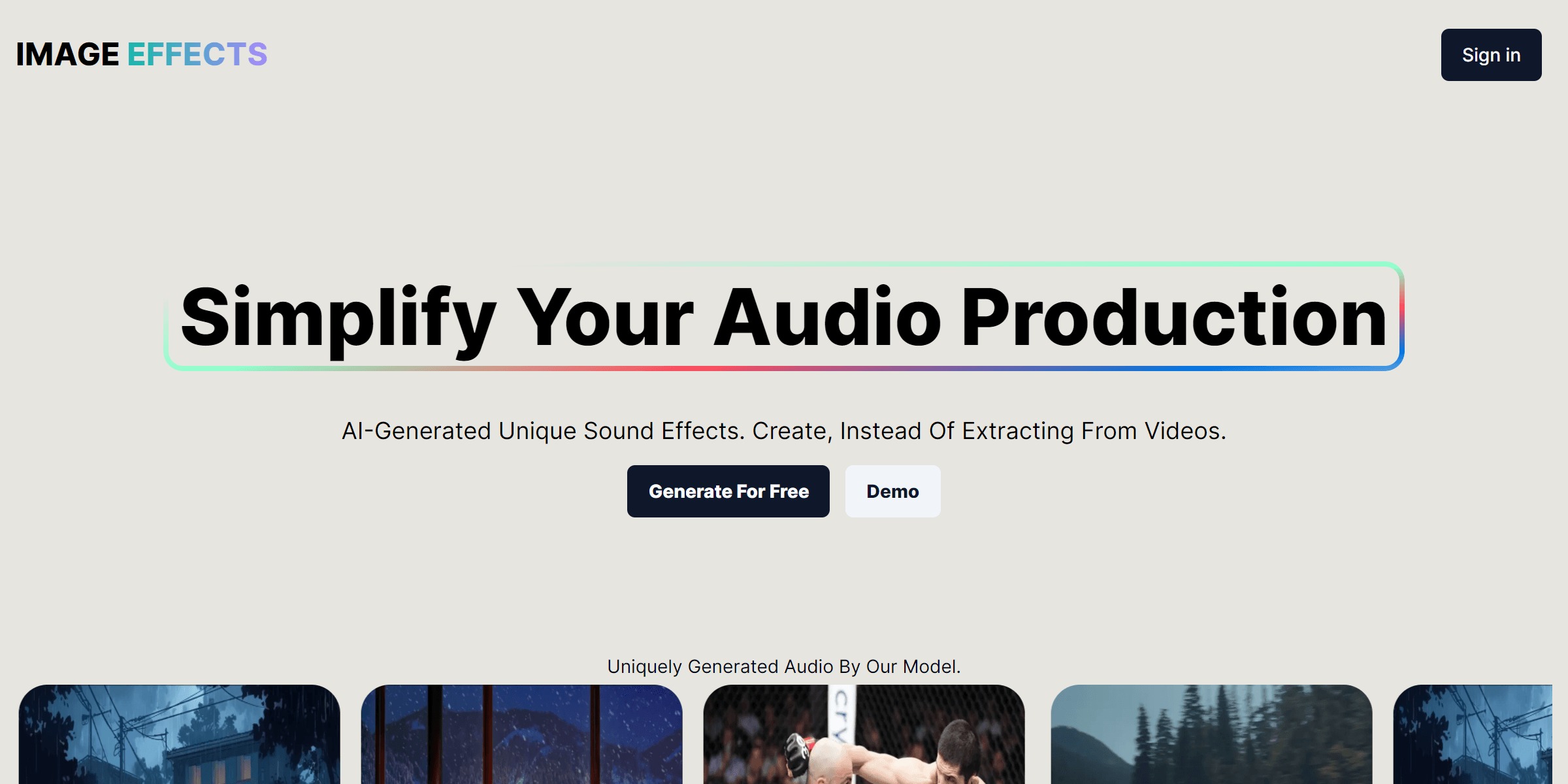
Image Effects
Image Effects is an AI-powered tool designed to simplify audio production by generating unique sound effects. Users can create custom audio by describing what they want to hear or by uploading an image to inspire a sound effect. The AI instantly generates a high-quality sound based on the input, which can then be previewed, downloaded, and used royalty-free in various projects. This tool helps creators save time by eliminating the need to search for or extract sounds from videos, allowing them to focus more on content creation. It offers a free tier with limited credits and paid plans for more generations and longer output limits, including access to generation history.
Guideless
Guideless is an AI documentation tool designed to simplify the creation of video guides and tutorials. It captures user workflows directly in the browser, turning every click into a clear, structured step. The platform then leverages AI to write a script and generate natural, professional narration for the guide. Users can customize the AI voice, refine the tone, and apply brand styling to ensure consistency. Guides can be shared instantly via a link, embedded in documentation or help centers, or exported as MP4 videos. A key feature is the ability to update guides anytime without re-recording, making it ideal for evolving workflows and product updates. Guideless aims to help teams scale customer education and create demo-ready content efficiently.
DiffSynth-Studio
DiffSynth-Studio is an open-source Diffusion model engine developed and maintained by the ModelScope Community, focusing on aggressive technical exploration and academic use. It provides cutting-edge model capability support for diffusion models, including text-to-music, image editing, audio-video generation, and various training capabilities like LoRA and FP8. The platform aims to lower the threshold for technical exploration with detailed documentation and supports a wide range of models such as Stable Diffusion, SDXL, ACE-Step-1.5, JoyAI-Image, LTX-2.3, Anima, FLUX.2, and Qwen-Image. It also features advanced VRAM management and split training for optimized performance.
Google AI Studio
Google AI Studio is a platform designed to accelerate the development, testing, and deployment of advanced AI models, particularly those powered by Gemini. It offers a streamlined environment for prompt engineering and code generation, enabling developers to quickly prototype and experiment with AI solutions. The platform aims to simplify the journey from initial concept to a production-ready AI application, making it an accessible tool for those looking to integrate sophisticated AI capabilities into their projects. It is offered by Google and is available for free, providing a robust set of features for AI development.
nunchaku
Nunchaku is a high-performance inference engine specifically designed for 4-bit neural networks, implementing the SVDQuant post-training quantization technique. This technology allows for 4-bit weights and activations while maintaining visual fidelity, as detailed in the accompanying ICLR 2025 Spotlight paper. The engine achieves significant memory reduction, up to 3.6x for 12B FLUX.1-dev models, and offers substantial speedups, such as 8.7x over 16-bit models on a 16GB laptop 4090 GPU by eliminating CPU offloading. Nunchaku also supports various features like LoRA, ControlNet, asynchronous offloading, and compatibility with ComfyUI, making it a versatile tool for accelerating diffusion models and other AI applications.
embabel-agent
embabel-agent is an open-source agent framework designed for the JVM, allowing developers to author agentic flows that combine LLM-prompted interactions with custom code and domain models. It features sophisticated planning capabilities, going beyond simple state machines to dynamically formulate and re-plan action sequences to achieve goals. The framework supports strong typing and object-oriented benefits, ensuring clean interaction between prompts and authored code. Key differentiators include superior extensibility, platform abstraction for consistent QoS, and design for effective LLM mixing, enabling the use of various models for different tasks, including local models for cost and privacy. Built on Spring, it integrates easily with existing enterprise functionality and offers robust testing capabilities for both unit and end-to-end agent flows. It supports both annotation-based and Kotlin DSL approaches for flow authoring.
nboost
NBoost is a scalable, open-source platform designed to enhance the relevance of search results by deploying state-of-the-art transformer models. It acts as a neural proxy, sitting between a client and a search engine like Elasticsearch, to rerank results based on fine-tuned models. This allows for domain-specific neural search engines and can improve other ranked input tasks such as question answering. NBoost offers easy installation via Docker, PyPi, or Kubernetes, and provides benchmarks demonstrating significant search boost compared to traditional methods. It supports both PyTorch and TensorFlow dependencies, making it flexible for various deployment environments.
Ratatoskr
SignalPM is an AI-powered project management platform designed to streamline project reporting, meetings, and presentations for B2B teams. It leverages AI to generate projects from natural language descriptions, analyze project risk, and provide instant executive insights at both project and portfolio levels. The platform automates the workflow from meeting notes to tasks, ensuring traceability and creating executive-ready presentations directly from live project data. Key features include multi-project Gantt timelines, hierarchical assignment structures, and real-time project health dashboards. SignalPM aims to provide immediate understanding of project status through its "10-Second Rule" philosophy, making it ideal for mid-market and enterprise teams seeking efficient project oversight and communication.
openbrowser
OpenBrowser is an autonomous web browsing framework built in TypeScript, designed to empower AI agents to interact with the web like a human. Leveraging Playwright, it supports leading AI models such as OpenAI, Anthropic, and Google, allowing agents to perform tasks described in natural language. Key capabilities include navigating, clicking, typing, scrolling, and extracting data without manual scripting. It features multi-model support via the Vercel AI SDK, an interactive REPL for debugging, and sandboxed execution with resource limits. OpenBrowser is production-ready, offering stall detection, cost tracking, session management, and replay recording, making it a robust solution for browser-based AI automation.