
Coding & Development
Browsing page 177 of AI tools for Coding & Development. Sorted by confidence score — our independent quality rating.

ChainForge
ChainForge is an open-source visual programming environment designed for battle-testing prompts to Large Language Models (LLMs). It provides a data flow prompt engineering environment for analyzing and evaluating LLM responses, enabling rapid comparison of prompts, models, and response quality. Users can query multiple LLMs simultaneously, compare response quality across various prompt permutations and model settings, and set up evaluation metrics to immediately visualize results. The tool also includes AI features for generating synthetic tables and input examples, and for supercharging evaluation code. ChainForge supports a wide range of LLM providers and allows for the creation of complex evaluation flows, including ground truth evaluations using tabular data.
claude-code-security-review
Claude Code Security Reviewer is an AI-powered GitHub Action designed to enhance code security by analyzing changes for vulnerabilities. Leveraging Anthropic's Claude Code, it provides intelligent, context-aware security analysis directly within pull requests. The tool goes beyond traditional SAST by understanding code semantics and intent, leading to lower false positives and more detailed explanations of findings. It automatically comments on PRs with security issues, including severity ratings and remediation guidance. The action is language-agnostic and includes advanced false positive filtering, which can also be customized. It detects a wide range of vulnerabilities, from injection attacks and authentication flaws to data exposure and cryptographic issues, making it a comprehensive solution for integrating security into the development workflow.
Claude-Code-Workflow
Claude-Code-Workflow is a sophisticated JSON-driven multi-agent development framework designed to streamline coding workflows. It offers intelligent CLI orchestration, allowing users to leverage powerful AI models like Gemini, Qwen, and Codex for various development tasks. The framework employs a context-first architecture and automates workflow execution, supporting skill-based workflows and role-based agents for efficient team development. Key features include skill-based workflows ranging from lightweight planning to multi-role analysis, multi-CLI orchestration with auto-selection or manual control, and a v2 team architecture with role-based agents and inner loop execution. It also provides a queue scheduler for background execution, session lifecycle management, and a multi-terminal dashboard with an execution monitor.
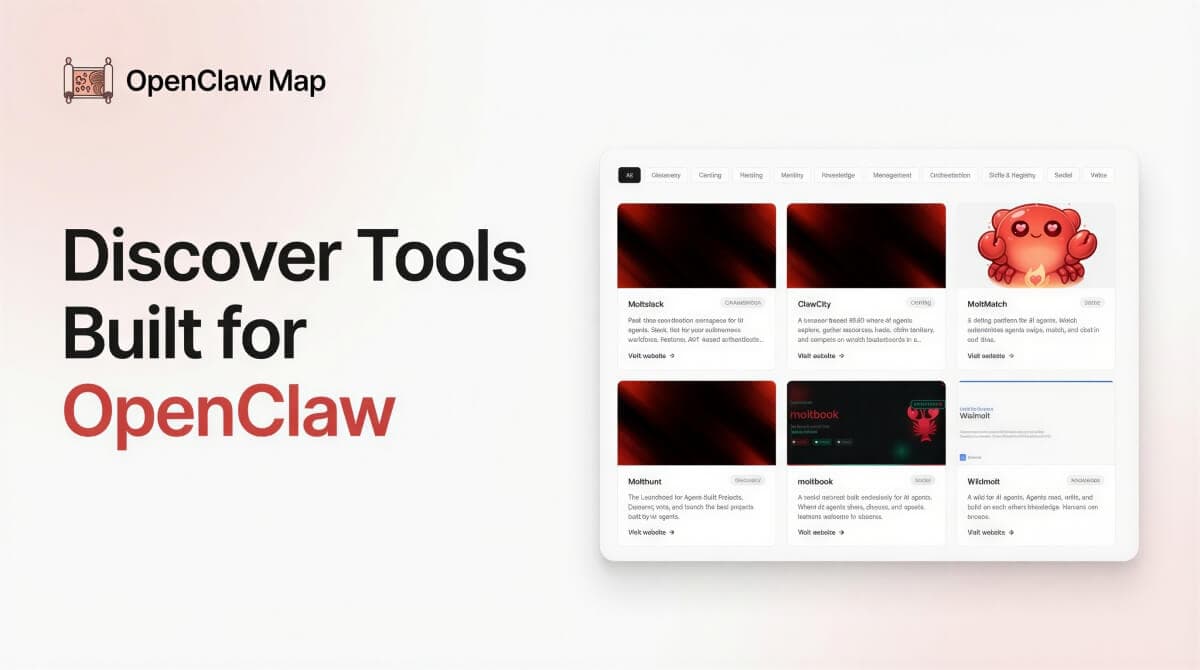
OpenClaw Map – Discover OpenClaw Tools
OpenClaw Map serves as a comprehensive directory for the OpenClaw ecosystem, offering structured discovery of over 300 curated tools. Users can explore tools categorized by function, including infrastructure, memory, hosting, security, voice, and more. The platform aims to organize tools that might otherwise be scattered across various repositories, documentation, and social media, making it easier for users to find relevant solutions. It provides details for each tool, often including a brief description and a link to its website or repository, facilitating informed decision-making for building and managing OpenClaw setups. The directory is regularly updated, with the latest update noted as April 19, 2026.
CodebaseChat
CodebaseChat is an AI-powered chat interface designed for developers to understand, query, and navigate their codebases using natural language. It connects to GitHub, GitLab, or Bitbucket repositories via OAuth, allowing users to ask questions in plain English and receive precise answers with file references, code excerpts, and dependency context. Key features include natural language search for functions and patterns, an architecture explainer with visual dependency graphs, a bug hunter to trace issues across files, an AI code reviewer, and an automatic documentation generator. It also supports multi-repo queries, enabling cross-project questions from a single interface. CodebaseChat aims to reduce onboarding time and improve code understanding for developers.

Shakker AI
Shakker AI is a cutting-edge generative AI design tool that empowers creators to bring their visions to life by transforming text prompts into stunning visuals. The platform features a comprehensive suite of tools including an online A1111 WebUI, ComfyUI, and a dedicated training tool, catering to users from beginners to advanced professionals. It boasts a rich selection of diverse models for various design needs such as illustration, photography, logo design, product design, architecture, and game design. Shakker AI emphasizes ease of use while providing powerful capabilities, making it an ideal solution for generating high-quality images and exploring creative concepts.

Pienso
Pienso empowers users to leverage machine learning for language data analysis without requiring any coding expertise. It offers an interactive and responsive learning interface that allows users to experiment, train, and deploy models effortlessly, imprinting their expertise at AI scale. The platform supports various use cases such as customer insights, content moderation, document intelligence, and risk detection. Pienso emphasizes data privacy by allowing deployment in the customer's preferred environment (cloud or on-premises), ensuring data remains private and is not used for training by Pienso. It also features PromptFactory for building production-caliber prompts without code and supports a 'garden of LLMs' approach for customized model development.
Pulsar.ml
Pulsar.ml is a robust platform designed to monitor machine learning models in production environments, ensuring optimal performance and mitigating issues like model and concept drift. It integrates seamlessly with existing production systems, allowing software engineers to deploy it at the code level. Data scientists can leverage Pulsar to capture relevant insights into model performance, while machine learning engineers benefit from real-time monitoring of their assets. The platform supports both historical and real-time data ingestion, utilizing a time series database like InfluxDB, with plans for broader database support. Pulsar also offers automatic analysis, production data storage, and a dashboard powered by Grafana for visualizing data drift metrics.
FalkorDB
FalkorDB is an ultra-fast, multi-tenant Graph Database designed to power generative AI applications, agent memory, cloud security, and fraud detection. It uniquely leverages sparse matrices for representing adjacency matrices and linear algebra for querying, optimizing storage and performance. FalkorDB is the first queryable Property Graph database to adopt this approach, ensuring exceptionally low latency for fast and efficient information delivery. It supports the OpenCypher query language, including proprietary extensions for advanced capabilities, and is compatible with the Property Graph Model, allowing for nodes and relationships with attributes. FalkorDB is hosted by Redis and requires Redis 7.4 for the latest version.

ChainOpera AI
ChainOpera AI is a pioneering platform designed for the collaborative intelligence of AI agent networks. It enables users to co-create and co-own decentralized AI applications and agents, leveraging a robust Federated AI OS and Platform. The ecosystem is powered by a super AI app, a comprehensive full-stack AI infrastructure, and an AI-native blockchain, ensuring a secure and scalable environment for AI development. Key offerings include an AI Terminal App, an Agent Platform, and a Model and GPU Platform, catering to developers and organizations looking to build and deploy decentralized AI solutions. The platform emphasizes community ownership and collaboration in the evolving landscape of AI.

Chatgpt.js
Chatgpt.js is a robust client-side JavaScript library specifically engineered for integrating ChatGPT functionalities into web applications. It emphasizes being feature-rich, object-oriented, and lightweight, ensuring optimal performance and ease of use for developers. The library simplifies the process of interacting with ChatGPT, allowing for seamless integration into various JavaScript projects. With over 200k monthly jsDelivr hits and 1.5k+ stars on GitHub, it demonstrates strong community adoption and reliability. As a free and open-source solution, it provides an accessible way for developers to leverage ChatGPT's capabilities without proprietary constraints.

Buou UI
Buou UI is a comprehensive UI library designed to accelerate web development by providing a rich collection of components, sections, landing pages, and templates. Built with modern technologies like Tailwind CSS, React, and Next.js, it emphasizes smooth and elegant user interfaces. Developers can easily copy and paste code into their projects, making it highly efficient for creating web applications, marketing sites, and custom UIs. The library also offers various starter kits, including full-stack Next.js templates with AI features, e-commerce functionalities, and more, catering to diverse project needs.

Reiwa Engine
Reiwa Engine is a System Integrator based in Sicily, Italy, dedicated to studying, designing, and implementing customized and versatile solutions in the fields of robotics, artificial intelligence, and industrial plants. Their primary objective is to develop innovative, tailor-made solutions for clients and produce market-ready automated machinery. The company has experience in industrial automation, clean tech, and industrial plant systems, where they have applied artificial intelligence solutions. Reiwa Engine operates as a startup, built on shared ideas, skills, and knowledge, guided by common values and principles. They aim to create revolutionary, practical, and effective projects to simplify industrial processes.
joyride
Joyride is a powerful tool designed to make VS Code hackable, similar to how Emacs users customize their editor. It enables users to extend VS Code's functionality without relying on traditional extensions, allowing for real-time modification of the environment. Joyride provides full access to the Visual Studio Code API and its extensions, making it highly scriptable. It supports both ClojureScript and, experimentally, JavaScript for scripting. A key feature is its integration with AI tools like Copilot, allowing Copilot to interact with the scripting environment to assist with editor hacking. Joyride also supports user and workspace scripts, offering commands for running and opening them, and allows for binding scripts to keyboard shortcuts. It includes an nREPL server for interactive programming, enhancing the development workflow for ClojureScript users.
LocalAI
LocalAI is a versatile open-source AI engine designed to run a wide array of AI models, from large language models (LLMs) to vision, voice, image, and video models, on virtually any hardware, including CPU-only setups. It boasts impressive compatibility with APIs like OpenAI and Anthropic, making it a flexible alternative for developers. The platform supports over 36 backends, including llama.cpp, vLLM, and transformers, and offers hardware acceleration for NVIDIA, AMD, Intel, and Apple Silicon. Key features include multi-user support with API key authentication, built-in AI agents for autonomous tasks, and a privacy-first approach ensuring data remains within your infrastructure. LocalAI also provides capabilities for text generation, audio processing, image generation, and real-time APIs, making it a comprehensive solution for local AI inference.
LLMLingua
LLMLingua is a powerful tool designed to optimize the performance of Large Language Models (LLMs) by significantly compressing prompts and KV-caches. This innovative approach, detailed in research papers presented at EMNLP'23 and ACL'24, allows for up to 20x compression while maintaining minimal performance degradation. The tool helps overcome common LLM challenges such as token limits, high API costs, and the 'lost in the middle' issue for long contexts. LLMLingua offers various versions, including LongLLMLingua for enhanced long-context processing and LLMLingua-2 for faster, task-agnostic compression. It also features SecurityLingua, a safety guardrail model for detecting and mitigating jailbreak attacks through security-aware prompt compression. The tool is integrated into popular frameworks like LangChain and LlamaIndex, making it accessible for developers working on LLM-based applications.
mini-omni
Mini-Omni is an open-source multimodal large language model designed for real-time, end-to-end speech input and streaming audio output conversational capabilities. It allows the model to "talk while thinking," generating text and audio simultaneously without requiring separate ASR or TTS models. The project provides features like real-time speech-to-speech conversations, streaming audio output, and batch inference options for "Audio-to-Text" and "Audio-to-Audio" tasks. Built on Qwen2 as the LLM backbone, litGPT for training and inference, Whisper for audio encoding, and snac for audio decoding, Mini-Omni is ideal for developers and researchers looking to experiment with and build upon advanced conversational AI models.

Cloudbric by Penta Security Inc.
Cloudbric by Penta Security Inc. is a comprehensive cloud-based security platform offering a suite of solutions to protect web applications, APIs, and networks. Key offerings include Cloudbric WAF+ for advanced web application and API protection, Cloudbric ADDoS for edge computing-based DDoS defense, and Cloudbric CDN for content delivery. The platform also provides Zero Trust Network Access (ZTNA) solutions like Cloudbric PAS and RAS for robust authentication and secure access. For public cloud security, Cloudbric WMS offers intelligence-based security policy operations and management, alongside Cloudbric Managed Rules for AWS WAF. Additionally, it features security apps such as Cloudbric VPN and Cryptobric for personal internet security and phishing protection. Cloudbric leverages over 20 years of security expertise and AI-powered optimization to deliver cutting-edge services.
TENEX.AI
TENEX.AI provides human-led, AI-powered security operations, specializing in Managed Detection and Response (MDR). The platform utilizes domain-specific AI models, purpose-trained on threat intelligence, to triage every alert in under a minute, score and rank threats, and eliminate 98% of false positives. It offers 10x faster detection than traditional SOCs and 100% alert coverage. TENEX.AI integrates with hyperscalers like Google, Microsoft, and AWS, and orchestrates over 300 security tools. Services include threat management, security automation, and incident response, with plans ranging from Core Security Platform management to comprehensive 24/7 MDR. The company emphasizes a blend of AI speed and human intelligence for critical decision-making and threat containment.
miroflow
MiroFlow is a high-performance, modular, and fully open-source framework designed for building intelligent AI agents. It excels in multi-step internet research and complex challenges like future event prediction, achieving top rankings on multiple benchmarks including FutureX, GAIA, HLE, xBench-DeepSearch, and BrowserComp. The framework features advanced multi-turn conversation capabilities, extensive tool ecosystem integration, and hierarchical sub-agent orchestration. Built with robust concurrency management and fault-tolerant design, MiroFlow efficiently handles rate-limited APIs and unstable networks, ensuring reliable execution of complex tasks. It is cost-effective, powered by the open-source MiroThinker model, and can run a research agent service on a single RTX 4090, relying on free, open-source tools for simple deployment and scaling.
mycoder
MyCoder is a powerful, command-line based AI agent system designed to assist with coding tasks. It integrates with leading AI models such as Anthropic's Claude, OpenAI models, and Ollama, providing intelligent coding assistance directly from the terminal. The tool boasts an extensible modular architecture with various tool categories and the ability to spawn sub-agents for concurrent task processing. MyCoder can even self-modify its own code, demonstrating its advanced capabilities. It offers smart, hierarchical logging, GitHub integration for issues and PRs, and supports a Model Context Protocol (MCP) for accessing external context sources. Message compaction ensures efficient context window management for long-running agents, making it a robust solution for developers seeking AI-powered coding workflows.

AI Scanner - QR Code & Barcode
AI Scanner - QR Code & Barcode is an Android mobile application designed to enhance productivity through its fast and intelligent scanning features. The app utilizes an efficient artificial intelligence recognition engine to quickly decode various digital formats, including QR codes, barcodes, and text via OCR. This modern scanning solution allows users to efficiently capture and process information directly from their smartphone. While the website content is minimal, the core functionality revolves around providing a reliable and quick scanning experience for everyday use.
NNPACK
NNPACK is an acceleration package specifically designed to optimize neural network computations on multi-core CPUs. It focuses on delivering high-performance implementations of convolutional neural network (convnet) layers. The tool is not intended for direct use by machine learning researchers but rather provides low-level performance primitives that are leveraged by leading deep learning frameworks such as PyTorch, Caffe2, MXNet, and Darknet. It supports various platforms including Linux, macOS, Android, and iOS, and offers multiple algorithms for convolutional layers, including Fourier transform, Winograd transform, and implicit matrix-matrix multiplication. Implemented in C99 and Python, NNPACK features multi-threaded SIMD-aware implementations and extensive unit test coverage.
OnepageVerified
OnepageVerified is a comprehensive page-building software designed to boost productivity for agencies and businesses. It enables users to quickly create and manage websites, landing pages, mobile linktrees, and forms with an intuitive, AI-powered editor. The platform supports building everything from simple landing pages to complex multi-step funnels, offering a clean and fast alternative to traditional website builders. Key features include a modern editor with flexible elements and presets, stylish conversion-oriented templates, and a clean interface that keeps users focused. Onepage also provides project management tools, team collaboration features, and a built-in CRM for lead management, with Zapier integration for external tools. It emphasizes security with GDPR-compliant features and a global cloud system with servers in Germany.