
Coding & Development
Browsing page 197 of AI tools for Coding & Development. Sorted by confidence score — our independent quality rating.

chatglm-openai-api
chatglm-openai-api is an open-source project that offers an OpenAI-compatible API for various large language models, specifically ChatGLM-6B, ChatGLM2-6B, and Chinese Embeddings Models. This tool simplifies the integration of these powerful models into existing applications by providing a standardized API interface, similar to what developers are accustomed to with OpenAI. It supports loading models from Hugging Face and running inference on GPUs, with options for local loading and multi-GPU inference. The project also includes advanced features like ngrok and Cloudflare tunnel integration for exposing the API, making it accessible for development and deployment. It's designed for developers looking to leverage these specific models with ease.
char-rnn-tensorflow
char-rnn-tensorflow is an open-source implementation of multi-layer Recurrent Neural Networks (LSTM, RNN) designed for character-level language models. Developed in Python using Tensorflow, it provides a foundational framework for researchers and developers interested in text generation and language modeling experiments. The tool is inspired by Andrej Karpathy's char-rnn and offers basic usage for training models with default parameters on datasets like tinyshakespeare, with options to sample from checkpointed models. Users can supply any plain text file as input, making it highly flexible for various text-based projects. It also includes guidance on tuning models, using Tensorboard for visualization, and contributing to its development, making it a comprehensive resource for those working with RNNs.
Composer
Composer is an open-source AI tool designed to generate video game music using neural networks. Developed by HackerPoet, this project provides a unique approach to game audio development by leveraging artificial intelligence to compose original scores and background music. It is hosted on GitHub, making it accessible for developers and enthusiasts to explore, contribute, and utilize its capabilities. The tool focuses on automating the music creation process, offering a solution for generating dynamic and context-aware soundtracks for various video game scenarios. Its neural network foundation allows for complex musical compositions, potentially saving time and resources for game developers.
ChatWaifu_Mobile
ChatWaifu_Mobile is an Android-based AI chatbot designed to provide interactive conversations with anime-style characters. It leverages ChatGPT for its language model, allowing for dynamic and engaging dialogues. The application features voice responses from integrated models, including characters like Youxiang from Blue Archive and Makise Kurisu from Steins Gate, with the ability to add local models. Graphics are rendered using Native Live2D, bringing the characters to life. It supports local voice input recognition via Sherpa-ncnn and integrates with a native meta-lipSync for mouth synchronization. Users can customize models, settings, and even integrate Baidu Translate for enhanced functionality, making it a versatile tool for fans of anime and AI interaction.
petercat
PeterCat is a comprehensive solution for creating intelligent Q&A bots specifically designed for GitHub repositories. It offers a conversational Q&A agent configuration system, self-hosted deployment options, and an all-in-one application SDK. Users can easily create Q&A bots by simply providing their repository address or name, with PeterCat automating the entire setup process. The system automatically ingests GitHub documentation and issues to build a knowledge base for the bot. PeterCat supports multi-platform integration, including an SDK for websites and a GitHub App for direct repository integration. Beyond basic Q&A, the bots can handle project information queries, discussion and PR summaries, code reviews, and issue management.
Morphic
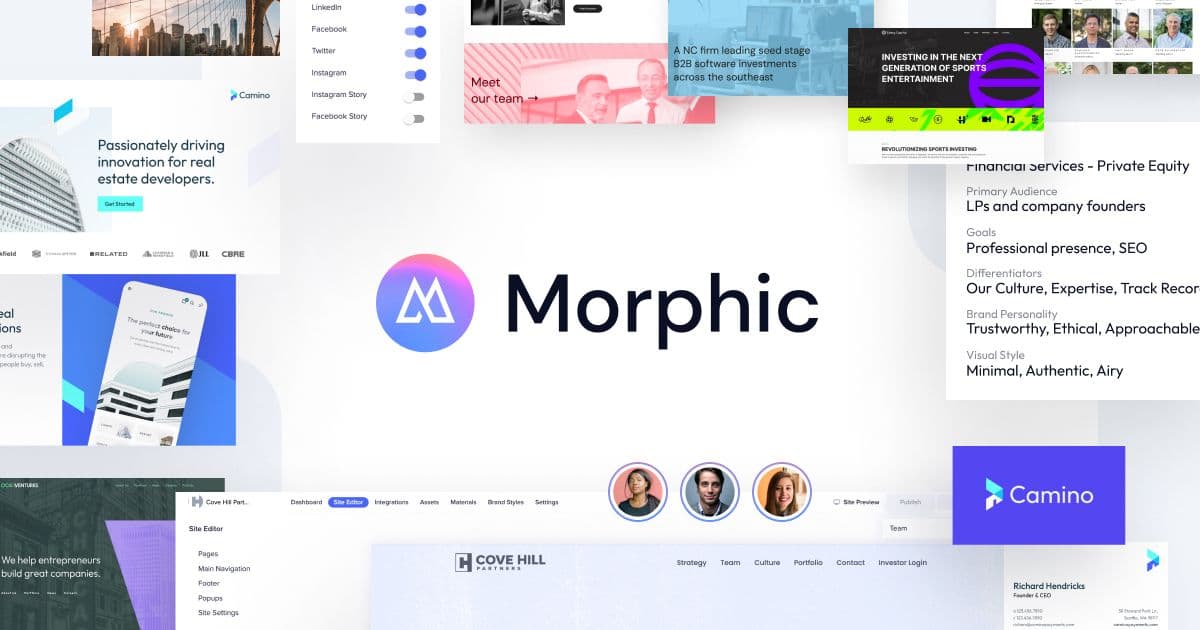
Morphic is an automated design platform specifically tailored for startups and professional firms, enabling them to create world-class websites without requiring designers or developers. The platform leverages AI to streamline the entire website creation process, from initial strategy and design to ongoing optimization. It offers an intuitive content management system (CMS) for easy updates and continuous improvement with new features, SEO enhancements, and design optimizations. Morphic aims to provide professional, custom web design automation, making high-quality online presence accessible for businesses, including those in venture capital and growth equity.
Octopoda
Octopoda offers a robust memory infrastructure specifically designed for AI agents, allowing them to maintain context and information across multiple sessions. This capability is crucial for developing sophisticated and reliable AI applications that require long-term memory. Key features include semantic search, which enables agents to retrieve relevant information efficiently, and comprehensive audit trails for tracking agent activities and ensuring accountability. The platform also incorporates crash recovery mechanisms to enhance operational resilience. Octopoda supports flexible deployment options, accommodating both local and cloud environments, and is available as an open-source solution, providing developers with transparency and customization opportunities.
qiskit-machine-learning
Qiskit Machine Learning is an open-source library built on Qiskit, designed for quantum machine learning tasks at scale. It introduces fundamental computational building blocks like Quantum Kernels and Quantum Neural Networks, which are essential for applications such as classification and regression. The library aims to be user-friendly, allowing quick prototyping without extensive quantum computing knowledge, while also being flexible for proofs-of-concept and innovative research. It is extensible, facilitating the integration of new features leveraging Qiskit's architecture. Key features include kernel-based methods using FidelityQuantumKernel, generic interfaces for neural networks (EstimatorQNN, SamplerQNN), and integration with PyTorch for automatic differentiation in hybrid quantum-classical neural networks.
STT
Coqui STT (🐸STT) is a fast, open-source, multi-platform, deep-learning toolkit designed for training and deploying speech-to-text models. It has been battle-tested in both production and research environments, offering a high-quality pre-trained STT model. Key features include an efficient training pipeline with multi-GPU support, streaming inference capabilities, and real-time inference. The toolkit can provide multiple possible transcripts, each with an associated confidence score, and boasts a small-footprint acoustic model. It also offers bindings for various programming languages, making it accessible for developers. However, it is important to note that this project is no longer actively maintained, with focus shifting to newer models like Whisper and Coqui's other projects.
yomo
yomo is an open-source serverless AI Agent Framework designed for building scalable and ultra-fast AI agents, leveraging geo-distributed edge AI infrastructure. It empowers exceptional customer experiences by focusing on speed, reliability, and scalability of AI interactions. Key features include seamless deployment and management of serverless LLM tools, enhanced security with TLS v1.3 encryption for all data packets, and effortless Agents DevOps to streamline the entire lifecycle from development to deployment. The geo-distributed architecture brings AI inference and tools closer to users, resulting in significantly faster response times. yomo is built with Rust, ensuring high performance and efficiency for AI applications.
SampleApp.ai
SampleApp.ai is an innovative platform designed to significantly accelerate API and SDK integration for developers. It offers a Stripe-like guided onboarding experience, allowing developers to visualize and understand how to implement APIs directly into their codebase. The tool generates personalized code snippets tailored to the prospect's tech stack and provides pre-built flows for specific use cases. With a live preview synced with the code, developers can track their progress, while teams gain full visibility into engagement and usage. This solution aims to reduce integration time from weeks to hours, enhance developer activation, and decrease support tickets by providing a fast, guided, and measurable integration process.
Same.dev
Same.dev offers an innovative approach to website development, enabling users to create websites simply by chatting with an AI. This platform aims to streamline the development process, making it accessible even for those without extensive coding knowledge. Users can interact with the AI to describe their desired website, and the tool will generate the necessary components. The platform emphasizes ease of use, allowing for rapid prototyping and development of web projects. It is designed to empower individuals and teams to bring their web ideas to life efficiently.
Modal
Modal offers a serverless cloud platform specifically designed for compute-intensive AI and machine learning applications. It enables developers to define and run their code, including CPU, GPU, and data-intensive compute, at scale without managing underlying infrastructure. Key features include sub-second cold starts, instant autoscaling, and elastic GPU scaling with access to thousands of GPUs across various clouds. The platform provides a programmable infrastructure where everything is defined in code, eliminating the need for YAML or config files. It also boasts a built-in storage layer optimized for fast model loading and data processing, along with unified observability for integrated logging and full visibility into workloads. Modal supports various ML workloads like inference, training, sandboxes, batch processing, and notebooks, making it a comprehensive solution for AI and data teams.
10Web
10Web is an AI website builder ecosystem designed to help users create or recreate any website in minutes. It features an Agentic Website Builder powered by AI agents that plan, execute, and refine websites from prompt to production-ready. The platform includes AI tools for generating content, images, and optimizing for SEO. Beyond building, 10Web provides premium WordPress hosting with 99.99% uptime, free SSL, backups, staging, and CDN. It also offers White Label solutions for agencies and hosting providers to integrate AI website creation into their services, enabling them to launch branded AI website SaaS platforms or add full WordPress sites to their offerings.
Emmi AI
Emmi AI specializes in Large Engineering Models (LEMs), which are pre-trained engineering intelligence designed to replace traditional solvers and deliver instant, physics-accurate results across entire industrial verticals. The platform emphasizes real-time engineering, enabling rapid validation of designs. Emmi AI's framework allows for building, training, fine-tuning, and deploying physics AI models at an industrial scale, from data loading to inference optimization. It provides physics-validated datasets and production-ready models for specific engineering use cases, which can be deployed immediately or fine-tuned. The company has released NeuralMould for injection molding simulation and the Noether Framework, an open-source deep learning framework for engineering AI, built for reproducible and extensible workflows.

Landing.report
Landing.report is an AI-powered platform designed to optimize landing page performance and boost conversion rates. It offers comprehensive AI reviews that audit design, copy, and SEO, transforming landing pages into sales machines. Users can get instant AI feedback, ask follow-up questions for deeper insights, and receive actionable tips to improve conversion rates. The tool also provides a unique "landing page roast" feature, allowing AI to quickly identify and highlight areas for improvement. It's ideal for anyone looking to identify and fix conversion roadblocks, overcome common pitfalls, and get tailored recommendations to enhance their landing pages.
api-for-open-llm
api-for-open-llm is an open-source project that offers a unified backend interface for a wide range of open large language models, designed to mimic the OpenAI ChatGPT API. This allows developers to seamlessly integrate and utilize models such as LLaMA, LLaMA-2, BLOOM, Falcon, Baichuan, Qwen, Xverse, SqlCoder, CodeLLaMA, and ChatGLM into their applications. Key features include support for streaming responses, enabling printer-like effects, and the implementation of text embedding models crucial for document knowledge Q&A. It also integrates with LangChain for advanced LLM development and supports loading fine-tuned LoRA models. The project simplifies the process of using open models as ChatGPT alternatives by requiring only simple environment variable modifications, and it offers vLLM for inference acceleration and concurrent request handling.
AI-Codereview-Gitlab
AI-Codereview-Gitlab is an automated code review tool designed to enhance code quality and development efficiency for teams using GitLab. It leverages large language models such as DeepSeek, ZhipuAI, OpenAI, Anthropic, Tongyi Qianwen, and Ollama to perform intelligent code reviews during merge requests or push operations. The tool offers instant notification delivery of review results via DingTalk, Enterprise WeChat, or Feishu. Additionally, it generates automated daily reports based on GitLab, GitHub, and Gitea commit records, providing insights into daily development progress. A visual dashboard centralizes all code review records, offering project and developer statistics. Users can also choose from various review styles, including professional, sarcastic, gentle, and humorous.
aider.el
aider.el brings AI-assisted programming to Emacs, leveraging the Aider terminal tool to offer a lightweight yet powerful UI. It supports AI-driven agile workflows, including TDD, refactoring, and legacy code handling. Developers can utilize diff extraction and AI code review tools, along with AI assistants for code reading and software planning. The tool also features automated Flycheck error fixes, context expansion for dependencies, and code/repo evolution analysis using git blame and log. With minimal configuration and clear documentation, aider.el is designed as a stable, daily productivity tool, with many of its own Elisp components generated by Aider or aider.el itself. It supports various models like Claude Sonnet and ChatGPT, requiring API keys for usage.
Chainlit
Chainlit is an open-source Python framework designed to accelerate the development of production-ready conversational AI applications. It allows developers to build interactive chat user interfaces in minutes, not weeks, by providing a streamlined environment for integrating AI agents and automated workflows. The framework supports popular AI tools and services such as OpenAI, Anthropic, LangChain, LlamaIndex, ChromaDB, and Pinecone, making it versatile for various AI projects. Chainlit emphasizes ease of use for Python developers, enabling them to quickly prototype and deploy AI applications. While the original team has stepped back from active development, it is now community-maintained, ensuring ongoing support and evolution.
chatgpt-vercel
chatgpt-vercel provides an elegant and powerful user interface for deploying ChatGPT, powered by OpenAI and Vercel. It supports Progressive Web App (PWA) functionality and offers extensive prompt presets, searchable via keywords. Users can manage multiple conversations, each with independent settings, roles, and direct URL access. The tool allows for exporting and importing conversations and settings, real-time token usage monitoring, and various balance inquiry methods. It also supports URL queries for search engine-like functionality and offers advanced features like context management, message locking, and customizable settings for API keys, passwords, and conversation behavior. Deployment is streamlined for Vercel, with options for local development and other platforms like Netlify and CloudFlare Worker.
FEDOT
FEDOT is an open-source framework designed for automated modeling and machine learning (AutoML) tasks. It leverages an evolutionary approach to automatically generate and optimize machine learning pipelines for diverse problems such as classification, regression, clustering, and time series prediction. A key feature is its graph-based representation, which effectively manages complex interactions between data preprocessing and model blocks. FEDOT supports widely used ML libraries like Scikit-learn, CatBoost, and XGBoost, and allows for the integration of custom models. It offers flexibility for various data types and tasks, extensibility through task-specific strategies, and customizability for managing model complexity. The framework also ensures reproducibility by allowing pipelines to be exported as JSON or ZIP archives.
WP Safe AI
WP Safe AI is a Security as a Service (SaaS) solution designed to swiftly and effortlessly secure compromised WordPress websites. Leveraging AI-powered algorithms, it performs thorough malware detection and removal, backed by expert verification for complex cases. The service guarantees a fast cleanup, aiming to get sites back online within 24 hours or it's free. It features a user-friendly interface requiring no technical skills, a free scan to assess malware extent, and a one-click cleanup process. Users can review their cleaned site on a secure staging server before deployment, ensuring satisfaction and confidence. WP Safe AI provides a comprehensive solution for WordPress security, combining automation with human expertise.
PandaWiki
PandaWiki is an open-source, AI large language model-driven system designed for building intelligent knowledge bases. It enables users to quickly create product documentation, technical documentation, FAQs, and blog systems. The platform leverages AI for content creation, question answering, and search functionalities, enhancing the efficiency and intelligence of knowledge management. Key features include robust rich-text editing compatible with Markdown and HTML, export options to Word, PDF, and Markdown, and easy integration with third-party applications like web widgets or chat bots for DingTalk, Feishu, and WeChat. PandaWiki also supports content import from various sources, including web URLs, sitemaps, RSS feeds, and offline files.