
Coding & Development
Browsing page 206 of AI tools for Coding & Development. Sorted by confidence score — our independent quality rating.

MERN.AI
MERN.AI offers an AI-powered estimate generator to provide instant cost estimates for app ideas, eliminating the need for sign-up. The platform specializes in building, launching, and scaling applications, leveraging a combination of AI tools and human expertise. They emphasize a structured yet flexible development process, including dedicated project managers, weekly deliveries, and transparent progress tracking. MERN.AI focuses on building highly scalable and performant applications, ensuring clients own 100% of their code and intellectual property. Their services cover frontend, backend, mobile app, database, AI, and cloud expertise, aiming to deliver products faster to market.
Voqal Assistant
Voqal Assistant transforms the software development experience by enabling natural speech programming. Developers can control their IDE, navigate, run, and debug software using plain-spoken language without wake words. The tool also facilitates code generation through natural, progressive conversations, allowing users to think aloud while Voqal handles the typing. It offers extensive customization options, including context extensions for integrating live data, access to underlying prompt templates for real-time tweaking, and custom tools to perform actions. Voqal supports over 15 compute providers, from OpenAI to self-hosting, ensuring adaptability and access to the latest AI advancements.

DigitalSherpa, Your Digital Buddies!
DigitalSherpa is a software company focused on leveraging Agentic AI for Business Process Management (BPM). Their core offering, the DS iFlow platform, enables rapid, low-code development of complex business use cases. This platform is designed to help both enterprises and startups optimize their operations by reimagining traditional case management and workflow automation processes. By blending Agentic AI with BPM principles, DigitalSherpa aims to guide organizations through their innovation journeys, providing tools for efficient and intelligent workflow solutions.
DevAssure - AI Test Agent
DevAssure is an AI-Agentic Test Automation Platform designed to streamline end-to-end software testing for web, mobile, and API applications. It leverages AI agents, specifically its 'O2' agent, to understand code changes, map impact, and autonomously generate and execute tests. The platform offers a no-code interface for defining test behaviors in plain English, eliminating the need for manual script writing and maintenance. DevAssure integrates seamlessly into CI/CD pipelines (GitHub, GitLab, Bitbucket, CircleCI) and provides IDE-native extensions for VS Code, allowing developers to run tests directly from their development environment. Key features include precision impact mapping, dynamic test generation, and self-adjusting test suites for zero-flakiness, ensuring faster releases and higher coverage.
Embold Technologies GmbH
Embold Technologies GmbH provides a static code analysis platform designed for enterprises to improve code quality and security. The platform identifies structural design issues, security vulnerabilities, and technical debt early in the development cycle. Key features include anti-pattern detection, identifying up to 30 types of structural design issues, and a collaborative team dashboard for synchronized issue tracking and deep-dive file analysis. Embold also offers continuous reporting, a history and compare engine for tracking code health over time, and a flexible quality gate system with instant failure alerts. It seamlessly integrates into CI/CD pipelines and supports code reviews for GitHub, Bitbucket, GitLab, and Azure DevOps. Additionally, Embold provides free IDE plugins for Visual Studio Code, Visual Studio, IntelliJ Idea, and Android Studio to fix code issues before commits.

KrosAI
KrosAI provides AI-native phone infrastructure designed for emerging markets, allowing users to provision local numbers and connect AI agents for real-time voice automation globally. This platform handles essential telecom infrastructure, including number provisioning, call routing, and billing, making it a comprehensive solution for deploying voice AI. It offers full call visibility and is ideal for businesses, call centers, enterprises, and NGOs looking to build phone-first workflows. KrosAI serves as an alternative to traditional CPaaS solutions, focusing on AI integration and ease of deployment for voice-enabled services.

Magic Potion
Magic Potion is an AI tool designed to help users craft effective prompts for various AI models. It streamlines the process of refining inputs to achieve desired AI outputs, saving time and improving the quality of results. This platform is particularly useful for individuals and teams looking to enhance their interaction with generative AI systems by providing a structured approach to prompt engineering. By focusing on the art of prompt creation, Magic Potion aims to make AI more accessible and powerful for a wide range of applications, from content generation to data analysis.

AI and Games
AI and Games is a Substack publication by Tommy Thompson that delves into the research and practical applications of artificial intelligence within the video game industry. It offers insights into how AI tools and techniques are being utilized for both new and ongoing game development projects. The publication aims to provide easily-digestible content, drawing on decades of experience in industry and academia to break down complex topics. It serves as an essential resource for understanding the intersection of AI and game development, helping developers and enthusiasts alike to grasp how AI can elevate the gaming experience in various ways.
Documentation
Adala is an open-source framework designed for building Autonomous Data (Labeling) Agents. It offers a robust structure for implementing agents that specialize in data processing, with a particular focus on various data labeling tasks. These agents are autonomous, meaning they can independently acquire and refine skills through iterative learning, influenced by their operating environment, observations, and reflections. Users define the environment by providing a ground truth dataset, and agents learn and apply their skills within a 'runtime,' typically an LLM. The framework supports defining skills like classification, connecting to datasets, and integrating with different runtimes such as OpenAI's models.
ClassifyAI
ClassifyAI is a Python project designed to classify data using personalized models powered by the OpenAI API. It provides a REST API that allows users to send classification requests and receive structured responses from GPT models. This tool supports defining custom classification models, either by referencing pre-configured JSON files or by passing the model structure directly in the API request. It's built with Flask and Python, offering flexibility for integration into various applications. Key features include model creation, editing, deletion via a Python API, and the ability to define and run tests for models, ensuring accurate and consistent data classification.
Kornia AI
Kornia AI is a non-profit organization dedicated to advancing Spatial Artificial Intelligence through open collaboration. Founded in 2018, it offers a PyTorch-based geometric computer vision library that serves as the foundation for its ecosystem, powering millions of downloads monthly with differentiable computer vision operations. Beyond the core library, Kornia AI also provides Kornia-rs, a high-performance, low-level 3D computer vision library in Rust, and Bubbaloop, a VLM serving platform for multimodal AI. The platform enables seamless multimodal inference from prototype to production at enterprise scale. Kornia AI supports its community with pre-built developer bundles, including hardware with Docker services and the Bubbaloop platform pre-installed, designed for immediate use with zero configuration.
Loadmill
Loadmill is an AI-powered platform designed for comprehensive test automation, unifying API, UI, and Performance testing. It leverages generative AI to create tests directly from real user traffic, significantly reducing the effort and time traditionally associated with test creation. The platform aims to eliminate test flakiness and ensure robust validation of business processes across complex environments. By prioritizing API-level testing, Loadmill provides extensive coverage and faster testing cycles, enabling development teams to ship software with greater confidence and efficiency. Its capabilities are geared towards helping developers and QA professionals streamline their testing workflows.

oh-my-openagent
Oh My OpenAgent, also known as omo, is a powerful open-source agent harness designed to orchestrate multi-model AI agents for coding and development tasks. It offers a "batteries-included" solution with features like background agents, over 40 lifecycle hooks, and specialized agents for various workflows such as architecture consulting, code search, and plan validation. The tool emphasizes a "think, then act" orchestration workflow, separating planning from execution, and includes a "Sisyphus" agent for deep architectural reasoning and complex debugging. It supports dynamic agent assembly, matching requests to the right model and skills, and ensures session continuity with its "boulder system" to resume work exactly where it left off, even after interruptions. Oh My OpenAgent aims to provide a highly precise and autonomous AI-driven development experience.
sourcery
Sourcery is an automated code reviewer designed to provide instant AI code reviews for any pull request on GitHub. It aims to accelerate development velocity by improving code quality and reducing the time spent on reviews. Each review includes a summary of changes, high-level feedback, and line-by-line suggestions. Beyond code reviews, Sourcery also functions as an automated pair programmer within your IDE, assisting with code understanding, adding unit tests and docstrings, and optimizing code for readability or performance. It supports integrations with popular IDEs like PyCharm, VS Code, Sublime, and Vim.
nanobrowser
Nanobrowser is an open-source Chrome extension designed for AI-powered web automation, providing a free and privacy-focused alternative to tools like OpenAI Operator. It enables users to run complex multi-agent workflows directly within their browser, leveraging their own LLM API keys from providers such as OpenAI, Anthropic, Gemini, Ollama, and custom OpenAI-Compatible services. Key features include a multi-agent system for collaborative task execution, an interactive side panel for real-time updates, and the ability to automate repetitive web tasks. Users can configure different LLM models for various agents (Navigator, Planner, Validator) to optimize performance and cost, ensuring complete control over their data as everything runs locally.
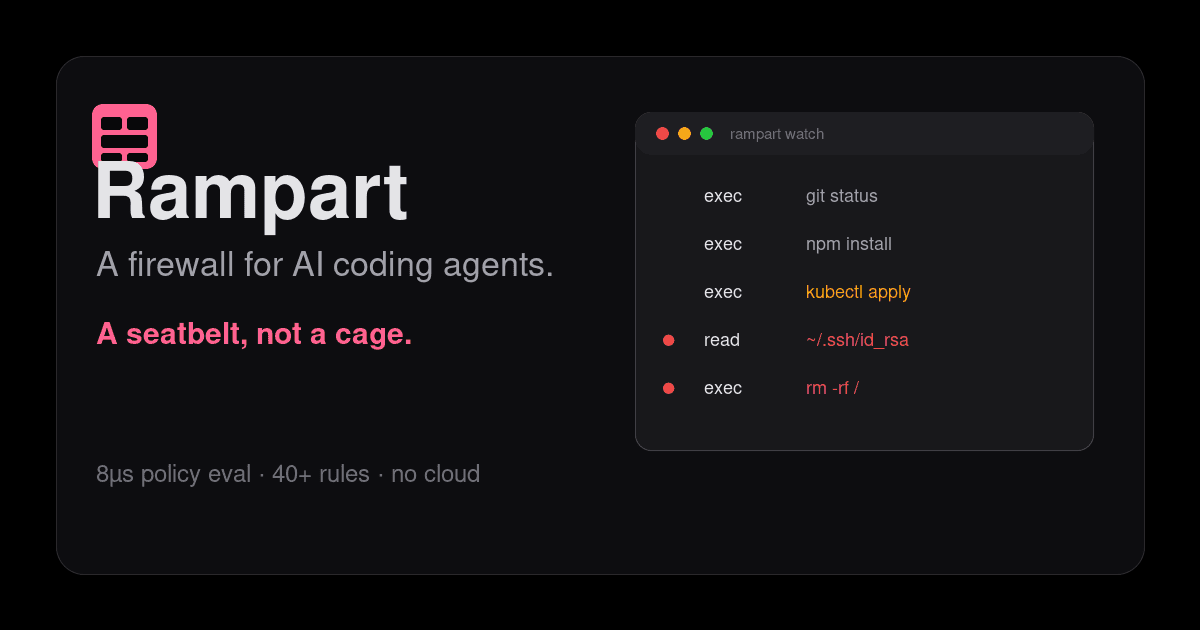
Rampart
Rampart is an open-source AI agent firewall designed to enhance the security of AI coding agents like Claude Code, Codex, Cline, OpenClaw, and MCP. It operates by sitting between the agent and the system, evaluating commands, file access, and network requests against a user-defined YAML policy before execution. This local-first approach ensures no cloud dependency and provides real-time protection against credential reads, data exfiltration patterns, and destructive commands. Rampart allows normal development actions to proceed quickly while blocking or requiring approval for risky operations, providing a crucial "seatbelt, not a cage" for AI agent workflows. It also maintains a hash-chained local audit log for tamper-evident record-keeping.

DockYard, Inc.
DockYard is an industry-leading digital product development studio specializing in custom software, mobile, and web app development, product design, and strategy. They leverage AI-powered tools alongside 15 years of human expertise to enhance development processes, reduce time and costs, and give products a competitive edge. Services include product strategy & discovery, custom websites & mobile apps, architectural reviews, application maintenance, engineering consulting, and AI & intelligent automation. DockYard works with Fortune 500 companies and industry disruptors, focusing on building scalable architectures and integrating modern tech stacks like Swift, Rust, Svelte, Ruby, Elixir, Android, Vue, and React. They aim to be an extension of their clients' teams, ensuring open communication and seamless knowledge sharing.
Centaur.ai
Centaur.ai offers expert data annotation services designed to accelerate AI development with precision-labeled datasets. The platform utilizes a unique competitive annotation approach, where a global network of over 50,000 experts compete to produce accurate labels, driving higher data quality. Centaur.ai supports multimodal data annotation across various industries, including medical devices, life sciences, and consumer intelligence, for data types such as text, image, audio, video, and waveforms. It also provides a pre-deployment trust layer for AI, focusing on defensible data de-identification and certification to ensure sensitive data is protected while remaining valuable for AI training and evaluation. The service is HIPAA-compliant and adheres to rigorous security protocols.
Perpetual ML
Perpetual ML offers a comprehensive, unified ML studio designed for both solo developers and data science teams, integrating directly with existing data warehouses like Snowflake. The platform enables users to automatically train models using PerpetualBooster, track and compare experiments, and instantly deploy models for batch or real-time inference. It also provides effortless monitoring of metrics, data drift, and model drift, ensuring continuous learning from real-time data for optimal business decisions. Key features include continual learning to significantly cut training time, direct optimization of user-defined business objectives, and a secure model registry. Perpetual ML also includes Marimo Notebooks for streamlined data exploration and development, all while keeping data within your data warehouse for enhanced security and governance.
Featureform
Featureform is an open-source virtual feature store designed to empower data scientists by providing a centralized platform to define, manage, and serve machine learning features. It orchestrates existing data infrastructure to build and maintain training sets and production features, offering built-in versioning, lineage, orchestration, monitoring, and governance. The platform facilitates deployment by orchestrating transformation pipelines for both training and inference, enhances collaboration through searchable and reusable features, and organizes experimentation by capturing and versioning changes in feature pipelines. It also increases reliability with active monitoring for job failures and data drift, and preserves compliance with role-based access control, audit logs, and native integrations.

Claude Code Attempted 752 /proc/*/environ Reads. 256 Succeeded. Codex: 0
This analysis from grith.ai provides a deep dive into the security implications of AI coding agents, specifically Claude Code and Codex. By using `strace` to monitor system calls, the report uncovers significant differences in their operational behaviors. It reveals that Claude Code, when performing a simple task like adding input validation to a single file, attempts to read the environment variables of 752 processes, successfully accessing 256, including sensitive ones like browser, Slack, and credential stores. The report also details how both agents read credential files and how Claude Code initializes unrelated services like Gmail and Google Calendar during coding tasks. This research emphasizes the 'blast radius problem,' where AI agents implicitly authorize broad access, creating potential attack surfaces that are not immediately visible to the user. The findings advocate for per-syscall interception to enhance visibility and control over AI agent actions.

Twistcode
Twistcode is an AI and supercomputing service company based in Malaysia, known for its self-assembled supercomputer, A.D.A.M., which was ranked 88th fastest globally in 2019. The company specializes in developing enterprise AI solutions for various sectors, including engineering, healthcare, and finance. Twistcode provides high-performance computing services, offering ready-to-use virtualized or bare-metal servers with dedicated hardware and GPUs. Its ML/AI Model Deployment platform, Mata, simplifies the deployment of AI and machine learning models, allowing users to utilize pre-trained models or upload their own. Additionally, Twistcode offers specialized services like Weather Forecasting with proprietary data and state-of-the-art models, and World Market Predictions (Okane) for cryptocurrencies, commodities, and forex, aiding in data-driven decision-making.
CodeGraphContext - An MCP server that converts your codebase into a graph database, enabling AI assi
CodeGraphContext functions as an MCP server designed to transform a codebase into a structured graph database. This conversion provides a rich, interconnected context that is invaluable for both AI assistants and human developers. By organizing code information in a graph format, the tool facilitates precise and efficient retrieval of specific code elements, relationships, and dependencies. This capability is particularly beneficial for enhancing the performance and accuracy of AI-powered development tools, such as GitHub Copilot, by giving them a deeper understanding of the code's architecture. Ultimately, CodeGraphContext aims to improve code comprehension, streamline navigation within complex projects, and boost overall development efficiency.
![[D] AMA Secure version of OpenClaw](/_next/image?url=https%3A%2F%2Fironclaw.com%2Ffeatured-v1.jpg&w=3840&q=75)
[D] AMA Secure version of OpenClaw
IronClaw is a secure, open-source alternative to OpenClaw, designed to run AI agents in encrypted enclaves on NEAR AI Cloud. It addresses critical security concerns associated with AI agents, such as prompt injection and credential exfiltration. IronClaw ensures that sensitive information like API keys, tokens, and passwords are encrypted at rest and injected only into approved endpoints, making them invisible to the AI. The platform utilizes a defense-in-depth security model, including sandboxed tools running in Wasm containers with capability-based permissions, and real-time leak detection for outbound traffic. Built entirely in Rust, IronClaw offers memory safety at compile time, eliminating common vulnerabilities like buffer overflows. It provides a one-click cloud deployment option on NEAR AI Cloud, allowing users to launch secure agent instances within Trusted Execution Environments without complex setup.