
Coding & Development
Browsing page 314 of AI tools for Coding & Development. Sorted by confidence score — our independent quality rating.

rtdl
RTDL (Research on Tabular Deep Learning) is a comprehensive, open-source GitHub repository dedicated to advancing the field of deep learning for tabular data. It serves as a valuable resource for researchers and practitioners by curating a collection of academic papers and associated software packages. While the original `rtdl` Python package is deprecated, the repository itself remains active, pointing users to updated and more efficient packages like `rtdl_revisiting_models` and `rtdl_num_embeddings` for implementing models such as MLP, ResNet, and FT-Transformer. The project aims to provide up-to-date research and practical implementations, allowing users to stay informed on the latest advancements and apply deep learning techniques to tabular datasets.
maple-diffusion
Maple Diffusion is an open-source project designed for running Stable Diffusion models locally on Apple devices, specifically iOS and macOS. It leverages Apple's MPSGraph framework, rather than Python, to achieve efficient inference. The tool is optimized for performance on Apple Silicon Macs and recent iPhones, with image generation times as low as <1 second per step on macOS and around 2.3 seconds per step on an iPhone 13 Pro. To overcome iOS memory limitations, Maple Diffusion employs FP16 (NHWC) tensors, operator fusion, and strategic model swapping to device storage. It supports various Stable Diffusion PyTorch model checkpoints and requires Xcode 14 and iOS 16 for building and running. The project also highlights related tools like Core ML Stable Diffusion and Native Diffusion, offering a robust solution for on-device AI image generation.
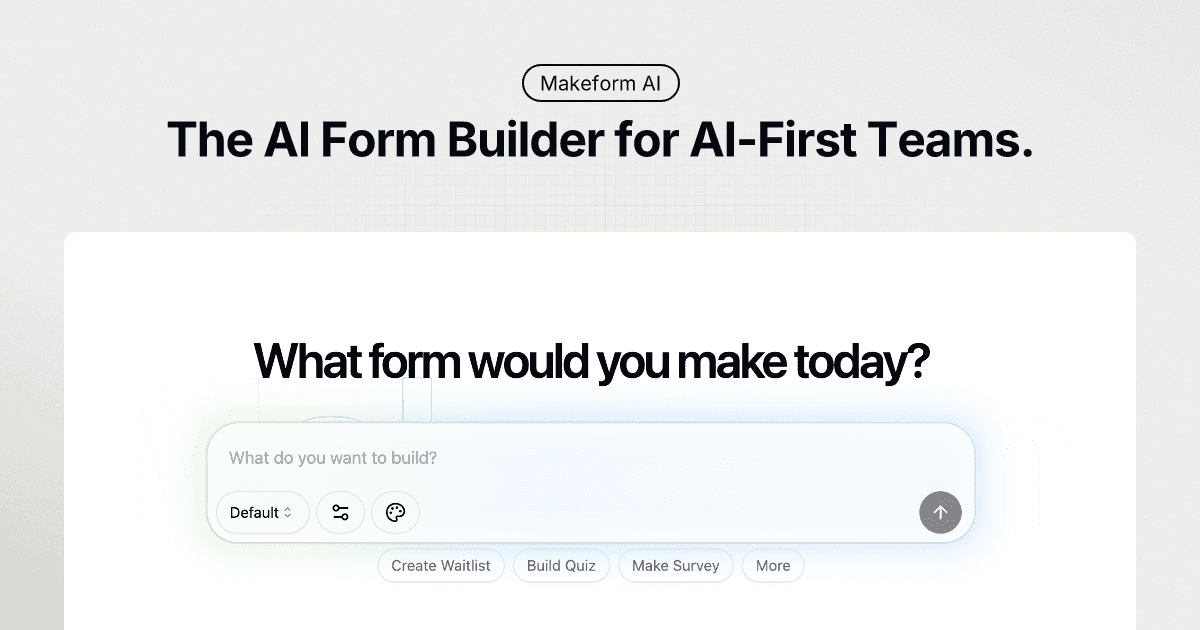
Makeform
Makeform is a free AI-native form builder that allows users to create various types of forms, including surveys, quizzes, polls, and registration forms, simply by describing their needs in a conversational chat interface. The AI generates questions, logic, and design, eliminating the need for coding or complex settings. Key features include AI form generation, secure enterprise-grade security, smart automations, and complete customization options for branding, domains, and conditional logic. It integrates with popular tools like Slack, Google Sheets, and Zapier, and offers analytics to track form performance. Makeform aims to save time and help users gather insights faster by transforming text input into fully customized forms in seconds.
navan.ai
Navan AI is an autonomous AI development platform designed to transform Product Requirements Documents (PRDs) into production-ready, tested code. It leverages a Smart Agent Manager (SAM) to orchestrate specialized AI agents through strict Test-Driven Development (TDD) cycles, ensuring quality software delivery without direct human intervention. The platform features a TDD pipeline with RED-GREEN-REFACTOR methodology, where agents like Titan (Test Architect) write failing tests, Dyna (Developer) implements code to pass them, and Argus (Code Reviewer) refactors. SAM acts as the master orchestrator, managing state and enforcing quality gates. Key benefits include autonomous execution, guaranteed TDD enforcement, built-in quality gates, state tracking, smart retries, and automatic documentation generation, accelerating software delivery with built-in quality.
mobile-use
Mobile-use is an open-source AI agent designed to automate mobile device interactions using natural language commands. It allows users to control Android and iOS apps, performing tasks from sending messages to navigating complex interfaces, just like a human. Key features include natural language control, UI-aware automation, and data scraping capabilities, allowing extraction of structured information from any app. The tool is highly extensible and customizable, supporting various LLMs. It has achieved top performance on the AndroidWorld benchmark, demonstrating its effectiveness in mobile automation. Developers can get started via a platform quickstart or by setting up the environment from source, with support for physical Android phones, Android simulators, and iOS simulators.
spirit-of-kiro
Spirit of Kiro is an infinite crafting workshop game developed as a demo project for Kiro, an AI engineering platform. Over 95% of the game's code was written by prompting Kiro, demonstrating best practices for AI engineering. The game features unique, procedurally generated items with individual descriptions, damage, and quirks. Players can craft and improve items by adding them to a workbench, breaking them down into components, or combining them. The game supports a wide range of actions like cutting, welding, painting, and enchanting. Items can also be sold to an appraiser. Spirit of Kiro is open-source, inviting contributions from developers to expand its features and explore its roadmap.

WebPresented CRM (WPCRM)
WebPresented CRM (WPCRM) is an AI-driven CRM and sales enablement platform specifically designed for wholesale distributors. It helps streamline sales processes, manage customer relationships, and accelerate business growth by integrating in real-time with distribution-specific ERP systems. WPCRM offers features like Mobile CRM, Plaimaker (an AI-powered sales assistant), cross- and up-sell recommendations, actionable analytics, job management, real-time quoting, marketing automation, and customer service tools. It aims to improve sales operations consistency and predictability, guiding sales teams to take the most impactful actions based on ERP data. The platform is built to require less IT administration and includes easy-to-use configuration tools.

Loop CRM
Loop CRM by Builders' Board is a comprehensive customer relationship management solution designed to automate sales processes for businesses, particularly those using JobTread. It helps users capture, nurture, and close leads through various channels including SMS, Email, Live Chat, and Phone Calls. Key features include automated follow-up across seven channels, AI-powered appointment booking, live call transfer, and a centralized communication center. The platform also offers smart nurture campaigns to achieve high response rates, performance insights, and a mobile app for on-the-go lead management. Loop CRM integrates seamlessly with JobTread and hundreds of other tools via custom integrations and Zapier, aiming to streamline operations and increase sales efficiency.
Tavern of Azoth
Tavern of Azoth is an innovative AI-powered RPG platform designed for creating and playing story-driven campaigns. Users can generate a wide array of unique game elements, including creatures, characters, merchants, and equipment, enhancing the depth and variety of their adventures. The platform supports both solo play and multiplayer sessions with up to three friends, all guided by an intelligent AI Game Master. This setup allows players to explore, interact with the world, and shape the narrative in real-time, offering a dynamic and personalized role-playing experience.
wincnn
wincnn is a Python module specifically designed to generate minimal Winograd convolution algorithms, which are crucial for optimizing convolutional neural networks. This tool implements the algorithms proposed in the research paper "Fast Algorithms for Convolutional Neural Networks" by Lavin and Gray (CVPR 2016). It provides symbolic computation capabilities, ensuring exact results for the transforms. Users can compute transforms for various F(m,r) configurations, including examples like F(2,3), F(4,3), and F(6,3), and also generate algorithms for linear convolution. The module requires Python 3.8 or higher and SymPy 1.9 or higher for its operation, making it a valuable resource for developers and researchers working on neural network optimization.
SoraWatermarkCleaner
SoraWatermarkCleaner is an open-source deep learning-powered tool designed to remove watermarks from videos generated by the Sora AI model. It utilizes a two-part system: a YOLOv11s detector for identifying the Sora watermark and a WaterMarkCleaner based on the LAMA model for removal. The tool offers both fast (LAMA) and time-consistent (E2FGVI_HQ) cleaning options, with performance optimizations like batch detection and TorchCompile. Users can install it via uv, use a one-click portable build for Windows, or deploy it with Docker Compose. A FastAPI-based web server is also available for API-driven usage, and a commercial hosted service, SoraWatermarkRemover.ai, provides a one-click online solution.
whisper_android
whisper_android provides robust offline speech recognition capabilities for Android applications, leveraging OpenAI's Whisper model and TensorFlow Lite. The project includes two distinct Android apps: one utilizing the TensorFlow Lite Java API for straightforward integration by Java developers, and another employing the TensorFlow Lite Native API for optimized performance. It also features a Python script for converting Whisper models into TensorFlow Lite format, alongside pre-generated TFLite models. Developers can find pre-built APKs for direct installation, simplifying deployment. The repository offers detailed integration guides for both Whisper speech recognition and audio recording, making it a comprehensive solution for adding speech-to-text functionality to Android projects.
CryptoDo
CryptoDo is an AI-powered, multichain, no-code builder designed for creating web3 solutions and decentralized applications (DApps). It enables users to build verified smart contracts for businesses or crowdsales in just five minutes, eliminating the need for programming skills. The platform's core is a modular no-code architecture that facilitates the creation of web3 applications through a visual builder. Additionally, CryptoDo incorporates an AI module, offering enhanced customization options for smart contracts, making blockchain technology more accessible and adaptable. It supports various use cases including DeFi, NFT tokenization, DAO & Voting, Web3 Safe, and GameFi, aiming to simplify and accelerate blockchain development.
whisper-diarization
whisper-diarization is an open-source pipeline designed for automatic speech recognition with integrated speaker diarization, built upon OpenAI's Whisper. It processes audio by first extracting vocals to improve speaker embedding accuracy, then generates a transcription using Whisper. The tool corrects and aligns timestamps with ctc-forced-aligner to minimize diarization errors. It further utilizes MarbleNet for Voice Activity Detection (VAD) and segmentation to exclude silences, and TitaNet to extract speaker embeddings for identifying speakers in each segment. The results are then associated with timestamps and realigned using punctuation models for precise word-level speaker detection. It supports command-line options for audio file processing, model selection, device usage, and language specification, offering a robust solution for detailed audio analysis.
Sign-Language-Interpreter-using-Deep-Learning
Sign-Language-Interpreter-using-Deep-Learning is an open-source project designed to interpret sign language in real-time using a live video feed from a camera. Developed as part of HackUNT-19, a 24-hour hackathon focused on improving accessibility, the tool aims to provide a personal translator for deaf individuals. It leverages deep learning technologies like TensorFlow and Keras, along with OpenCV for video processing. Users can set hand histograms, create and label gestures, and train a Convolutional Neural Network (CNN) model to recognize American Sign Language (ASL) gestures. The project achieved over 95% prediction accuracy for 44 ASL characters and serves as a foundational application for real-time sign language translation.
AI Consistent Character Generator
AI Consistent Character Generator is an advanced AI tool designed to transform a single photo into multiple consistent character variations. It excels at maintaining perfect character consistency across different poses, styles, and backgrounds, ensuring that facial features, identity, and core characteristics remain the same in every generated image. The tool offers features like character animation and motion control, allowing users to bring their characters to life with text-driven animation or transfer motion from reference videos. It supports various image formats including JPG, PNG, and WebP, and provides different quality modes (Lite, Standard, Professional) to suit diverse needs. Ideal for creators, marketers, and developers, it streamlines the process of generating consistent visual content.
Paird.ai
Paird.ai is a collaborative AI tool designed to enhance pair programming experiences for development teams. It facilitates real-time code generation and allows users to create custom code suggestions and lessons. By selecting a specific programming language and setting a project goal, teams can leverage AI to streamline their coding process. The platform emphasizes seamless code collaboration and provides real-time feedback, making it easier for multiple developers to work together on coding projects efficiently. This tool aims to improve team productivity and code quality through intelligent assistance and shared development environments.
3DUnetCNN
3DUnetCNN is an open-source Pytorch 3D U-Net Convolution Neural Network (CNN) specifically developed for medical image segmentation. This tool simplifies the process of applying and controlling the training and application of various deep learning models to medical imaging data. It includes tutorials and examples for use with data from MICCAI challenges, such as Brain Tumor Segmentation (BraTS 2020). Users can easily install dependencies, create configuration files, and train UNet models on their own data. The project emphasizes speed, with recent updates making data loading significantly faster. Comprehensive documentation and support via GitHub issues or email are available for users.
CleanSweep
CleanSweep is an AI agent designed to optimize cloud spending by identifying and terminating unused cloud resources across AWS and Azure. This desktop application automatically detects orphaned snapshots, unused IP addresses, and idle instances, helping users reduce their cloud bills by up to 30%. The tool operates with a strong emphasis on safety, initially running in a "Read-Only" mode where it identifies potential deletions without executing them. Users must approve every termination, ensuring control and preventing accidental data loss. Key features include a "Zombie Resource Killer" for EC2 instances and Load Balancers with zero traffic, and a "Snapshot Cleanup" function for old AWS EBS snapshots no longer attached to active volumes. CleanSweep also boasts zero-data retention and read-only access for enhanced security.
Amphion
Amphion is an open-source toolkit designed for Audio, Music, and Speech Generation, aiming to support reproducible research and assist junior researchers and engineers in the field. It provides a unique feature: visualizations of classic models or architectures, which are beneficial for understanding complex models. The platform's objective is to offer a comprehensive solution for converting various inputs into audio, supporting individual generation tasks such as Text to Speech (TTS), Singing Voice Synthesis (SVS), Voice Conversion (VC), Accent Conversion (AC), Singing Voice Conversion (SVC), and Text to Audio (TTA). Additionally, Amphion includes several vocoders and evaluation metrics crucial for producing high-quality audio signals and ensuring consistent metrics in generation tasks. It also focuses on advancing audio generation in real-world applications, including building large-scale datasets for speech synthesis.
AnimateDiff
AnimateDiff is an open-source AI tool available on Hugging Face, designed for animation diffusion. It serves as a model repository for generating animated content and is suitable for research and development. The tool operates under the Apache 2.0 license, promoting open collaboration and use. While the current live instance on Hugging Face is experiencing a runtime error, its core purpose is to facilitate the creation of animations through diffusion models. It integrates with various models like OpenAI's CLIP-ViT and CompVis's Stable Diffusion, indicating its capability to leverage advanced AI for animation tasks. The platform itself is a Hugging Face Space, which typically offers web-based access to AI models.
Appliorvc Inference
ApplioRVC Inference is a Hugging Face Space designed for AI model inference. It enables users to deploy and utilize various machine learning models within the Hugging Face ecosystem. While the specific application of 'ApplioRVC' isn't detailed, the platform itself provides the infrastructure for running AI models, making it suitable for content generation, research, and development purposes. Users can leverage Hugging Face's extensive resources, including hardware options for Spaces and Inference Endpoints, to scale their AI applications. The tool is part of the broader Hugging Face Hub, which fosters collaboration and provides a central place for ML development.
Hyper FLUX 8Steps LoRA
Hyper FLUX 8Steps LoRA is an AI image generation tool developed by ByteDance, available as a Hugging Face Space. Users can input a detailed text description of the desired image, and the application will instantly generate a matching picture. The tool provides options to adjust various parameters, including image size, the number of steps, guidance scale, and seed, allowing for fine-tuned control over the output. Its focus on rapid generation and parameter customization makes it suitable for quick experimentation and creative exploration in image synthesis.
dataMatters GmbH
dataMatters GmbH specializes in developing KIoT (AI-powered IoT) and Smart City solutions aimed at fostering sustainable urban development. Their platform facilitates the creation and deployment of AI models and applications, managing the entire process from sensor data acquisition to user-facing applications. The company focuses on real-world economic applications, leveraging technologies like LoRaWAN for efficient data transmission. By integrating AI with IoT, dataMatters GmbH helps cities and organizations implement intelligent systems that contribute to a more sustainable future, addressing challenges in urban environments through innovative technology.