
Coding & Development
Browsing page 324 of AI tools for Coding & Development. Sorted by confidence score — our independent quality rating.

Tessl
Tessl is an agent enablement platform designed to help teams build reliable AI-native software. It functions as a package manager for agent skills and context, allowing developers to find, install, version, and evaluate the skills their coding agents rely on. This ensures agents behave consistently across various tools and projects. Tessl enables organizations to turn internal APIs, libraries, and conventions into agent-usable skills, documentation, and rules, reducing retries and review cycles. The platform also provides evaluation capabilities to test skills against structured best practices and real-world scenarios, preventing regressions as systems evolve. By offering a single source of truth for skills and context, Tessl promotes reusability across agents, models, and development environments, avoiding lock-in and ensuring consistent behavior.

marimo app template
The marimo app template is a specialized tool designed for developers and data scientists looking to deploy Marimo applications on Hugging Face Spaces. This web application opens a Marimo notebook, enabling users to directly edit Python code cells within the browser and immediately observe the execution results. It serves as a foundational template, allowing users to supply their own Python code and any necessary data, which the app then executes and displays the outputs. This facilitates rapid prototyping, development, and sharing of interactive Python applications, particularly useful for those working with data science and machine learning models within the Hugging Face ecosystem.
DataDesigner
DataDesigner is an open-source library developed by NVIDIA NeMo for generating high-quality synthetic datasets. It allows users to create diverse data from scratch or by leveraging existing seed datasets, going beyond simple LLM prompting. The tool provides a flexible framework for building production-grade synthetic data, enabling control over relationships between fields with dependency-aware generation. It includes built-in Python, SQL, and custom local/remote validators for quality assurance, and can score outputs using LLM-as-a-judge. DataDesigner also offers a preview mode for quick iteration before full-scale generation and supports agent-assisted development, particularly with Claude Code, for schema design and generation.
pyannote-audio
pyannote-audio is an open-source Python toolkit designed for speaker diarization, a process that identifies 'who spoke when' in an audio recording. Built on the PyTorch machine learning framework, it offers robust capabilities for speech activity detection, speaker change detection, and speaker embedding. The toolkit includes pretrained models and pipelines, allowing users to quickly implement and experiment with audio analysis tasks. Furthermore, it supports fine-tuning of these models, enabling users to optimize performance on their specific custom datasets. This makes pyannote-audio a versatile tool for researchers and developers working with audio data.
Plugin.st
Plugin.st is a comprehensive platform designed to assist startups and developers by offering a diverse range of applications and plugins. The tools available on the platform cover key areas such as large language model (LLM) development, scriptwriting, and various marketing functionalities. It aims to provide essential resources to streamline development and operational processes for its target audience. The platform operates on a freemium model, allowing users to explore its offerings through a free trial before committing to paid plans.
self-attention-cv
Self-attention-cv is an open-source repository offering implementations of diverse self-attention mechanisms specifically tailored for computer vision applications. Built in PyTorch, it leverages `einsum` and `einops` for efficient and flexible module creation. The repository serves as an ongoing collection of building blocks, enabling developers to integrate advanced attention models into their projects. It supports a range of computer vision tasks, including image recognition and segmentation, with examples for Multi-head attention, Axial attention, Vision Transformers (ViT), and TransUnet. It also includes various positional embedding implementations.
AI-Gateway
AI-Gateway is a comprehensive set of labs designed to help developers and platform engineers explore and manage AI Models, MCP servers, and Agents. Powered by Azure API Management and Microsoft Foundry, it offers an enterprise-grade gateway for building production-ready AI applications. Key features include robust security with OAuth 2.0 and content safety filtering, enhanced performance through load balancing and semantic caching, and detailed observability with token metrics and built-in logging. It also provides cost control via rate limiting and quota management, and extensibility with MCP protocol support and multi-model routing. The labs offer hands-on Jupyter notebooks, Bicep infrastructure templates, and APIM policies for easy deployment to Azure subscriptions, making it ideal for those looking to implement secure, reliable, and scalable AI solutions.

Gummy - AI Game Maker
Gummy is an innovative AI-powered game maker app designed to transform any idea into a playable video game instantly, without requiring coding or game development experience. Available on iOS and Android, it allows users to describe their game concept in plain English, and Gummy's AI engine generates the mechanics, levels, characters, and physics in seconds. Users can then customize elements like characters, gravity, and difficulty using visual tools. The platform supports various genres including platformers, shooters, RPGs, and puzzle games. Gummy also features a Community Arcade for playing and remixing user-made games, and offers future direct publishing to app stores, making it an ideal tool for rapid prototyping, education, and casual game creation.
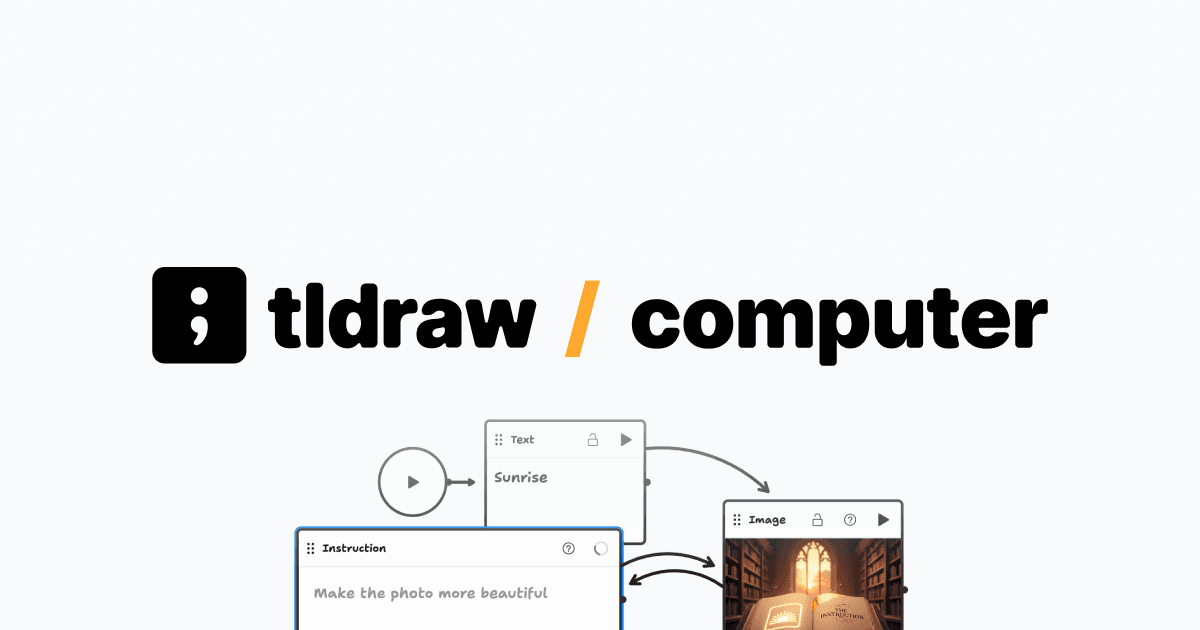
tldraw computer
tldraw computer offers a unique approach to visual computing, allowing users to create and connect interactive components on an infinite canvas. This browser-based tool integrates AI to enhance creations, providing a powerful platform for visual programming. It's designed for building visual programs, enabling users to develop interactive elements and link them together seamlessly. The free availability in the browser makes it accessible for anyone looking to explore visual programming and leverage AI in their projects, from simple interactive designs to more complex visual applications.
TelcoBrain Technologies, Inc.
TelcoBrain Technologies, Inc. offers an industry-first Techno-Economic Cognitive Twin Platform designed to reinvent digital infrastructure for CSPs, enterprises, and cloud/AI providers. This platform unifies networks, cloud, and AI Factories operations, turning complexity into clarity, lowering CapEx and OpEx, and accelerating sustainable growth. It leverages Deep AI Models and techno-economic insights to enable innovation at scale, optimize investments, and streamline operations. The platform provides a single cognitive twin that links performance, cost, and carbon, allowing users to simulate futures, rank investments, and prove ROI before deployment. It features real-time assets and lifecycle management, over 100 integrations, and predictive analytics to transform digital infrastructure into a living, learning system.
EASYChatGPT
EASYChatGPT is an open-source desktop application project designed to facilitate developer access to ChatGPT. It provides a straightforward way for users to interact with ChatGPT's interface directly from their desktop environment, requiring only a personal API key. The project emphasizes ease of use, with a two-step setup process for installation and conversation initiation. It's particularly useful for developers who want to experiment with ChatGPT functionalities without needing to rely on web interfaces or complex setups. The tool currently supports single-turn conversations and requires users to replace the API key in the configuration file. It's important to note that this is a personal project and not an official OpenAI product.
Code Companion
Code Companion is an AI-powered programming tutor designed to assist users with various programming problems. Leveraging the advanced capabilities of GPT-4, it provides real-time help and feedback, making it a valuable resource for improving coding skills and efficiency. The tool offers guidance and suggestions, acting as a virtual mentor for developers. It aims to streamline the learning and development process by offering immediate support and insights into coding challenges. This makes it suitable for individuals looking to enhance their programming proficiency and tackle complex problems with AI-driven assistance.
camel_tools
camel_tools is a comprehensive, open-source Python toolkit developed by the CAMeL Lab at New York University Abu Dhabi, specifically designed for Arabic natural language processing. It offers a wide array of functionalities including text pre-processing, advanced morphological modeling, and specialized components for Dialect Identification, Named Entity Recognition, and Sentiment Analysis. The tool is built to be accessible for researchers and developers, with clear installation instructions for various operating systems like Linux, macOS, and Windows. It also provides options for installing necessary data packages, making it a robust solution for anyone working with the complexities of the Arabic language in NLP tasks.

Moderne
Moderne is an AI-driven platform that builds knowledge, discovery, and execution tools for coding agents. It enables agents to operate faster, more accurately, and at significantly lower cost across real-world software systems. Powered by the OpenRewrite Lossless Semantic Tree (LST), Moderne offers a comprehensive context model for understanding and transforming code at scale. The platform provides tools for deterministic framework and language upgrades, bulk vulnerability remediation, multi-repository change coordination, precomputed context registries, and high-performance organization-wide search. Moderne aims to improve agent performance, reduce token costs, accelerate change velocity, and ensure multi-agent enterprise readiness.
machine-learning-samples
machine-learning-samples is an open-source repository offering various sample applications developed with AWS' Amazon Machine Learning (AML). It includes practical code examples for diverse use cases such as targeted marketing, social media filtering, and mobile prediction. Developers can find samples for targeted marketing in Java, Python, and Scala, demonstrating how to use the AML API. Additionally, there's a sample for social media filtering that integrates Amazon Mechanical Turk for data labeling and AWS Lambda for automated tweet monitoring. Mobile prediction samples are available for both iOS and Android, showcasing real-time ML predictions from mobile devices. The repository also features a k-fold cross-validation sample in Python for model evaluation and a collection of utility scripts.
tensorflow-federated
TensorFlow Federated (TFF) is an open-source framework designed for machine learning and other computations on decentralized data. It specifically supports Federated Learning (FL), an approach where a shared global model is trained across many participating clients while their sensitive training data remains local. This framework enables developers to utilize included federated learning algorithms with their existing TensorFlow models and data, or to experiment with novel algorithms. TFF provides both a high-level Federated Learning (FL) API for applying federated training and evaluation, and a lower-level Federated Core (FC) API for expressing new federated algorithms. It includes a single-machine simulation runtime for experiments, making it suitable for researchers and developers exploring privacy-preserving machine learning.
ChinesePinyin-CodeCompletionHelper
ChinesePinyin-CodeCompletionHelper is a plugin designed for JetBrains IDEs, including IDEA, PyCharm, PhpStorm, WebStorm, AndroidStudio, and GoLand. It facilitates code completion for Chinese identifiers using various input methods like Pinyin and Wubi, providing a coding experience consistent with English environments. This tool addresses challenges in naming conventions, especially for business-specific terms that are difficult to express in English, or in teams with varying English proficiency. It supports multi-syllable word completion and is compatible across multiple programming languages such as Java, Python, JavaScript, Kotlin, and Go. The plugin aims to offer more choices for code expression and is considered a practical solution for developers facing naming difficulties.
CLUENER2020
CLUENER2020 offers a PyTorch implementation of various models for Named Entity Recognition (NER), focusing on Chinese language tasks. It includes baseline code for the CLUENER2020 competition, featuring models like BiLSTM-CRF, BERT-base with Softmax/CRF/BiLSTM+CRF, and Roberta with Softmax/CRF/BiLSTM+CRF. The project utilizes the CLUENER2020 dataset, a Chinese fine-grained NER dataset derived from THUCNEWS, with 10 distinct categories such as organization, person name, and address. Users can configure model parameters and other hyperparameters, and the repository provides instructions for setting up the environment and running the models. It also includes pre-trained BERT and Roberta models for convenience.
cnn-text-classification-pytorch
cnn-text-classification-pytorch is an open-source implementation of Convolutional Neural Networks (CNNs) for sentence classification, built using PyTorch. This tool is based on the model described in Kim's influential paper on CNNs for Sentence Classification. It offers a practical framework for developers to perform text classification tasks, providing consistent results with the original research. The implementation has been updated to be compatible with modern PyTorch versions (2.0+), removing deprecated dependencies like `torchtext` and fixing various runtime errors. It supports datasets like MR and SST, includes options for different optimizers (Adam, Adadelta), and allows for easy training, testing, and prediction of text sentiment.
Doczilla
Doczilla offers a high-performance API designed for efficient PDF and screenshot creation, ensuring scalable and reliable document delivery for developers and businesses. The platform simplifies document generation by allowing users to create, save, and manage templates using a robust HTML editor and a Handlebars-based templating system. This streamlines workflows, enabling the definition of templates once and rendering them repeatedly. Doczilla supports various image formats like PNG, JPEG, and WebP for screenshots and can convert password-protected web pages to PDFs using basic authentication. It prioritizes security, never storing data longer than necessary, and offers flexible API responses, including immediate direct responses or structured webhook callbacks. The service is designed to scale effortlessly, handling everything from hundreds to millions of documents.
veles
Veles is a distributed platform designed for rapid deep learning application development, released under the Apache 2.0 license. It comprises several key components, including the core Veles platform, the Znicz Plugin which serves as a neural network engine, and Mastodon, a bridge facilitating integration between Veles and Java-based systems like Hadoop. Additionally, it features a SoundFeatureExtraction library for audio processing. This platform is ideal for developers and researchers looking to build and deploy deep learning applications in a distributed environment, offering tools for both model development and data processing.
Clivi
Clivi is a gaming platform designed to enhance the gaming experience by connecting players for competition and creative endeavors. Users can easily find and match with others to play their favorite games, participate in organized tournaments, and build esports teams. The platform also incorporates generative AI features, allowing users to create custom skins, adding a unique personalization aspect to their gaming. This combination of social connectivity, competitive play, and AI-powered customization aims to provide a comprehensive and engaging environment for gamers.
feathr
Feathr is a scalable, unified data and AI engineering platform widely used in production at LinkedIn and now an open-source project under the LF AI & Data Foundation. It allows users to define data and feature transformations using Pythonic APIs, register these transformations, and share them across teams. Particularly useful for AI modeling, Feathr automatically computes and joins feature transformations to training data with point-in-time correctness to prevent data leakage. It supports materializing and deploying features for online production use, offers native cloud integration with scalable architecture, and has been battle-tested for over six years. Feathr handles billions of rows and petabyte-scale data with built-in optimizations, providing rich transformation APIs including time-based aggregations and sliding window joins. It also features a built-in registry for feature reuse and an intuitive UI for searching and exploring features and their lineages.
Clivi
Clivi is a comprehensive gaming platform designed to enhance the experience for gamers, tournament organizers, and esports teams. The platform provides tools for connecting players with others for their favorite games, fostering a vibrant community. A key feature of Clivi is its AI-powered skin creation tool, which empowers gamers to design and generate unique in-game skins using generative artificial intelligence. This functionality allows for significant creative expression and personalization within the gaming environment. Beyond individual customization, Clivi supports the organization of tournaments and the formation of esports teams, aiming to streamline competitive gaming activities.