
Coding & Development
Browsing page 328 of AI tools for Coding & Development. Sorted by confidence score — our independent quality rating.
.jpg&w=3840&q=75)
AgentsForce
Minded, previously known as AgentsForce, is an innovative AI agent platform designed to empower users to build and deploy AI agents by simply recording their work. This approach eliminates the need for complex API integrations, allowing agents to operate like humans across existing tools and systems. The platform offers an intuitive drag-and-drop AI editor for agent creation and customization, alongside an AI Recorder that captures screen actions to train agents. Minded is built for regulated industries, providing full audit trails, SSO, and robust permission management, ensuring data security and compliance. It supports processing documents in any format with human-level accuracy and allows for management of AI agents using natural language.

Bloop
Bloop is building tools designed to empower engineers to plan, orchestrate, and review the work of autonomous AI agents. The platform aims to provide the necessary infrastructure to significantly multiply output, especially as the industry transitions from simple auto-complete functionalities to more complex, long-running tasks. Its core mission is to transform every engineer into a high-velocity engineering manager by streamlining the management of AI agent workflows. This focus on agent orchestration and review positions Bloop as a critical tool for developers working with advanced AI systems, enabling more efficient and effective project execution.

PipeCNN
PipeCNN is an OpenCL-based FPGA Accelerator specifically designed for large-scale Convolutional Neural Networks (CNNs). It leverages High Level Synthesis (HLS) tools to facilitate the design and implementation of customized circuits on FPGAs, significantly speeding up the hardware development cycle compared to traditional RTL-based methodologies. The project provides a generic, yet efficient, OpenCL-based CNN accelerator that is scalable in both performance and hardware resources, making it suitable for various FPGA platforms. PipeCNN supports both Intel OpenCL SDK and Xilinx Vitis based FPGA design flows and includes a ModelZoo with pre-quantized models for networks like VGG-16 and ResNet-50. While the performance may not match the latest state-of-the-art designs, PipeCNN serves as a complete and valuable resource for learning about Deep Learning Architecture (DLA) and experimenting with new ideas in FPGA acceleration.
kedro
Kedro is an open-source Python framework designed for building production-ready data engineering and data science pipelines. It emphasizes software engineering best practices to ensure pipelines are reproducible, maintainable, and modular. Key features include a project template based on Cookiecutter Data Science, a Data Catalog for connecting to various data sources and versioning, and pipeline abstraction for automatic dependency resolution and visualization with Kedro-Viz. Kedro also supports coding standards like test-driven development with pytest and flexible deployment strategies, including integration with Argo, Prefect, Kubeflow, AWS Batch, and Databricks. It aims to address the shortcomings of one-off scripts and Jupyter notebooks by promoting team collaboration and efficiency through modular, reusable analytics code.
DeepLiveCam
DeepLiveCam is an open-source AI tool designed for transforming digital identities, making it ideal for VTubers, streamers, and content creators. This powerful offline software facilitates real-time face swapping and avatar creation, allowing users to seamlessly change their appearance during live streams and video content. DeepLiveCam emphasizes privacy and data security by operating entirely offline, ensuring no uploads or online dependencies. It supports both Nvidia and AMD GPUs, as well as Mac/Apple Silicon, offering broad accessibility. Key features include real-time video playback without rendering, advanced face mapping, and an ethical approach to AI-assisted video transformation, empowering users with unlimited creativity while maintaining full control over their data.
nnstreamer
nnstreamer is an open-source project offering a collection of GStreamer plugins designed to simplify the integration and efficient processing of neural network models within multimedia pipelines. It allows both GStreamer developers to easily adopt neural network models and neural network developers to manage pipelines effectively. The tool supports various neural network frameworks like TensorFlow and Caffe, and provides connectivity for efficient streaming in AI projects. It enables the use of neural network models as media filters, facilitates composite models within a single stream pipeline, and supports multi-modal intelligence. nnstreamer is compatible with multiple platforms including Tizen, Ubuntu, Android, Yocto, and macOS, and offers API support for C/C# and Java.
tlm
tlm functions as a local command-line interface (CLI) copilot, leveraging the power of Ollama to provide AI-driven code assistance. It is designed to be a workstation companion, allowing developers to utilize various open-source models such as Llama 3, Phi4, DeepSeek-R1, and Qwen within their local environment. This setup ensures that code assistance is available directly from the command line, offering a private and secure way to enhance coding workflows without relying on external cloud services. The tool is particularly beneficial for those who prioritize data privacy and wish to keep their code and AI interactions within their local infrastructure.
Keras-Project-Template
Keras-Project-Template is an open-source project template designed to streamline the development and training of deep learning models with Keras. It offers a clear, structured architecture, including predefined folders for models, trainers, data loaders, and configurations, simplifying project organization. The template supports checkpointing and TensorBoard visualization for monitoring training progress. A key feature is its integration with Comet.ml, enabling comprehensive experiment tracking, including hyper-parameters, metrics, and graphs, with real-time updates. This allows developers to easily manage and compare different model iterations and configurations, enhancing the efficiency of deep learning research and development.
holmesgpt
HolmesGPT is an open-source AI agent designed to investigate production incidents and pinpoint root causes across diverse infrastructure stacks, including Kubernetes, VMs, and cloud providers. As a CNCF Sandbox project, it offers robust features like petabyte-scale data handling with server-side filtering and memory-safe execution to prevent OOM kills during large data queries. It boasts deep integrations with popular observability tools such as Prometheus, Grafana, Datadog, and Kubernetes, alongside bidirectional alert integrations with platforms like AlertManager, PagerDuty, and Jira. A key differentiator is its 'Operator Mode,' which allows HolmesGPT to run continuously, detect issues before they impact customers, and even open PRs to fix identified problems, making it a proactive SRE solution.
Legends-Of-Heroes
Legends-Of-Heroes is an open-source C# game framework built on ET 8.1, designed for dual-end game development using .NET8 and Unity6000. It features a comprehensive battle system with ECS skills and a buff system, with ongoing development for skill and behavior tree editors. The framework includes a LOL-style ball battle demo that utilizes state synchronization, where all collision detection, skills, and AI logic are executed server-side. It integrates with EUI, Luban, and YooAsset for UI, configuration, and resource management, respectively. The project also supports HybridCLR for hot updates and offers one-click packaging for various platforms like Windows and Android. It's ideal for developers looking for a robust foundation for real-time multiplayer games with advanced combat mechanics.
ReconAIzer
ReconAIzer is a powerful Jython extension designed for Burp Suite, integrating OpenAI (GPT) to significantly optimize the reconnaissance process for bug bounty hunters. This extension automates various tasks, making it faster and easier for security researchers to identify and exploit vulnerabilities. Key functionalities include discovering endpoints, parameters, URLs, and subdomains. Once installed, ReconAIzer adds a contextual menu and a dedicated tab within Burp Suite to display results, streamlining the analysis workflow. Users need to configure their OpenAI API key to utilize its full potential, making it a valuable asset for those looking to leverage AI in their security research.
TLDR
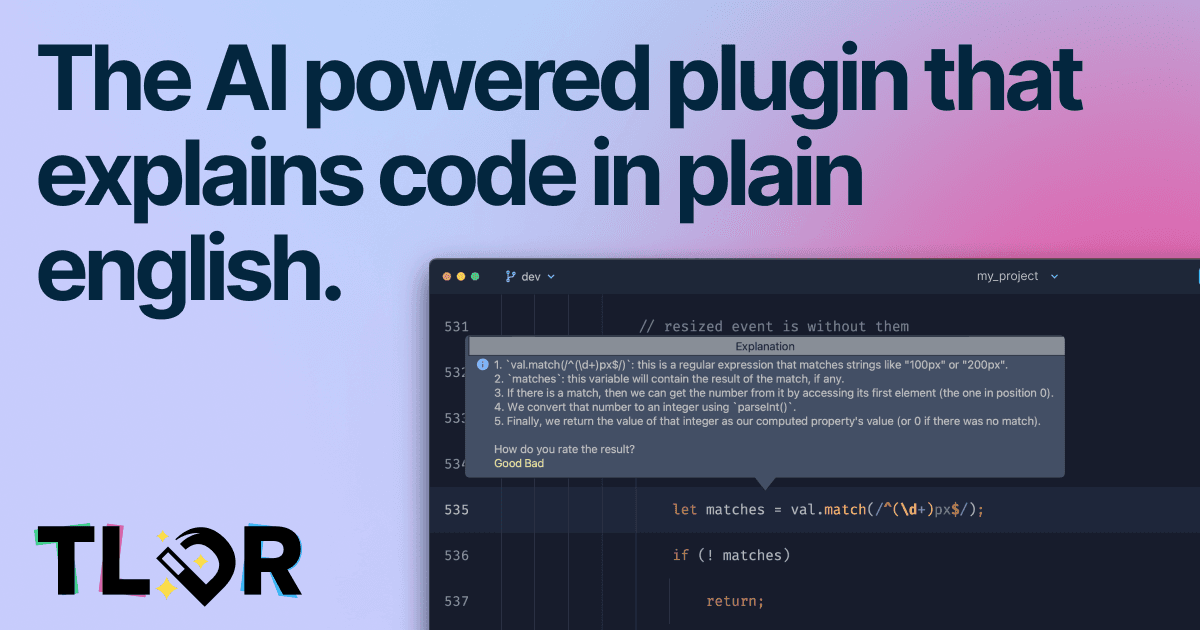
TLDR is an AI-powered IDE plugin designed to help developers quickly understand code by explaining it in plain English. It supports nearly all programming languages, making it a versatile tool for various development environments. The plugin is particularly useful for deciphering complex elements like regular expressions and SQL queries, as well as for gaining a rapid understanding of new codebases. TLDR aims to save developers time by providing instant summaries of code, allowing them to build mental context efficiently. It offers a free version with limited credits and paid tiers for individual and organizational use, all accessible via the JetBrains plugin marketplace.
Mistral AI
Mistral AI provides a powerful AI platform designed for enterprises to build and deploy advanced AI systems. Users can customize, fine-tune, and deploy AI assistants, autonomous agents, and multimodal AI using state-of-the-art open models. The platform supports various deployment options, including on-premises, cloud, edge, and devices, ensuring full data control. Key offerings include Le Chat for autonomous work, Vibe for autonomous coding, Studio for AI application development, Forge for custom model development, and Applied AI for advanced R&D. Mistral AI emphasizes deep engagement and hands-on assistance from AI scientists for deployment, solutioning, and safety.

Harver
Harver offers predictive assessments and automated solutions designed to optimize the hiring process for businesses. The platform helps organizations identify and engage top talent more efficiently, reducing time to hire and improving the quality of hires. Harver's scientifically validated assessments pinpoint candidates with high potential, leading to a significant reduction in employee turnover. It also provides customizable automation to streamline candidate progression, reducing bias and saving resources. With robust business analytics, Harver delivers actionable insights at every stage of recruitment, supporting data-driven decision-making. The tool is particularly effective for volume hiring across various industries, including BPO, contact centers, retail, and tech.
EasyChat AI
EasyChat AI is a dedicated Windows application designed to provide a superior ChatGPT experience. It boasts a fast and responsive interface, ensuring smooth interactions with the AI. The application features a stunning and intuitive UI, enhancing user experience. Key functionalities include comprehensive Markdown support for enriched conversations and a sleek Dark Mode for comfortable viewing. Users can choose between a free tier with daily query limits, a monthly subscription for unlimited queries, or a lifetime BYO (Bring Your Own) API key option, offering flexibility for different usage needs. EasyChat AI is a third-party app, not affiliated with OpenAI Inc., providing a distinct platform for accessing ChatGPT's capabilities on Windows.
Humanizer.me
Humanizer.me is a prompt manager and design tool designed to assist users in generating and customizing prompts for AI chatbots. The platform aims to streamline the often time-consuming process of finding, tweaking, and managing effective prompts. By providing tools to organize and refine prompts, Humanizer.me enhances productivity for creative professionals and anyone working with AI models. It helps users eliminate repetitive prompt searches and ensures consistency in their AI interactions, making it easier to achieve desired outputs from various AI chatbots.
WPeChatGPT
WPeChatGPT is an IDA plugin designed to assist reverse engineers and security analysts in understanding binary files more efficiently. Leveraging advanced AI models such as OpenAI's gpt-3.5-turbo and DeepSeek, it provides capabilities like analyzing function usage environments, intended purposes, and renaming variables for clarity. The plugin can also attempt to restore functions using Python, particularly for smaller code blocks, and identify potential vulnerabilities within functions. Furthermore, it can generate corresponding exploits for identified vulnerable functions and offers an automatic binary file analysis feature through Auto-WPeGPT. This tool significantly streamlines the binary analysis workflow by integrating AI-powered insights directly into the IDA environment.
speech-to-text-benchmark
speech-to-text-benchmark is an open-source, minimalist, and extensible framework designed for evaluating the performance of different speech-to-text engines. It allows users to benchmark engines like Amazon Transcribe, Azure Speech-to-Text, Google Speech-to-Text, OpenAI Whisper, and Picovoice Cheetah/Leopard against various datasets including LibriSpeech, TED-LIUM, Common Voice, and VoxPopuli. The framework calculates key metrics such as Word Error Rate (WER), Punctuation Error Rate (PER), Core-Hour for computational efficiency, Word Emission Latency for streaming engines, and Model Size. It supports multiple languages and provides clear instructions for setting up and running benchmarks, making it a valuable tool for researchers and developers in speech recognition.
BMInf
BMInf (Big Model Inference) is an open-source toolkit designed to facilitate efficient inference for large-scale pretrained language models (PLMs). It enables the execution of models with over 10 billion parameters, even on low-resource hardware like a single NVIDIA GTX 1060 GPU. The tool offers significant performance improvements over existing PyTorch implementations, particularly for GPUs like V100 or A100. BMInf 2.0.0 introduced compatibility with any transformer-based model, making it a versatile solution for researchers and developers working with big AI models. It provides methods for automatic model conversion using `bminf.wrapper` or manual replacement of modules like `torch.nn.ModuleList` and `torch.nn.Linear` for optimized performance.
Calk AI
Calk AI empowers marketing agencies to build custom AI agents that automate a wide range of tasks using their internal knowledge and tools. Users can connect platforms like Notion, Slack, Intercom, HubSpot, Gmail, and Google Analytics to allow agents to access real data instantly. The platform simplifies agent creation, requiring only a description of the desired task, and the agent then plans, orchestrates, and executes steps autonomously without complex workflows or code. Calk AI agents can automate reporting, manage client accounts, streamline operations, and scale marketing output, helping agencies handle more clients without increasing headcount. It offers pre-built agent examples across productivity, sales, marketing, product, customer support, and data categories.
ramalama
RamaLama is an open-source developer tool designed to simplify the local serving and use of AI models for inference. It leverages familiar OCI containers, allowing engineers to apply container-centric development patterns to AI use cases. The tool eliminates the need for complex host system configurations by automatically detecting GPUs and pulling appropriate accelerated container images. RamaLama supports multiple AI model registries, including OCI Container Registries, HuggingFace, and Ollama, treating models similarly to how Podman and Docker handle container images. It enables secure model execution in rootless containers with no network access by default, ensuring data privacy and temporary data removal upon exit. Users can interact with models via REST API or as a chatbot.
AI SEO Tools: Rank & Grow
AI SEO Tools: Rank & Grow is an AI-powered mobile application designed to assist content creators, bloggers, YouTubers, marketers, and small business owners in enhancing their digital growth. The app simplifies content optimization by providing instant, AI-driven suggestions for keywords, titles, content, and tags. It features a user-friendly interface that combines powerful SEO tools like Keyword Generator, Title Generator, Content Generator, Viral Video Ideas, Description Generator, and Tag Generator. This eliminates the need for complex tools or lengthy research, allowing users to save time and grow their online presence faster. It's ideal for generating optimized ideas for blog posts, videos, and social media captions.
GitStart
GitStart is a platform designed to accelerate software development by providing elastic engineering capacity through a hybrid model of AI and human developers. It features Ticket Studio, which transforms vague tickets into quality specifications with clear context, integrating with tools like Figma, Jira, Linear, and GitHub. The Accelerate component then delivers merge-ready pull requests, combining coding agents with human developer oversight through a five-stage quality process. GitStart supports over 15 languages and frameworks, including React, Node.js, and Python, and can be used for frontend development, testing, bug fixes, and new feature development. It aims to make software development more accessible globally, offering a dedicated team of developers that learns your codebase over time.
text-to-image
text-to-image is an experimental TensorFlow implementation for synthesizing images from captions. This open-source tool leverages Skip Thought Vectors to understand the textual input and the GAN-CLS (Generative Adversarial Network - Conditional Latent Space) algorithm to generate corresponding images. It allows users to create images based on descriptive text, with the model currently trained on the flowers dataset. The implementation provides options for data processing, training with customizable parameters like noise dimension, batch size, and learning rate, and generating images from user-provided captions. It's a valuable resource for researchers and developers interested in the mechanics of text-to-image synthesis.