
Coding & Development
Browsing page 331 of AI tools for Coding & Development. Sorted by confidence score — our independent quality rating.

promptr
Promptr is a command-line interface (CLI) tool designed to help developers modify their codebases using plain English instructions. It leverages OpenAI's LLM models to interpret these instructions and apply changes directly to specified files. Promptr supports a liquidjs-based templating system, allowing for reusable code snippets and consistent application of project-wide coding standards. This feature is particularly useful for tasks like refactoring, generating boilerplate code, and conducting code experimentation. Users can define prompts in files, include relevant file paths, and then execute Promptr to apply the model's output to their filesystem, with options for dry runs and interactive modes.
antigravity-agent
antigravity-agent is an open-source tool designed for the effortless management of multiple Antigravity accounts. It allows users to quickly switch between accounts with a single click, eliminating the need for repetitive logins. The software automatically identifies and saves current account data, and offers secure backup functionality through password-encrypted export of account configurations, facilitating cross-device migration. A VSCode extension is also available, enabling users to switch accounts and view model quotas directly within their editor. The tool emphasizes security, distributing only through official GitHub Releases to protect sensitive account information.
Go2
Go2 is an edge-native link platform designed for speed and comprehensive analytics, built on Cloudflare's global network for sub-10ms redirects. It offers a developer-first approach with robust APIs and SDKs, alongside features like custom domains, dynamic QR codes, and real-time tracking of clicks, locations, and devices. The platform supports advanced functionalities such as geo-targeting, device-based routing, and retargeting pixels for major ad platforms. Go2 is open-source, emphasizing transparency and auditable operations, and provides enterprise-grade security with SOC 2 Type II compliance and GDPR adherence. It caters to a wide range of users from solo creators to large enterprises, enabling efficient link management, campaign performance tracking, and scalable growth.
opcode
opcode is a robust desktop application built with Tauri 2, designed to enhance interaction with Claude Code. It offers a visual interface for managing Claude Code sessions, creating custom AI agents with specific system prompts and behaviors, and tracking usage analytics including API costs and token breakdowns. The tool features a visual project browser, session history, smart search, and a timeline with checkpoints for session versioning and instant restore. Additionally, opcode includes an MCP Server Manager for configuring Model Context Protocol servers and a built-in editor for CLAUDE.md files with live preview and syntax highlighting, making AI-assisted development more intuitive and productive.
Tengine
Tengine, developed by OPEN AI LAB, is a high-performance, modular inference engine specifically designed for embedded devices. It facilitates the rapid and efficient deployment of deep learning neural network models across various AIoT applications. The core modules are developed in C language, with deep framework trimming to suit the limited resources of embedded systems. Tengine features a completely separated front-end and back-end design, which simplifies the porting and deployment to heterogeneous computing units like CPUs, GPUs, and NPUs, thereby reducing evaluation and migration costs. It supports various models and offers tools for conversion and quantization, making it a versatile solution for AI deployment on edge devices.
Swimm
Swimm is an AI-augmented platform designed to help enterprise developers understand complex codebases and drive modernization. It provides accurate understanding of application behavior, business rules, and decision paths through deterministic code analysis. Swimm extracts business rules and decision logic, making them readable across the business and traceable directly to the source code. It supports end-to-end application behavior analysis, flow and dependency tracking, screen generation for legacy UIs, and system mapping. Swimm is deployed where modernization is hardest, offering SOC 2 and ISO 27001 compliance, on-premise deployment options, and support for customer-managed LLMs, ensuring data control and security.
WebWave
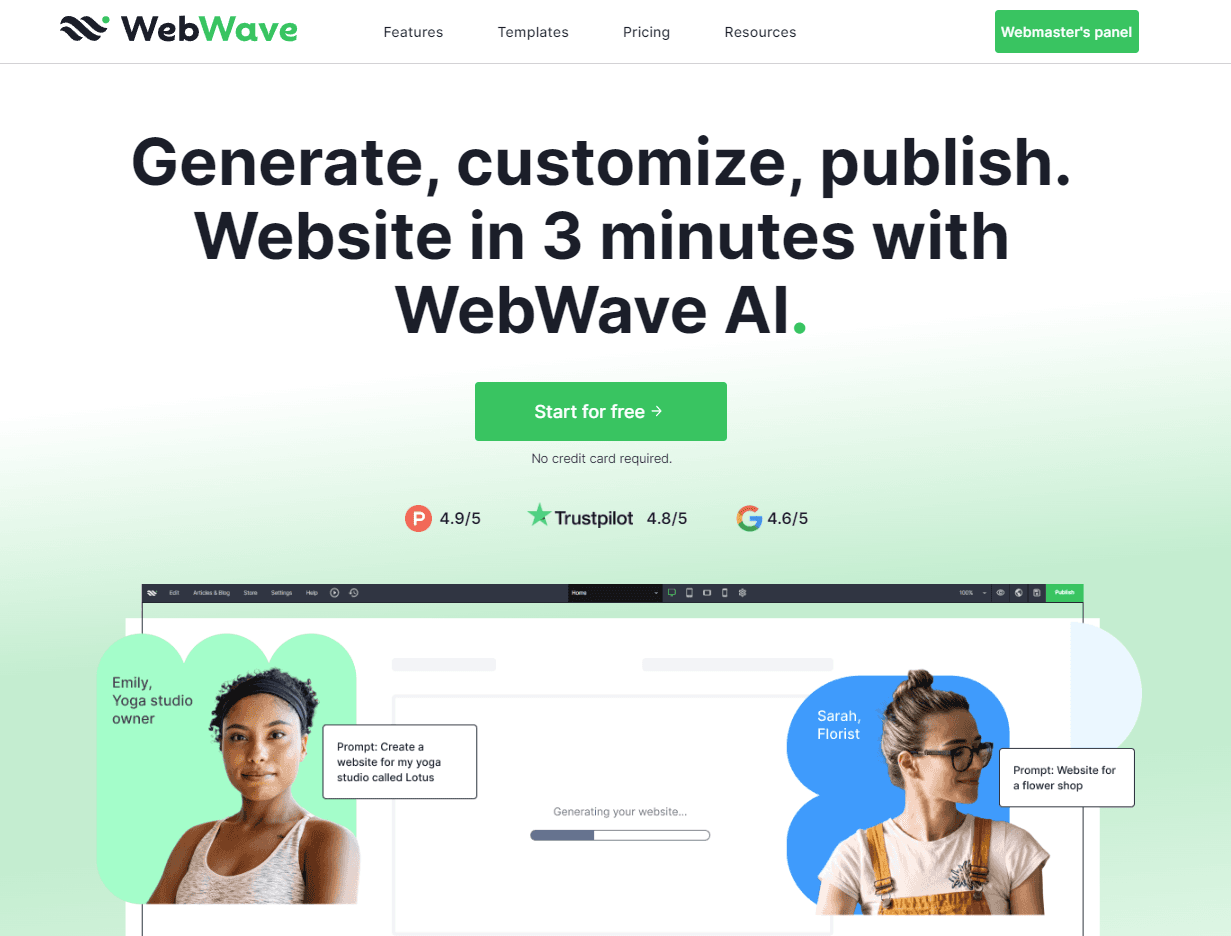
WebWave is an AI-powered website builder designed for creating professional websites without coding. Its AI suggests templates, content, and structure, enabling users to generate a functional website in as little as three minutes. The platform offers a true drag-and-drop editor, providing creative freedom to place elements anywhere on the canvas, unlike section-based builders. It supports various website types, including landing pages, business websites, blogs, and online stores. WebWave also includes SEO tools and offers a free plan, allowing users to build and publish websites before upgrading for custom domains and advanced features. It's suitable for both small business owners and freelance web designers.
serve
Jina-Serve is a robust, open-source framework designed for building and deploying multimodal AI applications using a cloud-native stack. It facilitates communication via gRPC, HTTP, and WebSockets, allowing developers to scale their AI services efficiently from local development environments to full production. Key features include native support for major ML frameworks and data types, high-performance service design with scaling, streaming, and dynamic batching, and LLM serving with streaming output. Jina-Serve also offers built-in Docker integration, an Executor Hub, and one-click deployment to Jina AI Cloud, making it enterprise-ready with Kubernetes and Docker Compose support. It provides advantages over tools like FastAPI through DocArray-based data handling, native gRPC support, and seamless microservice scaling.
tensorflow_template_application
tensorflow_template_application offers a versatile and generic template for deep learning projects built with TensorFlow. It is designed to streamline the development process by providing a structured foundation. The tool supports multiple data formats, including CSV, LIBSVM, and TFRecords, ensuring flexibility in data handling. Key features extend to prediction servers, leveraging TensorFlow Serving and a Python HTTP server, as well as prediction clients available in various programming languages. This comprehensive setup makes it suitable for developers looking to quickly deploy and manage deep learning models.
Claude-Code-Usage-Monitor
Claude-Code-Usage-Monitor is an open-source, real-time terminal monitoring tool designed for Claude AI token usage. It offers advanced analytics, machine learning-based predictions, and a rich, color-coded UI to track token consumption, burn rate, and cost analysis. Key features include configurable refresh rates, smart auto-detection of usage plans, and an advanced warning system with cost and time predictions. The tool supports various Claude plans (Pro, Max5, Max20) and includes a default 'Custom' plan that intelligently adapts to usage patterns by analyzing past sessions to calculate personalized limits. It also provides model-specific pricing with cache token calculations and comprehensive logging options, making it an essential utility for developers managing their Claude AI expenses and usage efficiently.
TensorFlow-VAE-GAN-DRAW
TensorFlow-VAE-GAN-DRAW is an open-source collection of generative methods implemented using TensorFlow. This repository offers implementations of Deep Convolutional Generative Adversarial Networks (DCGAN), Variational Autoencoders (VAE), and DRAW: A Recurrent Neural Network For Image Generation. It allows users to experiment with and run these different generative models, providing a foundation for research and development in image generation. The project highlights that DCGANs produce decent results after 10 epochs with default parameters and outlines future enhancements like more complex data integration and replacing the current attention mechanism with a Spatial Transformer Layer.
holmesgpt
HolmesGPT is an open-source AI agent designed to investigate production incidents and pinpoint root causes across diverse infrastructure stacks, including Kubernetes, VMs, and cloud providers. As a CNCF Sandbox project, it offers robust features like petabyte-scale data handling with server-side filtering and memory-safe execution to prevent OOM kills during large data queries. It boasts deep integrations with popular observability tools such as Prometheus, Grafana, Datadog, and Kubernetes, alongside bidirectional alert integrations with platforms like AlertManager, PagerDuty, and Jira. A key differentiator is its 'Operator Mode,' which allows HolmesGPT to run continuously, detect issues before they impact customers, and even open PRs to fix identified problems, making it a proactive SRE solution.
cockpit-tools
cockpit-tools is a universal AI IDE account management tool designed to streamline the workflow for developers using multiple AI coding assistants. It supports a wide array of platforms including Antigravity, Codex, GitHub Copilot, Windsurf, Kiro, Cursor, Gemini-cli, CodeBuddy, Qoder, Trae, and Zed. Key features include one-click account switching, real-time quota monitoring, automated wake-up tasks, and the ability to run multiple instances of the same AI IDE concurrently with different accounts. This allows developers to efficiently manage resources, switch between projects, and optimize their usage across various AI tools without manual login/logout processes. The tool also provides device fingerprint management to mitigate risk and supports 18 languages for a global user base.
chatblade
Chatblade is a versatile command-line interface (CLI) tool designed to interact with OpenAI's ChatGPT. It accepts piped input, arguments, or both, enabling flexible query submission. Users can save common prompt preambles for quick usage and manage distinct conversations through named sessions. The tool also provides utility methods to extract JSON or Markdown from ChatGPT responses, with options for raw output or formatted syntax highlighting. It supports both gpt-3.5 and gpt-4 models, interactive chat sessions, and streaming responses. Chatblade can also be configured for Azure OpenAI endpoints. Note: This project is archived and no longer under active development, with the developer recommending alternatives like llm or Fabric for modern CLI needs.
Stellon Labs
Stellon Labs is an AI research lab dedicated to developing powerful, tiny AI models specifically optimized for edge applications. Their focus is on creating 'frontier AI' solutions that can operate efficiently on minimal hardware, making advanced artificial intelligence accessible for devices with limited computational resources. The lab aims to push the boundaries of AI performance in constrained environments, enabling new possibilities for on-device intelligence without requiring extensive infrastructure. Their work is geared towards practical applications where low-power and small-footprint AI is crucial.
kur
Kur is an open-source system designed to simplify the development and application of state-of-the-art deep learning models. It caters to both novices and experienced machine learning practitioners by allowing models to be described using easily understandable specification files, eliminating the need for extensive coding. The tool supports popular deep learning frameworks such as Theano, TensorFlow, and PyTorch, and provides out-of-the-box multi-GPU support for efficient training. Users can quickly explore different model versions using the Jinja2 templating engine. Kur also offers a friendly and extensible API for advanced deep learning architectures and workflows, making it a versatile solution for building sophisticated AI models.
Ava PLS
Ava PLS is an open-source desktop application designed to run language models directly on your computer, providing a local and private environment for AI experimentation. It features a batteries-included graphical user interface (GUI) for llama.cpp, simplifying the process of interacting with language models without needing cloud infrastructure. Users can easily download pre-built artifacts from GitHub Actions or compile the application themselves using Zig. The tool is built with a robust tech stack including Zig, C++, SQLite, Preact, Preact Signals, and Tailwind CSS, ensuring a stable and efficient local AI experience.
Spark Tech AI
Spark Tech AI specializes in delivering custom AI, machine learning, and cloud solutions designed to help businesses extract meaningful insights and drive real business impact from their data. The platform focuses on providing compliant, scalable, and secure solutions tailored to specific organizational needs. Beyond core AI and ML capabilities, Spark Tech AI also emphasizes user-friendly interfaces and integrates IoT-enabled systems, ensuring that advanced technology is accessible and actionable for its clients. This comprehensive approach aims to transform raw data into strategic assets, fostering innovation and efficiency across various business functions.
Humanizer.me
Humanizer.me is a prompt manager and design tool designed to assist users in generating and customizing prompts for AI chatbots. The platform aims to streamline the often time-consuming process of finding, tweaking, and managing effective prompts. By providing tools to organize and refine prompts, Humanizer.me enhances productivity for creative professionals and anyone working with AI models. It helps users eliminate repetitive prompt searches and ensures consistency in their AI interactions, making it easier to achieve desired outputs from various AI chatbots.
MistoLine ControlNet Demo
MistoLine ControlNet Demo is an AI tool designed for image generation, specifically focusing on the ControlNet architecture. It provides a platform for users to explore and experiment with ControlNet, a neural network that offers precise control over image synthesis. Hosted on Hugging Face, this demo allows individuals to interact with the technology and understand its capabilities in generating controlled images. While the live website currently indicates a runtime error, the tool's purpose is to showcase the potential of ControlNet in AI-driven image creation.
spacy-models
spacy-models offers a collection of pre-trained models specifically designed for use with the spaCy Natural Language Processing (NLP) library. These models are essential for data scientists and machine learning engineers who are building applications that require advanced text processing capabilities. The models support a wide range of NLP tasks, including efficient text analysis, named entity recognition, and dependency parsing. By leveraging these pre-trained models, users can significantly accelerate their NLP development workflows, reducing the need for extensive custom training. The integration with spaCy ensures high performance and ease of use for various linguistic tasks.
pytorch-ddpm
pytorch-ddpm offers an unofficial PyTorch implementation of Denoising Diffusion Probabilistic Models (DDPM), closely following the details of the official TensorFlow implementation. Designed for researchers and AI developers, this tool facilitates experimentation with generative models in a PyTorch environment. Key features include support for various datasets like CIFAR10, LSUN, and CelebA-HQ, along with gradient accumulation and multi-GPU training capabilities. Users can train models from scratch, evaluate performance, and reproduce experiments, with options to overwrite arguments and select specific GPU IDs. The project aims to be easily understandable for those familiar with PyTorch, making it a valuable resource for deep learning practitioners.
novel
Novel is an open-source, Notion-style WYSIWYG editor designed to streamline the writing process with AI-powered autocompletion. It allows users to create and edit content within a familiar and intuitive interface, similar to Notion. The tool integrates OpenAI for AI completions and is built on a modern tech stack including Next.js, Tiptap, and Vercel AI SDK. Novel is suitable for developers looking to integrate a powerful editor into their applications, as well as writers and content creators seeking an enhanced writing experience with intelligent suggestions.

AI Prompt Builder
Eduardo Develops offers expertise in prompt engineering, leveraging Large Language Models (LLMs) to create intelligent systems and applications. While the provided website content describes a professional's services rather than a specific app, it highlights a strong focus on AI and data-driven analysis. The professional develops tailored applications across Apple platforms (iOS, macOS, watchOS, tvOS) and has experience in crafting robust, innovative, and user-friendly apps. This background suggests the capability to develop tools like an AI Prompt Builder, which would aim to eliminate trial and error in prompt creation, making it easier for professionals and casual users to achieve desired outputs from AI tools efficiently.