
Coding & Development
Browsing page 338 of AI tools for Coding & Development. Sorted by confidence score — our independent quality rating.

qwen600
qwen600 is a static, suckless single batch CUDA-only mini inference engine specifically designed for the QWEN3-0.6B instruct model. Developed for educational purposes, it allows users to learn about Large Language Models (LLMs) and transformers while practicing CUDA programming. The engine boasts significant performance improvements, claiming to be approximately 8.5% faster than llama.cpp and 292% faster than Hugging Face with flash-attn in tokens/sec. It features compile-time optimization, minimal dependencies (CUDA, cuBLAS, CUB, std IO), efficient memory management, and zero-cost pointer-based weight management on GPU, making it suitable for systems with limited VRAM like an RTX 3050 8GB.
Upscale-A-Video
Upscale-A-Video is an open-source, diffusion-based model designed for real-world video super-resolution, enhancing video quality with temporal consistency. Developed by S-Lab at Nanyang Technological University and presented at CVPR 2024, this tool takes low-resolution videos and text prompts as inputs to generate high-resolution outputs. It provides inference code for various video types, including AIGC videos, old movies, and animations. Users can also address color discrepancies with options like "AdaIn" or "Wavelet" color fixes. The project includes the YouHQ dataset, comprising over 38,000 videos for training and 40 for evaluation, making it a valuable resource for researchers and developers in the video processing domain.
WebLaTex
WebLaTex offers a comprehensive alternative to Overleaf, designed for students, lecturers, and professors to create journals, research papers, and resumes. It integrates the familiar VSCode environment with web and Git capabilities, allowing users to commit changes, roll back to older versions, and collaborate seamlessly. Key features include GitHub Copilot for intelligent code and sentence completion, built-in Grammarly or LanguageTool for grammar and spell checking, and live collaboration support. The platform is built on GitHub Codespaces and Dev containers, ensuring quick setup and access. Users can easily manage their LaTeX projects, generate PDFs automatically upon saving, and customize various configurations, making it a powerful tool for academic and technical document creation.

Momentum CRM Mobile
Momentum CRM Mobile offers a comprehensive suite of cloud-based solutions specifically designed for the automotive industry. It helps dealerships streamline their entire operations, from sales and service to customer engagement and follow-up. Key features include unparalleled sales management, efficient service operations, simplified automotive F&I processes, and AI-powered communication. The platform is fully cloud-based, ensuring scalability and flexibility to grow with the business. With US-based customer support, dealerships can rely on fast and efficient assistance from experts. Momentum CRM is trusted by OEMs worldwide and integrates seamlessly with industry-leading tools to optimize efficiency.
QiZhenGPT
QiZhenGPT is an open-source Chinese medical large language model developed by CMKRG. It leverages a Chinese medical instruction dataset built from the QiZhen Medical Knowledge Base to significantly improve performance in Chinese medical contexts. The model has been fine-tuned on Chinese-LLaMA-Plus-7B, CaMA-13B, and ChatGLM-6B models. Initially, it focuses on drug knowledge Q&A with a dedicated evaluation dataset, with plans to expand to diseases, surgeries, and examinations. QiZhenGPT also underpins MedCopilot, a smart medical assistant integrated with HIS and electronic medical record systems, offering features like functional assistant, auxiliary diagnosis, medical quality assurance, and medical record documentation. MedCopilot is already in use at Zhejiang University Second Affiliated Hospital.

QR Code Scanner & AI Generator
QR Code Scanner & AI Generator is a versatile mobile application designed for both scanning and creating QR codes and barcodes. Users can easily scan codes by pointing their camera, with features to help optimize scanning conditions like distance and lighting. The app also supports scanning codes from images stored in the phone's gallery. For creation, users can generate new QR codes by selecting a format and filling in the necessary details, which remain static and active indefinitely. The app includes a history section to view all scanned codes and offers options to delete or export scan history in CSV format. It also provides settings for managing sound notifications during scanning and subscription management.
Rabot
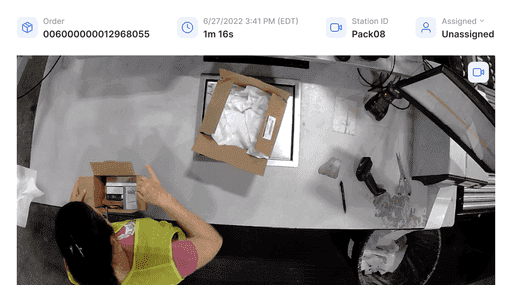
Rabot is a Vision AI platform designed for warehouse pack stations, offering comprehensive quality control and operational insights. It records and AI-analyzes every order packed, providing verifiable proof, preventing errors, and improving overall performance. The platform has processed over 113 million items and integrates with more than 62 Warehouse Management Systems (WMS) without requiring WMS changes or API modifications. Rabot helps businesses cut costs by optimizing shipping, guides teams to reduce ramp-up time, resolves disputes with video evidence, and ensures operations compliance. It offers products like Pack, Scan, and Ship Right, with capabilities such as Pulse for single-screen operation and Workflows for enforcing rules.
Humanizer.me
Humanizer.me is a prompt manager and design tool designed to assist users in generating and customizing prompts for AI chatbots. The platform aims to streamline the often time-consuming process of finding, tweaking, and managing effective prompts. By providing tools to organize and refine prompts, Humanizer.me enhances productivity for creative professionals and anyone working with AI models. It helps users eliminate repetitive prompt searches and ensures consistency in their AI interactions, making it easier to achieve desired outputs from various AI chatbots.
OpenHGNN
OpenHGNN is an open-source toolkit designed for Heterogeneous Graph Neural Networks (HGNNs), built upon the Deep Graph Library (DGL) and PyTorch. It aims to facilitate research and development in heterogeneous graph-based machine learning by integrating state-of-the-art HGNN models. The toolkit offers easy-to-use interfaces for conducting experiments and supports various tasks including node classification, link prediction, and recommendation. Key features include extensibility for user-defined tasks, models, and datasets, efficiency through DGL's backend, and tools for hyperparameter optimization and visualization. It also supports mini-batch training and distributed training for large-scale graphs.
xoul.ai
xoul.ai is an innovative entertainment and storytelling platform powered by AI, designed for users to create, explore, and share AI characters (Xouls) and scenarios. The platform emphasizes freedom of expression and unfettered creativity, aiming to provide intentional and meaningful experiences rather than an endless stream of content. Users can chat with AI characters, generate images and voice messages, and even create entire worlds. It offers various subscription plans with different energy allowances, cell allocations for premium features, and enhanced streak rewards. The platform supports community engagement through Discord and Reddit, and offers referral bonuses for new sign-ups.
ppq
PPL Quantization Tool (PPQ) is a powerful, open-source offline neural network quantization tool designed for industrial applications. It focuses on optimizing neural networks by converting floating-point operations to fixed-point operations, which significantly reduces computational costs and memory usage. This makes PPQ particularly suitable for deployment on edge devices where chip area and power consumption are limited. The tool offers a highly flexible and extensible framework, allowing users to customize quantization bit-width, granularity, and calibration algorithms for individual operators and tensors. PPQ's execution engine is specifically designed for quantization, supporting 99 common Onnx operator execution logics and native quantization simulation. It integrates with various inference frameworks like TensorRT, OpenVINO, and Onnxruntime, providing pre-built quantizers and export logic.
text-to-image
text-to-image is an experimental TensorFlow implementation for synthesizing images from captions. This open-source tool leverages Skip Thought Vectors to understand the textual input and the GAN-CLS (Generative Adversarial Network - Conditional Latent Space) algorithm to generate corresponding images. It allows users to create images based on descriptive text, with the model currently trained on the flowers dataset. The implementation provides options for data processing, training with customizable parameters like noise dimension, batch size, and learning rate, and generating images from user-provided captions. It's a valuable resource for researchers and developers interested in the mechanics of text-to-image synthesis.
model_analyzer
Triton Model Analyzer is a command-line interface (CLI) tool designed to help users better understand the compute and memory requirements of models running on the Triton Inference Server. It assists in finding optimal configurations for various model types, including single, multiple, ensemble, and BLS models, on a given piece of hardware. The tool offers several search modes, such as Optuna Search for hyperparameter optimization, Quick Search for sparse exploration of batch size and instance group parameters, and Automatic/Manual Brute Search for exhaustive parameter sweeps. Model Analyzer also supports profiling Large Language Models (LLMs) and generates detailed and summary reports to highlight trade-offs between different model configurations. Users can apply QoS constraints to filter results based on specific latency or other performance requirements.
Spark Tech AI
Spark Tech AI specializes in delivering custom AI, machine learning, and cloud solutions designed to help businesses extract meaningful insights and drive real business impact from their data. The platform focuses on providing compliant, scalable, and secure solutions tailored to specific organizational needs. Beyond core AI and ML capabilities, Spark Tech AI also emphasizes user-friendly interfaces and integrates IoT-enabled systems, ensuring that advanced technology is accessible and actionable for its clients. This comprehensive approach aims to transform raw data into strategic assets, fostering innovation and efficiency across various business functions.

IRIS Engage
IRIS Engage is an AI-powered mobile CRM specifically tailored for sales professionals who spend significant time in the field. This tool streamlines pipeline management and opportunity prioritization through its proprietary IRISRank algorithm. A key differentiator is its real-time voice conversation interface, allowing users to update their CRM, receive deal recommendations, and dictate notes on the go. This hands-free interaction enhances productivity and ensures that critical sales data is captured promptly, even when away from a desk. The mobile-first approach makes it an invaluable asset for sales teams needing efficient, on-the-spot CRM capabilities.
promptr
Promptr is a command-line interface (CLI) tool designed to help developers modify their codebases using plain English instructions. It leverages OpenAI's LLM models to interpret these instructions and apply changes directly to specified files. Promptr supports a liquidjs-based templating system, allowing for reusable code snippets and consistent application of project-wide coding standards. This feature is particularly useful for tasks like refactoring, generating boilerplate code, and conducting code experimentation. Users can define prompts in files, include relevant file paths, and then execute Promptr to apply the model's output to their filesystem, with options for dry runs and interactive modes.
holmesgpt
HolmesGPT is an open-source AI agent designed to investigate production incidents and pinpoint root causes across diverse infrastructure stacks, including Kubernetes, VMs, and cloud providers. As a CNCF Sandbox project, it offers robust features like petabyte-scale data handling with server-side filtering and memory-safe execution to prevent OOM kills during large data queries. It boasts deep integrations with popular observability tools such as Prometheus, Grafana, Datadog, and Kubernetes, alongside bidirectional alert integrations with platforms like AlertManager, PagerDuty, and Jira. A key differentiator is its 'Operator Mode,' which allows HolmesGPT to run continuously, detect issues before they impact customers, and even open PRs to fix identified problems, making it a proactive SRE solution.
Bhava
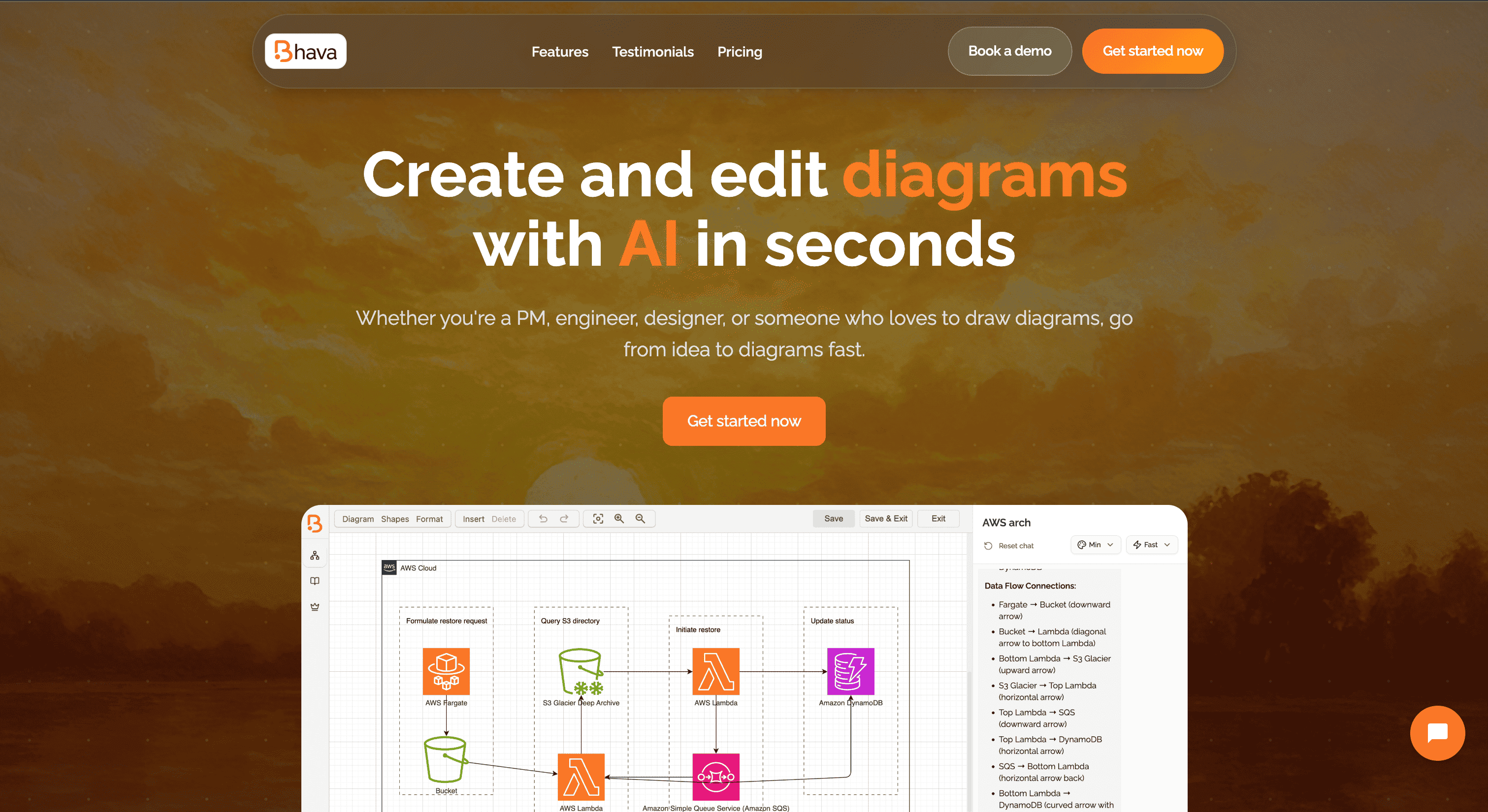
Bhava is an AI-powered diagram editor designed to transform ideas into professional diagrams instantly. It allows users to create and edit various diagram types, including flowcharts, architecture diagrams, UML, ERD, sequence diagrams, network maps, org charts, mind maps, and hardware schematics, all in seconds. The tool supports generating diagrams from text or by dropping images, sketches, or screenshots, automatically recognizing services and symbols like AWS, GCP, Azure, and Kubernetes icons. Diagrams remain fully editable, including styles, layers, and groups. Bhava also offers easy import from draw.io or Mermaid and export to formats like PNG and SVG, ensuring no vendor lock-in. It is trusted by product managers, developers, and engineers for faster and smarter diagramming.
nerd-dictation
nerd-dictation is a simple, hackable, and offline speech-to-text utility designed for Desktop Linux. It leverages the VOSK-API for accurate transcription without requiring an internet connection. The tool is a single-file Python script with minimal dependencies, making it easy to set up and use. Key features include optional conversion of numbers to digits, a timeout function for automatic speech ending, and configurable output types (simulating keystrokes or printing to standard output). Users can customize text manipulation through Python scripts and bind begin/end/cancel commands to shortcut keys for efficient workflow. It also supports suspend/resume functionality to manage resource usage, especially with larger language models.
marimo app template
The marimo app template is a specialized tool designed for developers and data scientists looking to deploy Marimo applications on Hugging Face Spaces. This web application opens a Marimo notebook, enabling users to directly edit Python code cells within the browser and immediately observe the execution results. It serves as a foundational template, allowing users to supply their own Python code and any necessary data, which the app then executes and displays the outputs. This facilitates rapid prototyping, development, and sharing of interactive Python applications, particularly useful for those working with data science and machine learning models within the Hugging Face ecosystem.
Protect AI
Protect AI offers a comprehensive platform designed to secure AI applications across their entire lifecycle, from model selection and testing to deployment and runtime. Their suite of products, including Guardian for AI model security, Recon for scalable red teaming, and Layer for runtime security, operate on a unified platform. The company emphasizes a "Secure by Design" approach, shifting from reactive to proactive security measures against evolving AI threats. Protect AI also leverages extensive threat research, backed by a community of over 17,000 security researchers and partnerships with industry leaders like Hugging Face, to continuously feed its products with the latest threat intelligence. This ensures robust protection and helps organizations stay ahead of attackers.

Causal Foundry
Causal Foundry offers Kenkai, an adaptive AI platform designed for real-time personalization, optimization, and scalable decision-making. Built on ClickHouse, Kenkai streams and queries high-resolution data instantly, enabling enterprise-scale interventions. It leverages reinforcement learning and contextual bandits to continuously optimize engagement strategies through experimentation and adaptation. The platform also includes embedded metrics and analytics, allowing users to define governed metrics once and explore them everywhere, integrating live dashboards directly into existing systems without black boxes. Causal Foundry aims to democratize reinforcement learning for organizations worldwide, adapting to individual preferences, environments, and behaviors.
natasha
Natasha is a powerful open-source Python library designed to solve basic NLP tasks specifically for the Russian language. It offers a comprehensive suite of functionalities including tokenization, sentence segmentation, word embedding, morphology tagging, lemmatization, phrase normalization, syntax parsing, NER tagging, and fact extraction. The library emphasizes production readiness, focusing on optimized model size, RAM usage, and performance, with models running efficiently on CPU using Numpy for inference. Natasha integrates several specialized libraries like Razdel for segmentation, Navec for compact Russian embeddings, Slovnet for deep-learning morphology, syntax, and NER, and Yargy for rule-based fact extraction. While its API may evolve, it provides a convenient unified interface for various Russian NLP tasks, with models primarily optimized for news articles.
TensorLayer
TensorLayer is a powerful, open-source deep learning and reinforcement learning library built for scientists and engineers. It offers an extensive collection of customizable neural layers, enabling rapid development of advanced AI models. Inspired by PyTorch, TensorLayer provides transparent and flexible APIs, making it easier to build and train complex AI models compared to other TensorFlow wrappers. It supports multiple backends including TensorFlow, PyTorch, MindSpore, PaddlePaddle, OneFlow, and Jittor, allowing deployment on various hardware like Nvidia-GPU and Huawei-Ascend. The library is recognized for its simplicity, flexibility, and high performance, with comprehensive documentation and a large community.