
Coding & Development
Browsing page 342 of AI tools for Coding & Development. Sorted by confidence score — our independent quality rating.
Echolon
Echolon is a powerful, local-first API client designed for modern developers, offering a robust open-source alternative to tools like Postman. It boasts deep Git integration, allowing all workspaces, collections, variables, and settings to be stored locally as plain text files, enabling seamless version control and team collaboration through standard Git workflows. The tool supports multiple protocols including REST/HTTP and WebSocket, with GraphQL support on the roadmap. Echolon is built with an offline-first architecture, ensuring all data is stored on your machine without mandatory cloud sync or account requirements, prioritizing user privacy and data security. Key features include an advanced request editor, dynamic variable system, one-click API publishing, and powerful API mocking capabilities for both local and cloud environments.

TensorLayer
TensorLayer is a powerful, open-source deep learning and reinforcement learning library built for scientists and engineers. It offers an extensive collection of customizable neural layers, enabling rapid development of advanced AI models. Inspired by PyTorch, TensorLayer provides transparent and flexible APIs, making it easier to build and train complex AI models compared to other TensorFlow wrappers. It supports multiple backends including TensorFlow, PyTorch, MindSpore, PaddlePaddle, OneFlow, and Jittor, allowing deployment on various hardware like Nvidia-GPU and Huawei-Ascend. The library is recognized for its simplicity, flexibility, and high performance, with comprehensive documentation and a large community.
tiefvision
tiefvision is an integrated end-to-end image-based search engine powered by deep learning. It offers comprehensive functionalities including image classification, image location (based on OverFeat), and image similarity (based on Deep Ranking). The system is built using Torch for its deep learning modules and the Play Framework (Scala version) for its tooling modules. It currently supports Linux operating systems with CUDA-enabled GPUs, indicating a focus on performance-intensive image processing tasks. Beyond its core deep learning capabilities, tiefvision also provides a suite of web tools designed to streamline dataset generation and enhance productivity, such as visual database editors and automated dataset generation for training and testing.
Top2Vec
Top2Vec is an open-source Python library designed for advanced topic modeling and semantic search. It automatically detects topics within text data and generates jointly embedded topic, document, and word vectors. The library offers a 'classic' version for general topic modeling and a newer 'contextual' version that leverages contextual token embeddings to identify multiple topics per document and even detect topic segments within documents. This contextual approach provides a more nuanced understanding of complex texts. Key features include automatic topic number detection, hierarchical topic generation, keyword-based topic search, and document search by topic or keywords. Top2Vec eliminates the need for stop word lists, stemming, or lemmatization, and works effectively on short texts. It also supports various embedding models like Doc2Vec, Universal Sentence Encoder, and BERT Sentence Transformer for flexible deployment.
Enkrypt AI
Enkrypt AI offers a comprehensive platform for AI security and compliance, designed to help organizations deliver AI applications quickly and safely. The platform features Agent Red Teaming for continuous threat detection, Agent Guardrails for real-time threat removal, and Agent Policy Engine for automated compliance. It also includes an AI Data Risk Audit and tools like MCP Scanner and MCP Gateway. Enkrypt AI helps accelerate time to certify and ship by automating security and compliance processes, providing real-time insights for audits, and protecting against emerging threats like prompt injection, data leakage, and model bias. It is recognized as a Gartner® Cool Vendor in AI security for 2025.
spacy-models
spacy-models offers a collection of pre-trained models specifically designed for use with the spaCy Natural Language Processing (NLP) library. These models are essential for data scientists and machine learning engineers who are building applications that require advanced text processing capabilities. The models support a wide range of NLP tasks, including efficient text analysis, named entity recognition, and dependency parsing. By leveraging these pre-trained models, users can significantly accelerate their NLP development workflows, reducing the need for extensive custom training. The integration with spaCy ensures high performance and ease of use for various linguistic tasks.
robustmq
RobustMQ is a unified messaging engine built with Rust, designed as a communication infrastructure for the AI era. It operates as a single binary, one broker, and one storage layer, eliminating external dependencies and allowing deployment from edge devices to cloud clusters. It natively supports MQTT, Kafka, NATS, AMQP, and its own mq9 protocol on a shared storage layer, meaning a message written once can be consumed by any protocol. The mq9 protocol is specifically designed for AI Agent asynchronous communication, offering features like agent mailboxes with persistent store-first delivery, priority levels, and public mailbox discovery. RobustMQ emphasizes minimal operations, multi-tenancy, and ultra-low-latency dispatch, making it suitable for diverse messaging needs from IoT to streaming data pipelines.
mcp-context-forge
mcp-context-forge is an open-source AI Gateway, registry, and proxy designed to federate Model Context Protocol (MCP) servers, A2A servers, and REST/gRPC APIs into a unified endpoint. It offers centralized governance, discovery, and observability across AI infrastructure, optimizing agent and tool calling. Key capabilities include a Tools Gateway for MCP, REST, and gRPC translation, an Agent Gateway for A2A protocol and OpenAI/Anthropic routing, and an API Gateway with rate limiting, authentication, and retries. The tool supports extensive plugin extensibility with over 40 integrations and provides OpenTelemetry tracing for comprehensive observability. It runs as a fully compliant MCP server, deployable via PyPI or Docker, and scales to multi-cluster Kubernetes environments with Redis-backed federation and caching.
SuperGluePretrainedNetwork
SuperGluePretrainedNetwork is a research project from Magic Leap, presented at CVPR 2020, focusing on learning feature matching using Graph Neural Networks. The core of the project is the SuperGlue network, which integrates a Graph Neural Network with an Optimal Matching layer. This architecture is specifically designed to perform matching tasks on two distinct sets of sparse image features. The repository offers both the PyTorch code implementation and pretrained weights, making it accessible for researchers and developers interested in computer vision and feature matching applications. It serves as a valuable resource for those looking to implement or build upon advanced feature matching techniques.
Testportal
Testportal is an online skills and knowledge assessment tool designed for businesses and educational institutions. It enables users to create custom tests, quizzes, and exams with various question types, including self-grading, open-ended, and choice questions. The platform features an AI Question Generator that can create questions based on provided materials or selected topics, significantly saving time. It also offers comprehensive reporting, real-time insights and analytics, and robust security measures. Testportal integrates with Microsoft Teams and provides automated feedback and grading, making it a versatile solution for recruitment, employee training, certification, and academic evaluations.

Mojo AI
Mojo AI offers an AI-powered safety management platform designed for the construction and oil & gas sectors. Its flagship product, Safety Mojo, streamlines safety processes by unifying risk, compliance, and frontline data across projects, trades, and crews. Key features include AI-scored Pre-Task Plans (PTP/JSA) for quality and risk coverage, conversational AI tools like Ask Mojo, and multilingual support. The platform automatically generates OSHA 300/301/300A logs, TRIR, DART, and lost-time reports from submitted forms and field data. It also provides real-time dashboards for visibility across sites, allowing users to prioritize audits and identify high-risk work. Mojo AI helps meet OCIP data requirements and integrates with other software via API.
Kane AI
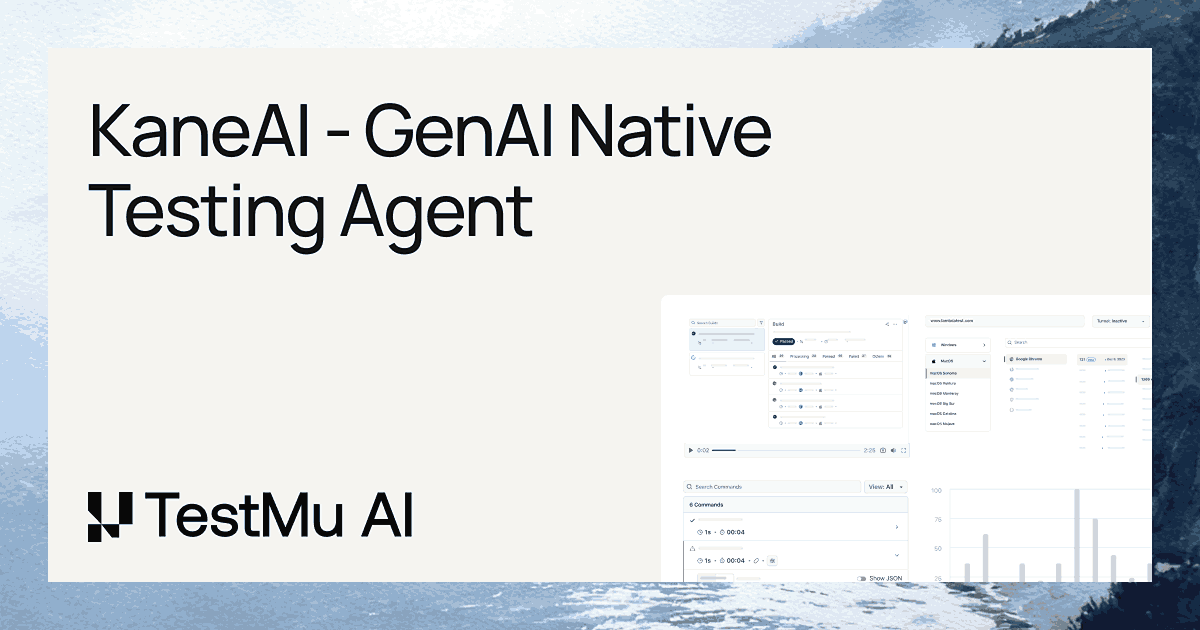
Kane AI, developed by TestMu AI (formerly LambdaTest), is a pioneering GenAI-native testing agent designed for high-speed Quality Engineering teams. It empowers users to plan, author, and evolve end-to-end tests using natural language, eliminating the need for complex coding. The tool supports testing across various layers including databases, APIs, and accessibility, and can generate structured test cases from diverse inputs like text, JIRA tickets, PRDs, PDFs, images, audio, and spreadsheets. Kane AI also features real-time network checks, pixel-perfect validation, and built-in accessibility testing. Its 'human in the loop' functionality allows for manual interaction recording and plan approval, ensuring AI-created tests align with user intent. It also offers intelligent and modular test building, adapting to different environments and real-world conditions.
stellargraph
StellarGraph is a comprehensive Python library designed for machine learning on various types of graphs and networks. It provides a rich collection of state-of-the-art algorithms, including GraphSAGE, GCN, GAT, Node2Vec, and Metapath2Vec, enabling users to perform tasks such as representation learning for nodes and edges, classification of nodes or entire graphs, and link prediction. The library supports diverse graph structures, from homogeneous to heterogeneous and knowledge graphs, and integrates seamlessly with TensorFlow 2, Keras, Pandas, and NumPy. This makes it user-friendly, modular, and extensible, allowing for smooth interoperability with existing machine learning workflows and easy augmentation of its core algorithms.
rnn
rnn is a specialized library designed for building Recurrent Neural Networks within the Torch7's nn framework. It offers functionalities to construct different types of RNN architectures, including LSTMs (Long Short-Term Memory), GRUs (Gated Recurrent Units), and BRNNs (Bidirectional Recurrent Neural Networks). This tool is particularly useful for developers and researchers working on deep learning projects that require sequential data processing and advanced neural network models. While the original repository is deprecated, its principles and functionalities laid a foundation for subsequent RNN implementations in Torch.
Scikit Learn
Scikit Learn is a comprehensive, open-source machine learning library for Python, designed to be simple and efficient for predictive data analysis. Built upon NumPy, SciPy, and matplotlib, it offers a wide array of algorithms for classification, regression, clustering, and dimensionality reduction. The library also includes robust tools for model selection and data preprocessing, such as feature extraction and normalization. Its accessibility and reusability across various contexts make it a valuable resource for both beginners and experienced practitioners in the field of machine learning. Scikit Learn is commercially usable under a BSD license, fostering a vibrant open-source community.
nlprule
Nlprule is a fast, low-resource Natural Language Processing and Text Correction library written in Rust. It implements a rule- and lookup-based approach, leveraging resources from LanguageTool for its NLP tasks. Key features include rule-based grammatical error correction with thousands of rules, a comprehensive text processing pipeline covering sentence segmentation, part-of-speech tagging, lemmatization, chunking, and disambiguation. The library supports English, German, and Spanish, with spellchecking currently in progress. Nlprule is designed for speed and efficiency, making it suitable for pre/post-processing in more sophisticated AI approaches, background application tasks with low overhead, or client-side execution via WebAssembly.
BigCode - Playground
BigCode - Playground is an AI tool designed for code experimentation and model testing, hosted on Hugging Face Spaces. It serves as a platform for developers and AI enthusiasts to interact with and test various code models. While the live website currently indicates a runtime error, suggesting it may not be fully operational at this moment, its intended purpose is to provide a space for exploring and validating code-related AI functionalities. The tool is part of the BigCode initiative, aiming to foster community engagement in the development and application of large language models for code.
Whisper
Whisper is a general-purpose speech recognition model developed by OpenAI, trained on an extensive and diverse audio dataset. It functions as a multitasking model capable of multilingual speech recognition, speech translation, spoken language identification, and voice activity detection. The tool uses a Transformer sequence-to-sequence model, processing various speech tasks as a sequence of tokens. This allows a single model to handle multiple stages of a traditional speech-processing pipeline. Whisper offers several model sizes, including English-only and multilingual versions, with varying speed and accuracy tradeoffs. It supports command-line and Python usage, making it versatile for developers and researchers.
sumo-rl
sumo-rl is an open-source tool designed to simplify the creation and management of Reinforcement Learning (RL) environments for Traffic Signal Control using SUMO. It offers a straightforward interface, ensuring compatibility with widely used RL libraries and frameworks such as Gymnasium, PettingZoo, stable-baselines3, and RLlib. The tool supports both single-agent and multi-agent RL scenarios, allowing for flexible experimentation. Users can easily customize observation spaces and reward functions to suit their specific research or application needs. sumo-rl is particularly useful for developers and researchers focused on advancing AI agents for traffic management and optimization, providing a robust platform for simulating and evaluating different control strategies.
Review-Gate
Review-Gate is a specialized tool designed to integrate with the Cursor IDE, significantly enhancing the code review process. It provides interactive AI assistance, allowing developers to engage with the AI through various modalities including text, voice, and image uploads. This multi-modal interaction facilitates a more dynamic and efficient review cycle. The tool is particularly adept at supporting iterative work within a single request, which streamlines the coding process and helps developers refine their code more effectively. By offering these advanced AI-powered features, Review-Gate aims to improve the overall quality and speed of code development and review.
synthcity
synthcity is a comprehensive open-source Python library designed for generating and evaluating synthetic tabular data. It provides a flexible, plugin-based architecture that allows for easy extension and integration of new models. The library includes a wide array of reference models, categorized by type, such as GAN-based (AdsGAN, CTGAN), VAE-based (TVAE), Normalizing Flows, Bayesian Networks, and LLM-based (GReaT) for general-purpose data. It also features specialized generators for time series (TimeGAN, FourierFlows), static survival analysis (SurvivalGAN), and even images (Image ConditionalGAN). synthcity emphasizes privacy-focused generation with models like DECAF and DP-GAN, and offers several evaluation metrics for correctness and privacy. It's ideal for researchers and developers working on data privacy, fairness, and augmentation tasks, though it requires prior imputation for missing data.
Warp
Warp is an agentic development environment designed to modernize the terminal experience for developers. It addresses the limitations of traditional terminals and the scalability challenges of agentic development tools. Warp integrates modern UI and code editing features, allowing users to leverage its built-in agent, Oz, or run other CLI coding agents like Claude Code, Codex, or Gemini CLI. Oz functions as an orchestration platform for cloud agents, enabling the spin-up of unlimited parallel coding agents that are programmable, auditable, and fully steerable. This facilitates the automation of repetitive tasks and the parallel execution of agents in the cloud. The project is actively developed, with weekly updates and plans to open-source its Rust UI framework and parts of its client codebase.
Lovable
Lovable is an AI-powered full-stack development platform designed to accelerate the creation of web applications and websites. Users can describe their desired app or website through natural language chat or by providing screenshots and documents, and the AI will build a working prototype in real-time. The platform supports iterative refinement with simple feedback and one-click deployment. Lovable builds front-end applications using React, Tailwind, and Vite, and can connect to OpenAPI backends, with Supabase support for data persistence and authentication in alpha. It integrates with GitHub for source control and allows users to own their projects and code. The platform offers features like real-time execution visualization, error detection with an auto-repair option, and version history for tracking changes.
BMInf
BMInf (Big Model Inference) is an open-source toolkit designed to facilitate efficient inference for large-scale pretrained language models (PLMs). It enables the execution of models with over 10 billion parameters, even on low-resource hardware like a single NVIDIA GTX 1060 GPU. The tool offers significant performance improvements over existing PyTorch implementations, particularly for GPUs like V100 or A100. BMInf 2.0.0 introduced compatibility with any transformer-based model, making it a versatile solution for researchers and developers working with big AI models. It provides methods for automatic model conversion using `bminf.wrapper` or manual replacement of modules like `torch.nn.ModuleList` and `torch.nn.Linear` for optimized performance.