
Coding & Development
Browsing page 346 of AI tools for Coding & Development. Sorted by confidence score — our independent quality rating.

Fiddler AI
Fiddler AI provides an AI Control Plane designed for enterprise agents, offering comprehensive observability, security, and governance across the entire agentic lifecycle. The platform features Agentic Observability for end-to-end visibility and control, Fiddler Trust Service for secure in-environment evaluation and guardrails, and industry-leading guardrails to protect agentic applications. It also supports AI Governance, Risk Management, and Compliance, helping enterprises mitigate bias and build responsible AI cultures. Fiddler AI integrates with major platforms like Amazon SageMaker, Google Cloud Vertex AI, NVIDIA NIM, Databricks, and Datadog, ensuring high-performing AI solutions at scale.

ViZDoom
ViZDoom is an open-source platform designed for developing AI bots that play the classic 1993 game Doom using only visual information from the screen buffer. It is primarily intended for research in machine visual learning and deep reinforcement learning. The tool offers a robust API for Python (including Gymnasium/Gym wrappers) and C++, supporting multi-platform deployment on Linux, macOS, and Windows. Key features include high performance (up to 7000 frames/steps per second), lightweight footprint, and easy creation of custom scenarios with visual editors and a powerful scripting language. Researchers can leverage its async and sync single-player/multiplayer modes, customizable rendering, access to depth and audio buffers, object labeling, and in-game data for advanced AI experimentation. ViZDoom is reinforcement learning friendly, suitable for learning from demonstration, apprenticeship learning, and inverse reinforcement learning.
opencode.nvim
opencode.nvim is a powerful Neovim plugin designed to integrate seamlessly with OpenCode AI, enhancing the coding workflow for developers. It enables users to connect to any OpenCode instance, providing a rich environment where editor context such as buffers, selections, and diagnostics can be shared with the AI. Users can input prompts with intelligent completions and normal-mode support, select from a library of predefined prompts, and define their own. The tool supports executing commands, monitoring events, and managing edits with options to view, accept, or reject changes. It also offers an experimental in-process LSP for advanced interactions and provides sensible defaults for quick setup, making it a versatile AI assistant for Neovim users.
pytorch-ddpm
pytorch-ddpm offers an unofficial PyTorch implementation of Denoising Diffusion Probabilistic Models (DDPM), closely following the details of the official TensorFlow implementation. Designed for researchers and AI developers, this tool facilitates experimentation with generative models in a PyTorch environment. Key features include support for various datasets like CIFAR10, LSUN, and CelebA-HQ, along with gradient accumulation and multi-GPU training capabilities. Users can train models from scratch, evaluate performance, and reproduce experiments, with options to overwrite arguments and select specific GPU IDs. The project aims to be easily understandable for those familiar with PyTorch, making it a valuable resource for deep learning practitioners.
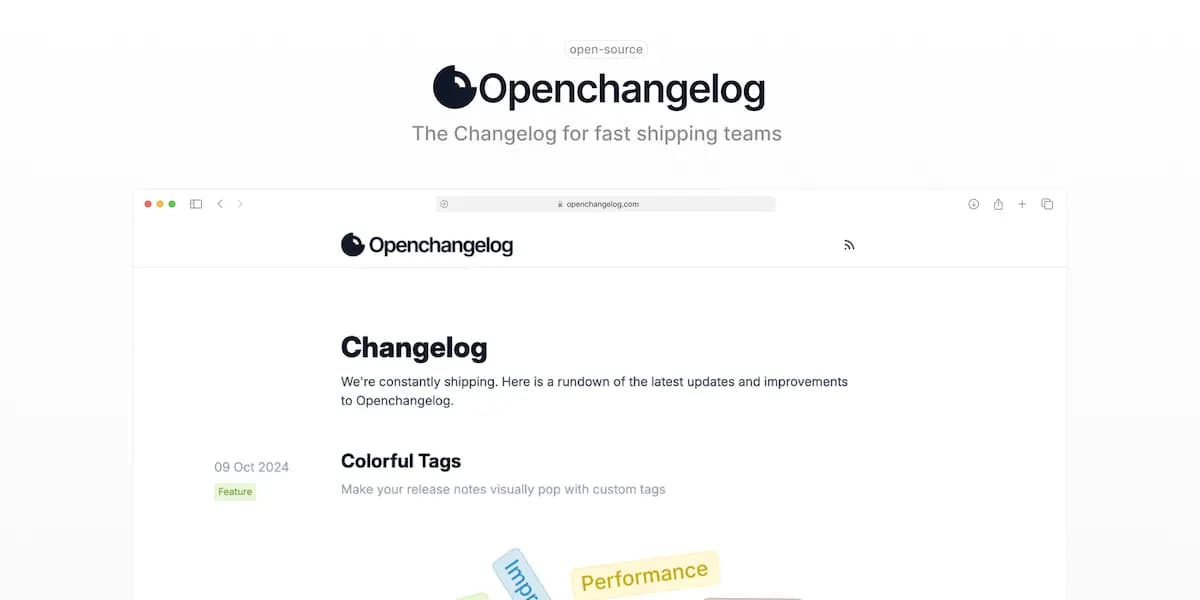
Openchangelog
Openchangelog allows development teams to easily integrate release notes into their workflow, ensuring users are always updated on product changes. It offers a customizable changelog with light and dark themes, custom domain support, and password protection for sensitive communications. Key features include an automatic RSS feed for updates, full-text search for release notes, and direct synchronization with GitHub repositories. The platform supports self-hosting and provides SDKs for easy integration, such as with Next.js. Openchangelog aims to simplify the process of publishing and managing product updates, making it an essential tool for maintaining transparent communication with users.
Caktus AI
Caktus AI is an all-in-one AI-powered academic platform specifically designed for students, offering a comprehensive suite of over 25 specialized tools. It enables users to generate high-quality essays with real, verifiable academic citations in various styles like APA, MLA, Chicago, and Harvard. The platform also features a step-by-step math solver for algebra, calculus, and statistics, ensuring students understand the process. A key differentiator is its AI Text Humanizer, which transforms AI-generated content into natural, human-sounding prose with multiple style presets. Additionally, Caktus AI includes tools for research, flashcard creation from notes, and specialized assistance for science and STEM subjects, making it a versatile academic assistant.
Productive.ai Call Assistant
Productive.ai Call Assistant is an AI-powered tool designed to automate note-taking, CRM logging, and call recording for cell phone conversations. It allows users to conduct business hands-free, ensuring all important information from calls is captured and organized. The assistant generates AI notes, tasks, and events, and automatically logs data into integrated CRM systems. Users can toggle AI functionality on or off at any time and benefit from compliant call recordings. Productive.ai works with existing phone numbers, maintaining call quality and offering features like enhanced caller ID, spam filtering, and custom voicemail greetings. It aims to save professionals time on data entry and improve follow-ups by centralizing call details.
MockingBird
MockingBird is an open-source voice cloning tool designed for real-time speech generation. It allows users to clone a voice in approximately 5 seconds and generate arbitrary speech. The tool supports Chinese Mandarin and has been tested with multiple datasets, including aidatatang_200zh, magicdata, and aishell3. It is compatible with Windows, Linux, and even M1 macOS, offering flexibility for various environments. MockingBird leverages PyTorch and provides options for training custom models for encoders, synthesizers, and vocoders, or utilizing community-shared pretrained models. It offers a web server, a toolbox, and a command-line interface for generating voices.

Famous AI - Idea to app
Famous AI is an innovative mobile application designed to streamline the process of creating and deploying websites and mobile apps. Leveraging artificial intelligence, the tool allows users to build projects directly from their mobile devices, offering a highly accessible development experience. It provides real-time previews, enabling immediate feedback and adjustments during the design and development phases. The platform also boasts instant deployment capabilities, allowing users to quickly launch their creations. This tool is ideal for individuals looking to rapidly prototype and publish web and mobile applications without needing extensive coding knowledge or traditional development environments, empowering them to bring their digital ideas to life efficiently.
TransNetV2
TransNetV2 is an open-source neural network designed for fast and effective shot boundary detection in videos. This repository provides the code for TransNet V2, an advanced deep network architecture that significantly improves upon previous methods for identifying shot transitions. It is particularly useful for tasks like video editing and content analysis, enabling automated segmentation of video content. The project includes resources for both inference and training, with a PyTorch version available for inference. While training datasets can be large, users can leverage pre-trained models and instructions in the inference folder to detect shots in their own videos without needing to retrain the network.
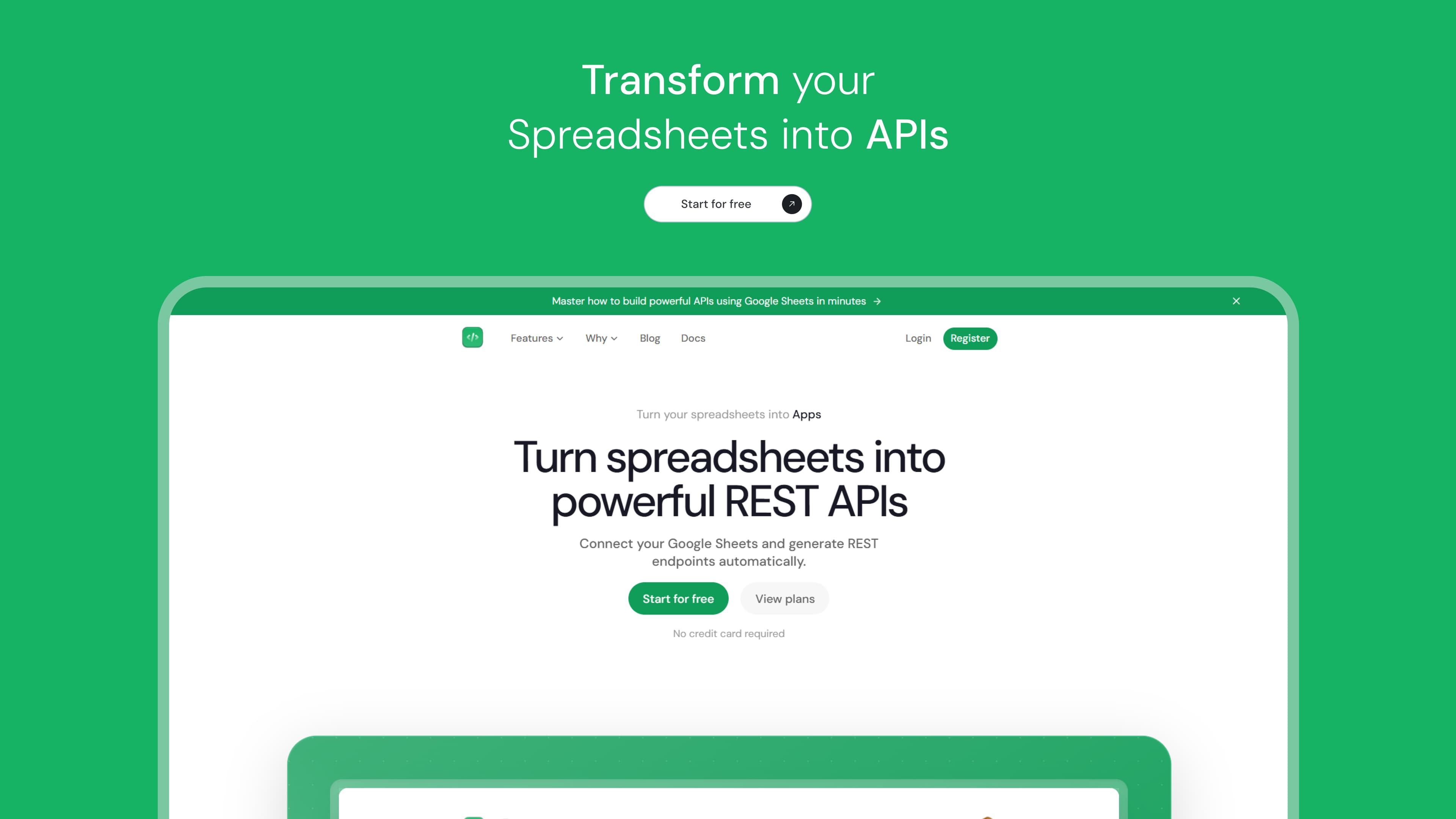
Sheetful
Sheetful is an API-as-a-Service platform designed to turn Google Sheets into high-performance REST APIs instantly. Users can connect their Google Sheets and automatically generate REST endpoints for GET, POST, PUT, and DELETE operations. This no-code solution allows spreadsheets to function as a database for web and mobile apps, no-code tools, or internal systems. Sheetful offers real-time analytics, smart spreadsheet endpoints, and live endpoint testing directly from the dashboard. It prioritizes data privacy and security, acting as a bridge to fetch data via Google's official API only when requested, and supports API Key authentication for secure access.

SaaSberry Innovation Laboratories Ltd.
SaaSberry Innovation Laboratories Ltd. specializes in building AI solutions to address decision latency and operational friction within large organizations. They integrate executive intelligence and automation directly into existing Microsoft environments, promising deployment within 90 days. The firm focuses on identifying where value is lost due to slow decision-making and inefficient workflows, then re-engineering these processes. Their approach is implementation-focused, not advisory, aiming to deliver measurable outcomes like increased operating leverage and improved efficiency without requiring new headcount or system replacements. They target executive leaders accountable for capital efficiency and experiencing margin compression, offering private, confidential enterprise deployments with C-level sponsorship.
rnn
rnn is a specialized library designed for building Recurrent Neural Networks within the Torch7's nn framework. It offers functionalities to construct different types of RNN architectures, including LSTMs (Long Short-Term Memory), GRUs (Gated Recurrent Units), and BRNNs (Bidirectional Recurrent Neural Networks). This tool is particularly useful for developers and researchers working on deep learning projects that require sequential data processing and advanced neural network models. While the original repository is deprecated, its principles and functionalities laid a foundation for subsequent RNN implementations in Torch.
Tetris-deep-Q-learning-pytorch
Tetris-deep-Q-learning-pytorch is an open-source Python project that demonstrates the application of Deep Q-learning for training an AI agent to play the classic game Tetris. Developed with PyTorch, this tool serves as a foundational example of reinforcement learning in action. Users can leverage the provided source code to train their own Tetris-playing models from scratch or test pre-trained models. The project includes all necessary scripts for training and testing, making it accessible for those interested in understanding and experimenting with AI agents and deep learning techniques in a practical gaming context. It's an excellent resource for students and developers exploring the basics of reinforcement learning.

Bostel Workgroup CRM
Bostel Workgroup CRM is a comprehensive Business Management System (BMS) featuring an easy-to-use Customer Relationship Management (CRM) application. This top-tier platform is designed to streamline business operations, combining lead capture with full-cycle sales management to deliver enterprise-level capabilities. It provides clear visibility into leads and opportunities, empowering teams to confidently control sales processes. Bostel also offers Media Answering services, including a flagship AI-powered communication system that can answer calls 24/7 in multiple languages. Additionally, Bostel provides various support service plans to assist users with setup, user management, report design, and training.
ogb
OGB (Open Graph Benchmark) offers a comprehensive suite of benchmark datasets, data loaders, and evaluators specifically designed for graph machine learning. It supports a wide array of graph ML tasks, including predictions at the node, link, and graph levels, and covers diverse real-world applications. The platform provides datasets of varying scales, from those processable on a single GPU to large-scale graphs requiring advanced techniques. OGB's data loaders are fully compatible with leading graph deep learning frameworks like PyTorch Geometric and Deep Graph Library (DGL), offering automatic dataset downloading, standardized splits, and unified performance evaluation. This ensures reliable comparison of different methods and facilitates research in graph machine learning.
spacy-models
spacy-models offers a collection of pre-trained models specifically designed for use with the spaCy Natural Language Processing (NLP) library. These models are essential for data scientists and machine learning engineers who are building applications that require advanced text processing capabilities. The models support a wide range of NLP tasks, including efficient text analysis, named entity recognition, and dependency parsing. By leveraging these pre-trained models, users can significantly accelerate their NLP development workflows, reducing the need for extensive custom training. The integration with spaCy ensures high performance and ease of use for various linguistic tasks.
MagicQuill
MagicQuill is an intelligent and interactive image editing system, officially implemented for CVPR 2025. This open-source tool offers a user-friendly interface with AI-powered suggestions and precise local editing features. Users can leverage three types of 'magic quills': an add brush to introduce details, a subtract brush to remove or redraw elements, and a color brush for precise color adjustments. The system also includes a 'Draw and Guess' feature that intelligently suggests prompts based on user strokes. With robust canvas tools for uploading, erasing, dragging, rotating, and resizing strokes, MagicQuill streamlines the editing workflow. It supports various base models for different editing styles, including realistic, fantasy, portrait, and anime, and allows for negative prompts to refine generation results. Hardware requirements include a GPU with at least 8GB VRAM, and it offers Docker container setup for isolated environments.
tlm
tlm functions as a local command-line interface (CLI) copilot, leveraging the power of Ollama to provide AI-driven code assistance. It is designed to be a workstation companion, allowing developers to utilize various open-source models such as Llama 3, Phi4, DeepSeek-R1, and Qwen within their local environment. This setup ensures that code assistance is available directly from the command line, offering a private and secure way to enhance coding workflows without relying on external cloud services. The tool is particularly beneficial for those who prioritize data privacy and wish to keep their code and AI interactions within their local infrastructure.
Newelle
Newelle is an open-source AI virtual assistant designed for advanced customization and flexible AI model integration. Users can tailor the application with a wide range of settings and choose from multiple AI models and providers, including the ability to download and run local models using Llama.cpp or Ollama. It supports extensions for added functionality, skills from platforms like Claude and Codex, and tools via MCP servers. Key features include voice support with wakeword detection, a call mode for real-time AI interaction, long-term memory for conversations, and the ability to chat with documents and perform web searches. Newelle also offers terminal command execution, dynamic context management, file permissions, scheduled tasks, a profile manager, and a built-in file manager with AI assistance. It supports rich formatting (Markdown and LaTeX), multichat, chat branching, and chat editing, allowing for a highly personalized and efficient virtual assistant experience.

Scanner App-QR Code
Scanner App-QR Code is a mobile application designed for fast and convenient QR code scanning and parsing. Users can easily scan any type of QR code using their phone or tablet's camera, eliminating the need for manual data entry. The app supports multiple QR code formats, including URL links, contact information, text content, and calendar events. After scanning, the product immediately parses and displays relevant information, making it easy for users to view details in various situations. Additionally, users can generate custom QR codes with personalized content and diversified styles, choosing different colors and designs to meet their needs. The intuitive user interface ensures a quick learning curve and straightforward operation.
prompt-layer-library
PromptLayer is a robust AI development tool designed for prompt engineers and developers working with large language models. It functions as middleware, seamlessly integrating with the OpenAI Python library to log and manage all API requests and prompts. Users can track, debug, and replay past completions, offering a comprehensive solution for prompt versioning, testing, and monitoring. The library provides convenient access to the PromptLayer API, allowing for prompt template retrieval, listing, publishing, and cache invalidation. It also includes features for manual request logging, request annotation with metadata, prompt linkage, scores, and groups, and even a decorator for tracing custom functions. With support for both synchronous and asynchronous operations, PromptLayer streamlines the development workflow for AI applications.
PageLlama
The website for PageLlama, pagellama.com, currently displays content for "yl9193永利集团(中国)股份有限公司," which translates to a Chinese university or college. The site details academic activities, research, faculty, student affairs, and partnerships related to political science and public administration. It features news articles, announcements, academic forums, and information about various research centers. There is no indication on the live website that this is an AI tool for converting web pages to Markdown, as suggested by the previous description. The site seems to be a legitimate academic portal for a Chinese institution.
mlops-stacks
mlops-stacks offers a customizable, open-source solution for initiating new machine learning projects on Databricks, adhering to production best practices. It streamlines the development process by providing a pre-configured environment that includes ML project structure, ML resources as code, and CI/CD workflows (GitHub Actions or Azure DevOps). Data scientists can quickly iterate on ML code, while MLOps engineers can efficiently set up continuous integration and continuous deployment pipelines and manage ML resources. The tool supports automated model training and batch inference jobs across dev, staging, and production Databricks workspaces, facilitating an easy transition to production-grade ML solutions. It also integrates with Databricks asset bundles and offers options for Unity Catalog and Feature Store.