
Coding & Development
Browsing page 348 of AI tools for Coding & Development. Sorted by confidence score — our independent quality rating.

phycv
PhyCV is the first Physics-inspired Computer Vision Python library developed by Jalali-Lab at UCLA. It introduces a new class of computer vision algorithms that simulate the propagation of light through physical mediums with diffractive properties, followed by coherent detection. Unlike traditional empirical algorithms, PhyCV leverages physical laws as blueprints, making these algorithms potentially implementable in real physical devices for fast and efficient computation. The library currently includes Phase-Stretch Transform (PST) for edge and texture detection, Phase-Stretch Adaptive Gradient-field Extractor (PAGE) for directional edge detection, and Vision Enhancement via Virtual diffraction and coherent Detection (VEViD) for low-light and color enhancement. Both CPU and GPU versions are available for each algorithm, with GPU versions depending on PyTorch and torchvision.
Shakespeare
Shakespeare is an open-source AI builder designed to assist developers in creating custom applications with AI. It offers a comprehensive development environment for building, editing, and deploying fully customizable AI websites. The platform is geared towards facilitating low-code and no-code development projects, enabling users to leverage AI assistance throughout the application creation process. By providing an open-source foundation, Shakespeare allows for flexibility and customization, making it suitable for a wide range of development needs.
Quantum Teknologi (Nusantara)
Quantum Teknologi (Nusantara) offers an ecosystem of modular AI products and a low-code platform designed to accelerate innovation and optimize operations for organizations. Their QuantumByte Low-Code App Builder allows users to build apps in minutes from prompts, scalable to millions of users. The QuantumAI Modular AI Platform provides real-time data analysis, behavioral learning, and proactive decision-making, empowering non-technical teams to create workflows and automate organizational needs. They also offer industry-specific solutions like Meepo Marketplace for graphic design, Quasar Cybersecurity AI for threat identification, SOT Operations Management, and Kenangan Social Commerce for gifting, revolutionizing various sectors with AI and low-code capabilities.
ImageCaptioning.pytorch
ImageCaptioning.pytorch is a comprehensive open-source codebase designed for advanced image captioning research. It offers robust support for self-critical training, a technique crucial for optimizing caption generation. Researchers can leverage bottom-up features for more detailed image understanding and utilize multi-GPU training for efficient model development, including DistributedDataParallel with pytorch-lightning. The codebase also supports Transformer captioning models, providing a flexible framework for experimenting with state-of-the-art architectures. It includes functionalities for evaluating models on various datasets like COCO and Flickr30k, generating captions for raw images, and performing beam search for improved decoding. With detailed instructions for installation, data preparation, and training, it serves as a valuable resource for academics and developers in the field of computer vision and natural language processing.
keras2cpp
keras2cpp is an open-source project designed to facilitate the porting of Keras neural network models into pure C++ code. This tool is particularly useful for developers who need to deploy Keras models in environments where C++ is the preferred or required language. It stores both the neural network's weights and architecture in plain text files, ensuring transparency and ease of inspection. While initially prepared to support simple Convolutional networks, such as those found in MNIST examples, its design allows for easy extension to accommodate more complex architectures. The current implementation includes ReLU and Softmax activations and is compatible with the Theano backend, providing a robust solution for integrating Keras models into C++ applications.
Bhava
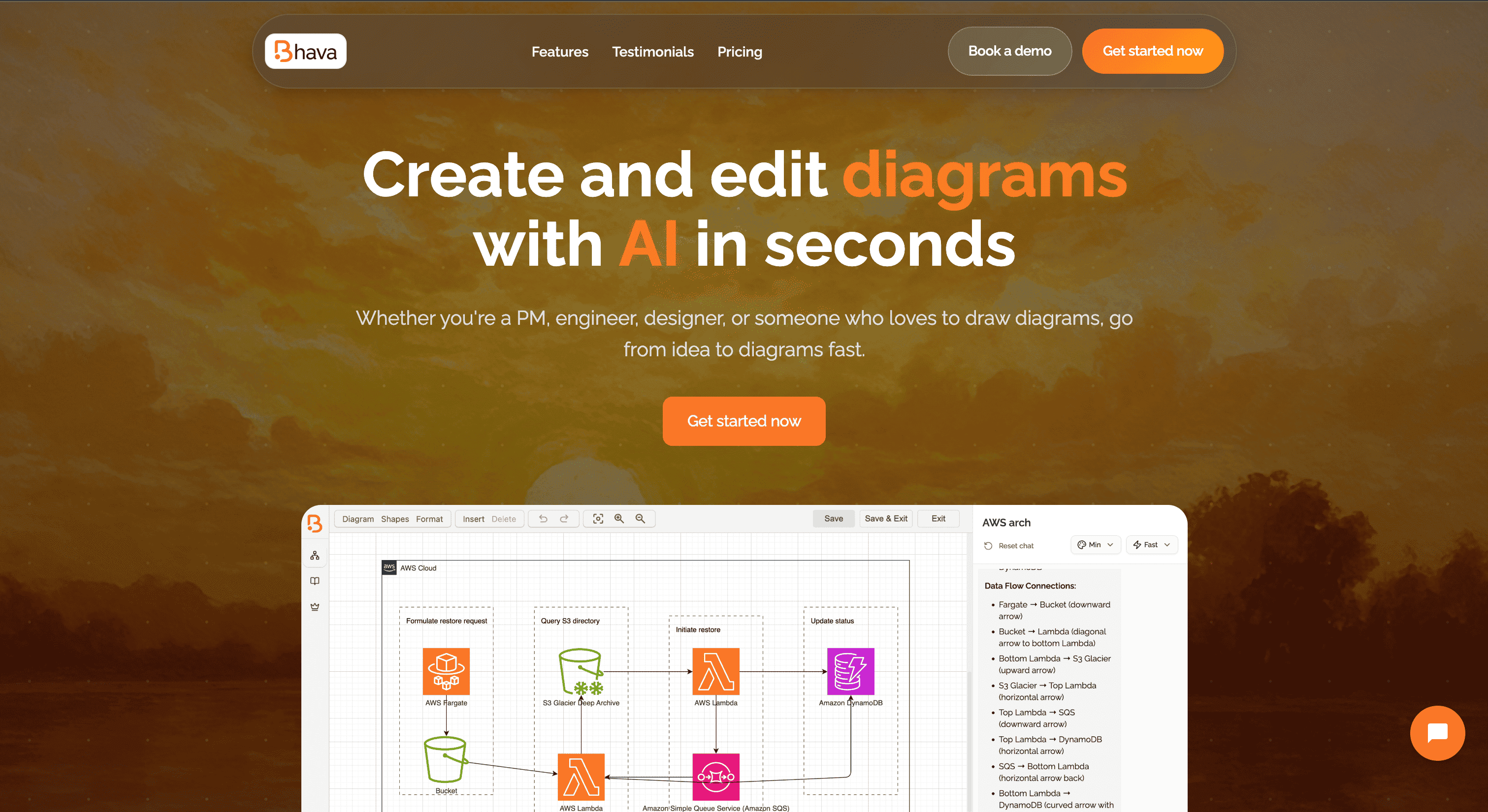
Bhava is an AI-powered diagram editor designed to transform ideas into professional diagrams instantly. It allows users to create and edit various diagram types, including flowcharts, architecture diagrams, UML, ERD, sequence diagrams, network maps, org charts, mind maps, and hardware schematics, all in seconds. The tool supports generating diagrams from text or by dropping images, sketches, or screenshots, automatically recognizing services and symbols like AWS, GCP, Azure, and Kubernetes icons. Diagrams remain fully editable, including styles, layers, and groups. Bhava also offers easy import from draw.io or Mermaid and export to formats like PNG and SVG, ensuring no vendor lock-in. It is trusted by product managers, developers, and engineers for faster and smarter diagramming.
Atai - Automated Testing AI
Atai, pronounced "ah-tay," is an all-in-one testing platform that leverages Vision AI to automate the creation of test cases. It aims to significantly reduce the time and effort typically spent on writing automated tests by allowing users to describe their testing needs, success criteria, and edge cases to an AI-powered test writer named Sprucebot. Sprucebot then builds the test steps, which can be run repeatedly without incurring additional AI costs. Key features include the ability to configure dummy data and users, repair tests when UI changes, and monitor test execution in real-time. Atai offers both a lifetime license for local use and a cloud subscription, providing flexibility for different user needs.
Privacy AI App
Privacy AI App is a unique application designed for iPhone, iPad, and Mac users seeking ultimate privacy and control over their AI interactions. It functions as an offline AI chatbot hub, ensuring all data processing occurs directly on the device, eliminating the need for an internet connection and safeguarding user information. The app supports powerful open-source AI models like LLaMA, Mistral, Phi3, StableLM, and Gemma2, which are optimized for superior performance on Apple devices. Users can enhance their AI experience through extensive customization options, including adjusting sampling temperature, system prompts, and Top-p values, allowing for a truly personalized interaction. Privacy AI App offers a consistent experience across all compatible devices and prioritizes user-centered development with a focus on data privacy and security.

CybeReconN
CybeReconN.com is currently listed for sale on HugeDomains, a platform specializing in domain name transactions. The domain is available for a one-time purchase of $4,095 or through a 24-month payment plan at $170.63 per month with 0% interest. HugeDomains provides a 30-day money-back guarantee and ensures quick delivery of the domain, typically within one to two hours. The platform emphasizes safe and secure shopping with SSL encryption and offers payment options via PayPal or Escrow.com. While the purchase includes only the domain name, NameBright.com, their registrar, offers email packages, though users will need to arrange their own hosting and web design services.
ClipBERT
ClipBERT is an official PyTorch code implementation for an efficient framework designed for end-to-end learning across image-text and video-text tasks. Recognized with a CVPR 2021 Best Student Paper Honorable Mention, ClipBERT processes raw videos/images and text inputs to generate task predictions. It leverages 2D CNNs and transformers, incorporating a sparse sampling strategy to enable efficient multimodal learning. The framework supports end-to-end pretraining and finetuning for tasks such as image-text pretraining on COCO and VG captions, text-to-video retrieval on MSRVTT, DiDeMo, and ActivityNet Captions, video-QA on TGIF-QA and MSRVTT-QA, and image-QA on VQA 2.0. Its modular design allows for easy integration of additional image-text or video-text tasks.

Rails Blocks update (ViewComponents are finally available)
Rails Blocks offers a comprehensive library of UI components designed for modern Ruby on Rails web applications. These components are built with Rails conventions in mind, ensuring seamless integration with Turbo Drive, Turbo Frames, and Turbo Streams. Each component is fully responsive and supports both light and dark modes out of the box. The library leverages Stimulus controllers for interactivity, allowing developers to build dynamic web applications without extensive JavaScript. All components are provided in a copy-and-paste format, giving users full control to customize styles, behavior, and markup to fit their specific needs while maintaining consistency across their application. Recent updates include the availability of Shared Partials and ViewComponents for all component sets, along with Markdown documentation.
tinyengine
TinyEngine is the official implementation of a memory-efficient and high-performance neural network library specifically designed for Microcontrollers. As a core component of MCUNet, a system-algorithm co-design framework, TinyEngine works in conjunction with TinyNAS to facilitate tiny deep learning on IoT devices with extremely tight memory budgets. It significantly outperforms existing inference libraries like TF-Lite Micro, CMSIS-NN, and X-CUBE-AI by improving inference speed by 1.1-18.6x and reducing peak memory by 1.3-3.6x. Key optimization techniques include in-place depth-wise convolution, patch-based inference, operator fusion, SIMD programming, and various loop optimizations to enhance performance and minimize memory footprint.
kornia
Kornia is a differentiable computer vision library built on PyTorch, designed for spatial AI applications. It offers a comprehensive suite of differentiable image processing and geometric vision algorithms, allowing users to leverage powerful batch transformations, auto-differentiation, and GPU acceleration. Key features include a wide range of image processing operators like filters, transformations, and enhancements, as well as advanced augmentation pipelines for training AI models. Kornia also provides access to pre-trained AI models for tasks such as face detection, feature matching, segmentation, and classification. The library is expanding its focus towards end-to-end vision models, with a particular emphasis on integrating state-of-the-art Vision Language Models (VLM) and Vision Language Agents (VLA). It supports multi-framework usage, including TensorFlow, JAX, and NumPy, making it a versatile tool for developers and researchers in the AI and computer vision fields.
machine-learning-samples
machine-learning-samples is an open-source repository offering various sample applications developed with AWS' Amazon Machine Learning (AML). It includes practical code examples for diverse use cases such as targeted marketing, social media filtering, and mobile prediction. Developers can find samples for targeted marketing in Java, Python, and Scala, demonstrating how to use the AML API. Additionally, there's a sample for social media filtering that integrates Amazon Mechanical Turk for data labeling and AWS Lambda for automated tweet monitoring. Mobile prediction samples are available for both iOS and Android, showcasing real-time ML predictions from mobile devices. The repository also features a k-fold cross-validation sample in Python for model evaluation and a collection of utility scripts.
NaturalReader - Text to Speech
NaturalReader is an AI-powered text-to-speech tool that converts various text formats, including documents, PDFs, webpages, and even physical books, into natural-sounding audio. It leverages advanced language models to create lifelike voices that can understand text content and adjust delivery accordingly. The tool supports over 90 languages and offers features like voice cloning, custom voice design, and content-aware voices. Beyond basic text-to-speech, NaturalReader provides AI-powered features such as AI Podcast for converting long readings into episodes, AI Recap for summaries, AI Screenshot for detailed analysis of captured text, AI Chat for document interaction, and AI Quizzes for studying. It is available as a web app, mobile app, and Chrome extension, catering to personal, commercial, and educational users.
autopilot
Autopilot is an AI tool designed to assist developers by leveraging GPT to understand and interact with codebases. It reads existing code, builds a metadata database for context, and then attempts to solve requested tasks by implementing code changes. Key features include pre-processing codebase files, implementing code changes, and providing a full process log for each AI interaction. It also offers an interactive mode, allowing users to review and control each step of the process with options to retry, continue, or abort. Autopilot can be used as a GitHub app to automatically resolve issues and manage pull requests, providing a direct integration with GitHub for an easy interface.
Meku.dev
Meku.dev is an AI web app and website builder designed for developers to rapidly create, customize, and deploy stunning websites and web applications. Users can describe their desired full-stack web app or site in plain language, and Meku.dev instantly generates a functional, production-ready version. The platform supports continuous refinement through conversational AI, allowing users to customize and extend their applications directly in chat. Key features include one-click deployment with SSL and custom domains, the ability to launch full-stack applications with authentication, databases, and APIs, and seamless integrations with GitHub, Figma, and Supabase. Meku.dev emphasizes developer-friendly features like live previews, real-time refinements, and full code ownership with export options to GitHub or ZIP files, ensuring no vendor lock-in.

Project Numina
Project Numina is a non-profit initiative dedicated to advancing mathematics through open collaboration between humans and AI. It focuses on building open-source AI tools, models, and datasets specifically designed for mathematical collaboration and research. The platform aims to deepen how humans and machines engage with mathematics by providing accessible resources and fostering a community of shared exploration. Users can discover flagship projects, current research directions, and access all models and datasets which are open and available. The initiative encourages community involvement through contributions, resource exploration, and donations to support its mission of open, collaborative mathematics.
OnSpace.AI: App Builder AI No-code Platform
OnSpace.AI is a leading no-code AI app builder designed to transform ideas into production-ready web, iOS, and Android applications in minutes. This platform empowers users to craft tailored AI applications effortlessly, without needing any coding skills. It integrates agentic AI for smarter app functionality and offers built-in monetization capabilities with Stripe payment integration. OnSpace.AI provides a fully managed backend including database, authentication, and storage, eliminating the need for DevOps. Users can build and edit apps from their phone, deploy cross-platform instantly, and even export their code via GitHub integration for self-hosting. The platform supports various AI models and offers features like App Store and Google Play publishing.
image_captioning
image_captioning is an open-source TensorFlow implementation of a neural image caption generation system, based on the "Show, Attend and Tell" paper. This tool takes an image as input and outputs a descriptive sentence. It leverages a convolutional neural network (CNN) to extract visual features from the image, which are then decoded into a sentence by an LSTM recurrent neural network (RNN). A soft attention mechanism is integrated to enhance the quality and relevance of the generated captions. The project supports end-to-end training of both CNN and RNN components, allowing for fine-tuning with datasets like COCO train2014. Users can evaluate models, generate captions for new images, and monitor training progress with TensorBoard.
helion
Helion is a Python-embedded domain-specific language (DSL) designed for authoring machine learning kernels, compiling down to Triton for performant GPU programming. It aims to raise the abstraction level compared to Triton, making it easier to write correct and efficient kernels while enabling more automation in the autotuning process. Helion significantly reduces manual coding effort by evaluating hundreds of potential Triton implementations generated from a single Helion kernel, leading to better performance portability across different hardware. Key features include automated tensor indexing, masking, grid size determination, implicit search space definition, kernel argument management, looping reductions, and various automated optimizations like PID swizzling and loop reordering. It integrates seamlessly with PyTorch operators, allowing users familiar with PyTorch to quickly adopt Helion.
serve
Jina-Serve is a robust, open-source framework designed for building and deploying multimodal AI applications using a cloud-native stack. It facilitates communication via gRPC, HTTP, and WebSockets, allowing developers to scale their AI services efficiently from local development environments to full production. Key features include native support for major ML frameworks and data types, high-performance service design with scaling, streaming, and dynamic batching, and LLM serving with streaming output. Jina-Serve also offers built-in Docker integration, an Executor Hub, and one-click deployment to Jina AI Cloud, making it enterprise-ready with Kubernetes and Docker Compose support. It provides advantages over tools like FastAPI through DocArray-based data handling, native gRPC support, and seamless microservice scaling.

Tag Companion
Tag Companion streamlines Google Tag Manager (GTM) implementation, transforming hours of manual setup and debugging into minutes. Users can visually select elements on their website, configure GA4 event names and parameters through a point-and-click interface, and then export a complete GTM container file. This eliminates the need for complex CSS selectors, developer tickets, or direct code changes on the website. It supports tracking various elements like button clicks, form submissions, and full GA4 eCommerce events, even for forms that submit without page reloads. The tool integrates seamlessly with GTM, allowing users to import configurations and publish, ensuring tracking runs independently through GTM without ongoing dependencies on Tag Companion.
Moreh
Moreh offers full-stack inference software designed to unlock peak LLM inference performance across a range of hardware, including AMD GPUs, Tenstorrent chips, and heterogeneous GPU clusters. Its MoAI Inference Framework handles routing, scheduling, auto-scaling, and SLO-driven optimization, while Moreh vLLM provides state-of-the-art model optimization, quantization, and graph execution. The platform also includes native vLLM Moreh Libraries with custom kernels for GEMM/Attention/MoE and communication. Moreh aims to unify GPUs across vendors and generations, maximize tokens per dollar through chip-level and cluster-level optimization, and significantly reduce inference costs and latency, as demonstrated by benchmarks showing substantial improvements over existing solutions.