
Coding & Development
Browsing page 352 of AI tools for Coding & Development. Sorted by confidence score — our independent quality rating.

AI-Gist
AI-Gist is a privacy-focused, open-source AI prompt management tool designed to maximize the value of personal AI prompts. It offers core functionalities such as variable substitution, Jinja templating, and AI-powered generation and optimization of prompts. Users can efficiently create, organize, and refine their AI prompts with features like multi-view management, filtering by tags and categories, and historical version tracking for continuous improvement. The tool integrates with various AI models, including local options like Ollama and LM Studio, as well as online models like OpenAI, allowing for AI-generated prompts, prompt refinement, and automatic variable extraction. AI-Gist prioritizes privacy by storing all data locally by default, with optional cloud backup via WebDAV and iCloud for multi-device synchronization. It supports Windows, macOS, and Linux, and offers multi-language support.
self-attention-cv
Self-attention-cv is an open-source repository offering implementations of diverse self-attention mechanisms specifically tailored for computer vision applications. Built in PyTorch, it leverages `einsum` and `einops` for efficient and flexible module creation. The repository serves as an ongoing collection of building blocks, enabling developers to integrate advanced attention models into their projects. It supports a range of computer vision tasks, including image recognition and segmentation, with examples for Multi-head attention, Axial attention, Vision Transformers (ViT), and TransUnet. It also includes various positional embedding implementations.
DeepXi
DeepXi is a deep learning framework implemented in TensorFlow 2/Keras, designed for a priori Signal-to-Noise Ratio (SNR) estimation. This tool is primarily used for speech enhancement, noise estimation, and mask estimation, and can also serve as a front-end for robust Automatic Speech Recognition (ASR). It supports various deep neural network architectures, including MHANet, RDLNet, ResNet, ResLSTM, and ResBiLSTM, to efficiently model noisy speech. DeepXi offers both causal and non-causal versions of its models, providing flexibility for different application requirements. It operates on mono/single-channel audio at a standard sampling frequency of 16000 Hz, with configurable window duration and shift. The tool supports common audio codecs like .wav, .mp3, and .flac, and provides pre-trained models and datasets for research and development.

Hire22 Anonymous AI Job search
Hire22.ai is India's first agentic job portal specializing in mid and senior-level hiring, transforming recruitment through AI. It offers an anonymous job search experience, connecting employers with AI-matched, interview-ready candidates in as little as 22 hours. The platform utilizes a Virtual Recruiter powered by three distinct AI agents: Hunter AI for talent discovery, CoNCT AI for candidate engagement, and JoinX AI for benchmarking joining probability. This ensures a bias-free hiring process, where candidates are evaluated purely on skills and experience, with personal details revealed only upon mutual agreement. For job seekers, the platform is completely free, while employers benefit from flexible pricing models, including success-based fees and subscription plans, significantly reducing hiring time and costs.
Enkrypt AI
Enkrypt AI offers a comprehensive platform for AI security and compliance, designed to help organizations deliver AI applications quickly and safely. The platform features Agent Red Teaming for continuous threat detection, Agent Guardrails for real-time threat removal, and Agent Policy Engine for automated compliance. It also includes an AI Data Risk Audit and tools like MCP Scanner and MCP Gateway. Enkrypt AI helps accelerate time to certify and ship by automating security and compliance processes, providing real-time insights for audits, and protecting against emerging threats like prompt injection, data leakage, and model bias. It is recognized as a Gartner® Cool Vendor in AI security for 2025.

AI React Code Generator
FullStackPathway is an all-in-one AI toolkit designed to help users solve a wide range of problems, from generating lyrics and scripts to creating business plans and solving technical challenges. The platform offers over 900 AI-powered tools across categories like Assistants & Utilities, Business & Marketing, Coding & Technical, Creative Writing & Media, Education & Academic, Math/Science & Puzzles, Naming & Branding, and Writing & Communication. All tools are 100% free to access, with no sign-ups or payments required, and boast an average response time of 2 seconds. It's an ideal resource for anyone looking for quick, AI-driven solutions in creation, coding, study, and identification tasks.

Gamers Home
Gamers Home is an all-in-one workspace designed specifically for indie game development teams. It helps solo founders and small studios overcome common challenges like overscoping and project management overhead. Users can paste their Game Design Document (GDD) to instantly generate a comprehensive production plan, including epics, stories, tasks, milestones, and dependencies across all disciplines. The platform also features a network of over 500 collaborators across 38 countries, allowing teams to find and invite producers, engineers, artists, and composers. Gamers Home integrates Kanban boards, drag-and-drop workflows, and syncs with tools like Jira and Linear, providing a unified dashboard for managing game production.
Supadex
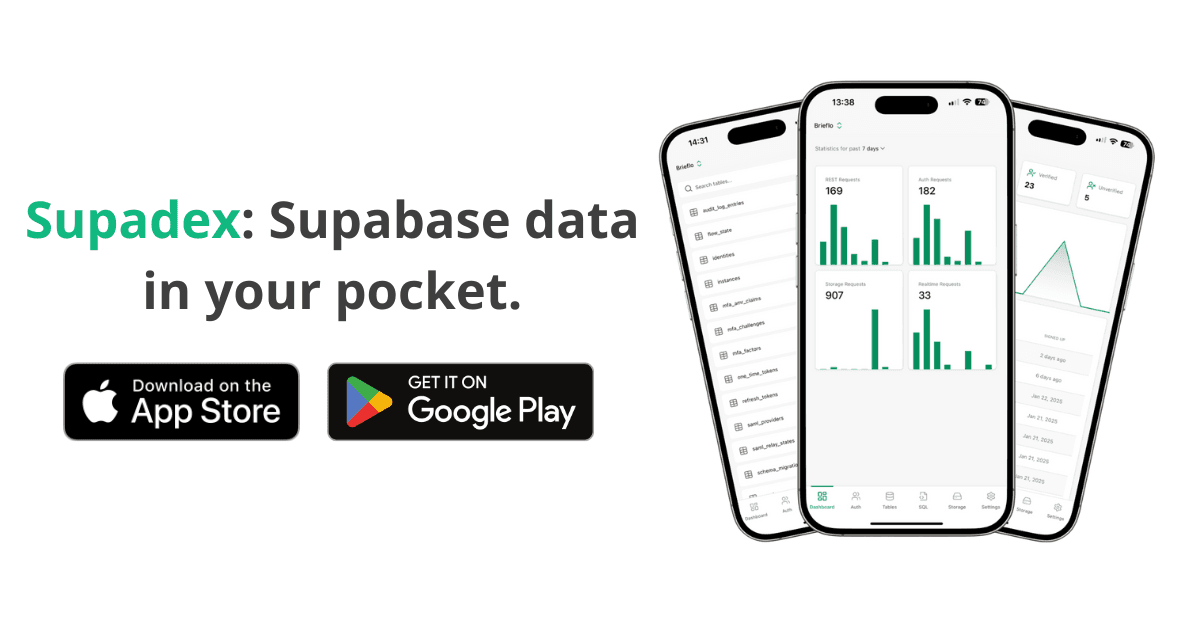
Supadex is a mobile application designed to provide a comprehensive dashboard for Supabase projects. It enables users to manage databases, track key metrics, and monitor project performance from anywhere, anytime. The tool offers real-time statistics, including requests count, authentication statistics, and storage usage. Users can browse schemas, tables, and storage buckets, explore detailed views of tables and rows, and preview files. Supadex also features a SQL Editor for writing and executing queries, along with the ability to save favorite Supabase queries. It ensures data security by storing API tokens encrypted on the user's device only, never transmitting them to external servers. The app supports managing multiple Supabase projects, allowing easy switching between them.
ollama-grid-search
ollama-grid-search is a multi-platform desktop application designed to evaluate and compare Large Language Models (LLMs). Written in Rust and React, it automates the process of selecting optimal models, prompts, or inference parameters for a given use case. Users can iterate over various combinations and visually inspect the results, making it an invaluable tool for prompt engineering and model selection. The application assumes Ollama is installed and serving endpoints, either locally or on a remote server. Key features include automatic fetching of models from Ollama servers, A/B testing of prompts, a fully functional prompt database, and the ability to list, inspect, and re-run past experiments.
A1111-Web-UI-Installer
A1111-Web-UI-Installer is a comprehensive installer designed to streamline the setup process for Automatic1111's Stable Diffusion WebUI. This tool aims to make the powerful AI image generation interface accessible to a broader audience by simplifying the often complex installation steps. Users can quickly get the WebUI up and running, enabling them to leverage Stable Diffusion for various creative tasks without extensive technical knowledge. The project is hosted on GitHub, indicating its open-source nature and community-driven development. While the project notes that this specific launcher is obsolete and recommends Stability Matrix, it still serves as a historical reference for simplified WebUI deployment.
Time-MoE
Time-MoE is an open-source project offering a family of decoder-only time series foundation models, utilizing a Mixture of Experts architecture. These models are designed for auto-regressive operation, enabling universal forecasting with arbitrary prediction horizons and context lengths up to 4096. It scales up to 2.4 billion parameters and is trained from scratch. A key component is the Time-300B dataset, the largest open-access time series data collection, comprising over 300 billion time points across more than nine domains. Time-MoE supports making forecasts, fine-tuning with custom datasets in jsonl format, and evaluation on benchmark datasets, making it suitable for advanced time series analysis.
SLM-Lab
SLM-Lab is a comprehensive and modular deep reinforcement learning (RL) framework built using PyTorch. It is designed to facilitate RL research and application, serving as the companion library for the book "Foundations of Deep Reinforcement Learning." The framework offers a suite of ready-to-use algorithms such as PPO, SAC, CrossQ, DQN, A2C, and REINFORCE, all validated across more than 70 environments. Users can easily configure experiments using JSON spec files, eliminating the need for code changes. SLM-Lab emphasizes reproducibility by saving each run's specification and git SHA, and provides automatic analysis with training curves, metrics, and TensorBoard logging. It also integrates with dstack for GPU training and HuggingFace for sharing results, supporting various environments including Classic Control, Box2D, MuJoCo, and Atari.

Codelita: Anyone Can Code
Codelita is an innovative online platform designed to teach programming from the ground up, making coding accessible to anyone, even on mobile devices. It leverages proprietary AI technologies, including 'Mentor-on-the-go™' for real-time code feedback and 'Machine-Teaching™' for personalized curricula based on individual progress. A standout feature is 'Codeeboard®', a patented virtual keyboard optimized for coding on touch devices, addressing the challenge of mobile programming. The platform breaks down learning into 'Microlearning Nuggets' (5-10 minute lessons) to fit into busy schedules. Codelita aims to provide a comprehensive and supportive learning experience, culminating in a verifiable certificate of completion for courses.
I built an AI-assisted roadmap tool to prioritize SaaS features
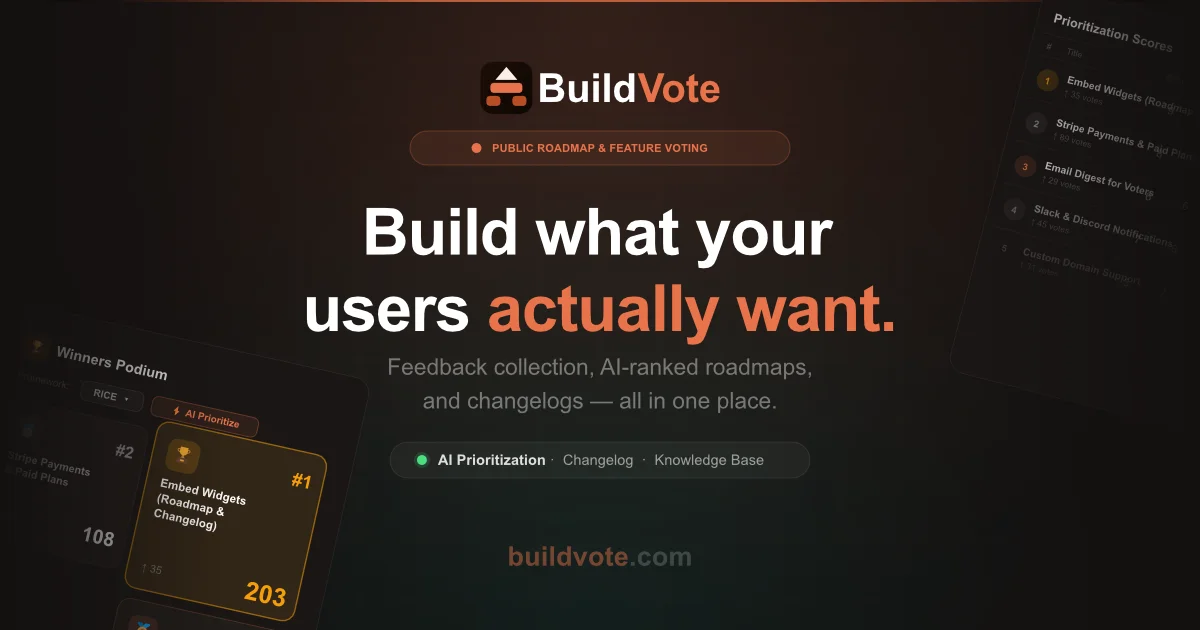
BuildVote is an AI-powered platform designed to help product teams and indie makers gather feedback, prioritize features, and manage their product roadmap effectively. It allows users to collect feedback from their audience, let them vote on proposed features, and then share a clear product roadmap. The platform leverages AI to provide intelligence for prioritizing features, ensuring that development efforts are focused on what truly matters to customers. This tool is ideal for those looking to build products that resonate with their user base by actively listening to their needs and incorporating their input into the development cycle. It aims to streamline the feedback-to-roadmap process, making it easier to ship valuable features.
Genie-TTS
Genie-TTS is an open-source, lightweight inference engine and model converter specifically designed for GPT-SoVITS ONNX models. It excels in providing near-instantaneous speech synthesis on CPUs, making it highly efficient for various applications. The tool integrates essential functionalities such as TTS inference, ONNX model conversion, and an API server, all aimed at delivering ultimate performance and convenience. It supports GPT-SoVITS V2 and V2ProPlus models, with planned support for V3 and V4, and handles Japanese, English, Chinese, and Korean languages. Genie-TTS also offers significant performance advantages over official PyTorch models, particularly in first inference latency and runtime size, making it an ideal solution for developers and content creators seeking high-performance, CPU-based speech synthesis.
TensorLayer
TensorLayer is a powerful, open-source deep learning and reinforcement learning library built for scientists and engineers. It offers an extensive collection of customizable neural layers, enabling rapid development of advanced AI models. Inspired by PyTorch, TensorLayer provides transparent and flexible APIs, making it easier to build and train complex AI models compared to other TensorFlow wrappers. It supports multiple backends including TensorFlow, PyTorch, MindSpore, PaddlePaddle, OneFlow, and Jittor, allowing deployment on various hardware like Nvidia-GPU and Huawei-Ascend. The library is recognized for its simplicity, flexibility, and high performance, with comprehensive documentation and a large community.

OpenRAIL-M v1
OpenRAIL-M v1 is an Open Responsible AI License (OpenRAIL) developed by the BigCode project, specifically for its AI models. This license facilitates free and open access, reuse, and redistribution of AI artifacts, including derivatives, for both research and commercial purposes. It promotes responsible AI practices by incorporating use restrictions that apply to all uses, including derivative works. The CodeML OpenRAIL-M 0.1 is an interim version of the license, designed to address potential harms from code generation models. It is not an Open Source Initiative-approved license due to its use restrictions, but it allows broad use as long as these restrictions are respected. The license also mandates clear disclaimers for AI-generated code.

Project Numina
Project Numina is a non-profit initiative dedicated to advancing mathematics through open collaboration between humans and AI. It focuses on building open-source AI tools, models, and datasets specifically designed for mathematical collaboration and research. The platform aims to deepen how humans and machines engage with mathematics by providing accessible resources and fostering a community of shared exploration. Users can discover flagship projects, current research directions, and access all models and datasets which are open and available. The initiative encourages community involvement through contributions, resource exploration, and donations to support its mission of open, collaborative mathematics.
Stitchflow
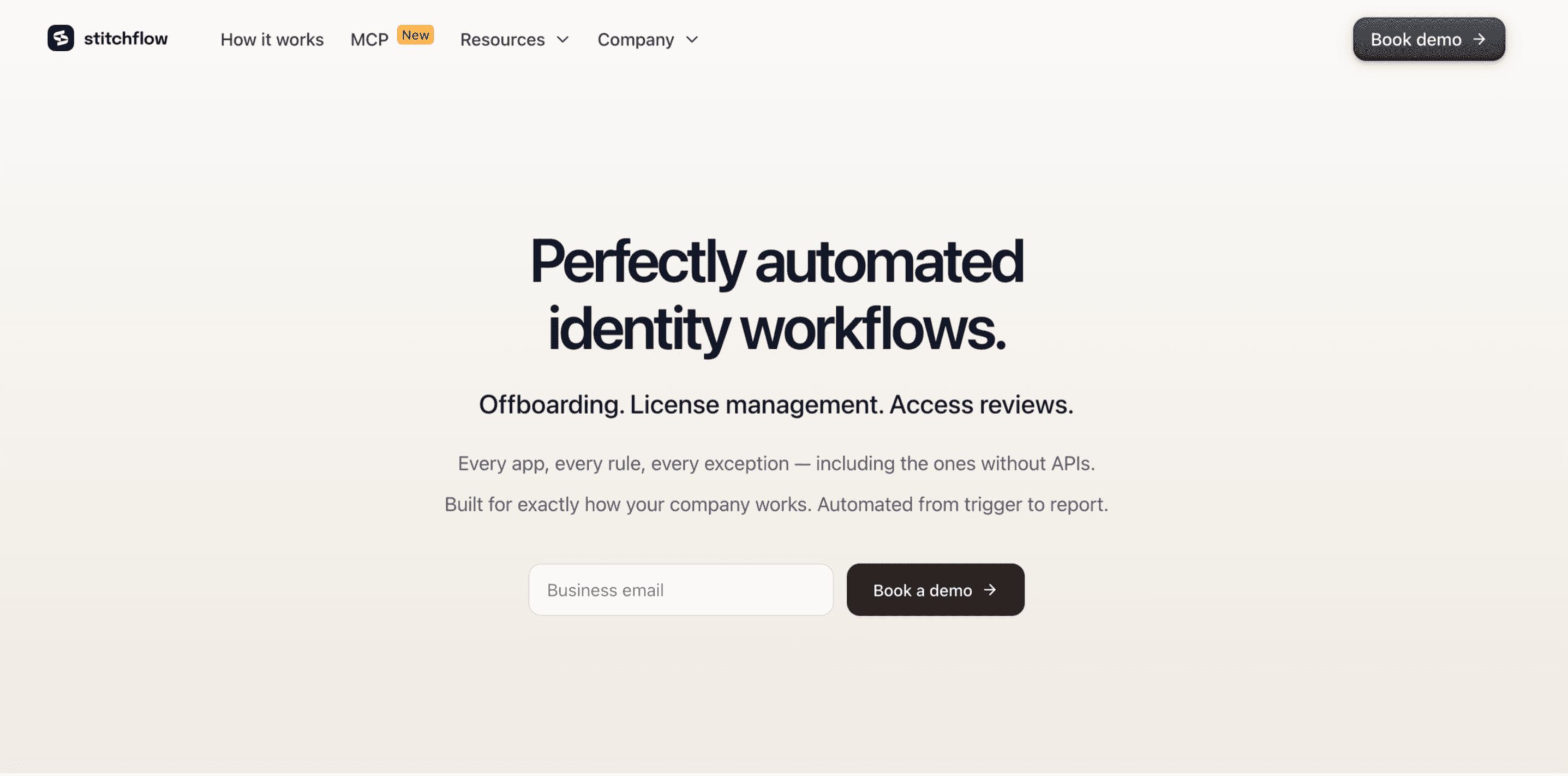
Stitchflow is a managed IT automation service designed to streamline complex IT operations like offboarding, license cleanup, access reviews, and SaaS spend management. It integrates with over 60 apps via API and utilizes a local browser agent for applications without management APIs, ensuring 100% coverage of your app stack. Stitchflow learns your specific workflows, including rules and edge cases, and builds them using AI for rapid deployment, typically under a week. The workflows then run on deterministic logic, ensuring consistent execution without AI hallucinations. The service also provides spend intelligence by mapping users and apps with financial data to identify shadow IT and optimize SaaS spend. Stitchflow handles all maintenance, monitoring, and updates for integrations, allowing IT teams to focus on strategic tasks.

Metaflow.org
Metaflow.org is an open-source framework designed to simplify the development, management, and deployment of real-life ML, AI, and data science projects. It allows users to build robust workflows using any Python libraries for models and business logic, managing dependencies locally and in the cloud. Key features include automatic versioning of variables for experiment tracking and debugging, and seamless orchestration of workflows in plain Python, enabling local development and debugging before deployment to production without code changes. Metaflow facilitates scaling to the cloud, leveraging GPUs, multiple cores, and large memory, and integrates with major cloud providers like AWS, Azure, and Google Cloud, or custom Kubernetes clusters. It was originally developed at Netflix to address the demanding needs of ML/AI engineers and data scientists.
Meshcapade
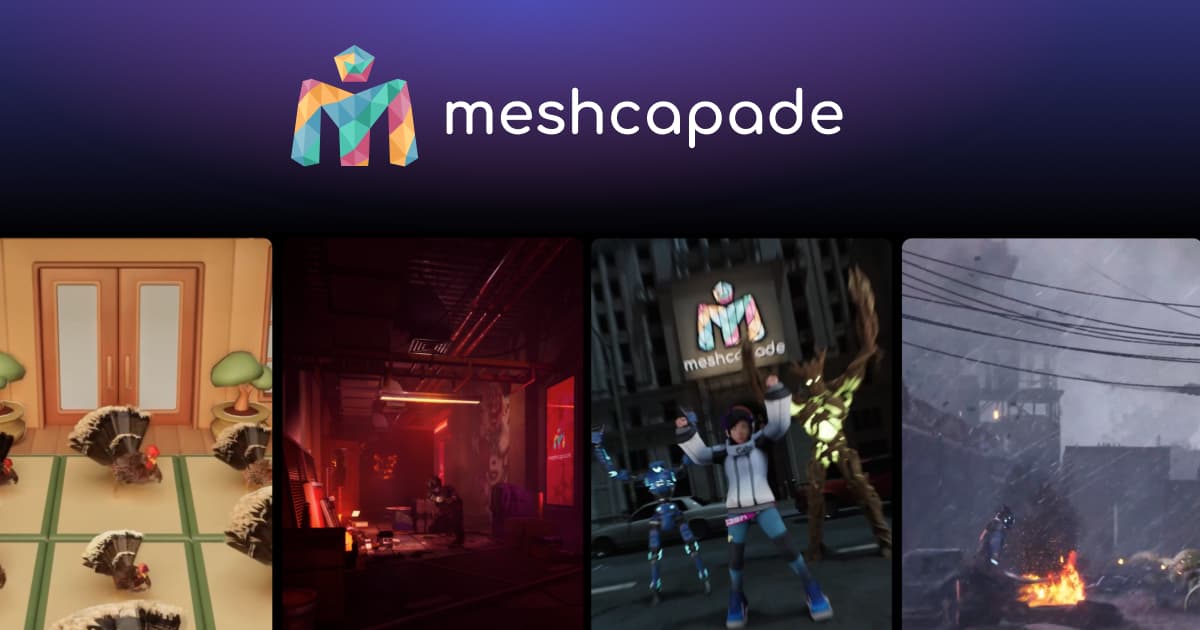
Meshcapade offers a comprehensive AI toolkit for markerless motion capture, motion generation, and human-understanding. It allows users to capture full body and hand movements with unmatched quality using any camera, from phones to professional setups, without the need for suits or markers. The platform supports various export formats like FBX and GLB, making it compatible with diverse workflows. Built on the SMPL foundation model, Meshcapade's technology adapts to industries such as gaming, fashion, and robotics, providing accurate 3D bodies and motion. It also offers features like realistic 3D hair estimation (coming soon) and is enterprise-proven, privacy-first, and EU/GDPR compliant.
ai-cli
ai-cli is a command-line interface tool designed to enhance developer productivity by integrating ChatGPT directly into the terminal. Users can ask questions about CLI commands and receive instant answers, streamlining their workflow and reducing the need to switch contexts. The tool requires users to provide their own OpenAI API key, which can be easily configured using the `ai auth` command. It supports changing the default model preference, currently set to `gpt-3.5-turbo`, and offers an autocomplete feature for various shells. This makes it an efficient solution for developers seeking quick command assistance and explanations without leaving their terminal environment.
tiefvision
tiefvision is an integrated end-to-end image-based search engine powered by deep learning. It offers comprehensive functionalities including image classification, image location (based on OverFeat), and image similarity (based on Deep Ranking). The system is built using Torch for its deep learning modules and the Play Framework (Scala version) for its tooling modules. It currently supports Linux operating systems with CUDA-enabled GPUs, indicating a focus on performance-intensive image processing tasks. Beyond its core deep learning capabilities, tiefvision also provides a suite of web tools designed to streamline dataset generation and enhance productivity, such as visual database editors and automated dataset generation for training and testing.

Paper Design
Paper Design is a modern and powerful design tool designed to help teams create, share, and ship their best work. It functions as a connected canvas, integrating teams, AI agents, code, and data within a unified design environment built on web standards. Key features include Paper Desktop for a new design workflow connecting visual work with apps, agents, and repositories, and the ability to sync design tokens, styles, and components between codebase and canvas. The tool supports connecting any IDE or CLI agent, allowing for a shared layer between code and design. It also enables users to bring real content and data from various apps and databases, facilitating design with actual information rather than placeholders. Paper Design leverages AI agents to handle repetitive tasks like responsive layouts and style variations, freeing designers to focus on creative decisions.