
Coding & Development
Browsing page 337 of AI tools for Coding & Development. Sorted by confidence score — our independent quality rating.

Sheety.ai
Sheety.ai is an AI-powered tool designed to streamline spreadsheet operations by generating formulas for both Excel and Google Sheets. It helps users simplify complex calculations, automate repetitive tasks, and enhance overall efficiency within their spreadsheets. The tool aims to make data manipulation more accessible, allowing users to focus on insights rather than formula construction. By leveraging artificial intelligence, Sheety.ai provides a user-friendly solution for anyone looking to improve their productivity and accuracy in spreadsheet management, whether for data analysis, financial modeling, or general data organization.

AICA SA
AICA SA offers a platform for advanced robotics, simplifying robot integration and programming across diverse hardware. The AICA System allows robots to sense and adapt to variations, enabling reliable automation in real-time. It supports various use cases such as screwing, polishing, and assembly by combining real-time control with advanced sensor-driven technologies. The platform provides a library of pre-built software components and a visual, node-based editor to develop and deploy advanced robotic skills quickly. AICA System also ensures hardware independence, allowing solutions to be deployed across different robots and sensors, and offers access to an ecosystem for simulation and AI model integration.

DoubleCloud
DoubleCloud offers a comprehensive platform for building data analytics infrastructure, leveraging fully managed open-source solutions like ClickHouse, Apache Kafka, and Apache Airflow. The platform streamlines data pipelines from ingestion to visualization, providing integrated, reliable, and zero-maintenance services. Key offerings include a no-code ELT tool for real-time data syncing, and a managed open-source Data Visualization tool for creating dashboards and charts. Designed for engineers, DoubleCloud focuses on exceptional performance, security with ISO 27001, SOC 2, GDPR compliance, and cost-effectiveness through a pay-as-you-go model and hybrid storage options. It aims to simplify day-to-day operations by handling routine maintenance, allowing engineers to focus on product development.
WeDLM
WeDLM is an open-source diffusion language model developed by Tencent, designed for high-speed inference. It uniquely reconciles diffusion language models with standard causal attention, enabling native KV cache compatibility with technologies like FlashAttention and PagedAttention. This approach allows for direct initialization from pre-trained autoregressive models such as Qwen2.5 and Qwen3, delivering significant real speedups compared to vLLM-optimized baselines. WeDLM achieves 3-6x speedup on tasks like math reasoning and up to 10x on sequential/counting tasks, while maintaining competitive accuracy. It includes an inference engine, evaluation suite, and a fine-tuning framework, making it a powerful tool for developers and researchers focused on efficient language model deployment.
dalai
Dalai is an open-source AI development tool designed to simplify running LLaMA and Alpaca large language models directly on a local machine. It eliminates the need for cloud services, making it accessible for developers and AI enthusiasts to experiment with these powerful models. The tool is cross-platform, supporting Linux, Mac, and Windows, and includes a hackable web application. Dalai ships with both JavaScript and Socket.io APIs, allowing for programmatic installation, model requests, and server management. It provides clear instructions for installation and usage, including memory and disk space requirements for various model sizes, making it a practical solution for local LLM deployment.
ai-reference-models
Intel® AI Reference Models is a repository that provides Intel optimizations for running deep learning workloads on Intel® Xeon® Scalable processors and Intel® Data Center GPUs. It includes links to pre-trained models, sample scripts, best practices, and step-by-step tutorials for popular open-source machine learning models. The project aims to quickly replicate complete software environments that demonstrate the best-known performance of various model/dataset combinations, showcasing the AI capabilities of Intel platforms. While the project has reached the end of its active development, with v3.4.0 being the last release with new features, it will be archived in March 2026, with critical vulnerability fixes until then. Users can refer to Intel® Extension for PyTorch* and Intel® Extension for OpenXLA* projects for alternatives.
Plugin.st
Plugin.st is a comprehensive platform designed to assist startups and developers by offering a diverse range of applications and plugins. The tools available on the platform cover key areas such as large language model (LLM) development, scriptwriting, and various marketing functionalities. It aims to provide essential resources to streamline development and operational processes for its target audience. The platform operates on a freemium model, allowing users to explore its offerings through a free trial before committing to paid plans.
whisper-vits-svc
whisper-vits-svc is an open-source core engine for singing voice conversion and singing voice cloning, built upon the VITS framework. It leverages variational inference with adversarial learning for end-to-end voice transformation. Designed for deep learning beginners, the project requires basic knowledge of Python and PyTorch. Key features include support for multiple speakers, the ability to create unique speakers through mixing, and conversion of voices even with light accompaniment. Users can also edit F0 using Excel and benefit from various model properties like strong noise immunity and improved conversion stability. The tool does not support real-time voice converting and focuses on practical application for learning deep learning concepts.
Moreh
Moreh offers full-stack inference software designed to unlock peak LLM inference performance across a range of hardware, including AMD GPUs, Tenstorrent chips, and heterogeneous GPU clusters. Its MoAI Inference Framework handles routing, scheduling, auto-scaling, and SLO-driven optimization, while Moreh vLLM provides state-of-the-art model optimization, quantization, and graph execution. The platform also includes native vLLM Moreh Libraries with custom kernels for GEMM/Attention/MoE and communication. Moreh aims to unify GPUs across vendors and generations, maximize tokens per dollar through chip-level and cluster-level optimization, and significantly reduce inference costs and latency, as demonstrated by benchmarks showing substantial improvements over existing solutions.
Text2SQL.AI
Text2SQL.AI is an AI-powered tool designed to simplify the generation of SQL queries from natural language. It allows users to effortlessly create optimized SQL code for a wide range of databases, including MySQL, PostgreSQL, Oracle, and Microsoft SQL Server. The platform offers features like schema integration for accurate queries, an API for custom tool development, and a desktop application for maximum privacy and local execution. It also includes an 'Insights' feature that provides SQL queries, results, visualizations, and explanations in a unified view, streamlining data analysis from question to chart in seconds.
Transformer-TTS
Transformer-TTS is a PyTorch implementation of the "Neural Speech Synthesis with Transformer Network," designed for efficient and high-quality speech synthesis. This model boasts training speeds 3 to 4 times faster than well-known seq2seq models such as Tacotron, while maintaining comparable synthesized speech quality. It utilizes a post-network based on the CBHG model from Tacotron and converts spectrograms into raw audio waves using the Griffin-Lim algorithm. The project includes detailed instructions for data preparation, training the autoregressive attention network and post-network, and generating TTS samples, making it a valuable resource for researchers and developers in speech synthesis.
tiny-dnn
tiny-dnn is a C++14 implementation of deep learning, designed for environments with limited computational resources, such as embedded systems and IoT devices. It stands out as a header-only and dependency-free framework, meaning there's nothing to install beyond a C++14 compiler. This makes it highly portable and easy to integrate into existing applications. The framework supports a variety of network layers, activation functions, loss functions, and optimization algorithms, allowing for the construction of diverse deep learning models. It offers reasonable speed without a GPU, leveraging TBB threading and SSE/AVX vectorization. Additionally, tiny-dnn can import models from Caffe and provides a simple, exception-free operational model, making it a good choice for learning neural networks.
Mirai
Mirai is an AI platform designed to convert, optimize, distribute, and run AI models with the fastest inference engine on Apple Silicon. It allows developers to deploy models on Mac, iPhone, and iPad, ensuring offline and private execution. Mirai offers one-line model conversion, quantization with high quality, and supports various architectures. It leverages the full potential of Apple Silicon's Neural Engine and unified memory bandwidth for real-time generation on devices. The platform supports use cases like text summarization, classification, routing, and translation, with upcoming voice features. Mirai also enables seamless distribution, zero inference cost, and keeps data on the device, making it ideal for applications requiring privacy and low latency.
kur
Kur is an open-source system designed to simplify the development and application of state-of-the-art deep learning models. It caters to both novices and experienced machine learning practitioners by allowing models to be described using easily understandable specification files, eliminating the need for extensive coding. The tool supports popular deep learning frameworks such as Theano, TensorFlow, and PyTorch, and provides out-of-the-box multi-GPU support for efficient training. Users can quickly explore different model versions using the Jinja2 templating engine. Kur also offers a friendly and extensible API for advanced deep learning architectures and workflows, making it a versatile solution for building sophisticated AI models.
I got tired of switching between Postman, curl, and my editor so I built a terminal AI agent that does all three.
Charm offers a terminal-based AI agent designed to streamline development workflows by combining API testing, command-line execution, and code editing into a single interface. This tool aims to reduce the need for developers to switch between different applications like Postman, curl, and text editors. By wiring into your LLM of choice, Charm brings AI assistance directly to your terminal, making coding more glamorous and efficient. It supports macOS, Linux, Windows, and BSD, and is built on open-source technologies, emphasizing a commitment to the open-source community. Charm also provides various open-source libraries and tools for building terminal user interfaces and applications.
TinyChatEngine
TinyChatEngine is an open-source library designed for efficient on-device inference of Large Language Models (LLMs) and Visual Language Models (VLMs). It allows users to run these advanced AI models directly on edge devices such as laptops, cars, and robots, ensuring instant responses and enhanced data privacy by keeping processing local. The engine leverages sophisticated LLM model compression techniques, including SmoothQuant and AWQ (Activation-aware Weight Quantization), to optimize performance for low-precision models. It boasts universal compatibility across x86, ARM, and CUDA platforms, featuring a from-scratch C/C++ implementation with no external library dependencies. TinyChatEngine is recognized for its high performance, achieving real-time inference on various devices, and is designed for ease of use, requiring only download, compilation, and deployment.
cnn-text-classification-pytorch
cnn-text-classification-pytorch is an open-source implementation of Convolutional Neural Networks (CNNs) for sentence classification, built using PyTorch. This tool is based on the model described in Kim's influential paper on CNNs for Sentence Classification. It offers a practical framework for developers to perform text classification tasks, providing consistent results with the original research. The implementation has been updated to be compatible with modern PyTorch versions (2.0+), removing deprecated dependencies like `torchtext` and fixing various runtime errors. It supports datasets like MR and SST, includes options for different optimizers (Adam, Adadelta), and allows for easy training, testing, and prediction of text sentiment.
Supadash
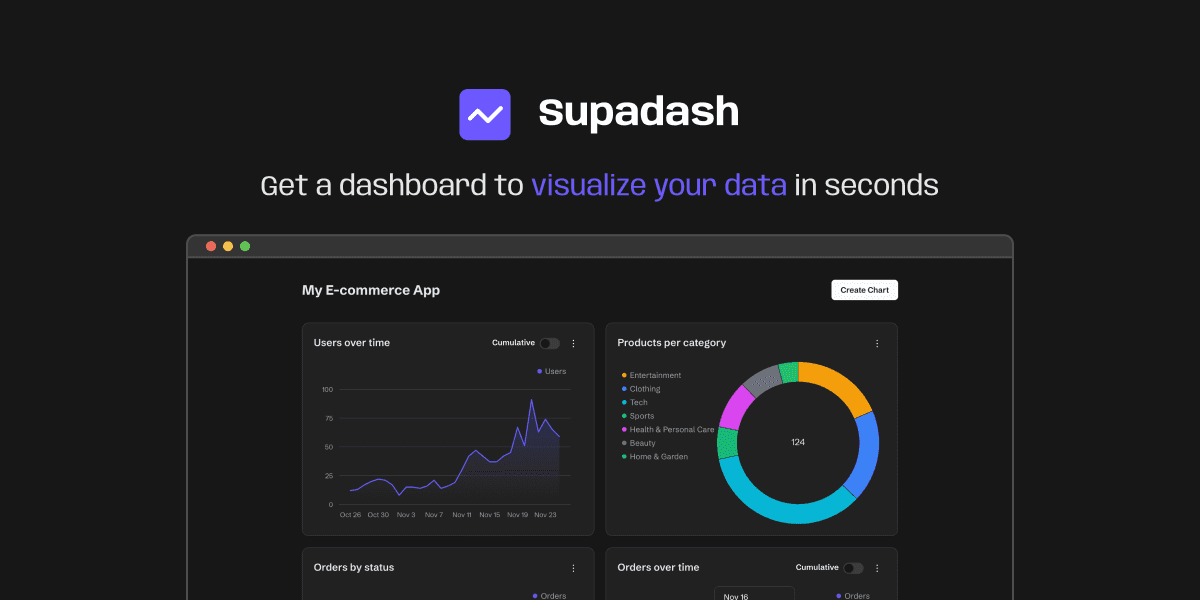
Supadash allows users to connect their database and instantly generate AI-powered charts and dashboards to visualize their data and analytics. This no-code solution eliminates the need for periodically running SQL queries to track metrics, as Supadash automatically creates time series charts and other visualizations. It transforms raw database tables into insightful and visually appealing dashboards in seconds, making data analysis accessible and efficient for users who need to understand their data better without extensive technical knowledge.
facial-expression-recognition-using-cnn
facial-expression-recognition-using-cnn is an open-source project designed for deep facial expression recognition using Convolutional Neural Networks (CNN) with OpenCV and TensorFlow. It can analyze facial expressions from both static images and real-time camera streams, categorizing them into emotions like Angry, Disgust, Fear, Happy, Sad, Surprise, and Neutral. The tool allows for training models on datasets like Fer2013, optimizing hyperparameters, and evaluating performance. It supports the integration of additional features such as face landmarks and HOG features to improve accuracy, providing a robust framework for researchers and developers interested in emotion detection and facial analysis.
Open-Claude-Cowork
Open-Claude-Cowork is an open-source desktop AI assistant designed to streamline programming, file management, and a wide array of other tasks. It serves as a genuine AI collaboration partner, moving beyond simple GUIs to offer a more interactive experience. Unlike terminal-only solutions, Agent Cowork runs as a native desktop application, providing visual feedback and convenient session management across projects. It reuses existing Claude settings, eliminating the need for a separate development environment or Claude Code installation. This tool is particularly beneficial for users seeking a persistent desktop AI assistant with visual insights into AI operations and efficient project organization.
Meeting Assistant Flow
Meeting Assistant Flow is an open-source project built on the crewAI framework, designed to streamline the entire meeting lifecycle. It automates critical tasks such as loading meeting notes from a text file, generating actionable tasks from meeting transcripts using AI agents, and integrating these tasks with Trello for project management. Additionally, it saves new tasks to a CSV file and sends Slack notifications to keep teams informed. This flow leverages multiple AI agents to handle different aspects of the meeting workflow, offering a modular and efficient solution for automating meeting management processes. Users can customize agents, tasks, and the flow itself to fit specific organizational needs.

Skillhub: Learn Coding with AI
Skillhub is an AI-powered educational platform designed to help users learn coding through personalized AI tutors. It provides an interactive AI playground where users can code directly in the app and receive line-by-line explanations. The platform features gamified coding challenges to make learning engaging and offers instant feedback on code to help users understand best practices. Skillhub supports multiple programming languages, including Swift, Python, and JavaScript, allowing for seamless language switching while maintaining a consistent AI tutor experience. It also includes daily puzzles to reinforce learning and keep users motivated, making it an effective tool for mastering programming faster.
Shimoku
Shimoku offers an analyst agent designed to assist users with data analysis and insight generation. While specific features are not detailed on the homepage, the tool's primary focus appears to be on leveraging AI to support analytical tasks. The platform aims to streamline the process of understanding complex data, potentially through automated reporting or intelligent data exploration. Its positioning as an "Analyst Agent" suggests a capability to act as a virtual assistant for data-driven decision-making, catering to individuals or teams who require efficient data interpretation.
AnimeBackgroundGAN
AnimeBackgroundGAN is an AI tool designed for generating anime-style backgrounds. It leverages generative adversarial networks (GANs) to produce visual assets suitable for various creative projects, including games and anime art. The tool is hosted as a demo on Hugging Face Spaces, indicating its accessibility for users to experiment with its capabilities. However, at the time of review, the application is encountering a build error, preventing its current functionality. It is built using Gradio, a popular framework for creating user interfaces for machine learning models.