
Coding & Development
Browsing page 320 of AI tools for Coding & Development. Sorted by confidence score — our independent quality rating.

Open LLM Leaderboard
Open LLM Leaderboard is a comprehensive platform designed for tracking, ranking, and evaluating open-source large language models (LLMs) and chatbots. Hosted on Hugging Face Spaces, this tool provides a centralized hub for comparing the performance of different models across a range of standardized tests. Users can explore benchmarks such as IFEval, BBH, MATH, GPQA, MUSR, and MMLU-PRO, gaining insights into how various LLMs stack up against each other. The platform is particularly valuable for AI researchers and practitioners who need to assess model capabilities, identify top-performing models, and stay updated on the latest advancements in the open-source LLM landscape. While the live website content indicates a runtime error, the tool's core purpose is to offer transparent and data-driven evaluations.
Web Gallery Manager
Web Gallery Manager is an AI application hosted on Hugging Face Spaces, designed to help users discover and explore a curated selection of AI tools and applications. This platform allows for easy navigation through various categories, including Popular, BEST, NEW, Productivity, Multimodal, Professional, Image, and LLM/VLM, making it simple to find tools relevant to specific interests or needs. While currently in a sleeping state due to inactivity, its purpose is to serve as a centralized hub for discovering diverse AI solutions. The application aims to streamline the process of finding new and effective AI tools across different domains.
APIAuto
APIAuto is an open-source HTTP API tool designed for agile development, offering powerful and easy-to-use functionalities. It features machine learning-based no-code testing, AI assistance for Q&A, code generation with static analysis, and automatic documentation with cursor hover comments. This tool integrates documentation, testing, mocking, debugging, and management into a single platform, surpassing many open-source and commercial API tools like Postman, Swagger, and YApi in common functionalities. It supports various HTTP methods and content types, and is recommended as the official documentation and testing tool for Tencent APIJSON. APIAuto is utilized by major companies including Tencent, Huawei, SHEIN, TRANSSION, and ICBC.
Security-Copilot
Microsoft Security Copilot is a generative AI-powered security solution designed to enhance the efficiency and capabilities of security and IT defenders. This open-source project aims to improve security outcomes at machine speed and scale, while adhering to responsible AI principles. The repository provides resources for contributing to the Security Copilot community, including guides for setting up a development environment, forking the repository, creating branches, and submitting pull requests. It includes sample prompts, plugins, and technical workshops to help users get started and integrate the solution into their security operations.
aiTest
aiTest is an AI-driven testing platform engineered to accelerate and optimize software testing processes. It offers comprehensive support for testing across a multitude of platforms, including web, mobile, and desktop applications. The platform ensures broad coverage across numerous browsers, devices, and operating systems, aiming to enhance efficiency and significantly reduce redundancy in testing workflows. By leveraging artificial intelligence, aiTest helps development teams streamline their QA efforts, identify bugs faster, and deliver higher-quality software with improved speed and reliability.
Pertmux
Pertmux is a Terminal User Interface (TUI) built with Rust that centralizes the developer workflow by linking GitLab/GitHub merge requests to local branches, Git worktrees, tmux sessions, and AI coding agents. This tool aims to reduce context switching and enhance productivity for software engineers. It provides a unified dashboard to monitor pipeline statuses, comments, and unread indicators for multiple forges like GitHub and GitLab. Pertmux also offers worktree management, allowing users to create, remove, and merge worktrees directly from the dashboard. A key differentiator is its ability to track AI coding agents (like Claude and opencode) across tmux panes, showing their status, token usage, and tasks. The daemon architecture ensures data remains fresh, with updates pushed via a Unix socket, making it an essential utility for modern software development teams.
maple-diffusion
Maple Diffusion is an open-source project designed for running Stable Diffusion models locally on Apple devices, specifically iOS and macOS. It leverages Apple's MPSGraph framework, rather than Python, to achieve efficient inference. The tool is optimized for performance on Apple Silicon Macs and recent iPhones, with image generation times as low as <1 second per step on macOS and around 2.3 seconds per step on an iPhone 13 Pro. To overcome iOS memory limitations, Maple Diffusion employs FP16 (NHWC) tensors, operator fusion, and strategic model swapping to device storage. It supports various Stable Diffusion PyTorch model checkpoints and requires Xcode 14 and iOS 16 for building and running. The project also highlights related tools like Core ML Stable Diffusion and Native Diffusion, offering a robust solution for on-device AI image generation.
Notus Autonomous Systems
Notus Autonomous Systems specializes in the development of solutions for autonomous systems, with a core focus on swarm robotics and the integration of AI command hierarchies. Their work involves advanced AI integration with robotics to facilitate coordinated operations among multiple robots. The company aims to provide sophisticated systems that can manage and execute complex tasks autonomously, leveraging artificial intelligence for enhanced decision-making and operational efficiency in multi-robot environments. While specific product details and features are not explicitly outlined on their current website, their domain suggests a strong emphasis on cutting-edge autonomous technologies.
iflow-cli
iFlow CLI is a powerful AI assistant designed to run directly within your terminal, offering comprehensive command-line intelligence. It excels at analyzing code repositories, executing coding tasks, and interpreting user needs across various contexts. The tool significantly boosts productivity by automating a wide range of operations, from basic file management to intricate workflow automation. Key features include access to free AI models like Kimi K2 and Qwen3 Coder, flexible integration with existing development tools, and natural language interaction that eliminates the need for complex commands. It also supports advanced functionalities like SubAgents, custom commands, plan mode, and task tools, making it a versatile solution for developers seeking to streamline their workflow and enhance coding efficiency.
SVDiff-pytorch Training UI
SVDiff-pytorch Training UI offers a graphical user interface for training SVDiff models, leveraging the PyTorch framework. This open-source tool simplifies the process of fine-tuning machine learning models, making advanced AI development more accessible. It is hosted on Hugging Face Spaces, providing a platform for community collaboration and sharing of ML applications. While the tool itself is open source, users should be aware that hosting on Hugging Face Spaces may incur costs for advanced hardware or dedicated inference, as detailed in their pricing structure. The UI aims to streamline the training workflow, allowing researchers and developers to focus on model experimentation rather than complex command-line operations.
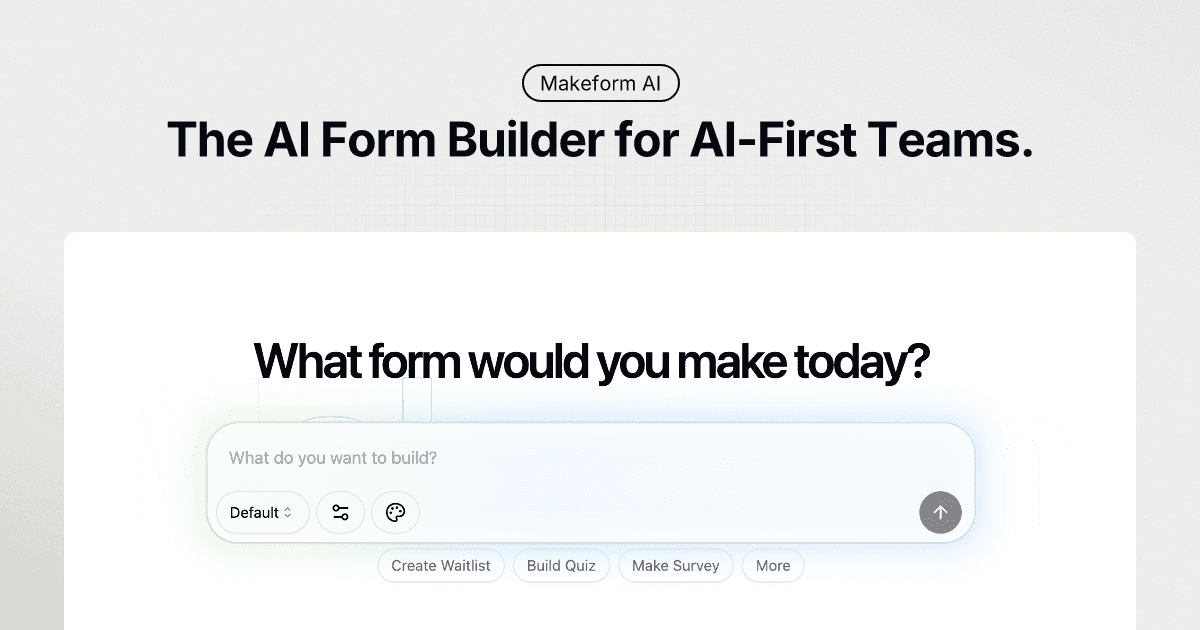
Makeform
Makeform is a free AI-native form builder that allows users to create various types of forms, including surveys, quizzes, polls, and registration forms, simply by describing their needs in a conversational chat interface. The AI generates questions, logic, and design, eliminating the need for coding or complex settings. Key features include AI form generation, secure enterprise-grade security, smart automations, and complete customization options for branding, domains, and conditional logic. It integrates with popular tools like Slack, Google Sheets, and Zapier, and offers analytics to track form performance. Makeform aims to save time and help users gather insights faster by transforming text input into fully customized forms in seconds.

Think For Advanced Technologies
Think Studio is an AI and software solutions company based in Cairo, dedicated to helping businesses innovate and optimize their operations. They provide comprehensive services to build intelligent platforms, automate various business processes, and drive innovation through advanced technology. Their expertise spans AI solutions, custom software development, and full-stack development, enabling clients to unlock smarter decision-making and maintain a competitive edge in the digital landscape. Think Studio focuses on delivering tailored solutions that meet specific business needs, ensuring that companies can leverage cutting-edge AI and software to enhance efficiency and achieve strategic goals.
All Seeing Dataset Browser
The All Seeing Dataset Browser is an AI-powered tool designed to facilitate the exploration and understanding of datasets. Built on the Gradio framework, it offers an interactive interface for users to browse and analyze various datasets. This tool is particularly useful for data scientists and researchers who need to gain insights into their data for machine learning model development. Its open-source nature, under the Apache-2.0 license, promotes transparency and community contributions. While the live website currently indicates a runtime error, suggesting it may not be fully operational, its intended purpose is to provide a comprehensive dataset browsing experience.
IDM-VTON
IDM-VTON is an open-source project that implements a novel approach to improving diffusion models for authentic virtual try-on in the wild. Based on research presented at ECCV 2024, this tool allows users to generate realistic virtual try-on images by integrating advanced diffusion techniques. It supports datasets like VITON-HD and DressCode, offering functionalities for both training and inference. The project provides detailed instructions for data preparation, model training, and running local Gradio demos, making it accessible for researchers and developers interested in virtual try-on technology.
danube.ai
danube.ai is an innovative AI prediction engine that distinguishes itself by utilizing Genetic AI, a unique approach that allows the system to train itself without the need for traditional training data. This technology aims to deliver low-carb, transparent, and decentralized AI solutions, specifically designed to be free from bias. The platform emphasizes personalization, enabling businesses to boost customer satisfaction by enhancing content relevance. danube.ai offers users greater control over their AI solutions and is capable of building very fast AI applications. It's described as a self-feedback simulation algorithm that determines the relevance of data features through a purely local approach, calculating the individual 'strength' of each dataset. While not based on traditional machine learning, it functions as a multi-dimensional sorting algorithm for intelligent prediction.
Spear AI
Spear AI specializes in advanced maritime AI and edge data solutions, focusing on transforming operations through AI-powered sensing, software, and services. The company builds AI solutions that enable maritime operators to make faster decisions and see farther, bridging the gap between advanced AI technology and practical, real-world use in challenging maritime defense environments. Their offerings include affordable, expendable maritime sensors optimized for real-time data collection, software that transforms raw sensor data into actionable insights and strategic planning, and services that enhance situational awareness, threat assessment, and mission success. Spear AI supports various organizations including the CDAO, ONR, IC, PEO UWS, COMSUBFOR, and AUKUS.
yShade.ai (exited)
yShade.ai (exited) was a pioneering Data & Analytics tool dedicated to fostering inclusivity within AI development. The platform's core mission was to build comprehensive datasets and advanced AI models that accurately represented and catered to all skin shades. By focusing on diverse skin tones, yShade.ai sought to actively combat and eliminate inherent biases often found in AI systems. This initiative was crucial for ensuring that predictive and generative AI technologies performed equitably across various demographic groups, ultimately leading to more fair and robust AI applications. While the project has exited, its objective highlighted a significant need in the AI landscape for ethical and inclusive data practices.
Open Source TTS Gallary
Open Source TTS Gallary is an AI tool hosted on Hugging Face Spaces, designed to help users explore and compare various open-source text-to-speech (TTS) models. It provides a convenient platform to discover and listen to samples from 12 different models, making it easy to evaluate their quality and characteristics. Users can filter the models by name or family to quickly find the best fit for their specific project or research needs. This gallery serves as a valuable resource for developers, researchers, and content creators looking to integrate or understand open-source TTS technologies.
Palladio AI
Palladio AI is an AI platform designed to revolutionize product-led growth, helping customers become a more valued part of their users’ everyday lives. This software-as-a-service (SaaS) solution provides advanced analytics and behavioral insights, specifically tailored to guide growth and product development teams in improving revenue. The platform initially focuses on the mobile gaming sector, chosen for its fast development cycles, highly engaged users, and immediate impact from experimentation, making it an ideal proving ground for the technology. The founding team brings decades of product impact from major consumer technology companies like Uber, Apple, Google, and Chime, and the company is backed by Griffin Gaming Partners.
navan.ai
Navan AI is an autonomous AI development platform designed to transform Product Requirements Documents (PRDs) into production-ready, tested code. It leverages a Smart Agent Manager (SAM) to orchestrate specialized AI agents through strict Test-Driven Development (TDD) cycles, ensuring quality software delivery without direct human intervention. The platform features a TDD pipeline with RED-GREEN-REFACTOR methodology, where agents like Titan (Test Architect) write failing tests, Dyna (Developer) implements code to pass them, and Argus (Code Reviewer) refactors. SAM acts as the master orchestrator, managing state and enforcing quality gates. Key benefits include autonomous execution, guaranteed TDD enforcement, built-in quality gates, state tracking, smart retries, and automatic documentation generation, accelerating software delivery with built-in quality.
Deep-Reinforcement-Learning-Hands-On
Deep-Reinforcement-Learning-Hands-On is an open-source GitHub repository that serves as a companion to the book "Deep Reinforcement Learning Hands-On" published by Packt. It provides comprehensive code samples and examples for various deep reinforcement learning methods, including Cross-entropy, policy gradients, Deep Q-Networks, Actor-Critic, and more. The project is actively maintained by the book's author, Max Lapan, ensuring compatibility with the latest versions of PyTorch and gym. It covers diverse applications such as stock trading, chatbot training, and web navigation, making it an invaluable resource for anyone looking to implement and understand advanced RL concepts.
Ilya-30u30
Ilya-30u30 is a GitHub repository that serves as a curated collection of resources for individuals interested in learning about Artificial Intelligence. It compiles papers, blogs, and websites that Ilya, a prominent figure in AI, has recommended. The repository is designed to provide a structured learning path, covering various fundamental and advanced topics in AI, from neural networks and deep learning to specific concepts like attention mechanisms and recurrent neural networks. It acts as a valuable, free, and open-source study assistant for students, researchers, and anyone looking to deepen their understanding of AI through expert-recommended materials.
ICEdit
ICEdit is an innovative open-source image editing tool that leverages a single LoRA (Low-Rank Adaptation) to achieve state-of-the-art instruction-based editing. It stands out by requiring only 0.5% of the training data and 1% of the parameters compared to prior SOTA methods, yet delivers fantastic image editing results. A key differentiator is its superior ID persistence, even surpassing models like GPT-4o. The tool is highly accessible, needing only 4GB VRAM to run, making it suitable for a wider range of hardware. ICEdit supports multi-turn and single-turn edits with high precision and offers various integration options, including official ComfyUI workflows and a Gradio demo for user-friendly interaction. It also provides training code for users to create their own editing LoRAs.
interview-questions
The interview-questions GitHub repository, maintained by geektutu, provides a curated collection of interview and written examination questions covering machine learning, deep learning, Python, and Go languages. This resource is continuously updated, ensuring relevance for job seekers in these rapidly evolving technical domains. It includes various question formats such as multiple-choice questions with detailed explanations and open-ended discussion questions. The repository aims to help individuals prepare thoroughly for technical interviews by covering fundamental concepts, implementation details, and advanced topics in each area. It's an excellent resource for self-study and review, offering practical examples and theoretical insights to strengthen understanding and problem-solving skills.