
Coding & Development
Browsing page 323 of AI tools for Coding & Development. Sorted by confidence score — our independent quality rating.

ScoutDB
ScoutDB is designed for fast-moving engineering teams to optimize database queries and reduce hosting costs. It integrates with GitHub to automatically scan and analyze all queries within a codebase. The tool identifies queries with the highest potential for cost savings and performance improvements, presenting them in a clear, central dashboard. ScoutDB then automates the optimization process by generating pull requests with suggested fixes and explanations, making it easy for developers to implement changes and improve their database's efficiency. It specifically targets MongoDB query optimization.

energy-forecasting
energy-forecasting is a comprehensive MLOps framework designed to teach machine learning engineering (MLE) and MLOps principles through a practical, hands-on approach. This repository contains a 7-lesson free course that guides users through building a production-ready ML batch system. The primary focus is on engineering a scalable system for forecasting hourly energy consumption levels in Denmark, integrating MLOps best practices. Users will learn to build, train, serve, and monitor an ML system using a batch architecture, incorporating tools like an experiment tracker, model registry, feature store, Docker, Airflow, and GitHub Actions. The course is suitable for intermediate to advanced MLEs and SWEs looking to transition into MLE, providing 2.5 hours of reading and video materials.
sshx
sshx offers a secure, web-based platform for sharing and collaborating on terminals. Users can invite others by sharing a unique browser link, enabling real-time collaboration with remote cursors and chat on a multiplayer infinite canvas. The tool is designed for speed and security, featuring end-to-end encryption to ensure data privacy, as the server never sees what is being typed. It supports cross-platform use with a command-line tool available for macOS, Linux, and Windows. sshx is ideal for teaching, debugging, or cloud access, allowing users to move and resize multiple terminals in any arrangement and see live presence of other participants. Its ultra-fast mesh networking connects users to the nearest distributed peer in a global network.
Plugin.st
Plugin.st is a comprehensive platform designed to assist startups and developers by offering a diverse range of applications and plugins. The tools available on the platform cover key areas such as large language model (LLM) development, scriptwriting, and various marketing functionalities. It aims to provide essential resources to streamline development and operational processes for its target audience. The platform operates on a freemium model, allowing users to explore its offerings through a free trial before committing to paid plans.
sleap
SLEAP is an open-source deep learning framework specifically designed for multi-animal pose tracking. It allows researchers to accurately track and analyze the movements and interactions of various animals in video footage. The tool features an intuitive graphical user interface (GUI) that supports active learning and proofreading, significantly speeding up the labeling process for large datasets. SLEAP offers both single- and multi-animal pose estimation with flexible training strategies and customizable neural network architectures. It boasts fast training times, typically 15-60 minutes on a single GPU, and rapid inference speeds of up to 600+ FPS for batch processing, with less than 10ms latency for real-time applications. The framework also includes a flexible developer API for building integrated applications and customizations, and supports remote training/inference workflows without requiring GPUs.
dgl-ke
dgl-ke is an open-source package designed for learning large-scale knowledge graph embeddings, built on top of the Deep Graph Library (DGL). It offers high performance, ease of use, and scalability, making it suitable for various machine learning tasks involving knowledge graphs. The package supports training knowledge graph embeddings using popular models like TransE, TransR, RESCAL, DistMult, ComplEx, and RotatE. Users can perform training on single machines (CPU/GPU) or distributed environments, evaluate pre-trained embeddings with link prediction tasks, and conduct inference for entity/relation linkage prediction or embedding similarity. DGL-KE is optimized for scale, capable of processing knowledge graphs with millions of nodes and billions of edges efficiently.

Zenvault
Zenvault is a CLI-first project control plane designed to streamline developer experience by centralizing repositories, environment variables, and resources. It allows for one-command onboarding to any project, eliminating the need for manual setup documentation and fragile .env files. Zenvault ensures that code runs correctly and consistently across all environments and machines, improving team productivity and reducing setup friction. Key features include secure secrets management with AES-256 encryption, environment variables per service, and audit logging. It integrates seamlessly into existing workflows, providing a single source of truth for project configuration and enabling secure team collaboration with granular access control.
DeepCL
DeepCL is an open-source OpenCL library designed for training deep convolutional neural networks. It offers C++, Python, and command-line APIs, allowing developers to implement and train deep learning models efficiently. The library supports various layer types including convolutional, max-pooling, normalization, activation, and dropout, alongside loss functions like softmax cross-entropy and square loss. DeepCL also incorporates multiple trainers such as SGD, Anneal, Nesterov, Adagrad, Rmsprop, and Adadelta. It is compatible with OpenCL-enabled GPUs or APUs and provides installation procedures for Windows and Linux, including Python wrappers. The project is actively maintained on GitHub, with recent updates focusing on compatibility and performance enhancements.
bnb-my-repo
bnb-my-repo is a Hugging Face Space designed to simplify the process of quantizing AI models. Users can select a model from Hugging Face, apply desired quantization settings, and then upload the reduced-size model directly to their personal Hugging Face account. This tool is particularly useful for developers and researchers looking to optimize model performance and reduce storage requirements without extensive manual configuration. It provides a straightforward interface for managing and deploying quantized models within the Hugging Face ecosystem.
dstack
dstack is an open-source control plane designed for agentic orchestration of AI infrastructure. It allows engineers to provision compute and run training, inference, and sandboxes across NVIDIA, AMD, TPU, and Tenstorrent GPUs on various platforms including cloud providers, Kubernetes, and bare-metal clusters. dstack simplifies the management of AI workloads by offering a unified control plane for compute orchestration, eliminating the need for complex Kubernetes or Slurm configurations. It supports running development environments, batch jobs, and high-performance model inference with features like auto-scaling, resource allocation, and GPU health metrics. dstack aims to reduce GPU costs through efficient reuse, right-sizing, and support for different capacity types.
XcodeLLMEligible
XcodeLLMEligible is an open-source project designed to enable Xcode LLM, Apple Intelligence, and iPhone Mirroring functionalities on macOS versions and hardware configurations that are not officially supported by Apple. The tool achieves this by overriding Darwin eligibility checks, offering two primary methods: a 'util tool' method that requires a one-time SIP disable and boot-arg modification, and an 'override file' method that does not require SIP to be disabled at all. It supports macOS 15.0 - 15.3.1 and has been tested with XcodeLLM, Apple Intelligence, and ChatGPT integration on Mac mini (M4 Pro, 2024) running macOS 15.2. The project is intended for learning and research purposes, allowing users to permanently access these features on their Macs.
Shakio
Shakio is an API proxy specifically designed for development environments, enabling developers to record all requests sent to their APIs. This functionality allows for easy replay of requests, which is crucial for debugging and testing. Beyond basic proxying, Shakio helps generate essential development assets such as types for various languages, comprehensive API documentation, and robust test suites based on real data. A key differentiator is its integration with AI, allowing users to interact with their API using AI, streamlining workflows and boosting productivity. It also supports microservices, request mocking, and Open API generation, making it a versatile tool for modern API development.
web-codegen-scorer
Web Codegen Scorer is a robust tool designed for evaluating the quality of web code generated by Large Language Models (LLMs). It enables developers to make evidence-based decisions regarding AI-generated code, offering features to iterate on system prompts, compare code quality across various models, and monitor generated code quality over time. The tool focuses specifically on web code and utilizes well-established measures of code quality, including built-in checks for build success, runtime errors, accessibility, security, LLM rating, and coding best practices. It also supports automatic repair attempts for detected issues and provides an intuitive report viewer UI to compare results.
Voice-Cloning-App
Voice-Cloning-App is an open-source Python/Pytorch application designed for easily synthesizing human voices. It offers key features such as automatic dataset generation, including support for subtitles and audiobooks, and additional language support. The tool facilitates both local and remote training, with easy start/stop functionality, and supports data importing/exporting, as well as multi-GPU setups. It is built upon a reworked version of Tacotron2 and integrates other technologies like DSAlign, Silero, DeepSpeech, and hifi-gan. The application is suitable for users running Windows 10 or Ubuntu 20.04+ with at least 5GB of disk space, and optionally an NVIDIA GPU with 4GB+ memory for enhanced performance.
text_renderer
text_renderer is an open-source tool designed to generate synthetic text line images, primarily for training deep learning Optical Character Recognition (OCR) models like CRNN. It features a modular design, allowing users to easily add different components such as Corpus, Effect, and Layout. A key capability is its integration with Albumentations, providing a wide range of image augmentation effects to enhance dataset diversity. The tool supports rendering multiple corpora on a single image with varying effects, generating vertical text, and creating LMDB datasets compatible with PaddleOCR. It also includes a web-based font viewer and corpus sampler for character balance.
ralphy
ralphy is an open-source autonomous bash script engineered to automate the completion of Product Requirements Documents (PRDs) by leveraging various AI agents. It integrates powerful AI models such as Claude Code, Codex, and Qwen, running them in a continuous loop to iteratively refine and generate code based on the PRD specifications. This tool aims to streamline the development workflow by automating significant portions of the coding process, reducing manual effort and accelerating project timelines. Developers can install ralphy via npm or by directly cloning its repository, making it accessible for integration into existing development environments. Its core functionality revolves around continuous AI iteration, ensuring that the generated code aligns closely with the evolving requirements outlined in the PRD.
AnimeBackgroundGAN
AnimeBackgroundGAN is an AI tool designed for generating anime-style backgrounds. It leverages generative adversarial networks (GANs) to produce visual assets suitable for various creative projects, including games and anime art. The tool is hosted as a demo on Hugging Face Spaces, indicating its accessibility for users to experiment with its capabilities. However, at the time of review, the application is encountering a build error, preventing its current functionality. It is built using Gradio, a popular framework for creating user interfaces for machine learning models.
susi_shell
susi_shell provides a collection of command-line tools designed for seamless interaction with various AI services directly from the terminal. This allows developers and technical users to integrate AI capabilities into their workflows without leaving the command line. While the specific AI services are not detailed, the tool aims to streamline AI-related tasks, offering a programmatic approach to leveraging artificial intelligence. Some functionalities within susi_shell require a connection to the OpenAI API, indicating its potential for tasks like natural language processing, code generation, or other generative AI applications. It caters to those who prefer a text-based interface for efficiency and automation.
sumo-rl
sumo-rl is an open-source tool designed to simplify the creation and management of Reinforcement Learning (RL) environments for Traffic Signal Control using SUMO. It offers a straightforward interface, ensuring compatibility with widely used RL libraries and frameworks such as Gymnasium, PettingZoo, stable-baselines3, and RLlib. The tool supports both single-agent and multi-agent RL scenarios, allowing for flexible experimentation. Users can easily customize observation spaces and reward functions to suit their specific research or application needs. sumo-rl is particularly useful for developers and researchers focused on advancing AI agents for traffic management and optimization, providing a robust platform for simulating and evaluating different control strategies.
stellargraph
StellarGraph is a comprehensive Python library designed for machine learning on various types of graphs and networks. It provides a rich collection of state-of-the-art algorithms, including GraphSAGE, GCN, GAT, Node2Vec, and Metapath2Vec, enabling users to perform tasks such as representation learning for nodes and edges, classification of nodes or entire graphs, and link prediction. The library supports diverse graph structures, from homogeneous to heterogeneous and knowledge graphs, and integrates seamlessly with TensorFlow 2, Keras, Pandas, and NumPy. This makes it user-friendly, modular, and extensible, allowing for smooth interoperability with existing machine learning workflows and easy augmentation of its core algorithms.
SuperGluePretrainedNetwork
SuperGluePretrainedNetwork is a research project from Magic Leap, presented at CVPR 2020, focusing on learning feature matching using Graph Neural Networks. The core of the project is the SuperGlue network, which integrates a Graph Neural Network with an Optimal Matching layer. This architecture is specifically designed to perform matching tasks on two distinct sets of sparse image features. The repository offers both the PyTorch code implementation and pretrained weights, making it accessible for researchers and developers interested in computer vision and feature matching applications. It serves as a valuable resource for those looking to implement or build upon advanced feature matching techniques.
Spark Tech AI
Spark Tech AI specializes in delivering custom AI, machine learning, and cloud solutions designed to help businesses extract meaningful insights and drive real business impact from their data. The platform focuses on providing compliant, scalable, and secure solutions tailored to specific organizational needs. Beyond core AI and ML capabilities, Spark Tech AI also emphasizes user-friendly interfaces and integrates IoT-enabled systems, ensuring that advanced technology is accessible and actionable for its clients. This comprehensive approach aims to transform raw data into strategic assets, fostering innovation and efficiency across various business functions.
sematic
Sematic is an open-source platform designed for ML engineers and data scientists to develop and manage machine learning pipelines. It enables users to write complex end-to-end pipelines using simple Python code, which can then be executed locally on a laptop, in a cloud VM, or on a Kubernetes cluster to leverage cloud resources. The platform emphasizes easy onboarding with no deployment or infrastructure needed to get started, offering local-to-cloud parity. Key features include end-to-end traceability of pipeline artifacts, reproducibility of results, dynamic graphs, lineage tracking, and runtime type-checking. Sematic also provides a modern web dashboard for monitoring, tracking, and visualizing pipelines and artifacts, along with integrations for Apache Spark, Ray, Snowflake, Plotly, Matplotlib, and Pandas.
Openchangelog
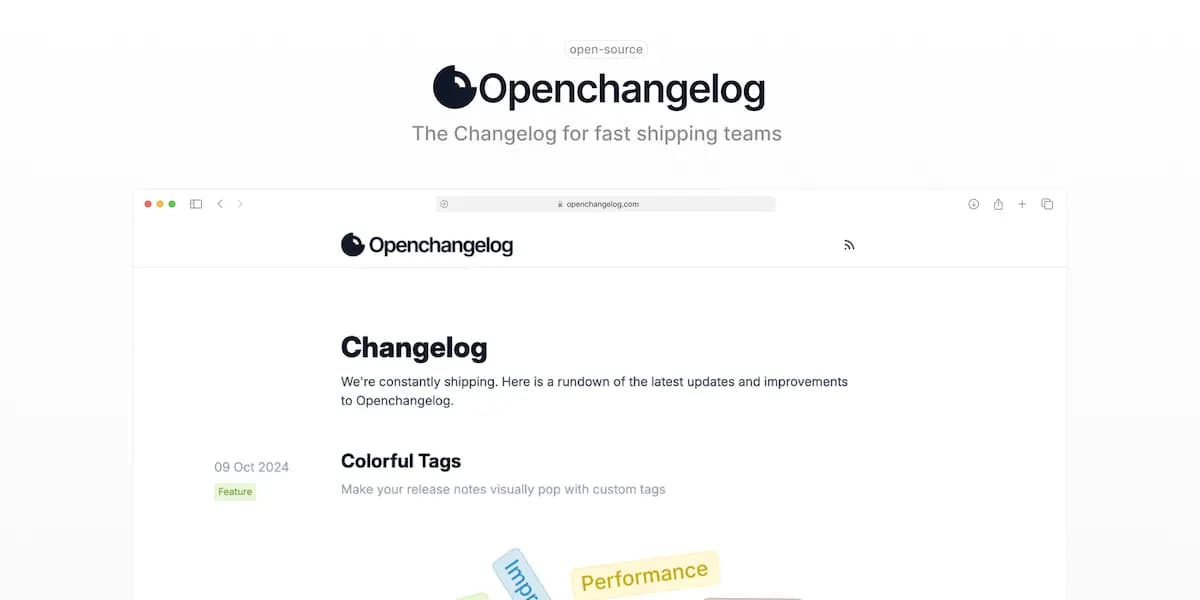
Openchangelog allows development teams to easily integrate release notes into their workflow, ensuring users are always updated on product changes. It offers a customizable changelog with light and dark themes, custom domain support, and password protection for sensitive communications. Key features include an automatic RSS feed for updates, full-text search for release notes, and direct synchronization with GitHub repositories. The platform supports self-hosting and provides SDKs for easy integration, such as with Next.js. Openchangelog aims to simplify the process of publishing and managing product updates, making it an essential tool for maintaining transparent communication with users.