
Coding & Development
Browsing page 98 of AI tools for Coding & Development. Sorted by confidence score — our independent quality rating.

anole
Anole is an open-source, autoregressive, and natively trained large multimodal model designed for interleaved image-text generation. Unlike other models, Anole achieves this without using stable diffusion. Building upon the strengths of Chameleon, Anole excels at generating coherent sequences of alternating text and images. It utilizes an innovative fine-tuning process with a curated dataset of approximately 6,000 images, enabling remarkable image generation and understanding with minimal additional training. This efficient approach, combined with its open-source nature, positions Anole as a catalyst for accelerated research and development in multimodal AI. Its functionalities include Text-to-Image Generation, Interleaved Text-Image Generation, Text Generation, and Multimodal Understanding.
AnyText
AnyText is an open-source project providing an official implementation for multilingual visual text generation and editing. Based on a diffusion pipeline, it utilizes an auxiliary latent module and a text embedding module to create and modify text within images. The auxiliary latent module processes text glyphs, positions, and masked images to generate latent features, while the text embedding module uses an OCR model to encode stroke data, blending it with image caption embeddings for seamless text integration. AnyText supports both text generation and editing modes, with features like FP16 inference for faster processing and the ability to merge weights from self-trained or community models. A newer version, AnyText2, further enhances performance and allows for font and color property adjustments.
attention-is-all-you-need-pytorch
attention-is-all-you-need-pytorch offers a PyTorch implementation of the Transformer model, as detailed in the influential "Attention is All You Need" paper. This open-source project focuses on a novel sequence-to-sequence framework that leverages the self-attention mechanism, moving away from traditional Convolution or Recurrent Neural Network structures. It has demonstrated state-of-the-art performance on tasks like WMT 2014 English-to-German translation. The project supports both training and translation with trained models, making it a valuable resource for researchers and developers in natural language processing. While still a work in progress, particularly concerning BPE-related parts, it provides a robust foundation for experimenting with and building upon the Transformer architecture.
awesome-spring-ai
awesome-spring-ai is a comprehensive, curated list of resources, tools, tutorials, and projects designed to help developers build generative AI applications using Spring AI. This GitHub repository simplifies the integration of Large Language Models (LLMs) and other AI capabilities into Spring applications by offering consistent abstractions across different AI providers, robust prompt engineering, built-in caching, retry mechanisms, and vectorized storage integration. It includes official documentation, blogs, learning resources like books and online courses, code examples, and community information. The project aims to provide a familiar and consistent Spring-style developer experience for AI development, supporting popular LLM providers and native Spring Boot integration.
awesome-ai-coding
Awesome-AI-Coding is a comprehensive, curated list of resources dedicated to AI coding topics. It features a wide array of projects, including open scientific collaborations like BigCode, code completion servers such as Fauxpilot, and AI integrations for popular IDEs like CodeGPT.nvim for Neovim and ChatIDE for VSCode. The list also highlights various open-source alternatives to GitHub Copilot, such as Tabby and Twinny, and tools for specific tasks like generating codebase documentation with Autodoc or operating on codebases using GPT with promptr. Additionally, it provides information on datasets, LLM models specifically trained for code, relevant research papers, and a directory of AI coding products and startups. This makes it an invaluable resource for developers, researchers, and anyone interested in the rapidly evolving field of AI-assisted software development.
Brewed
Brewed was a revolutionary semi no-code platform that leveraged AI to empower users in creating diverse web components, ranging from simple dropdowns to complex landing pages, dashboards, and intricate layouts. The core idea was to simplify web development by letting AI manage the heavy lifting, leaving users to handle the finishing touches with ease. Key features included AI-powered web component creation and versatile development capabilities. Brewed's innovative concept has now been integrated into AI Chat, which further enhances these capabilities by leveraging powerful AI models like ChatGPT, Claude, Gemini, and Grok for seamless, intuitive, and sophisticated web component creation, significantly boosting development efficiency.
awesome-transformer-nlp
awesome-transformer-nlp is a comprehensive, hand-curated list of machine (deep) learning resources specifically for Natural Language Processing (NLP). It focuses on key areas such as Generative Pre-trained Transformer (GPT), Bidirectional Encoder Representations from Transformers (BERT), attention mechanisms, Transformer architectures, ChatGPT, Large Language Models (LLMs), and transfer learning in NLP. The repository includes a vast collection of papers, articles, educational tutorials, and tools, making it an invaluable resource for researchers, students, and practitioners looking to understand and implement transformer-based models. It also features sections on AI safety, BERTology, and official/community implementations across various frameworks like PyTorch, Keras, and TensorFlow.
Awesome-Video-Diffusion
Awesome-Video-Diffusion is a comprehensive and curated list of cutting-edge diffusion models specifically designed for video generation, editing, and a wide array of other video-related applications. This GitHub repository serves as an invaluable resource for researchers, academics, and practitioners who are keen on staying updated with the latest advancements in video diffusion models. It categorizes and presents various models, making it easier to explore different techniques for tasks such as video creation, modification, and understanding. The list is continuously updated, reflecting the dynamic nature of AI research in video processing.
BabyCommandAGI
BabyCommandAGI is an innovative AI tool designed to explore the synergy between Command Line Interface (CLI) and Large Language Models (LLM). Based on BabyAGI, it streamlines workflows by enabling LLMs to interact directly with the CLI, facilitating tasks like automatic programming and environment setup. Users can provide feedback to the AI, and it can even answer prompts during command execution. The tool supports Claude 3.7 Sonnet and OpenRouter models, with a focus on efficient command execution. It's particularly useful for developers looking to automate coding tasks, set up development environments, and explore new use cases for AI in CLI-driven operations.
Awesome-Diffusion-Models
Awesome-Diffusion-Models is an open-source GitHub repository offering a curated collection of resources and academic papers focused on Diffusion Models. It is designed to be a central hub for researchers, practitioners, and enthusiasts in the fields of machine learning, artificial intelligence, and generative modeling. The repository includes a wide range of materials, making it easier to explore the latest advancements and foundational concepts in diffusion-based techniques. As a community-driven project, it provides a continuously updated knowledge base for anyone looking to deepen their understanding or apply diffusion models in their work.
aws-machine-learning-university-accelerated-nlp
The AWS Machine Learning University: Accelerated Natural Language Processing (NLP) class offers comprehensive educational resources for individuals looking to delve into the field of NLP. This open-source repository includes detailed slides, interactive notebooks, and relevant datasets, all designed to facilitate learning and practical application. The curriculum covers foundational concepts such as text processing, Bag of Words, and K-Nearest Neighbors, progressing to more advanced topics like tree-based models, neural networks, word embeddings, and recurrent neural networks (RNNs). A key component is the final project, which provides hands-on experience with a real-world NLP dataset. The initiative's mission is to democratize access to machine learning knowledge, making it a valuable resource for students and professionals alike.
CausVid
CausVid is an innovative open-source video diffusion model designed to overcome the latency issues of traditional bidirectional models. It achieves fast autoregressive video generation by adapting pretrained bidirectional diffusion transformers to generate frames on-the-fly. To further enhance speed, CausVid extends distribution matching distillation (DMD) to videos, condensing a 50-step diffusion model into a 4-step generator. This process is stabilized by a student initialization scheme based on the teacher's ODE trajectories and an asymmetric distillation strategy that supervises a causal student with a bidirectional teacher. This approach effectively mitigates error accumulation, allowing for long-duration video synthesis from short training clips. CausVid supports fast streaming generation of high-quality videos at 9.4 FPS on a single GPU, leveraging KV caching. It also facilitates streaming video-to-video translation, image-to-video generation, and dynamic prompting in a zero-shot manner.
Vitrin9
Vitrin9 specializes in developing AI-driven applications designed to future-proof enterprise businesses. Their services encompass a comprehensive suite of solutions including enterprise AI, robust cloud infrastructure, insightful business intelligence, and expert product development. By leveraging artificial intelligence and data science, Vitrin9 helps organizations craft innovative, data-driven products that enhance operational efficiency and strategic decision-making. Their approach focuses on delivering tailored AI solutions that integrate seamlessly into existing business processes, ensuring long-term growth and competitive advantage.
BERT-flow
BERT-flow offers a TensorFlow implementation of the research paper "On the Sentence Embeddings from Pre-trained Language Models" (EMNLP 2020). This tool is designed for researchers and developers working with natural language processing, specifically focusing on enhancing the quality of sentence embeddings derived from pre-trained BERT models. It provides scripts and configurations for fine-tuning BERT with NLI supervision and for unsupervised learning of flow-based generative models. The repository includes detailed instructions for setting up the environment, downloading pre-trained BERT models and GLUE data, and running experiments for both fine-tuning and flow-based model training and evaluation. BERT-flow is a valuable resource for academic research and experimentation in the field of sentence representation.

Telemetry Harbor
Telemetry Harbor, now known as Harbor Scale, is an all-in-one telemetry platform designed for monitoring various systems with minimal setup. It allows users to ingest metrics from Linux servers, Docker containers, and ESP32 sensors, providing a unified view of infrastructure and IoT data. The platform includes managed Grafana built-in, eliminating the need for complex configurations or DevOps expertise. Key features include one-command installation, auto-provisioned Grafana dashboards, zero configuration files, and built-in collectors for various systems. It also supports custom scripts, ESP32/Arduino/MicroPython SDKs, LoRaWAN, and Meshtastic monitoring, with Harbor AI for anomaly detection.
building-llm-applications-from-scratch
Building-llm-applications-from-scratch offers an open-sourced course designed for professionals to master the development of Large Language Model (LLM) applications. Unlike many courses that rely on pre-built frameworks, this program delves into the foundational building blocks of retrieval systems, empowering participants to design, build, and deploy custom LLM-powered solutions from scratch. The curriculum covers essential topics such as Transformer Architecture, Retrieval-Augmented Generation (RAG), and open-source LLM deployment. It includes 29 in-depth lessons, 6 real-world projects, interactive live sessions, and direct instructor access, culminating in a certificate upon completion. The course is ideal for those with existing Python and basic machine learning knowledge.
Bamberg Center for Artificial Intelligence (BaCAI)
The Bamberg Center for Artificial Intelligence (BaCAI) is a research institution dedicated to advancing open AI research with national and international visibility. Its core mission involves the responsible translation of AI algorithms into practical applications, with a strong emphasis on developing human-centric AI systems. BaCAI fosters interdisciplinary cooperation to achieve its goals, aiming to become a central hub for AI expertise and talent. The center's work contributes to the broader academic landscape by integrating AI research within the Otto-Friedrich-Universität Bamberg's various faculties, including humanities, social sciences, and applied computer science.
context-engineering-intro
Context-engineering-intro offers a comprehensive template for implementing context engineering, a method that significantly enhances the performance of AI coding assistants. Unlike traditional prompt engineering, which focuses on clever wording, context engineering provides a complete system including documentation, examples, rules, patterns, and validation. This approach reduces AI failures, ensures consistency with project patterns, enables complex feature implementation, and allows AI to self-correct through validation loops. While centered around Claude Code, the strategy is applicable to any AI coding assistant, providing a structured way to guide AI through multi-step implementations and ensure high-quality, consistent code generation.
claude-code-skill-factory
Claude Code Skill Factory is a powerful open-source toolkit designed for building and deploying production-ready Claude Skills, Code Agents, custom Slash Commands, and LLM Prompts at scale. It offers an interactive builder and pre-built commands to streamline the development process. Key capabilities include generating complete Claude Skills with proper formatting and documentation, creating specialized Claude Code Agents with enhanced YAML frontmatter, and generating mega-prompts for various roles with 69 professional presets. The toolkit also supports building Claude Code hooks for workflow automation with safety validation and language-specific templates, and creating custom slash commands with comprehensive validation. It further enables interoperability between Claude Code and OpenAI Codex CLI, making it a versatile solution for AI agent development.

Runday
Runday is a no-code platform designed to unite human and AI agents for accelerated business growth, primarily focusing on B2B appointment setting and sales orchestration. The platform features an AI agent named ALICE, which acts as an omni-channel brand ambassador. ALICE engages inbound visitors, initiates outbound conversations with qualified prospects, and books calls directly to calendars. Key capabilities include hyper-personalized AI outreach across multiple channels, engaging and qualifying leads by answering buyer questions based on sales materials, and integrating with CRM and calendars to book appointments faster and minimize no-shows. Runday also provides always-available customer support, handling up to 95% of inquiries by becoming a product expert through documentation.
Deep-Learning-Experiments
Deep-Learning-Experiments is an open-source GitHub repository designed to help users understand deep learning through a combination of videos, detailed notes, and practical experiments. It offers comprehensive lecture notes covering fundamental deep learning topics such as Supervised Learning, Multilayer Perceptrons (MLP), Convolutional Neural Networks (CNN), Recurrent Neural Networks (RNN), and Transformers. The repository also includes code implementations for many of these concepts, allowing users to run and experiment with models like Mamba, Autoencoders (AE), Variational Autoencoders (VAE), Generative Adversarial Networks (GAN), and Diffusion Models. Additionally, it provides resources for setting up development environments, including Python, Numpy, PyTorch, and Hugging Face, making it a valuable resource for both theoretical understanding and practical application in deep learning.
SwissNLP
SwissNLP is an association dedicated to advancing Natural Language Processing (NLP), Computational Linguistics, and Text Analytics within Switzerland. It serves as a bridge between AI and human language understanding and application, bringing together experts, solution providers, and customers from both industry and academia. The association organizes various events and projects to foster growth in the NLP field and also distributes datasets created through its initiatives. SwissNLP aims to promote innovation and knowledge sharing, offering membership opportunities for updates and collaboration, including a new 'Young Professionals' membership starting in 2026.
DB-GPT-Hub
DB-GPT-Hub is an experimental open-source project focused on leveraging Large Language Models (LLMs) for Text-to-SQL parsing. It provides a comprehensive workflow including data collection, preprocessing, model selection, construction, and fine-tuning of model weights. The project aims to improve Text-to-SQL capabilities while reducing training costs, making it accessible for more developers to contribute. It supports various base models like CodeLlama, Baichuan2, LLaMa/LLaMa2, Falcon, Qwen, XVERSE, ChatGLM2, ChatGLM3, internlm, sqlcoder-7b, and sqlcoder2-15b. DB-GPT-Hub also supports Text2NLU fine-tuning for enhanced semantic understanding and Text2GQL fine-tuning for generating graph queries. The project has achieved high execution accuracy rates on the Spider dataset, demonstrating its effectiveness in enabling automated question-answering based on databases using natural language.
Digma AI
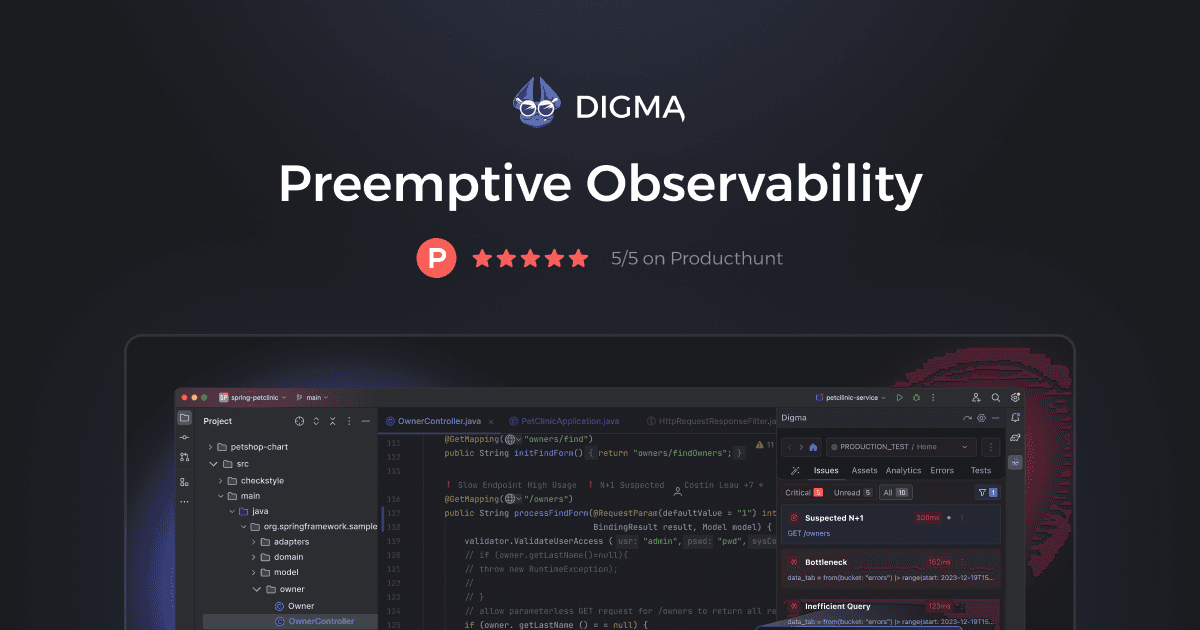
Digma AI operates as a fully autonomous AI SRE, designed to streamline the identification, root cause analysis, and remediation of issues across both code and infrastructure. Leveraging its Dynamic Code Analysis (DCA) engine, Digma identifies code-level problems in pre-production environments, preventing issues before they impact production. It integrates with existing observability stacks and data sources like PostgreSQL, GitHub, and Kubernetes to provide accurate and reliable resolutions. The tool also enhances code reviews by highlighting critical performance problems, bottlenecks, and slow database queries, and can suggest production-aware fixes directly into pull requests. Digma is OpenTelemetry compliant and works without requiring code changes, offering a free-forever plan for individual developers.