
Coding & Development
Browsing page 99 of AI tools for Coding & Development. Sorted by confidence score — our independent quality rating.

Kartoffel-1B-v0.1-Llasa 1b Tts
Kartoffel-1B-v0.1-Llasa 1b Tts is an AI tool hosted on Hugging Face Spaces, specializing in German zero-shot voice cloning. Users can generate speech from text by providing a reference audio sample, enabling personalized voice synthesis. The application also offers the flexibility to choose from a selection of predefined speakers or opt for a random voice, providing diverse options for audio output. This tool is fine-tuned with Llasa 1b, ensuring high-quality voice generation. The output is an audio file, making it suitable for various applications requiring synthesized German speech.
databend
Databend is an open-source enterprise data warehouse built in Rust, offering a unified architecture for analytics, search, AI, and Python sandbox environments. It provides core capabilities such as large-scale analytics, vector search, full-text search, and auto schema evolution. Databend is agent-ready, featuring sandbox UDFs for agent logic, SQL for orchestration, transactions for reliability, and branching for safe experimentation on production data. Its architecture supports flexible agent orchestration with a control plane for resource scheduling, an execution plane for SQL orchestration, and a compute plane for isolated sandbox workers. Databend is cloud-native, elastic, and compatible with S3, Azure, and GCS, making it suitable for enterprise-scale AI workloads.
custom-diffusion
Custom Diffusion is an open-source tool developed by Adobe Research for multi-concept customization of text-to-image diffusion models, such as Stable Diffusion. It allows users to fine-tune these models with as few as 4-20 images of a new concept, significantly reducing training time to approximately 6 minutes on two A100 GPUs. The method is efficient, fine-tuning only key and value projection matrices in cross-attention layers, which limits the extra storage per concept to 75MB. Custom Diffusion supports combining multiple concepts, like new objects with new artistic styles, and includes a dataset of 101 concepts (CustomConcept101) along with SDXL integration. It provides scripts for single-concept and multi-concept fine-tuning, as well as optimization-based weight merging.
Unfetch
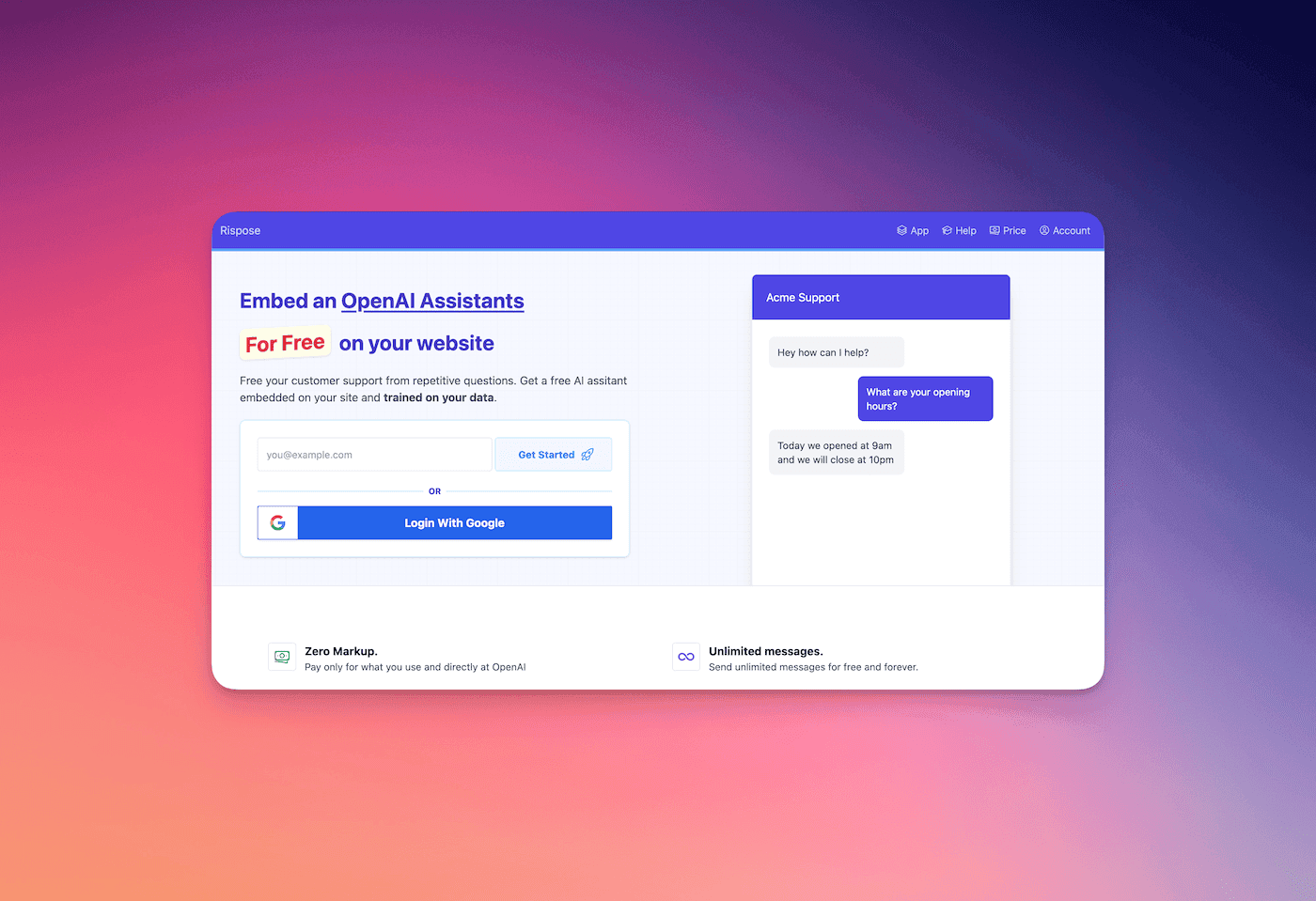
Rispose, formerly Unfetch, is an AI Agents & Automation tool designed to help businesses build and embed custom AI agents directly onto their websites or platforms. It enables automation of support, sales, and customer engagement through AI-powered assistants. Users can train their agents with up to 1,000 files, including PDFs, documents, and text files, and customize their behavior with specific instructions to match brand voice. The platform integrates with popular services like Shopify, WordPress, Notion, Wix, and Webflow. Rispose offers detailed history and metrics to track agent performance, understand user interactions, and facilitate continuous improvement. It provides a seamless and budget-friendly solution for integrating LLMs into existing web applications.

Volograms
Volograms leverages AI to convert standard 2D videos and photos into dynamic 3D volumetric holograms. This technology allows users to create photorealistic 3D human models from a single 2D source, making advanced volumetric capture accessible. The platform offers products like Volu for smartphone capture, Volu Pro, and Vologram Messages for engaging communication. Users can integrate their Volograms into various 3D tools and platforms such as Unity, Unreal Engine, ThreeJS, and 8th Wall, simplifying the creation of immersive content. Volograms aims to reshape communication by making volumetric video creation easier and more widely available.
deep-learning-pytorch-huggingface
deep-learning-pytorch-huggingface is an open-source GitHub repository dedicated to providing comprehensive instructions, examples, and tutorials for individuals looking to get started with deep learning using PyTorch and Hugging Face libraries. It covers a wide range of topics, including fine-tuning large language models like FLAN-T5 and Falcon 180B with advanced techniques such as DeepSpeed ZeRO, LoRA, and Flash Attention. The repository also includes guidance on using transformers and datasets, quantizing open LLMs with optimum and GPTQ, and implementing RLHF with DPO. It's a valuable resource for learning about efficient distributed training with FSDP and Q-LoRA, as well as various inference examples for text generation and other tasks.
Llama Bigasp Prompt Enhancer
Llama Bigasp Prompt Enhancer is an AI tool designed to assist users in generating comprehensive and detailed prompts for image generation. By simply inputting a request or a set of tags, the application crafts prompts that are 150 words or longer, providing rich descriptions for AI image models. Users can fine-tune the prompt generation process by adjusting settings such as temperature and other parameters, allowing for greater control over the output's creativity and specificity. This tool is particularly useful for artists, designers, and content creators who rely on AI for visual content, enabling them to achieve more precise and imaginative results from their image generation efforts.
LLaMA Board
LLaMA Board is a platform designed for fine-tuning large language models (LLMs) through an intuitive Gradio user interface. It enables users to enter text prompts to generate and receive text responses, making it ideal for various applications such as writing, brainstorming, and more. The tool is built on the LlamaFactory framework, providing a robust environment for model customization and training. While the live website currently indicates a runtime error, its core functionality aims to support AI researchers and machine learning engineers in developing and adapting LLMs for specialized tasks. The platform leverages Hugging Face Spaces for deployment, offering a collaborative environment for AI projects.
DISC-LawLLM
DISC-LawLLM is an intelligent legal system powered by large language models (LLMs), developed and open-sourced by Fudan University's Data Intelligence and Social Computing Laboratory (Fudan-DISC). It offers comprehensive legal services, including legal text processing for information extraction and summarization, and legal reasoning capabilities enhanced by legal syllogism theory. The system also features a retrieval-augmented module for improved knowledge adherence, utilizing a vast knowledge base of laws and legal exam questions. DISC-LawLLM provides high-quality training datasets, effective training paradigms, and a robust evaluation framework, with its performance on the Lawbench benchmark ranking second only to GPT-4 among legal LLMs.
Trillo Inc.
Trillo AI is an innovative platform designed to transform business requirements into full software blueprints, including detailed specifications, designs, and production-ready application code. Unlike traditional AI code generators, Trillo AI employs a multi-agent architecture with 16+ specialized agents that mirror expert team workflows, breaking down the specification process into reviewable steps. This human-in-the-loop approach allows users to comment on and regenerate any step's output, maintaining full control and ensuring accuracy. It excels in generating complex enterprise applications, providing 50-80% of the application code directly from the blueprint, which can be used as a working prototype or a solid starting point for development. The platform significantly reduces the time for specification and design from weeks to hours, fostering collaboration among architects, analysts, designers, project managers, and developers.
finetune-embedding
finetune-embedding provides a comprehensive workflow for fine-tuning embedding models to significantly improve Retrieval-Augmented Generation (RAG) performance. This tool is particularly valuable as it enables fine-tuning even in the absence of labeled data, by generating synthetic datasets using Large Language Models (LLMs). Users can process documents into text chunks, generate hypothetical questions for each chunk, and then use these query-document pairs to train an open-source embedding model. The repository includes step-by-step notebooks for dataset generation, model fine-tuning, and evaluation, demonstrating how this approach can substantially boost retrieval performance on small-scale datasets.
Browser Use
Browser Use is a leading AI company offering an open-source browser automation platform trusted by Fortune 500 companies. Its flagship product, the BU Agent, allows any application to autonomously browse, reason about, and extract structured data from websites via a single API call. The platform leverages proprietary stealth browser infrastructure and custom-trained models, powering web automation for both large enterprises and AI startups. Key features include undetectable browsers with anti-detect capabilities and 195+ country proxies, as well as purpose-built LLMs for browser automation. It also offers a cloud platform for managing tasks, browsers, and sessions, alongside an open-source library for easy integration.
EasyLM
EasyLM is a comprehensive open-source framework designed to streamline the development and deployment of large language models (LLMs). Built on JAX/Flax, it offers a unified solution for pre-training, fine-tuning, evaluating, and serving LLMs. A key differentiator is its ability to scale LLM training across hundreds of TPU/GPU accelerators by leveraging JAX's pjit functionality, enabling the training of models that exceed the capacity of a single accelerator. The framework supports multi-host training on Google Cloud TPU Pods and integrates with Hugging Face's transformers and datasets, providing an easy-to-use and customizable codebase. EasyLM currently supports popular models like LLaMA, LLaMA 2, and LLaMA 3, and has been used to train models such as OpenLLaMA and Koala.
Office Kube
Office Kube offers a comprehensive web-based platform that delivers fully configured and highly productive workspaces. Users can select a workspace tailored to their role and get it running instantly in a web browser, eliminating the need for local tool configuration or powerful hardware. The platform features a repository of pre-bundled applications and allows for the installation of additional apps. A key differentiator is its high degree of workflow automation, enabling users to save time and effort by leveraging a searchable repository of automated tasks or creating their own complex workflows. Office Kube also integrates AI capabilities directly into workspaces for tasks like documentation, code generation, troubleshooting, and optimization, ensuring seamless productivity without external services. The platform is built with enterprise-grade quality, focusing on security, scalability, and resilience, and supports team and organizational workflows.
Devaten
Devaten is an innovative on-premise AI tool designed for building and managing AI agent pipelines, offering enterprises full control over their data with enhanced privacy. It specializes in AI Agent Orchestration, allowing users to design, deploy, and manage intelligent data pipelines with customizable agents for automated monitoring, decision-making, and reporting. The platform provides real-time monitoring and insights, tracking performance metrics, detecting anomalies, and offering live visibility into operations across various sectors. Devaten also features smart alerting with AI-driven recommendations and predictive analytics for simulating future scenarios and optimizing workflows. Its key differentiator is 100% on-premises deployment, ensuring complete data control and compliance, making it suitable for sensitive industries like healthcare, telecom, finance, and manufacturing.

Grably
Grably is a multi-modal human interaction data research company specializing in providing high-quality conversational and interaction datasets for AI development. They offer a wide range of data applications, including large-scale multilingual and multimodal datasets for LLM pretraining, low-resource language modeling, and multimodal model training. Grably also provides specialized datasets for embodied AI, robotics, long-form video analysis, audio/speech understanding, code intelligence, and scientific/technical domain modeling. Their process involves defining critical human activities, capturing synchronized multi-signal data, structuring it with precise annotation, and scaling to diverse populations. They also offer custom dataset design and delivery tailored to specific research, legal, and infrastructure requirements.
Flatlogic
Flatlogic is a custom software development company that specializes in building and maintaining business software such as SaaS products, CRM/ERP systems, AI agents, customer portals, and internal tools. Since 2015, Flatlogic has tracked over 190,000 engineering hours across more than 70 client products. Businesses can engage with Flatlogic in two ways: by hiring their engineering team for comprehensive delivery, or by utilizing their AI-powered app generator to kickstart projects faster. The platform provides a real codebase, repository access, and deployment setup, ensuring no vendor lock-in. Flatlogic also offers various services including AI consulting, web and mobile app development, legacy system upgrades, and UX/UI design.
GODEL
GODEL offers large-scale pretrained models specifically designed for goal-directed dialog, built on a Transformer-based encoder-decoder architecture. These models are trained for response generation grounded in external text, making them highly effective for dialog tasks requiring conditioning on external information, such as retrieved documents. The repository provides the dataset, source code, and pre-trained models, allowing for efficient fine-tuning on new dialog tasks with minimal task-specific data. GODEL V1.1, for instance, was trained on 551 million multi-turn dialogs from Reddit and 5 million instruction and knowledge-grounded dialogs, demonstrating improved performance, especially in zero-shot settings. It supports fine-tuning and evaluation across various dialog tasks and includes a demo interface for interaction.
Peedief
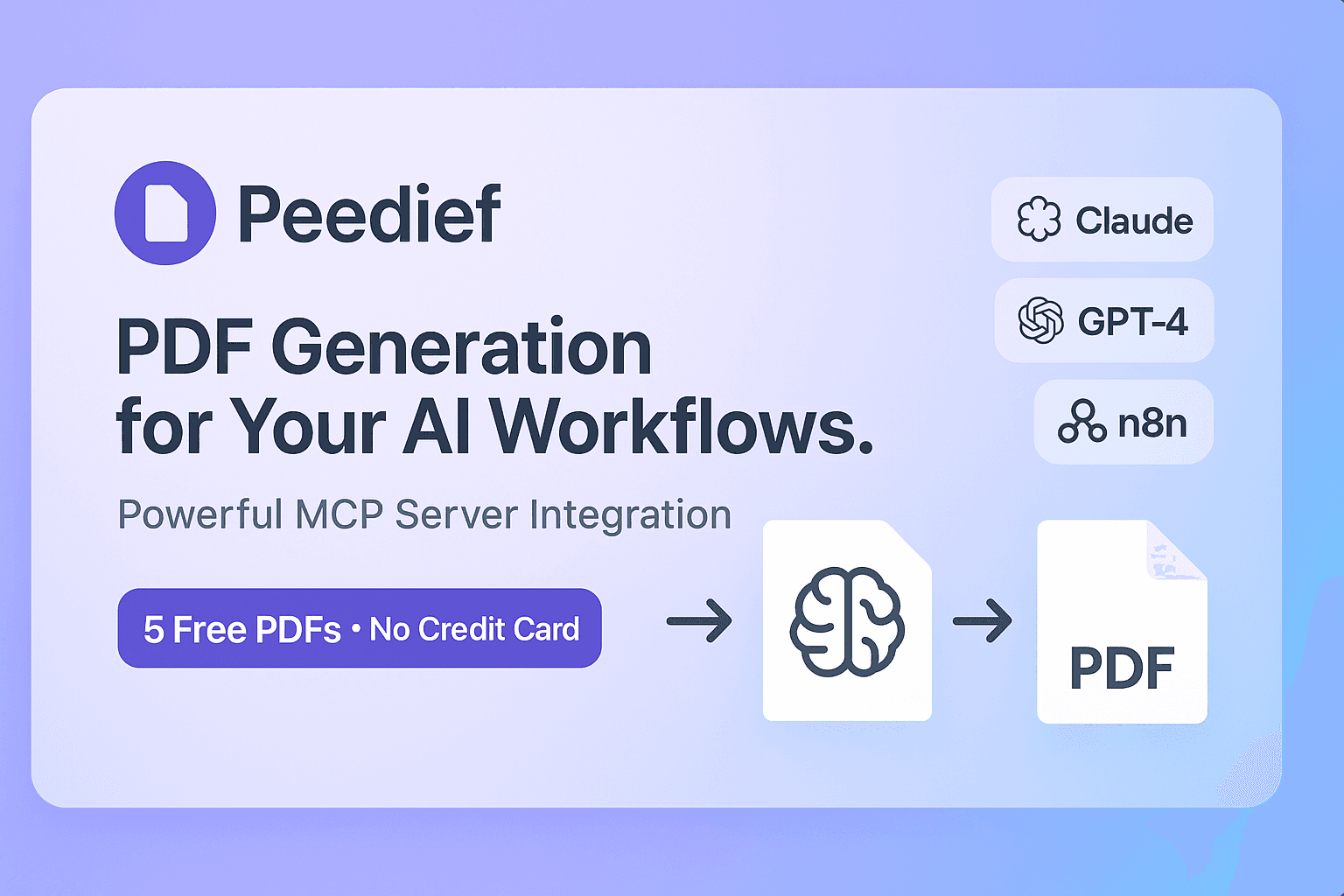
Peedief offers a powerful solution for generating professional PDFs from HTML templates through a clean REST API. Designed for developers and automation workflows, it simplifies document creation by allowing users to define templates once and generate documents via simple API calls. The platform supports conditional logic, loops, and dynamic data binding within HTML templates, making it suitable for invoices, certificates, reports, and more. Peedief integrates with popular automation tools like n8n, Make.com, Zapier, and Power Automate, and also features an MCP server for AI agents, enabling direct data-to-PDF generation without HTML knowledge. It provides instant preview URLs for embedding PDFs directly into applications, ensuring a seamless user experience.

Octopus.do
Octopus.do is a visual sitemap builder designed for rapid website planning and content creation. It enables users to instantly generate visual sitemaps and lo-fi wireframes for prototyping website architecture and structure. The tool supports importing URLs to visualize existing site structures or starting from scratch. Key features include AI assistance for analyzing SEO and generating content, integration with Figma for design synchronization, and various export options. It caters to a wide range of professionals involved in web development, including UX/UI specialists, web designers, copywriters, SEO professionals, and product owners, making website planning fast, easy, and fun.
TangoCode Inc
TangoCode Inc offers AI-powered Martech Solutions, focusing on the design, deployment, and optimization of operational AI. Their services are geared towards driving measurable performance across a client's entire marketing stack. The company emphasizes accelerating the speed to market for new technologies, leveraging artificial intelligence and machine learning. TangoCode works with customers from development through to marketing, providing comprehensive support for integrating AI into their operations. Their expertise helps businesses enhance their marketing efforts through advanced AI capabilities, ensuring efficient and effective technological implementation.
Hands-On-Graph-Neural-Networks-Using-Python
Hands-On Graph Neural Networks Using Python, published by Packt, is a comprehensive resource for machine learning practitioners, data scientists, and students interested in graph neural networks. The book covers fundamental concepts, practical implementation using Python and PyTorch Geometric, and applications ranging from natural language processing to drug discovery. It teaches users how to classify nodes, graphs, and edges, predict graph topologies, combine heterogeneous data sources, and forecast events. The resource includes all necessary code organized into folders, along with detailed instructions for setting up the required software and hardware, including Python, PyTorch, PyTorch Geometric, and optional GPU acceleration with CUDA and cuDNN. It also provides a list of required Python libraries and offers alternative access via Google Colab.
HCP-Diffusion
HCP-Diffusion is a comprehensive Diffusion model toolbox built on the RainbowNeko Engine, designed to simplify and unify Stable Diffusion workflows. It boasts a clean code structure and a flexible Python-based configuration system, making it ideal for conducting and managing complex experiments. The tool supports a wide array of training components and is highly extensible, flexible, and user-friendly compared to existing frameworks. Users can leverage a single Python config file to manage various training methods and model architectures, including Prompt-tuning (Textual Inversion), DreamArtist, Fine-tuning, DreamBooth, LoRA, and ControlNet. It also implements DreamArtist++, an upgraded version of DreamArtist based on LoRA, offering enhanced generalization, controllability, and faster training with minimal data.
grepai
grepai is a privacy-first command-line interface (CLI) tool designed for semantic code search and call graph generation, specifically tailored for AI agents. Unlike traditional `grep` which relies on exact text matching, grepai uses vector embeddings to understand the meaning of code, allowing users to perform natural language queries like "authentication logic" to find relevant code, even if naming conventions vary. It drastically reduces AI agent input tokens by providing relevant context instead of raw search results. Key features include searching by intent, tracing call graphs to understand function dependencies, 100% local operation ensuring code never leaves the machine, and an automatic file watcher to keep the index fresh. It's ready for AI agents, working out-of-the-box with tools like Claude Code, Cursor, and Windsurf, and can be called directly as an MCP server tool.