
Coding & Development
Browsing page 7 of AI tools for Testing & QA in Coding & Development. Sorted by confidence score — our independent quality rating.
ScoutUX
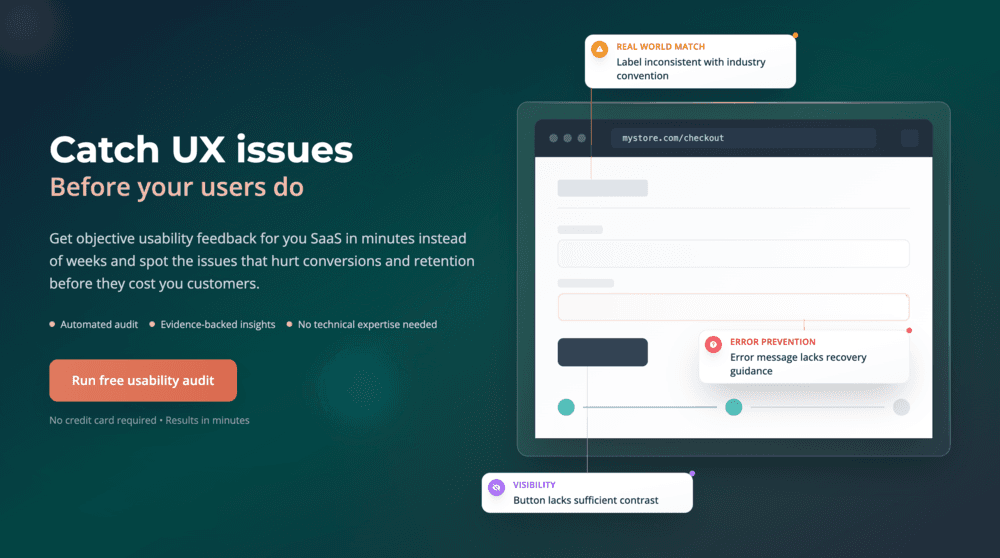
ScoutUX is an AI-powered tool designed to catch UX issues on SaaS products, apps, and websites by simulating real user behavior. It provides objective usability feedback in minutes, helping to identify problems that hurt conversions and retention. The platform conducts automated audits based on Nielsen's 10 Usability Heuristics, offering evidence-backed insights without requiring technical expertise. Users simply provide a website URL and optionally a specific task, and the AI agent navigates the site, recording interactions across desktop and mobile. The comprehensive report includes a visual timeline, identified usability issues, and improvement suggestions, making it ideal for product managers, designers, developers, QA, founders, and marketers.

Sonarly
Sonarly is an AI-powered tool designed to act as an AI engineer for production environments, streamlining the debugging process and improving system reliability. It triages alerts and fixes bugs and incidents by providing full context of your production system. Key capabilities include production bug resolution, AI coding agent functionality, and comprehensive bug context. Sonarly also offers session replay, error tracking, and user session recording to help debug production issues and identify JavaScript errors. It aims to provide an AI debugging solution and acts as a coding assistant for developers.
Kagura AI
Kagura AI is an open-source testing harness designed to empower AI coding agents with essential testing capabilities. It provides browser control, allowing agents to navigate, click, fill forms, and capture screenshots using Playwright power. The tool also includes email skills for handling magic links, OTPs, and email verification, eliminating common blockers in automated testing. Kagura AI supports CI/CD publishing, automatically integrating passing tests into your workflow without requiring manual script writing. It offers both a self-hosted option and a cloud-managed service, and is MCP native for Claude Code integration, while also providing an HTTP API for compatibility with other agents like Codex and Cursor.

HoundDog.ai
HoundDog.ai offers two primary products: a Privacy Code Scanner and an API Context Engine for AI Coding Agents. The Privacy Code Scanner integrates into development workflows, scanning code in IDEs and CI pipelines to detect PII leaks and map sensitive data flows across functions, APIs, third-party services, and AI integrations. It automates GDPR data mapping and generates audit-ready RoPA, PIA, and DPIA documentation. The API Context Engine augments AI coding agents with continuously updated API context, reducing wasted tokens and enabling safer, faster API changes. It analyzes .proto files and service code to provide a live map of gRPC APIs, consumers, and fields in use, acting as a gRPC service discovery layer and context source for MCP-compatible AI coding agents like Cursor, Claude Code, and Copilot. HoundDog.ai is designed for enterprise-grade security and is trusted by Fortune 1000 companies.
Bluejay
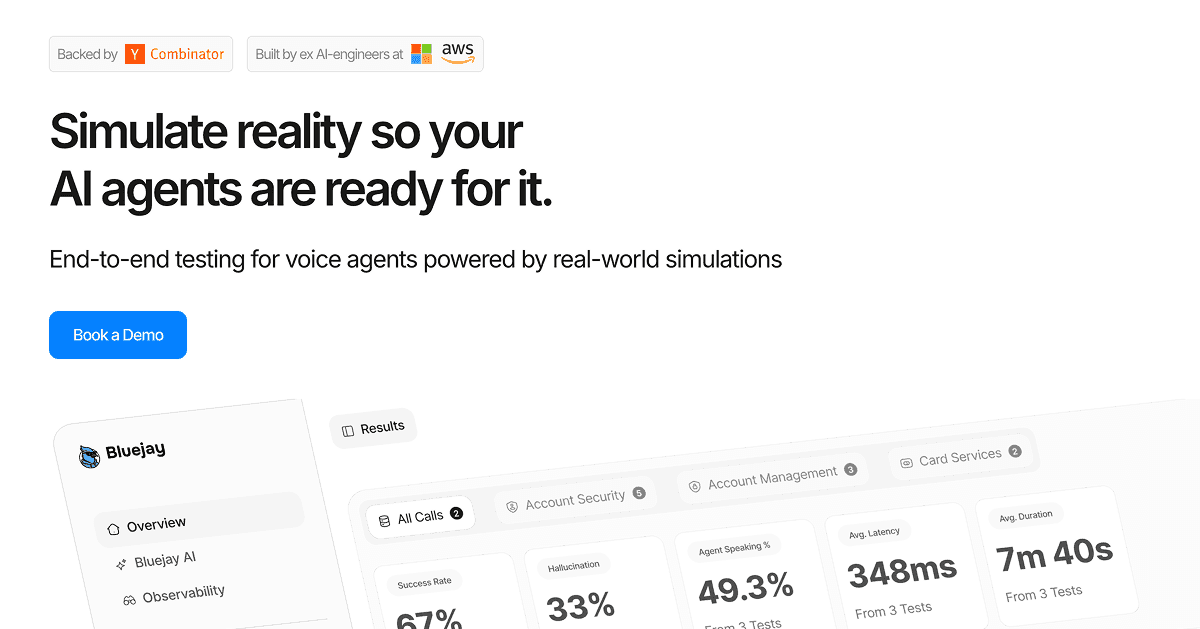
Bluejay is a comprehensive quality assurance platform designed for AI agents, specifically focusing on voice and chat interactions. It enables rigorous testing of conversational AI agents both before and after deployment, allowing users to simulate edge cases, catch regressions, and benchmark performance. The platform helps validate workflows, replay production calls, and stress-test agents using lifelike Digital Humans across various modalities. Bluejay aims to improve every interaction through real-world simulations and actionable observability, helping organizations save time, reduce defects, and ensure the robustness of their AI systems. It supports continuous feedback and constant improvement for AI agents in industries like customer services, healthcare, financial services, and logistics.
MCPJam Inspector
MCPJam Inspector is a comprehensive tool designed for developers to test, debug, and evaluate MCP servers and ChatGPT applications locally. It enables inspection of how servers and apps perform across various modern MCP clients, including ChatGPT, Claude, and Cursor. Key features include an Apps Inspector for direct tool execution and model-in-the-loop interactions, an OAuth Debugger to visualize and verify authorization flows, and a Chat Playground for interacting with MCP apps using frontier models. Developers can inspect traces, tool calls, inputs, outputs, app-to-host messages, and rendered UI, accelerating the iteration loop without needing external services like ngrok or a ChatGPT subscription.
apidash
Apidash is a beautiful AI-powered open-source cross-platform API client built using Flutter, available for desktop and mobile. It enables developers to easily create and customize HTTP and GraphQL API requests, visually inspect responses, and generate API integration code. Apidash supports various API types including HTTP, GraphQL, and SSE/Streaming, with planned support for WebSocket and MQTT. It offers advanced features like visual preview and download of data and multimedia API responses, which is a differentiator from other API clients. The tool also provides code generation for multiple languages and libraries such as JavaScript, Python, Kotlin, and Dart. Data is persisted locally, and collections can be exported as HAR files for version control or import into other API clients. Apidash includes DashBot, an AI assistant powered by local or cloud LLMs, to help debug requests, generate code, and create documentation.
Digma AI
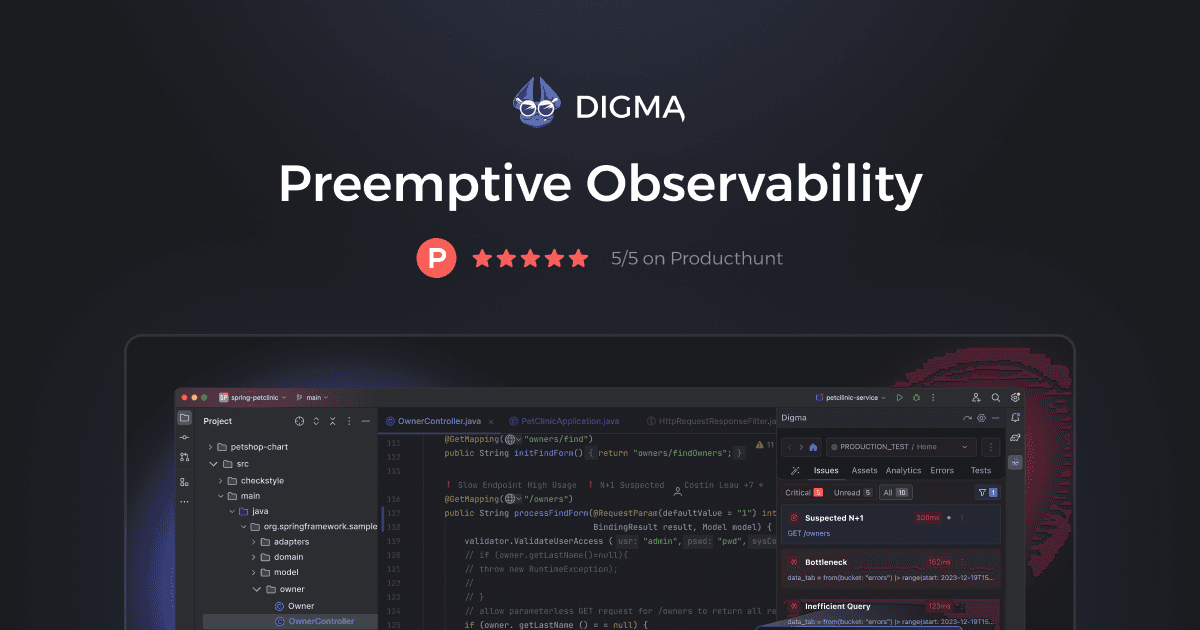
Digma AI operates as a fully autonomous AI SRE, designed to streamline the identification, root cause analysis, and remediation of issues across both code and infrastructure. Leveraging its Dynamic Code Analysis (DCA) engine, Digma identifies code-level problems in pre-production environments, preventing issues before they impact production. It integrates with existing observability stacks and data sources like PostgreSQL, GitHub, and Kubernetes to provide accurate and reliable resolutions. The tool also enhances code reviews by highlighting critical performance problems, bottlenecks, and slow database queries, and can suggest production-aware fixes directly into pull requests. Digma is OpenTelemetry compliant and works without requiring code changes, offering a free-forever plan for individual developers.
Kiln
Kiln is a comprehensive platform designed to build, evaluate, and optimize AI systems, offering a suite of tools for developers and AI practitioners. It provides intuitive desktop applications for Windows, MacOS, and Linux, making advanced AI development accessible. Key functionalities include state-of-the-art evaluators for model quality, optimizers for prompts and models, and zero-code fine-tuning for various LLMs like Qwen, GPT, and Gemini. Kiln also supports Retrieval-Augmented Generation (RAG) for knowledge integration, agentic system building, synthetic data generation for datasets, and custom reasoning model training. Its open-source Python library and OpenAPI REST API facilitate integration into existing workflows, while its privacy-first design ensures local operation and data control.
OpenAlpha_Evolve
OpenAlpha_Evolve is an open-source Python framework designed for autonomous code generation and improvement, drawing inspiration from DeepMind's AlphaEvolve. It leverages Large Language Models (LLMs) via LiteLLM to iteratively write, test, and refine code, guided by evolutionary principles. The framework features a modular, agent-based architecture, including agents for prompt engineering, code generation, evaluation, and selection. It supports LLM-powered code generation, an evolutionary algorithm core for iterative improvement, and automated program evaluation with sandboxed execution using Docker. Researchers, developers, and enthusiasts can use it to explore AI, code generation, and automated problem-solving.
prompt-forge
PromptForge is an AI prompt engineering workbench designed to bring engineering discipline to prompt development. It assists users in crafting effective prompts from scratch with AI-powered suggestions and provides advanced analysis to optimize prompts before testing. The tool systematically evaluates prompts by generating comprehensive test suites for robustness, safety, accuracy, and creativity. Users can execute tests with full parameter control, dynamic variable detection, and compare results across multiple models like Claude, GPT-4, Azure OpenAI, and Ollama. PromptForge also includes prompt management features with an organized library, search, tags, and execution history, making it a comprehensive solution for prompt engineers.
Bytronic Vision Intelligence
Bytronic Vision Intelligence offers AI-powered vision systems designed to tackle complex production challenges in manufacturing and logistics. Their solutions integrate advanced AI technology and rules-based logic with various hardware, including high-speed 2D/3D cameras, thermal imaging sensors, and edge processors. Bytronic's systems inspect, verify, and optimize production processes, reducing waste, improving accuracy, and ensuring compliance. Key solutions include SealCheck DL for seal integrity, PackCheck DL for pack content verification against Bill of Materials, and TempComply for thermal compliance and defect detection. These systems are configurable, compatible with existing production lines, and can be deployed as proof of concepts to demonstrate ROI before wider rollout.
TextClassificationBenchmark
TextClassificationBenchmark provides a comprehensive open-source benchmark for text classification tasks using PyTorch. It aims to include a wide range of text classification datasets, covering sentiment and topic classification in multiple languages like English and Chinese. The benchmark also offers basic word embeddings and implements numerous popular and state-of-the-art deep neural network models, including FastText, BasicCNN (KimCNN, MultiLayerCNN, Multi-perspective CNN), InceptionCNN, LSTM variants (BILSTM, StackLSTM), LSTM with Attention, Hybrids between CNN and RNN (RCNN, C-LSTM), Transformer, ConS2S, Capsule, and Quantum-inspired NN. This tool is ideal for researchers and developers looking to compare the performance of different text classification models on various datasets.
TruLens
TruLens is an open-source framework designed for systematically evaluating and tracking Large Language Model (LLM) experiments and AI agents. It offers fine-grained, stack-agnostic instrumentation, allowing developers to understand the performance of their LLM applications, including prompts, models, retrievers, and knowledge sources. The tool provides comprehensive evaluations to help identify failure modes and iterate on improvements. Key concepts include Feedback Functions, The RAG Triad, and Honest, Harmless, and Helpful Evals. TruLens integrates into the development workflow, enabling users to connect instrumentation and logging, define necessary feedback functions, and compare different versions of their applications through an easy-to-use user interface. It is installed via a simple pip package.

MagicPod
MagicPod is an AI-powered, no-code test automation tool designed to streamline the testing process for both mobile and browser applications. It enables users to create, edit, and execute tests using natural language with its "MagicPod Autopilot" feature. The platform leverages AI for automatic test correction and maintenance, significantly reducing the operational burden compared to manual testing. With unlimited test runs and user accounts across all plans, MagicPod supports rapid release cycles and fosters widespread test automation adoption within teams. It also offers comprehensive support for cross-browser and multi-device testing, along with integrations for CI/CD pipelines and other external tools.
Loghead
Loghead is a modern CLI log viewer for developers, designed to turn terminal logs into LLM-ready context. It allows users to pipe logs from various sources like terminals, browsers, and cloud tools for instant, structured visibility. The tool is open-source, local-first, and secure, running entirely on the user's local machine to protect data privacy. Loghead helps developers debug faster by providing clean, real-time log data to power local AI applications. It integrates with popular IDEs like VS Code, Cursor, and Windsurf, and aims to unify log streams from diverse environments, including local stdout, browser warnings, and remote errors, to feed AI coding assistants with high-quality context.

Spur
Spur is an agentic QA platform designed to help e-commerce businesses ship faster and break less by automating end-to-end testing. It utilizes autonomous AI agents that plan, execute, and report tests, ensuring every release is production-ready. The platform is remarkably easy to use, requiring no coding; users simply describe what they want to test in plain English. Spur adapts dynamically to UI changes, pop-up banners, cookies, and out-of-stock items, simulating actual customer behaviors for reliable testing. It covers a wide range of use cases including exploratory testing, localization, UI/UX testing, functional testing, and AI feature testing, catching bugs that manual QA or traditional scripts might miss. Teams can achieve up to a 95% reduction in manual QA time and significantly faster deployment velocities.
BetterBugs MCP
BetterBugs MCP is an AI debugging tool designed to streamline the bug-fixing process for developers. It provides AI with comprehensive context, including app data and user actions, enabling it to understand and resolve issues more effectively. This approach aims to eliminate the need for developers to manually explain bugs to AI, significantly reducing the time spent on debugging. By empowering AI to instantly resolve bugs, BetterBugs MCP seeks to enhance code quality and boost overall developer productivity. The tool focuses on making the AI an integral part of the development workflow, ensuring that bug resolution is efficient and accurate.
Andon Labs
Andon Labs specializes in developing custom evaluations for AI models, focusing on preparing organizations for a future where AI autonomously runs operations. The company benchmarks and deploys frontier AI in real-world scenarios, providing critical insights into AI performance and reliability. They are building the Safe Autonomous Organization by iteratively launching and scaling autonomous organizations, bridging AI control research with real-world testing. Their work includes projects like Vending-Bench 2, which tests AI agents on long-term tasks like managing a vending machine business, and Butter-Bench, evaluating LLM-controlled robots for practical intelligence in household tasks. Andon Labs also explores spatial intelligence in AI models with Blueprint-Bench and has collaborated with leading AI labs like Anthropic.
Neurala
Neurala offers Visual Inspection Automation (VIA) software powered by AI, designed to enhance quality control for manufacturers. The platform helps reduce product defects, increase inspection rates, and prevent production downtime by going beyond traditional machine vision capabilities. Utilizing its patented Lifelong-Deep Neural Network (L-DNN)™ technology, Neurala's software can be easily retrofitted into existing production lines without requiring AI experts or significant capital expenditures. It provides flexibility for deploying AI models either to the cloud or on-premise, enabling manufacturers to scale production, reduce waste, and adapt to workforce changes while achieving higher quality control standards. The software boasts a 100% inspection rate, requires 90% less data, and offers a 50% faster ROI.
Italian Open LLM Leaderboard
The Italian Open LLM Leaderboard is a specialized tool hosted on Hugging Face, designed for the evaluation and comparison of large language models specifically tailored for the Italian language. It provides a platform for researchers and developers to benchmark the performance of various Italian LLMs, offering insights into their capabilities and limitations. This leaderboard is crucial for monitoring advancements in Italian natural language processing and ensuring the development of high-quality, culturally relevant AI models. While the current live website indicates a runtime error, its intended purpose is to serve as a central hub for assessing and ranking Italian LLMs, fostering competition and innovation within the community.
Galileo
Galileo is an AI observability and evaluation platform designed to empower AI teams in evaluating, monitoring, and protecting GenAI applications and agents at enterprise scale. It offers an end-to-end solution for AI evaluation, observability, and guardrails, including features like Agent Reliability, Insights Engine, Luna-2, and Protect. The platform enables users to build datasets from synthetic, development, and live production data, create accurate evaluations, and distill optimized evaluations into Luna models for cost-effective traffic monitoring. Galileo provides over 20 out-of-box evaluations for RAG, agents, safety, and security, alongside custom evaluators. Its insights engine analyzes agent behavior to identify failure modes and prescribe fixes, accelerating deployments and ensuring confidence in AI systems.
Syndata AB
Syndata AB specializes in generating synthetic datasets through advanced machine learning and AI algorithms. The core functionality revolves around creating data that statistically mirrors real-world data while being entirely artificial. This capability is crucial for various applications, including predictive modeling, in-depth analytics, and comprehensive software testing. Syndata AB offers Syndapp, a versatile solution that can be deployed both on-premises and in cloud environments, providing flexibility for different organizational needs. This approach allows users to work with realistic data without compromising privacy or security, making it ideal for sensitive data scenarios.
testsigma
Testsigma is an agentic test automation platform designed for QA teams, enabling them to move from requirements to test results in minutes with AI. It supports end-to-end testing for web, mobile, APIs, and ERP systems like Salesforce and SAP, all within a single unified platform. The tool leverages AI agents to generate tests from Jira tickets or Figma files, instantly automate them, run them in CI/CD pipelines, and self-heal broken tests. Key features include autonomous web testing across 3,000+ browsers and devices, agentic AI for iOS and Android testing, and rapid API test generation. Testsigma also offers AI-powered test management, from sprint planning and test case generation to execution and bug reporting, with two-way Jira synchronization. It aims to significantly reduce testing effort and accelerate release cycles.