
Coding & Development
Browsing page 18 of AI tools for Open Source & Models in Coding & Development. Sorted by confidence score — our independent quality rating.

FlagEmbedding
FlagEmbedding is a comprehensive, open-source toolkit designed for retrieval and retrieval-augmented Large Language Models (LLMs). It offers a suite of functionalities for search and RAG applications, including various embedding models like BGE-VL for multimodal visual search and BGE-M3 for multi-linguality, multi-granularity, and multi-functionality. The toolkit also provides reranker models to enhance search accuracy. FlagEmbedding supports both inference and fine-tuning of these models, making it a versatile solution for developers and researchers working on advanced information retrieval systems. It is actively maintained with ongoing updates, tutorials, and community support, ensuring users have access to the latest advancements in the field.
Open WebUI
Open WebUI is a feature-rich, user-friendly, and extensible self-hosted AI platform designed for entirely offline operation. It supports various LLM runners like Ollama and OpenAI-compatible APIs, with a built-in inference engine for Retrieval Augmented Generation (RAG). Key features include effortless setup via Docker or Kubernetes, granular permissions, responsive design, full Markdown and LaTeX support, and hands-free voice/video call capabilities. It also offers a Model Builder, native Python Function Calling, persistent artifact storage, and advanced vector database support for RAG. The platform integrates with numerous web search providers and image generation/editing engines, ensuring a comprehensive AI deployment solution.
PEFT
PEFT (Parameter-Efficient Fine-Tuning) is a state-of-the-art open-source library developed by Hugging Face, designed to make fine-tuning large pretrained models more accessible and cost-effective. Instead of fine-tuning all model parameters, PEFT methods adapt models by only adjusting a small number of extra parameters, drastically cutting down on computational and storage requirements. It integrates seamlessly with Hugging Face Transformers for easy model training and inference, Diffusers for managing adapters in diffusion models, and Accelerate for distributed training of very large models. PEFT allows users to achieve performance comparable to fully fine-tuned models with a fraction of the resources, making advanced AI model adaptation feasible on consumer hardware.
ArtBot
ArtBot is a free, no-login required platform for generating AI-created images and photos using Stable Diffusion. It operates on the AI Horde, a distributed open-source network of GPUs, making powerful generative AI art accessible to everyone. Users can create new images, utilize ControlNet for precise image manipulation, perform image-to-image transformations, and use inpainting for detailed edits. The platform also features a live paint tool, a community showcase, and tools for interrogating images and managing workers within the AI Horde. ArtBot aims to be a gateway for experimenting with generative AI art without any cost or registration barriers.
PixArt-sigma
PixArt-sigma is an advanced, open-source Diffusion Transformer model designed for high-resolution 4K text-to-image generation. Leveraging a weak-to-strong training methodology, it offers PyTorch model definitions, pre-trained weights, and comprehensive inference/sampling code. The project emphasizes simplicity and compatibility, making it accessible for the PixArt community. It supports integration with Hugging Face's Diffusers library, allowing for fast experience and easy deployment. Key features include support for various image resolutions (256px to 2K, with 4K generation capabilities), LoRA code release, and ongoing development for features like ControlNet and ComfyUI integration. It's ideal for researchers and developers looking to push the boundaries of AI-driven image synthesis.
PixArt-alpha
PixArt-alpha is an open-source project focused on advancing photorealistic text-to-image synthesis through efficient Diffusion Transformers. It significantly reduces training time and cost compared to other large-scale T2I models, making high-quality image generation more accessible. The repository includes PyTorch model definitions, pre-trained weights, and inference/sampling code. Key features include support for high-resolution image synthesis up to 1024px, integration with Hugging Face Diffusers, and various training scripts for fine-tuning with DreamBooth, LCM, and ControlNet. PixArt-alpha also offers a community Discord channel for discussions and contributions, fostering an environment for developers and researchers.
ru-gpts
ru-gpts is a collection of open-source Russian GPT-3 models, including ruGPT3XL, ruGPT3Large, ruGPT3Medium, and ruGPT3Small, alongside a ruGPT2Large model. These autoregressive transformer language models are trained on an extensive dataset of the Russian language, offering different sequence lengths and attention mechanisms. The repository provides detailed setup instructions for both Colab and local environments, usage examples for generation, and finetuning capabilities. Pretraining details for each model, including dataset size, training time, and hardware used, are also available. The project is developed by AI-Forever and Sberbank-AI, making advanced Russian language models accessible for various applications.

Cognitive Latam
Cognitive Latam is a Deep Tech company specializing in Artificial Intelligence, Computer Vision, Intelligent Automation, and Blockchain. They partner with governments and visionary businesses to convert complex challenges into high-impact, scalable, and AI-driven solutions. Their services include strategic AI implementation, advanced computer vision for security, retail, and agriculture, and intelligent automation agents for complex processes. They also develop conversational AI and avatars for marketing and support, and design AI-Blockchain architectures for traceability and security. Additionally, Cognitive Latam conducts R&D in quantum AI and emerging technologies through their CGN Labs.
Kaggle
Kaggle serves as the world's AI proving ground, bringing together millions of builders, researchers, and labs to discover what truly works in artificial intelligence. The platform facilitates the evaluation of AI agents, models, and frontier technology through crowdsourced benchmarks, competitions, and hackathons. It provides a robust environment for data scientists, machine learning engineers, and AI enthusiasts to collaborate, learn, and showcase their skills. Kaggle is a central hub for community-led innovation, offering resources and tools to advance the field of AI.
VideoGPT
VideoGPT is an open-source project for video generation, leveraging VQ-VAE (Vector Quantized Variational AutoEncoder) and Transformer architectures. It learns downsampled discrete latent representations of raw video using 3D convolutions and axial self-attention. A GPT-like architecture then autoregressively models these discrete latents with spatio-temporal position encodings. The tool is designed for researchers and developers interested in AI video creation, offering a reproducible reference for transformer-based video generation models. It can generate samples competitive with state-of-the-art GAN models on datasets like BAIR Robot, UCF-101, and TGIF. The project includes scripts for training VQ-VAE and VideoGPT models, as well as for sampling and evaluation.
ultimate-n8n-ai-workflows
ultimate-n8n-ai-workflows offers the largest high-quality open-source library of n8n AI workflows, with over 3,400 ready-to-use automations. This project emphasizes accessibility through visual nodes and low/no-code options, scalability with enterprise-grade reliability, and flexibility via modular JSON workflows and custom modules. It supports multi-model AI, including GPT-4/4.5, Claude 3.5, LLaMA, and Mistral, and features retrieval and memory capabilities for RAG pipelines and vector store integration. Users can leverage it for content automation, data extraction, conversational agents, and integrations with webhooks, APIs, and cloud storage, making it a comprehensive resource for AI-driven automation.
unidiffuser
UniDiffuser is an open-source framework offering code and models for multi-modal diffusion research, based on the paper "One Transformer Fits All Distributions in Multi-Modal Diffusion." It unifies learning for marginal, conditional, and joint distributions by predicting noise in perturbed data across different modalities. The tool uses a transformer architecture to handle various input types and can perform image, text, text-to-image, image-to-text, and image-text pair generation. It supports tasks like image variation and text variation, and can be integrated with the Hugging Face Diffusers library for ease of use. UniDiffuser provides two pretrained models, UniDiffuser-v0 and UniDiffuser-v1, trained on large-scale image-text datasets.
WeKnora
WeKnora is an open-source, LLM-powered knowledge framework designed for enterprise-grade document understanding, semantic retrieval, and autonomous reasoning. It offers three core capabilities: RAG-based Quick Q&A for efficient lookups, a ReAct Agent that orchestrates retrieval, tools, and web search for complex multi-step tasks, and a Wiki Mode that distills documents into a self-maintaining, interlinked markdown knowledge base with an interactive knowledge graph. The platform supports auto-syncing knowledge from various sources like Feishu, Notion, and Yuque, handles over 10 document formats, and integrates with major LLM providers including OpenAI, DeepSeek, and Gemini. Its modular architecture allows for swapping LLMs, vector databases, and storage backends, ensuring complete data sovereignty with local and private cloud deployment options. WeKnora also provides comprehensive observability through Langfuse for agent reasoning and token usage.
vocode-core
vocode-core is an open-source Python library designed to simplify the creation of voice-based LLM applications. It facilitates real-time streaming conversations with large language models, allowing developers to deploy these agents to phone calls, Zoom meetings, or integrate them into personal assistants. The library provides easy abstractions and integrations for transcription services (e.g., AssemblyAI, Deepgram), LLMs (e.g., OpenAI, Anthropic), and synthesis services (e.g., Rime.ai, Eleven Labs). Its modular nature supports building custom voice agents and offers quickstart guides for various use cases, including spinning up conversations with system audio and managing outbound phone calls.
Radicalbit
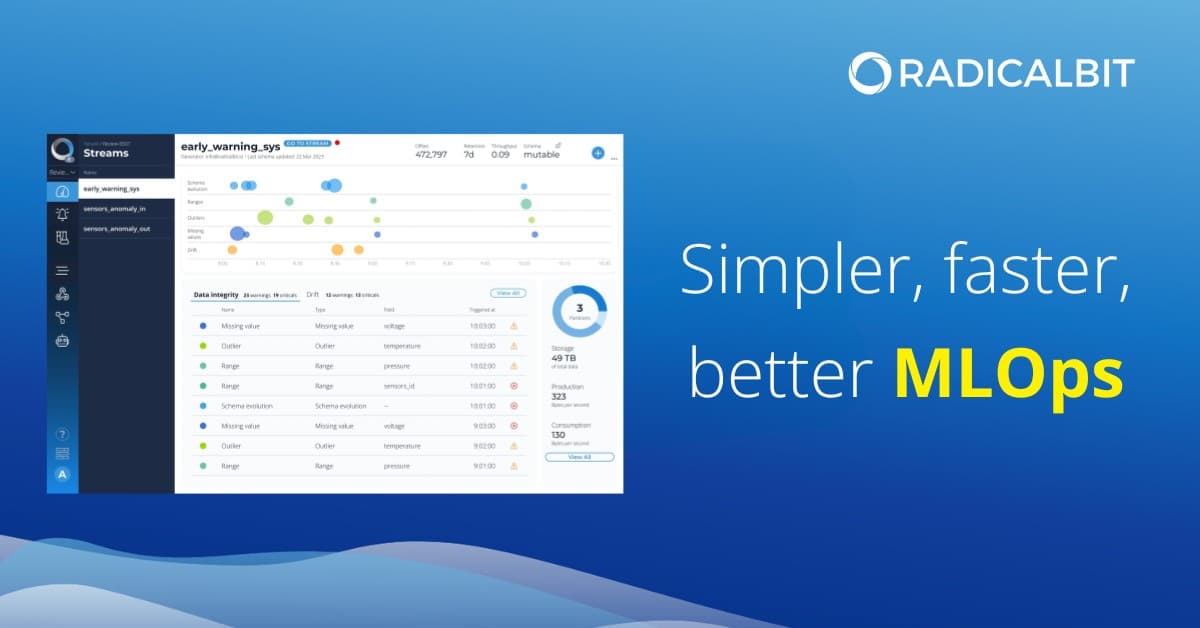
Radicalbit offers an enterprise AI infrastructure designed to accelerate the adoption of artificial intelligence by providing a comprehensive platform for building, deploying, and governing LLM and ML models in production. It facilitates the implementation and orchestration of ML models and Generative AI applications, focusing on performance and security. The platform includes a robust AI Gateway for simplified cost and resource management, enabling the integration of AI services and models for hybrid AI use cases. Radicalbit ensures full control over AI initiatives with built-in observability and monitoring functionalities, enhancing transparency and accountability. It aims to reduce time-to-value, ensure control and compliance, and enhance scalability for AI applications.
Weam
Weam provides a dedicated AI implementation service tailored for multi-unit businesses and franchise systems. Instead of generic AI tools, Weam offers a done-for-you approach, deploying purpose-built AI workflows directly into existing operations. This includes automating local marketing, reputation management, brand compliance, and roll-up reporting. The service aims to free up location managers from manual admin tasks, improve data-driven decision-making for HQ, and ensure consistent local execution. Weam integrates with common franchise tools like Toast, Square, Salesforce, FranConnect, and QuickBooks, offering both full-time and fractional AI engineering teams to build, monitor, and scale automated workflows.

MLcon
MLcon serves as a global platform for the Machine Learning and Generative AI engineering community, organizing conferences and bootcamps across major cities like London, Amsterdam, San Diego, Munich, New York, and Berlin. These events bring together industry leaders and AI experts to discuss the latest advancements in machine learning, MLOps, LLMOps, and AI strategy. Attendees can enhance their skills through keynotes, workshops, and specialized bootcamps covering topics such as Generative AI, ML Fundamentals, and Full-Stack AI Engineering. MLcon also provides continuous knowledge sharing through articles, webinars, whitepapers, and cheat sheets, fostering a vibrant community for professionals to learn, share, and grow.
Doclific
Doclific is an open-source internal documentation tool designed to help developers and teams create beautiful, maintainable technical documentation directly within their codebase. It provides a Notion-like rich text editor supporting headings, lists, and code blocks, alongside powerful features like ERD diagramming and interactive whiteboarding for architecture designs. A key differentiator is its AI integration, which automatically adds documentation skills to Cursor and Claude AI assistants, enabling AI-powered documentation creation and editing. Doclific runs entirely on your machine, ensuring speed and data privacy, and allows for smart code snippets that automatically update with git changes, preventing scattered and outdated documentation.
agentset
Agentset is an open-source platform designed for building, evaluating, and deploying production-ready Retrieval Augmented Generation (RAG) and agentic applications. It provides comprehensive end-to-end tooling, covering ingestion, chunking, embeddings, and retrieval processes. The platform is model-agnostic, allowing users to integrate their preferred LLM, embeddings, and vector database. Key features include a chat playground with message editing and built-in citations, production hosting with preview links and custom domains, and a developer-friendly API with typed SDKs and OpenAPI specifications. Agentset also supports multi-tenancy and is built with modern technologies like TypeScript, Next.js, AI SDK, Prisma, Supabase, and Trigger.dev, making it a robust solution for developers.
airflow-ai-sdk
airflow-ai-sdk is a Python SDK designed to seamlessly integrate Large Language Models (LLMs) and AI Agents into Apache Airflow workflows. It empowers users to define tasks that call LLMs, orchestrate multi-step AI reasoning with custom tools, and automatically parse and validate LLM outputs using type hints. The SDK supports all models available in the Pydantic AI library, including OpenAI, Anthropic, and Gemini. Key features include `@task.llm` for general LLM calls, `@task.agent` for orchestrating AI agents, `@task.llm_branch` for dynamic DAG control flow based on LLM output, and `@task.embed` for creating vector embeddings. This SDK is ideal for developers looking to leverage mature orchestration tooling like Airflow for robust, production-ready LLM and agent-based pipelines.
BCEmbedding
BCEmbedding, developed by Netease Youdao, provides open-source embedding and reranker models specifically designed for Retrieval Augmented Generation (RAG) products. It excels in bilingual and crosslingual scenarios, supporting English, Chinese, Japanese, and Korean. The EmbeddingModel generates semantic vectors crucial for semantic search and question-answering, while the RerankerModel refines search results and ranking tasks. BCEmbedding is a cornerstone of Youdao's RAG implementation, including QAnything, and is integrated into various Youdao products. It offers high performance on semantic representation evaluations and sets new benchmarks in RAG evaluations, making it ideal for diverse RAG tasks like translation, summarization, and question answering. The models are instruction-free and user-friendly, with efficient retrieval and broad domain adaptability.

ONE WARE
ONE WARE offers a platform for custom Vision AI, automatically generating neural networks optimized for individual vision analysis problems. This technology unlocks high-performance Vision AI for diverse industries and applications, tailoring AI models for deployment on PCs, microcontrollers, FPGAs, GPUs, and NPUs. The platform allows users to build production-ready AI models without extensive machine learning expertise, offering rapid results from data to deployment in minutes. It supports a wide range of applications, from robots with 3D cameras to MRI systems, and is built for extreme requirements like ultra-low latency and real-time processing. ONE WARE provides a free tier with monthly credits and offers enterprise solutions with custom pricing and on-premise training options.

Snowpixel App
Snowpixel App is a versatile generative media toolkit designed to help users create a wide range of digital content from simple text prompts. It enables the generation of beautiful images, dynamic videos, original music, and even 3D objects. A key differentiator is the ability to train custom models using your own data, allowing for a personalized touch and tailored content creation. The platform operates on a credit-based system, offering flexibility without the need for subscriptions, making it suitable for various creative projects and individual needs.

Build by Nvidia
Build by Nvidia offers NVIDIA NIM APIs, a comprehensive platform designed for building enterprise generative AI applications. It provides access to a wide range of leading AI models, optimized for efficient inference. Users can obtain free serverless APIs for development, with options for accelerated deployment via DGX Cloud or self-hosting on their own GPU infrastructure. The platform includes continuous vulnerability fixes and offers step-by-step playbooks, such as setting up NemoClaw for secure personal AI agents. Additionally, it features NeMo Data Designer for creating high-quality, domain-specific synthetic datasets at scale, and blueprints for building AI agents, video search and summarization tools, and data flywheels for continuous optimization.