
Coding & Development
Browsing page 15 of AI tools for Open Source & Models in Coding & Development. Sorted by confidence score — our independent quality rating.

Captum
Captum is an open-source PyTorch library designed for model interpretability, allowing users to understand the predictions of their AI models. It supports a wide range of modalities, including vision and text, making it versatile for different types of machine learning applications. Built specifically for PyTorch, Captum integrates seamlessly with most PyTorch models, requiring minimal modifications to existing neural networks. The library is extensible, providing a generic framework for interpretability research, which enables developers and researchers to easily implement and benchmark new algorithms. Captum is a valuable tool for anyone looking to gain deeper insights into their PyTorch models' decision-making processes.

Substrate
Substrate is a platform for building and running compound AI systems, offering powerful SDKs with "batteries included" such as optimized AI models, vector storage, and a code interpreter. It emphasizes agentic control flow and is designed to run multi-step AI workloads efficiently. The platform provides simple abstractions for connecting modular building blocks called nodes, allowing developers to describe complex tasks as directed acyclic graphs. Substrate automatically optimizes these graphs for maximum parallelism and fewer roundtrips, ensuring fast execution. It aims to simplify AI development by offering a unified platform that replaces the need for multiple inference APIs or complex frameworks like LangChain, providing a streamlined developer experience for creating sophisticated AI applications.

Asterisk-AI-Voice-Agent
Asterisk-AI-Voice-Agent is an open-source AI Voice Agent designed for seamless integration with Asterisk/FreePBX systems, leveraging Audiosocket/RTP technology. This powerful tool boasts a modular pipeline architecture, allowing users to mix and match various Speech-to-Text (STT), Large Language Model (LLM), and Text-to-Speech (TTS) providers to create highly customized voice agents. It comes with 6 production-ready golden baselines, validated for enterprise deployment, ensuring reliability and scalability. Key features include advanced calendar integrations for Microsoft and Google, robust rescheduling capabilities, and real-time LLM-to-TTS streaming for reduced latency. The platform also offers an Admin UI for easy configuration and management, alongside CLI tools for advanced users, making it a versatile solution for enhancing call center operations and automated customer interactions.

Feedback Intelligence
Feedback Intelligence is an enterprise workspace designed for AI product managers and developers. It aims to personalize Large Language Models (LLMs) based on user needs by helping to gain user signals and optimize LLMs through real-world usage. The platform emphasizes the importance of feedback loops and AI user observability, ensuring that AI systems are grounded in actual usage data. This approach allows for continuous improvement and better alignment of AI products with user expectations and behaviors, ultimately accelerating Active Intelligence initiatives.
llmflows
LLMFlows is a Python framework designed for building simple, explicit, and transparent Large Language Model (LLM) applications. It offers a minimalistic set of abstractions for utilizing LLMs and vector stores, allowing developers to construct well-structured applications like chatbots, question-answering systems, and AI agents. A core philosophy of LLMFlows is to ensure complete transparency for each component, making monitoring, maintenance, and debugging straightforward. The framework provides classes for LLMs (like OpenAI's APIs), PromptTemplates for dynamic prompt generation, and MessageHistory for managing chat conversations. For complex applications, it introduces Flow and FlowStep classes to manage dependencies between LLM calls, with AsyncFlowStep available for parallel execution to optimize performance. LLMFlows also supports integrations with vector databases like Pinecone and offers callbacks for enhanced customization and tracing.
ms-agent
MS-Agent is a lightweight, open-source framework designed to empower AI agents with autonomous exploration capabilities. It offers a flexible and extensible architecture, enabling developers to create agents for complex tasks such as code generation, data analysis, and general-purpose tool calling with Model Calling Protocol (MCP) support. Key features include multi-agent support, deep research capabilities for advanced exploration, and artifact-generating code generation. The framework also supports short video generation, implements the Anthropic-Agent-Skills Protocol, and provides a modern WebUI for agent interaction. Recent updates include context compression, enhanced deep research systems, knowledge search integration, and multimodal model input support, making it a versatile tool for advanced AI development.
model_server
OpenVINO™ Model Server (OVMS) is a high-performance inference server implemented in C++ for scalability and optimized for deployment on Intel architectures. It hosts models and makes them accessible to software components over standard network protocols, supporting both gRPC and REST API. OVMS offers advantages like remote inference for lightweight clients, independence from model framework and hardware, and efficient resource utilization with horizontal and vertical inference scaling. It supports generative APIs like OpenAI and Cohere, KServe, and TensorFlow Serving, and can pull models from local storage, object storage services, or HuggingFace Hub. Key features include speech generation/recognition, AI agents, image generation, text embeddings, reranking, and dynamic model inputs.
Rabbitt AI : Own your AI
Rabbitt AI is a comprehensive platform designed to empower enterprises in developing and deploying reliable Generative AI solutions. The platform specializes in leveraging enterprise data to create custom Large Language Models (LLMs) and offers a suite of services including interactive data annotation, smart labeling, and AI-assisted quality checks. Rabbitt AI provides consultation throughout the LLM adoption journey, from problem definition and data development to model building and application deployment. It emphasizes data ownership and offers a no-code solution for creating custom labeling projects, making advanced AI accessible for various business needs.
nncf
Neural Network Compression Framework (NNCF) is a powerful tool designed to enhance OpenVINO inference by optimizing neural networks. It offers a comprehensive suite of post-training and training-time algorithms, including quantization, weights compression, and pruning, all aimed at minimizing accuracy drop while improving performance. NNCF supports models from PyTorch, TorchFX, ONNX, and OpenVINO, making it versatile for various deep learning workflows. The framework is organized as a standalone Python package and includes GPU-accelerated layers for faster compressed model fine-tuning and distributed training support. It also provides extensive documentation, tutorials, and samples to facilitate quick integration and usage.

xFusion Technologies, Inc.
xFusion Technologies, Inc. specializes in leveraging AI, data, and cloud technologies to drive digital transformation for businesses. Their comprehensive services include technology strategy and architecture, data engineering and analytics, machine learning and artificial intelligence solutions, and systems integration. They also provide cloud infrastructure and DevOps automation, along with independent verification and validation services. xFusion Technologies aims to help enterprises gain a competitive edge by transforming raw data into actionable insights and streamlining operations through innovative AI solutions, ensuring reusability, interoperability, security, and compliance.
Repello AI
Repello AI offers an enterprise AI security platform designed to protect generative AI systems throughout their lifecycle. It features a proprietary 3-phase framework encompassing discovery, continuous testing, and runtime defense. Key capabilities include AI asset discovery to build a complete AI Bill of Materials (AI BOM), automated AI red teaming with ARTEMIS to identify vulnerabilities using over 15 million attack patterns, and adaptive guardrails with ARGUS for real-time threat monitoring and blocking. The platform also provides MCP Gateway for visibility and control over multi-cloud connections, ensuring comprehensive security for AI applications, agentic workflows, and chatbots.

wAI Industries
wAI Industries specializes in developing custom AI and ML models, offering advanced tools and advisory services to help organizations navigate complex AI transitions across various industries. The company focuses on creating proprietary AI assets using client data, emphasizing agentic intelligence where AI agents collaborate and evolve autonomously. This approach aims to drive innovation and seamless integration of AI-driven operations within enterprise environments. wAI Industries provides cutting-edge solutions for businesses seeking to transform their operations with artificial intelligence and machine learning.

Zalazium GmbH
Zalazium GmbH specializes in delivering data protection-compliant AI solutions tailored for the German Mittelstand (SMEs). Their offerings, including the ANOX suite, are designed to be fully compliant with DSGVO and the EU AI Act, ensuring all data remains within Germany without reliance on US-based cloud services. The company provides a range of practical AI tools such as ANOX chat for secure multi-LLM access, ANOX mail for intelligent email management, ANOX voice for AI-driven call handling, and ANOX chatbot for website customer support. They also offer ANOX crm, an AI-based CRM system for sales. Zalazium emphasizes a bottom-up, praxis-oriented approach, making AI accessible and manageable for businesses through step-by-step implementation and clear, transparent pricing.
Quetext
Quetext is an AI-powered writing integrity platform designed to help students, teachers, and professionals ensure the originality and authenticity of their content. Its core offering includes a robust Plagiarism Checker and an AI Detector, both powered by DeepSearch™ technology that scans billions of sources for duplication and AI-generated text. Beyond detection, Quetext provides an AI Humanizer to refine AI-generated content, an AI Summarizer for instant content condensation, and an AITutorMe Paraphrasing Tool to enhance originality. The platform also integrates a Grammar Checker and a Citation Generator, making it a comprehensive solution for maintaining academic integrity and producing high-quality, human-written content.
private-gpt
PrivateGPT, built by Zylon, is a production-ready, open-source AI project designed for secure document interaction using Large Language Models (LLMs). It guarantees 100% privacy, ensuring no data leaves your execution environment, making it ideal for data-sensitive domains like healthcare or legal. The tool offers an API that follows and extends the OpenAI API standard, supporting both normal and streaming responses. This API is divided into high-level functionalities for abstracting RAG pipeline implementation, including document ingestion, chat, and completions, as well as low-level APIs for advanced users to generate embeddings and retrieve contextual chunks. A Gradio UI client is also provided for testing, alongside useful tools like a bulk model download script and an ingestion script.

AnotherBrain
AnotherBrain is at the forefront of developing a new generation of artificial intelligence, termed Organic AI™. This innovative approach draws inspiration from the macroscopic functioning of the human brain, moving beyond traditional deep learning models. Organic AI™ is designed to be self-learning, significantly reducing the need for large datasets for training, and operates with remarkable energy efficiency. A key differentiator is its ability to explain its decisions, fostering a more human-friendly interaction with AI. The technology is adaptable to various sensory perceptions, including vision, smell, and sound, mirroring the cortex's versatility. AnotherBrain emphasizes kindness and responsibility in its development, aiming to provide real augmented intelligence for individuals and businesses.

Arbius
Arbius is a decentralized network for machine learning, powered by a global network of GPUs. It functions as a shared economy for generative AI, allowing model creators to monetize their creations or host them for free. The platform handles accelerated compute matchmaking, pairing tasks with the best solvers for rewards. Arbius is fully open-source, with holders voting on-chain for protocol upgrades. It features the Amica Marketplace for AI persona chatbots and an ecosystem where agents can source their own compute. The platform also offers veAIUS staking, allowing stakers to share in inference fees and direct rewards to specific AI models.
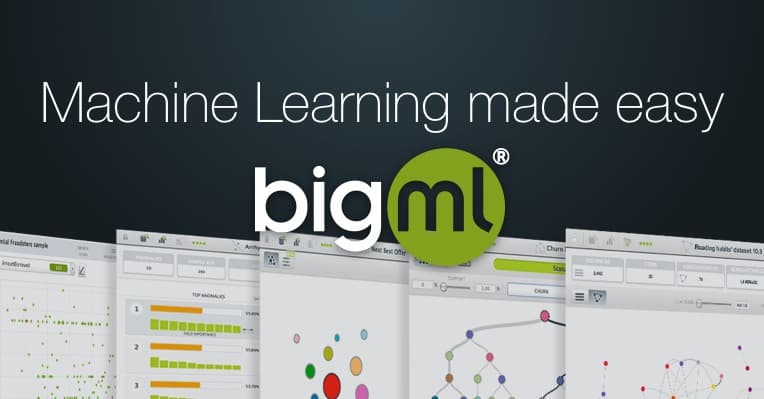
BigML, Inc
BigML, Inc. is a cloud-based Machine Learning platform designed to make complex ML tasks beautifully simple for everyone. It provides a comprehensive set of robustly-engineered algorithms for supervised and unsupervised learning, including classification, regression, time series forecasting, clustering, anomaly detection, and topic modeling. The platform supports various deployment options, from cloud-based subscriptions to private deployments on preferred infrastructure, catering to diverse security and scalability needs. BigML emphasizes interpretable and exportable models, collaboration features, and programmable automation, allowing users to seamlessly transform data into actionable insights and integrate predictive models into applications. It offers a 7-day free trial with full functionality for datasets up to 64MB, without requiring a credit card.
spark-nlp
Spark NLP is a state-of-the-art Natural Language Processing library built on top of Apache Spark, designed for machine learning pipelines that require scalability in distributed environments. It offers a comprehensive suite of NLP tasks including Tokenization, Part-of-Speech Tagging, Named Entity Recognition, Sentiment Analysis, Machine Translation, and Question Answering. The library supports over 100,000 pretrained pipelines and models across more than 200 languages, integrating seamlessly with modern transformer models like BERT, Llama-2, and GPT2. Spark NLP also provides easy model importing from frameworks such as TensorFlow, ONNX, OpenVINO, and Llama.cpp, enhancing flexibility for developers working with diverse machine learning ecosystems. It supports Python, Scala, Java, and Kotlin, and is compatible with platforms like Databricks, EMR, and Google Cloud Dataproc.
tabby
Tabby is a self-hosted AI coding assistant designed to be an open-source and on-premises alternative to GitHub Copilot. It operates as a self-contained system, eliminating the need for external DBMS or cloud services, which enhances data privacy and security. Tabby supports consumer-grade GPUs and features an OpenAPI interface for easy integration with existing infrastructure, such as Cloud IDEs. The tool offers advanced capabilities like RAG-based code completion, which utilizes repo-level context for smarter suggestions, and a rich admin UI for team management and secured access. Recent updates include enhanced code browsing, chat side panels, and integrations with platforms like GitHub and GitLab.
TangoFlux
TangoFlux is an advanced text-to-audio generation tool developed by declare-lab, accepted to ICLR 2026. It leverages FluxTransformer blocks, including Diffusion Transformers (DiT) and Multimodal Diffusion Transformers (MMDiT), conditioned on textual prompts and duration embeddings. The tool is capable of generating high-fidelity 44.1kHz stereo audio, up to 30 seconds in length, with remarkable speed, achieving generation in about 3 seconds on a single A40 GPU. TangoFlux learns a rectified flow trajectory to an audio latent representation encoded by a variational autoencoder (VAE). Its training pipeline involves pre-training, fine-tuning, and preference optimization using CRPO (Clap-Ranked Preference Optimization) for flow matching. The tool offers various interfaces including a Python API, CLI, and integration with ComfyUI, making it accessible for researchers and developers.

Gray Swan
Gray Swan offers enterprise-grade security solutions specifically designed for AI-powered applications, with a strong emphasis on Large Language Models (LLMs). Developed by pioneers in AI vulnerability research, the platform enables organizations to deploy AI systems with confidence by providing robust protection against emerging threats. Key features include an AI Security Suite with real-time input/output filtering and continuous agentic monitoring, alongside comprehensive AI Red-Teaming services. These services involve pressure-testing specific AI deployments using advanced techniques and a vast red-teaming network, ensuring tailored vulnerability assessments. Gray Swan's approach is backed by frontier research and aims to transform AI risk into a competitive advantage, integrating with just two lines of code.
turboseek
turboseek is an open-source AI search engine designed to provide detailed answers to user questions, inspired by the functionality of Perplexity. It integrates Together.ai for LLM inference, utilizing models like OpenAI's gpt-oss and Llama 3.1 8B. For search capabilities, it employs Exa.ai or Bing Search API to retrieve top results, then scrapes content from these links to form a comprehensive context. Helicone is used for observability, ensuring performance monitoring. The engine then streams answers back to the user and generates follow-up questions, enhancing the interactive search experience. It is built with a Next.js app router and Tailwind CSS, making it a robust platform for AI-driven information retrieval.
txtai
txtai is an open-source AI framework designed for semantic search and LLM orchestration, providing an embeddings database that integrates vector indexes, graph networks, and relational databases. This unification enables efficient vector search and comprehensive knowledge management within language model workflows. The tool is hosted on GitHub, suggesting a developer-centric approach and offering various features for code creation, developer workflows, and application security. It supports automation with GitHub Actions, package hosting, and project management features, making it suitable for teams looking to build and deploy intelligent applications.