
Coding & Development
Browsing page 14 of AI tools for Open Source & Models in Coding & Development. Sorted by confidence score — our independent quality rating.

datapizza-ai
Datapizza-ai is a Python-based framework designed to streamline the development and deployment of reliable Generative AI solutions. It emphasizes speed and efficiency, aiming to reduce overhead and accelerate the transition of AI agents from development to production environments. The framework offers an API-first design, multi-provider support for LLMs like OpenAI, Google Gemini, and Anthropic, and robust tool integration including web search and document processing. Key features include composable and reusable blocks, smart chunking for document processing, and built-in reranking. Datapizza-ai also provides comprehensive observability with OpenTelemetry tracing, allowing developers to monitor performance and debug execution flow effectively. Its vendor-agnostic approach ensures flexibility, enabling users to swap models and providers without extensive code changes, making it a migration-friendly option for various AI projects.
Agumbe
Agumbe.AI is a comprehensive platform designed to simplify machine learning operations for developers and enterprises. It offers a unified gateway for managing LLM access, including authentication, guardrails, routing, and usage visibility. The platform allows users to build and deploy full AI applications, agents, and policies, abstracting away infrastructure complexities. Agumbe supports hybrid cloud deployments on Kubernetes across AWS, GCP, and Azure, and provides a fully-managed developer API. Key features include a reactive core for low-latency performance, ephemeral environments for testing, and robust data platform capabilities for data preparation, feature stores, and experimentation, ensuring secure and scalable AI application development.
embedJs
embedJs is an open-source framework designed to streamline the development of Retrieval-Augmented Generation (RAG) and Large Language Model (LLM) applications using Node.js. It provides a comprehensive toolkit for personalizing LLM responses by segmenting data into manageable chunks, generating relevant embeddings, and storing them in a vector database for optimized retrieval. This framework enables users to extract contextual information, find precise answers, and engage in interactive chat conversations, all tailored to their specific data. With extensive documentation and examples, embedJs aims to make working with LLMs and embeddings accessible and efficient for developers.

DKube
DKube helps enterprises design, deploy, and scale secure, private AI systems across on-premise, private cloud, and hybrid environments. It ensures full control, compliance, and ownership of AI initiatives. The platform offers solutions like DKubeX for Generative AI and ML, and DKube for MLOps, enabling AI/ML and data engineering teams to build, train, and deploy complex models. DKube also provides AI Blueprints such as QueriLynx for data exploration, Virtual Teaching Assistant for education, and DocMind for document processing, all designed for real-world impact and rapid deployment within weeks.
kogpt
KoGPT, developed by KakaoBrain, is a Korean Generative Pre-trained Transformer (GPT) model. It is primarily trained on Korean texts, making it highly effective for tasks such as classifying, searching, summarizing, and generating Korean language content. The project offers different model descriptions, including KoGPT6B-ryan1.5b, with specific hardware requirements for GPU memory. Researchers and developers can utilize KoGPT for various AI community projects, with usage examples provided for inference and integration with the Hugging Face Transformers library. It's important to note that KoGPT was trained on raw data and may generate socially unacceptable texts, and its performance is optimized for Korean language inputs.
lemonade
Lemonade is an open-source local AI server designed to help users discover and run AI applications directly on their own hardware. It optimizes and serves large language models (LLMs), image generation models, and speech models using the user's GPUs and NPUs, offering capabilities similar to cloud APIs but with 100% privacy and no cost. Lemonade comes in two forms: a server that connects to apps via standard OpenAI, Anthropic, and Ollama APIs, and an embeddable binary for developers to integrate multi-modal local AI into their own applications. It supports a wide range of models including GGUF, FLM, ONNX, Whisper, and Stable Diffusion across various platforms like Windows, Linux, and macOS, with specific optimizations by AMD engineers for Ryzen AI, Radeon, and Strix Halo PCs.
llm-python
llm-python is a comprehensive repository offering instructional materials and code samples for working with Large Language Models (LLMs) in Python. It integrates popular frameworks and tools such as LangChain, OpenAI's Agent SDK, LlamaIndex, Chroma (Chromadb), and Pinecone. The resource is designed to help developers build sophisticated LLM applications and agents, with code examples that are self-contained and focused on specific usage patterns. It includes tutorials on building Q&A systems, querying databases, using HuggingFace's Inference API, understanding embeddings, and creating multi-agent systems. The repository also provides code references for public courses on building search engines and generative AI for various sectors.
langchain4j
LangChain4j is an idiomatic, open-source Java library designed to streamline the integration of Large Language Models (LLMs) into Java applications running on the JVM. It offers a unified API that abstracts away the complexities of various LLM providers (like OpenAI, Google Vertex AI) and embedding stores (such as Pinecone, Milvus), allowing developers to easily switch between them without extensive code changes. The library provides a comprehensive toolbox for common LLM patterns and techniques, including low-level prompt templating, chat memory management, function calling, and high-level patterns like Agents and Retrieval Augmented Generation (RAG). LangChain4j is built with Java conventions in mind, emphasizing type safety, POJOs, annotations, and seamless integration with enterprise Java frameworks like Quarkus and Spring Boot. It aims to provide a robust and developer-friendly solution for creating sophisticated LLM-powered applications in Java.
luke
LUKE (Language Understanding with Knowledge-based Embeddings) is a cutting-edge pretrained contextualized representation model for words and entities, built upon a transformer architecture. It incorporates entity-aware self-attention to achieve state-of-the-art performance across various NLP benchmarks, including SQuAD v1.1 for extractive question answering, CoNLL-2003 for named entity recognition, ReCoRD for cloze-style question answering, TACRED for relation classification, and Open Entity for entity typing. The repository provides source code for both pretraining the model and fine-tuning it for downstream tasks. LUKE models, including Japanese versions and lite versions with reduced memory footprint, are readily available on the Hugging Face Model Hub, making them accessible for researchers and developers.
markdown-site
Markdown-site is an open-source publishing framework designed for AI agents and developers to create and publish websites, documentation, or blogs. It allows users to write content in markdown and sync it directly from the terminal, making it instantly available to browsers, Large Language Models (LLMs), and other AI agents. Built on Convex and Netlify, it offers real-time data synchronization, ensuring that all connected browsers update automatically without requiring a rebuild or redeploy. Key features include four theme options, full-text search, an analytics dashboard, an MCP server for AI tools, newsletter integration, and comprehensive SEO optimization with RSS feeds, sitemaps, and structured data. The framework also provides extensive documentation optimized for AI coding assistants, including specific instructions for Claude Code CLI and general AI agent guidelines.
Vibe XL
Vibe XL is an all-in-one platform designed for "vibe coders" and AI-powered builders. It enables users to register and showcase their AI-coded projects with verified proof of creation. The platform also features Vibe Artifacts for extracting structured documents from AI conversations, and AiNFTs, which are living AI products that learn, evolve, and auto-update over time. Users can build and sell these living AI products, such as conversational AI bots and tutors. Additionally, Vibe XL offers Vibe Templates, a community for connecting with other developers, and a job board to find opportunities and monetize their work, making it a comprehensive ecosystem for AI development.
mindnlp
MindNLP bridges the gap between HuggingFace's extensive model ecosystem and MindSpore's hardware acceleration capabilities. By simply importing `mindnlp`, users can run over 200,000 HuggingFace models, including Transformers and Diffusers, on Ascend NPU, NVIDIA GPU, or CPU without requiring any code modifications. The tool offers full HuggingFace compatibility, supporting various model architectures and advanced features like mixed precision (FP16/BF16), quantization (INT8/INT4), distributed training, and PEFT/LoRA for parameter-efficient fine-tuning. MindNLP also provides a PyTorch-compatible API via mindtorch, safetensors support, and model hub mirrors for faster downloads, making it an efficient solution for AI developers and researchers.
MOVA
MOVA (MOSS Video and Audio) is a groundbreaking open-source foundation model designed for scalable and synchronized video-audio generation. Unlike traditional cascaded pipelines that generate sound as an afterthought, MOVA synthesizes video and audio simultaneously in a single inference pass, ensuring perfect alignment and eliminating error accumulation. Key features include native bimodal generation, precise lip-sync, and environment-aware sound effects. The project provides fully open-source model weights, inference code, training pipelines, and LoRA fine-tuning scripts. It also supports an Asymmetric Dual-Tower Architecture leveraging pre-trained video and audio towers fused via a bidirectional cross-attention mechanism for rich modality interaction. MOVA offers API access and ComfyUI integration for flexible use.
open-agent
Open-agent offers an open-source alternative to proprietary agentic AI systems like Claude Agent SDK, ChatGPT Agents, and Manus. It enables users to deploy and modify an agentic AI that can operate computers, browsers, and phones to perform real-world tasks. The platform integrates with cutting-edge models such as OpenAI, Claude, and Gemini, allowing them to collaborate within a multi-agent framework. Users can self-host the system, providing full control and customization. It emphasizes structured planning and decision-making for agents, giving users control over final calls, and is designed for easy deployment via Docker Compose.

Artificial Analysis
Artificial Analysis provides independent comparison and analysis of AI models and API hosting providers. The platform offers detailed benchmarks across critical performance metrics including intelligence, speed, and cost. Users can explore leaderboards for various AI capabilities like language models, image generation, video generation, and speech. It features an 'Intelligence Index' to evaluate model quality, 'Output Tokens per Second' for speed, and 'USD per 1M Tokens' for price. The tool also offers personalized model recommendations based on user priorities and insights into API provider performance, helping users make informed decisions for their AI deployments.
sgpt
SGPT (GPT Sentence Embeddings for Semantic Search) is an open-source tool that provides code, results, and pre-trained models for applying GPT models as Bi-Encoders or Cross-Encoders for symmetric or asymmetric search. SGPT-BE generates semantically meaningful sentence embeddings through contrastive fine-tuning of bias tensors and position-weighted mean pooling. SGPT-CE utilizes log probabilities from GPT models without requiring any fine-tuning. The project offers easy integration with Sentence Transformers and provides multilingual BLOOM SGPT models. Recent updates include GRIT & GritLM, which unify various SGPT functionalities into single, higher-performing models, and improved 5.8B Bi-Encoder models with better performance on USEB and BEIR benchmarks.
spacy-transformers
spacy-transformers is a powerful open-source package designed to bridge the gap between spaCy's natural language processing framework and state-of-the-art transformer models from Hugging Face. It allows users to seamlessly incorporate pretrained transformers such as BERT, GPT-2, and XLNet into their spaCy pipelines, enabling advanced NLP capabilities. The package supports easy multi-task learning, allowing backpropagation to a single transformer model from multiple pipeline components. It also features automatic alignment of transformer output to spaCy's tokenization, customizable handling of transformer data in the Doc object, and out-of-the-box serialization for model packaging. This integration is crucial for developers and researchers looking to leverage the power of modern transformer architectures within a familiar and extensible NLP framework.

DHARMA-AI
DHARMA-AI is an AI Lab specializing in the development of Specialized Small Language Models (SLMs) using proprietary hard tech. Their mission is to transform AI by creating intelligent, personalized, and efficient solutions for businesses. They focus on delivering custom AI models trained with client-specific data, leading to significant cost reductions (up to 50 times less than large market models) and improved accuracy. DHARMA-AI's approach prioritizes ethical, sustainable, and secure AI, with SLMs consuming 30 to 50 times less energy than traditional LLMs. They offer various business lines, including ready-to-use AI products like Smart OCR and KM Maintenance, and an AI Lab for custom solution development and MLOps support.
Verba
Verba, also known as The Golden RAGtriever, is a community-driven open-source application designed to offer a streamlined and user-friendly interface for Retrieval-Augmented Generation (RAG). It enables users to easily explore datasets and extract insights, supporting both local deployments with Ollama and Huggingface, as well as LLM providers like Anthropic, Cohere, and OpenAI. Verba is fully customizable, acting as a personal assistant for querying and interacting with data, whether locally or via cloud deployment. It combines state-of-the-art RAG techniques with Weaviate's context-aware database, offering choices between various RAG frameworks, data types, chunking and retrieving techniques, and LLM providers to suit individual use-cases. The project encourages community contributions to enhance its features and maintenance.
MLSoft
MLSoft offers enterprise-grade AI solutions designed to empower organizations with cutting-edge artificial intelligence platforms. The platform scales from startups to large enterprises, focusing on building agentic systems with private LLMs to automate routine tasks. Key services include assessing business AI readiness, tailoring custom AI solution architectures, and seamless deployment with performance monitoring. MLSoft's platform adapts to vertical-specific needs, offering multi-cloud ready systems and intelligent agents that integrate with existing enterprise ecosystems to streamline workflows and analyze data. They provide expert support and aim to transform complex AI technology into practical business solutions with measurable results.
Klika Tech
Klika Tech is a global technology solutions and consulting company, and an AWS Premier Consulting Partner, that specializes in delivering cutting-edge Cloud computing, Internet of Things (IoT), Artificial Intelligence and Machine Learning (AI/ML), and embedded systems solutions. They offer a comprehensive suite of services including business consulting, cloud application development, IoT application and platform creation, and AI/ML solutions with a focus on Edge ML and TinyML. Klika Tech also provides cloud adoption, application modernization, data engineering, and managed cloud operations. Their expertise spans various industries such as smart buildings, healthcare, manufacturing, and automotive, helping clients innovate, architect, and transform their digital infrastructure.

Nous Research
Nous Research is a leading organization in the American open-source AI movement, dedicated to training and proliferating world-class open-source language models. Their mission is to advance human rights and freedoms by supporting the unrestricted availability and use of these models, while also furthering their scientific and popular understanding. The company focuses on applied AI research, including model architecture, data synthesis, fine-tuning, and reasoning, all aimed at enhancing open-source language model capabilities. They also build infrastructure to coordinate distributed, unbiased training, exemplified by their Psyche project.
OddlyAI
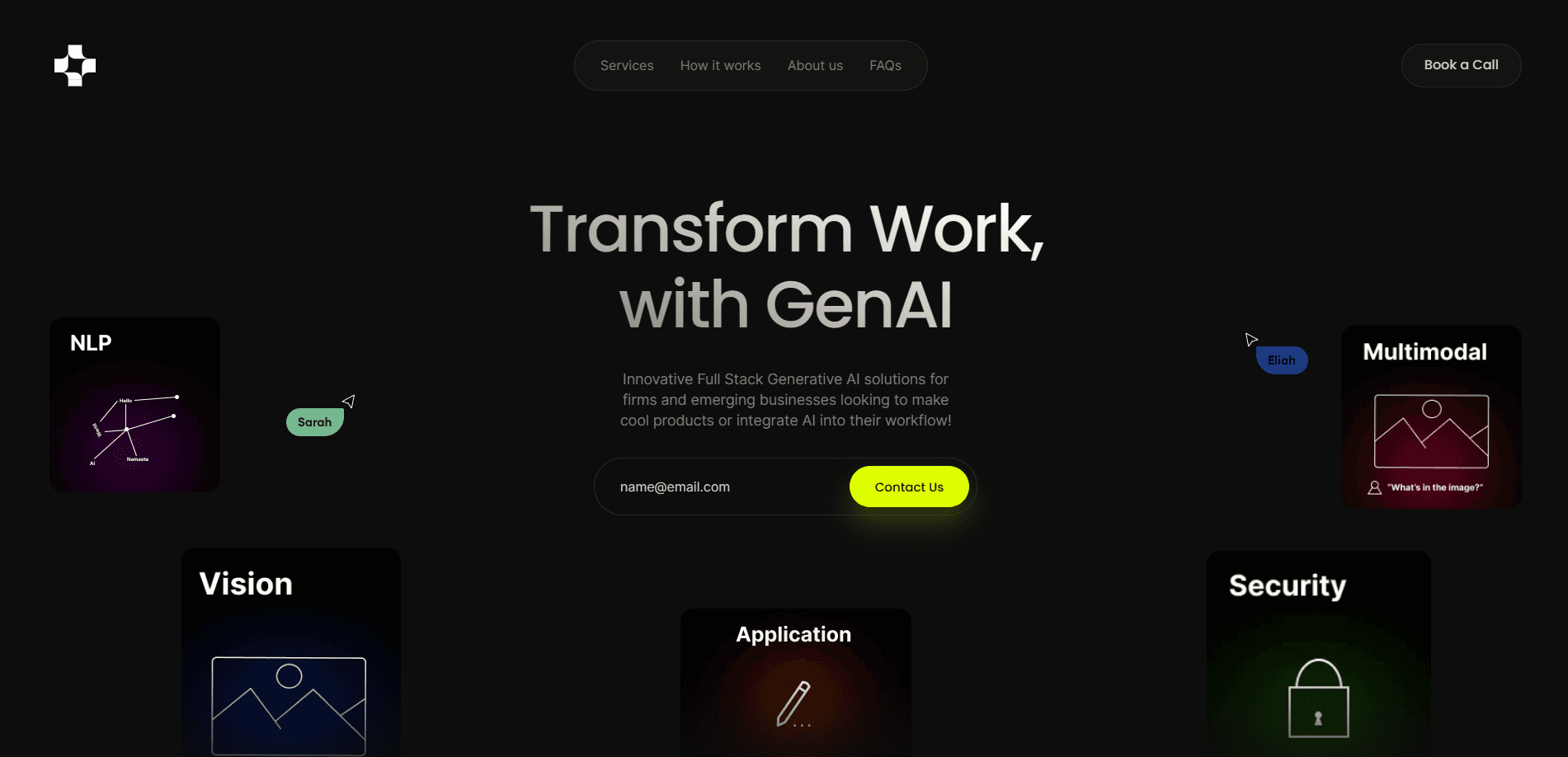
Oddly AI is a Generative AI agency specializing in creating custom AI solutions for businesses. The agency focuses on delivering tailored, end-to-end AI models designed to streamline operations, automate workflows, and foster business growth. Oddly AI's offerings include the development of custom AI models, ensuring seamless integration with existing systems, and enabling real-time automation capabilities. By leveraging these advanced AI solutions, Oddly AI empowers companies to unlock the full potential of artificial intelligence, enhancing efficiency and driving innovation across various business functions.
LLaMA
LLaMA is an industry-leading, open-source AI model family developed by Meta AI, designed for developers to build and deploy AI applications. It features a range of models, including the latest Llama 4 series (Maverick and Scout) which offer native multimodality, advanced reasoning, and extensive context windows up to 10M tokens. Llama models are optimized for easy deployment, cost efficiency, and performance, supporting various use cases from long document analysis and image understanding to synthetic data generation and multilingual translation. The platform also provides resources for model optimization, including prompt engineering, fine-tuning, quantization, and distillation, making it suitable for a wide array of applications and hardware environments.